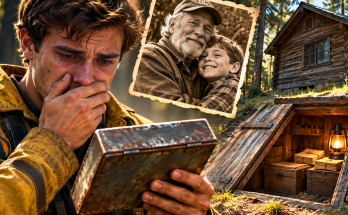
I did not expect Tom Miller to keep my shelter a secret forever.
But I hoped he would understand why I had hidden it.
The company still considered me a trespasser.
The eviction notice had not disappeared simply because December fifteenth had passed.
And although I had survived the first great storm, I knew a determined group of men could make my life difficult.
I had built a home beneath the granite because I wanted to remain unnoticed.
Now a miner from Prospect knew how to find my door.
I spent that evening thinking about what he might say.
I imagined him returning to his family.
His wife asking where he had found the wood.
His children wanting to know why he had been gone so long.
He would have to explain.
And once he explained, the story would begin moving beyond his household.
I could not control that.
I looked at Elias's journal.
Then I looked toward the door.
I had opened it.
There was no use pretending otherwise.
The following morning, I returned to my usual work.
The stove needed attention.
The woodpile needed checking.
The food stores still had to last.
Nothing about my responsibilities had changed.
That was reassuring.
I had spent months learning how to survive without depending on anyone else.
I was not going to abandon those habits because one man had visited.
Still, I found myself wondering about the Millers.
I remembered the way Tom's voice changed when he mentioned his youngest child.
He had tried to speak calmly.
But the fear was there.
I knew what it meant to watch someone you loved face danger you could not easily stop.
I had waited for Elias after the rock slide.
I had listened for footsteps that never came.
Tom still had a chance to help his family.
I hoped the advice I gave him was useful.
Later, I learned what happened after he returned home.
He reached Prospect with the wood still secured to his sled.
His wife had been waiting.
The cabin was cold.
The children were gathered near their stove.
Their youngest was coughing badly enough that Tom had begun fearing the worst.
He brought the wood inside.
Then he began changing the way the cabin held heat.
He did not make every alteration at once.
He was a miner with a family to care for and little spare time.
But he understood that burning more wood would not solve the problem if the warmth continued escaping.
He examined the north wall.
He found the places where wind entered.
Then he used snow to bank the outside where it could provide protection without blocking necessary openings.
He worked in the cold.
He packed the snow carefully.
When he finished, he returned inside and felt for drafts.
Some had weakened.
That was the first improvement.
Then he turned to the stove.
I had told him about the effect of the granite surrounding my chamber.
He could not move his family into a mountain.
He could, however, arrange a suitable mass of stone behind the stove to absorb and release some of its warmth.
He gathered the stone he needed.
He positioned it carefully.
Then he watched how it behaved while the stove burned.
At first, the difference was modest.
The cabin did not suddenly become comfortable.
The fire still needed fuel.
The boards still creaked when the wind struck them.
But the room began cooling more slowly.
Tom noticed.
So did his wife.
Their children no longer had to crowd quite so desperately against the stove during every lull in the fire.
The change mattered most at night.
A room that remained warmer for a little longer gave the family more time to sleep.
It reduced the need to feed the stove constantly.
And it made their remaining wood last longer.
I had not promised Tom that the improvements would cure his child's cough.
I had no authority to promise such a thing.
But I later learned that the youngest Miller child recovered.
That news affected me more deeply than I expected.
I had spent months thinking only about keeping myself alive.
Now something I had learned from Elias had helped a family I barely knew.
I did not know what to do with that feeling.
It was not pride exactly.
It was relief.
The kind of relief that leaves a person quiet.
Tom began telling people what he had discovered.
I imagine he found it difficult to describe at first.
How could a man explain that the widow everyone thought had left was living in a warm chamber beneath a granite shelf?
The story sounded impossible.
But Tom had been inside.
He had touched the wall.
He had seen the stove.
He had watched the thermometer.
And the improvements to his own cabin gave him something more convincing than a strange tale.
He had results.
People began asking questions.
Some wanted to know where he found the wood.
Others wanted to know why his cabin seemed warmer.
A few wanted to hear about the hidden shelter.
Tom told them what he understood.
He explained that I had found a way to use the mountain's stone to hold heat.
He described the thick wall.
The oak door.
The stove brought from my original cabin.
The chimney passing through the granite ceiling.
He spoke about the snow covering the entrance.
He told them I had survived the December blizzard while the temperature outside fell to thirty degrees below zero.
I had not asked him to repeat those facts.
I had simply shown him what I knew.
But a story like that did not remain inside one family's kitchen.
Prospect was a small town.
People spoke while purchasing supplies.
They spoke after leaving the mine.
They spoke beside stoves in boarding houses and cramped wooden cabins.
And that winter, everyone had reason to care about keeping warm.
I had believed the people of Prospect were too occupied with their own hardships to remember me.
Instead, those hardships made them interested.
The first visitors came because they needed something.
Not because they wanted to admire what I had built.
I understood that difference.
A woman who was running short of firewood did not care whether my shelter represented an unusual piece of engineering.
She cared whether she could keep her home warm.
A young couple without enough lamp oil did not need a lecture about geology.
They needed help getting through the dark hours.
I remembered how I had felt in November when Finch stood at my door.
He had spoken about company policy.
Occupancy rights.
A settlement.
None of those things answered the question I actually faced.
Where would I sleep when the winter came?
I did not want to treat frightened people the way he had treated me.
So when they came, I listened.
The first woman arrived after hearing that Tom had returned from the mountain with firewood and advice.
She was a widow.
Her own woodpile had been buried beneath a heavy drift.
She had been struggling to reach it.
I understood the problem immediately.
Snow could protect a wall while making stored supplies difficult to reach.
I listened as she explained where the pile stood and how the drift had formed around it.
Then I helped her think through the safest way to recover what she could.
I did not pretend I could change the weather.
I could only share what years on the mountain had taught me.
She looked at the chamber with open surprise.
I recognized the expression.
Tom had worn it too.
People expected a desperate hiding place.
They did not expect a dry room holding warmth inside a mass of granite.
She approached the back wall.
Held out her hand.
Then looked toward the stove.
"Does the stone really stay warm?"
"For a long time after the fire heats it."
She seemed to consider that.
"Longer than my cabin walls."
I nodded.
"That's part of why this place works."
She studied the room.
Then she looked at me.
"You made this yourself?"
"With what my husband left me."
She did not ask what I meant.
Her eyes moved to Elias's journal beside the lamp.
Perhaps she understood.
Perhaps she only saw that I was not interested in discussing my grief.
Either way, she returned to the problem that had brought her.
Her buried woodpile.
I helped her as best I could.
When she left, she thanked me quietly.
I watched her go through the snow.
Then I returned inside.
I thought about how differently people now approached me.
In November, I had imagined arriving in Prospect as a destitute widow.
Someone employers would pity.
Someone younger women might replace easily.
Someone the company could dismiss with fifty dollars.
Now people were climbing the mountain to ask my advice.
It was strange.
I had not become younger.
I had not acquired money.
I had not learned a fashionable trade.
I still wore the same worn clothing.
My hands were scarred.
My husband was dead.
Yet the knowledge I possessed had become valuable because the weather made its usefulness impossible to ignore.
Another visit came from a young couple.
They had exhausted their lamp oil.
Their evenings were dark.
And they were struggling to manage the cold.
I listened to what they needed.
I helped them with the limited resources I could spare.
Then we spoke about making better use of the heat already produced by their stove.
I showed them Elias's drawing.
I explained what the surrounding stone did for my chamber.
They listened carefully.
The young man examined the front wall.
The woman looked toward the narrow window.
They asked questions.
I answered what I knew.
When I did not know something, I said so.
I had no desire to sound wiser than I was.
Much of what I understood had come from Elias.
The rest came from building the shelter and watching how it behaved.
That was enough.
As the visits continued, I began to notice a pattern.
People arrived with one immediate problem.
But once they saw the chamber, they wanted to understand it.
They asked about the granite.
The snow.
The direction of the entrance.
The chimney.
The wood consumption.
They wanted to know why my stove did not need to burn as fiercely as theirs.
I found myself explaining the same principles repeatedly.
At first, I worried that speaking so much would reveal too much.
Then I remembered Tom's child.
I had already seen what could happen when someone carried the knowledge home and used it.
I could not refuse that merely because the company might hear.
I did remain careful.
I kept the rifle near the entrance.
I watched visitors' faces.
I did not encourage unnecessary wandering around the draw.
And I never forgot that the land dispute remained unresolved.
But I no longer treated every approaching figure as an enemy.
Sometimes a person was simply cold.
Sometimes a person needed wood.
Sometimes a person needed someone to explain why her house lost heat faster than her stove could replace it.
I could help with those things.
I began thinking of the shelter differently.
It was still my home.
It was still the place I built to survive.
But it had become something other people could learn from.
I found that difficult to admit.
For months, I had told myself that I needed nothing beyond my own survival.
That had been a reasonable goal when the company threatened to throw me out.
But survival had become a larger thing than I expected.
Tom's child recovered.
The widow learned how to manage her buried wood.
The young couple found help during the dark winter evenings.
And other people began finding ways to make their cabins warmer without consuming every remaining log.
I had not rescued them all.
I would never claim that.
They did the work themselves.
They carried stone.
Banked snow.
Closed gaps.
Managed their fires.
I had simply shown them what Elias had taught me and what my shelter had proved.
But the changes mattered.
I could see it in the way visitors spoke when they returned.
The first time, their voices carried fear.
Later, they carried questions.
They wanted to know whether a particular arrangement would work.
Whether a wall could be better protected.
Whether stone near a stove could hold enough warmth to make a difference.
Those were questions people asked when they believed a problem might have a solution.
I recognized that change because I had experienced it myself.
On November fifteenth, I sat beside an eviction notice and saw nothing but impossible choices.
Then I found Elias's drawing.
For the first time, I had something useful to do.
That was what I was giving these people.
Not certainty.
Not a promise.
A way to act.
By the end of those visits, I no longer believed keeping the chamber completely secret was possible.
Too many people knew.
Too many had seen the stove and the stonework.
Too many had carried the story back to Prospect.
I could not make them forget.
And I did not truly want to.
I had built the shelter because nobody else intended to save me.
Now I was watching people use its lessons to save themselves from the worst of the cold.
That mattered more than the quiet I had lost.
But I understood that another kind of attention would eventually follow.
Prospect belonged, in almost every practical sense, to Sterling Consolidated.
The company paid the miners.
The company controlled much of the work.
Its agents heard what people said.
And sooner or later, they would hear about the widow who had refused to disappear.
I still had the folded eviction notice.
I kept it among my papers.
Sometimes I looked at it before closing the journal.
Thirty days.
Fifty dollars.
A release of every further claim.
The company had treated those words as the end of my story.
Prospect was beginning to tell a different one.