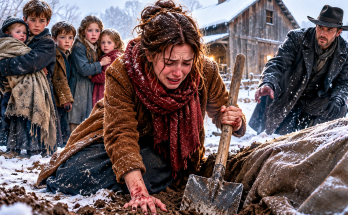
The memory of my husband’s hand was what hurt most.
Not his grave.
Not the empty chair beside the stove.
Not even the silence that came after three children stopped asking when their father was coming home.
It was his hand.
I could still remember the calluses beneath my fingers, the thick ridge along his thumb where an ax handle had rubbed his skin raw every winter.
I remembered how that hand had curled around mine on the fifth day of his fever.
Weak.
Apologetic.
As though dying were something he had done to me on purpose.
“I failed you, Addie.”
Those were Daniel’s last clear words.
For eighteen months, I carried them inside me like a splinter too deep to pull out.
On Tuesday, January 16, 1883, I stood at the edge of Stillwater Creek with the temperature nine degrees below zero and a wooden yoke laid across my shoulders.
The wind swept loose snow along the banks in white ribbons.
By nightfall, the drifts would reach the bottom of our windows.
By morning, they might cover the door.
I stepped into the creek.
The cold did not shock me anymore.
There had been a time when winter water made me gasp.
A time when the first touch of it around my ankles felt like knives.
Now it felt almost familiar.
That frightened me more.
The cold had become a living thing I understood.
It climbed from my ankles to my calves and settled in my bones.
By the time I reached the deeper channel, I could no longer feel my toes.
That was useful.
Pain was easier when the body stopped reporting it.
I filled the first bucket.
Then the second.
When I straightened, the yoke drove down across my shoulders.
For one moment my knees nearly folded.
I closed my eyes.
“Not today,” I whispered.
I did not know whether I was speaking to God, winter, death, or myself.
Perhaps all four.
I crossed back.
My daughter Clara waited on the bank.
She was ten years old, but grief had made her stand older.
Her shoulders were squared beneath Daniel’s old wool coat, and she wore her father’s boots,
the laces pulled so tight the leather had cracked across the instep.
She held a smaller pail.
She did not offer to take mine.
She had learned that lesson.
“The fire is almost out,” she said.
Not a complaint.
A report.
“Did you put the last split log on?”
“Yes.”
“How many are left?”
She hesitated.
I already knew.
“Three.”
I looked toward the cabin.
Smoke rose from the chimney in a thin gray thread.
Three logs.
One night, perhaps.
Two if I let the fire die while we slept and wrapped the children together under every blanket we owned.
“The little pieces behind the stove?”
I asked.
“Burned them this morning.”
I nodded.
Clara looked at my feet.
I knew what she saw.
My heels had split weeks ago.
The skin along the arches had gone purple from cold.
Blood had dried in two of the cracks and opened again when I crossed the creek.
“Don’t,” I said.
“I didn’t say anything.”
“You were going to.”
“I was going to say I can carry both buckets next time.”
“No.”
“Ma—”
“No.”
Her jaw tightened.
It was Daniel’s jaw.
That nearly undid me.
We walked back without speaking.
Silence had become the safest language in our family.
Inside the cabin, Peter sat on the dirt floor with his baby sister in his lap.
He was six.
He had Daniel’s brown eyes and Daniel’s habit of rubbing one thumb against the side of his finger when he was frightened.
He had not cried since his father’s funeral.
Not once.
That frightened me more than if he had screamed every night.
Anna lay against his chest.
She was eighteen months old.
She had been burning with fever for five days.
Not the shaking kind.
I almost wished it were.
A shaking child fought.
Anna had become terribly still.
Her skin was hot enough to frighten me whenever I touched her.
Her eyes opened only halfway.
She swallowed when I gave her water, but sometimes I had to rub her throat.
Peter looked up.
“She made a sound.”
“What kind?”
“A little one.”
“Did she cough?”
“No.”
I knelt.
The dirt floor pressed frozen hardness through my skirt.
I laid my hand on Anna’s forehead.
Heat.
Wrong heat.
The kind of heat I remembered from Daniel.
My stomach tightened.
I reached for the cloth in the basin and wrung it out.
There had been frontier winters when children survived things no doctor could explain.
There had also been winters when mothers woke beside children who had gone quiet forever.
I knew both kinds of stories.
I had stopped praying for miracles.
I prayed for smaller things.
One more breath.
One swallowed spoonful.
One hour without getting worse.
“Drink,” I whispered.
Anna’s lips moved.
A little water went in.
Some ran down her cheek.
Peter watched me.
“Is she going to die?”
Clara turned sharply from the stove.
“Peter.”
“What?”
“Don’t say that.”
“I only asked.”
“Don’t.”
I looked at my son.
“No,” I said.
It was not an answer.
It was an order I was giving the world.
Anna was not going to die.
I refused to consider another possibility.
Above the stove sat nearly everything we had left to eat.
A tin of cornmeal.
Almost empty.
A jar of rendered fat with only a yellow smear along the bottom.
Salt.
Half an onion.
Four dried beans Clara had found beneath a shelf and placed carefully on a saucer as though they were coins.
The woodpile inside held three logs.
Outside there was no woodpile.
We had burned the last fence rail two nights earlier.
I turned toward the calendar nailed beside the door.
Tuesday, January 16, 1883.
I had circled Friday.
Three days.
Three days until Ambrose Ward came for my land.
He had arrived the week before in a black sleigh with brass fittings polished bright enough to catch the winter sun.
He smelled of wool, leather, tobacco, and money.
Some men carried wealth quietly.
Ward wore his like armor.
He had stood on my porch without removing his gloves.
“The note is in default, Mrs.
Marsh.”
“I know.”
“Do you?”
His smile had been small.
I hated him more for that smile than I would have hated shouting.
“The interest has compounded.”
“Daniel said the payments were nearly finished.”
“Daniel is no longer here to discuss what he may or may not have said.”
My hands had gone cold then, though I was standing inside the cabin.
Ward had opened a leather folder.
“The amount presently due is one hundred forty-seven dollars and thirty-two cents.”
I had laughed.
I did not mean to.
It came out of me because the number was impossible.
“We borrowed eighty.”
“Six years ago.”
“We paid.”
“Not enough.”
“We paid every autumn.”
“Late twice.”
“Because the cattle buyer delayed payment.”
“Your circumstances do not alter arithmetic.”
Arithmetic.
As if hunger were arithmetic.
As if Daniel’s grave were arithmetic.
As if interest could grow in a ledger until it swallowed a widow and three children and still be called arithmetic.
Ward closed the folder.
“You will vacate by Friday.”
“And if I don’t?”
“I will take possession.”
“My children live here.”
His eyes moved past me.
Clara stood behind the table.
Peter held Anna.
Ward looked at them the way a man might look at chairs included with a house.
“The county orphanage in Helena can provide for minors whose parent is unable to do so.”
Clara had reached for my hand then.
I had not taken hers.
I was afraid Ward would see me shaking.
“You would separate them from me?”
“I would not.
The county would.”
“After you take the roof over their heads.”
His expression did not change.
“Friday, Mrs.
Marsh.”
Then he left.
The brass fittings on his sleigh flashed all the way up the road.
I had sold nearly everything by then.
Daniel’s horse paid for the coffin.
My mother’s quilt paid part of the doctor’s bill.
I sold my wedding ring for three dollars and fifty cents.
My boots brought two dollars and seventy-five.
That was the part I had not told Clara.
Ward’s wife owned them now.
Sturdy brown leather boots lined with lambswool.
A wedding gift from my mother.
Mrs.
Ward had examined the stitching, pressed one thumb against the heel, and said, “They are rather worn.”
I nearly slapped her.
Instead I took the money.
Anna needed willow-bark tonic.
You cannot feed pride to a sick baby.
Now the tonic bottle was empty.
Daniel’s ring was gone.
My boots were gone.
Three logs remained.
And on Friday, Ambrose Ward intended to take the last thing Daniel had left us.
“Maybe we should go to Helena,” Clara said.
I turned.
“The county orphanage is not a place you ask to go.”
“I didn’t mean there.”
“Then where?”
“I don’t know.”
She looked down.
“Somewhere.”
The word broke something in me.
My children no longer thought of home as a certainty.
Home had become a question.
I went to the stove and lifted the lid from the cornmeal tin.
I could see metal through the bottom.
“What do we do?”
Clara asked.
I opened my mouth.
Nothing came.
A mother was supposed to know.
That seemed to me the first commandment of motherhood.
Know where the food will come from.
Know how to stop a fever.
Know how to warm a house.
Know what to say when a man tells you he intends to take your children.
But I knew nothing.
I gripped the edge of the table.
That was when I heard the hooves.
Slow.
Heavy.
Crunching through snow.
Clara heard them too.
She crossed to the window.
“Ward?”
“No.”
I did not know that.
I took Daniel’s old rifle down from the wall anyway.
There were two cartridges in the drawer.
The rider came from the north.
A tall gray horse emerged through the blowing snow.
The man in the saddle wore a dark coat and a scarf wrapped across his face.
Snow clung to his hat brim and shoulders.
He stopped at the edge of the yard.
He did not ride straight to the cabin.
Instead he sat looking at the thin smoke rising from the chimney.
Then he looked toward the creek.
He dismounted.
“Stay here,” I told Clara.
I opened the door.
Wind forced itself into the room.
The stranger walked toward the water.
Not toward me.
Toward my tracks.
He stopped.
I saw his head lower.
There were twenty-seven footprints between the cabin and the creek.
I knew because Peter had counted them once in November.
That morning, each print was marked pink at the heel.
Blood on white snow.
The man crouched.
Then he turned.
His eyes found my bare feet.
Even from across the yard, I saw something change in his face.
I raised the rifle.
“That’s close enough.”
He slowly stood.
Then he pulled the scarf down.
He was perhaps forty, broad through the shoulders, weather-cut around the eyes.
His beard had gone gray at the chin.
“I reckon it is,” he said.
“I don’t know you.”
“No, ma’am.”
“Then you can keep riding.”
His gaze went to the rifle.
Then to my feet.
Then to the cabin.
“I was looking for Daniel Marsh.”
Something inside me went still.
“Who are you?”
“Elias Boone.”
The name meant nothing.
He removed his hat.
“I own the Broken Spur ranch north of the ridge.”
I had heard of it.
Everybody had.
The Broken Spur spread across several thousand acres of grassland and timber north of Stillwater.
Daniel had once said Boone ran more cattle than any man within two days’ ride of Helena.
I tightened my grip on the rifle.
“Daniel’s dead.”
The wind moved between us.
Boone looked at the ground.
“When?”
“Eighteen months ago.”
He did not offer the usual words.
No I’m sorry.
No God’s will.
I was grateful.
After a long moment, he asked, “Fever?”
“Yes.”
His jaw moved.
“I should’ve come sooner.”
I nearly laughed.
“Unless you brought him back with you, sooner wouldn’t have made much difference.”
His eyes lifted.
“No,” he said quietly.
“Maybe not.”
Anna coughed inside.
One small, dry sound.
I turned before I could stop myself.
Boone heard it.
“Child sick?”
“That’s not your concern.”
“No, ma’am.”
I looked back.
He had not moved.
“Why were you looking for my husband?”
Boone reached inside his coat.
I raised the rifle higher.
His hand stopped.
“Paper,” he said.
“Nothing else.”
“Take it out slowly.”
He did.
An envelope.
Old.
Creased.
He held it between two fingers.
“Daniel wrote me.”
“When?”
“Near two years back.”
“Why?”
Boone looked toward the house again.
Then at the bloody tracks between us.
“I think I’d rather answer that someplace your feet aren’t freezing.”
“I’ve managed without your advice.”
“I can see that.”
My anger came fast.
“Can you?”
He did not flinch.
“Yes.”
That answer stopped me.
Not pity.
Not judgment.
Just yes.
He reached down, unfastened something from behind his saddle, and lifted a pair of heavy riding boots.
“I have an extra pair.”
“No.”
“I haven’t offered them.”
“You were going to.”
“Probably.”
“I don’t take charity.”
His eyes moved again to the blood in the snow.
“Then call it rent.”
“For what?”
“For the privilege of standing here long enough to tell you why your husband wrote me.”
I should have sent him away.
Pride told me to.
Fear told me strangers brought debts more often than salvation.
But Anna coughed again.
And Elias Boone said something that made the rifle lower in my hands.
“Mrs.
Marsh,” he said, “if Ambrose Ward has been here already, then I may know why your husband thought you would someday need that letter.”
My heart struck once, hard against my ribs.
“How do you know Ward?”
Boone’s expression changed.
“Enough to know you shouldn’t sign anything he puts in front of you.”
“I haven’t.”
“Good.”
He stepped toward the cabin.
I raised the rifle again.
He stopped.
Then Clara spoke from behind me.
“Ma.”
I turned.
She had opened the door wider.
Anna was in her arms now.
The baby’s face had gone frighteningly pale beneath the fever.
“She’s shaking.”
Every thought I had scattered.
I dropped the rifle into the snow.
By the time I reached Clara, Anna’s small body had begun to tremble.
Elias Boone did not ask permission.
He ran for his horse.
And that was the first thing he changed.
Not my debt.
Not the ranch.
Not my future.
He changed the direction in which everyone was moving.
For eighteen months, everything in my life had been moving toward loss.
That afternoon, for the first time, someone moved toward us instead.
Chapter 2: THE MAN WHO OWED MY HUSBAND
Elias Boone carried medicine in his saddlebags.
Not much.
A small bottle of quinine, some dried herbs, clean cloth, and a flask he said contained brandy.
I nearly threw the brandy back at him.
“For the child?”
I demanded.
“For cleaning the cup and your hands.”
“Oh.”
One corner of his mouth moved.
I did not smile.
We laid Anna on the bed.
Boone did not pretend to be a doctor.
That made me trust him more.
“I’ve seen fever,” he said.
“Too much of it.”
“So have I.”
“I expect you have.”
He looked at Anna’s breathing.
“When did she last eat?”
“Yesterday.”
“Drink?”
“This morning.”
“She’s swallowing?”
“Some.”
“Then keep giving her small amounts.”
He dipped a cloth in creek water and laid it across her forehead.
I took it away.
“Not that cold.”
His brows rose.
“The doctor who came for Daniel said not to chill him.
Said it makes the body fight harder.”
Boone nodded.
“Then you know more than I do.”
It was such a simple sentence.
It nearly made me cry.
For eighteen months, every man who came through my door had told me what I did not know.
The undertaker told me I should have purchased a better coffin.
The doctor told me I had waited too long.
Ward told me I did not understand debt.
The storekeeper told me I did not understand credit.
Even the minister, kind as he was, told me I did not understand God’s purpose.
Elias Boone was the first man who admitted I might know something he did not.
I warmed water instead.
We washed Anna’s face and hands.
She took three spoonfuls.
Then four.
Her shaking eased.
Peter sat beside her, holding her fingers.
Boone watched him.
“You her brother?”
Peter nodded.
“What’s your name?”
“Peter.”
“I’m Elias.”
Peter looked at his boots.
“Those yours?”
Boone glanced down.
“Last I checked.”
“My mother doesn’t have any.”
“Peter,” I said.
He looked at me.
“What?”
Children can humiliate you simply by telling the truth.
Boone stood.
“I’m going outside.”
“You don’t need to—”
“Gray needs seeing to.”
He left before I could argue.
Five minutes later, I heard an ax.
I went to the window.
He was splitting one of the dead cottonwood limbs near the creek.
I opened the door.
“What are you doing?”
He kept chopping.
“Seeing to my horse.”
“With an ax?”
“Gray appreciates firewood.”
“Mr.
Boone.”
He buried the blade in the log.
“Yes, Mrs.
Marsh?”
“I said I don’t take charity.”
“I heard you.”
“Then stop.”
“I’ll make you a proposition.”
“I don’t want one.”
“That’s unfortunate.
I’m offering it anyway.”
I crossed my arms.
Snow blew around my bare ankles.
His eyes dropped.
I hated that.
He pointed the ax toward the cabin.
“I need coffee.”
“I don’t have any.”
“Then hot water.”
“I have that.”
“I’ll trade an hour of woodcutting for a cup.”
“An hour?”
“Two cups.”
Despite myself, I almost laughed.
“You own the Broken Spur.”
“So people keep telling me.”
“You could buy enough coffee to fill my cabin.”
“Probably.”
“Then why would you trade labor for hot water?”
His expression grew serious.
“Because you said you don’t take charity.”
The answer silenced me.
He picked up the ax again.
I went inside.
Clara was watching through the window.
“You could just let him help.”
“Mind your sister.”
“I am.”
“Then do it without commentary.”
She turned away, but I saw the faintest curve at the edge of her mouth.
Boone chopped for more than an hour.
He split the cottonwood.
Then he found a fallen pine beyond the creek and dragged branches through the snow behind his horse.
He cut enough fuel to fill half the wall beside the stove.
When he finally came inside, ice hung from his beard.
I set hot water before him.
He accepted it with both hands as though I had served him something valuable.
Then he took the old envelope from his coat.
“Now,” I said, “tell me about Daniel.”
Boone turned the envelope over.
“Your husband saved my life.”
Clara stopped moving.
Peter looked up.
I stared at him.
“When?”
“February of ’78.”
Daniel had never told me.
Boone leaned back.
“I was driving cattle south of the ridge.
Storm came fast.
Horse went through ice near a wash.
Broke my leg.”
I remembered that winter.
Daniel had disappeared for nearly two days.
He returned with frostbite along two fingers and a cut over his eyebrow.
He told me he’d found a stranded drover.
I had been furious.
“You said you weren’t going to risk your neck for every fool who rides into a storm,” I had told him.
He kissed my forehead.
“If I ever become the fool, I hope somebody ignores that advice.”
I had forgotten.
Boone continued.
“Daniel found me.
Dragged me into an abandoned line shack and kept us alive through the night.
Burned half the floorboards.”
“That sounds like him.”
“He got me to Helena the next day.”
“And you became friends?”
Boone shook his head.
“Not exactly.”
“Then why did he write you?”
“Because I told him if he ever needed anything, he was to ask.”
Something bitter rose inside me.
“He needed plenty.”
“I know.”
“Do you?”
My voice sharpened.
Boone did not answer.
I stood.
“He needed medicine.
He needed money.
He needed a doctor who would stay longer than ten minutes after he saw our cupboard.
He needed someone with a ranch full of cattle and enough money to burn floorboards without counting them.”
Clara whispered, “Ma.”
I could not stop.
“If he saved your life, where were you?”
Boone accepted every word.
That made me angrier.
“Where were you when he was dying?”
“I didn’t know.”
“You said he wrote you.”
“He did.”
“Then you knew he needed help.”
“No.”
Boone slid the envelope toward me.
“Read it.”
My fingers shook when I opened it.
Daniel’s handwriting was unmistakable.
Heavy downward strokes.
Letters leaning slightly to the right.
Elias,
You once said I should call a debt if I ever needed it.
I pray I never do.
But there is a matter concerning my place and Ambrose Ward that troubles me.
I borrowed eighty dollars from Ward when I bought the east pasture.
I have paid him each autumn since.
I have receipts for every payment except last year’s, which he says he misplaced in his book.
He claims I owe more now than I borrowed.
If anything happens to me, and Adelaide is left to manage the place, I ask only that you see she is given a fair accounting.
She will not ask you herself.
She is too proud.
Do not hold that against her.
It is one of the things I love most.
Daniel Marsh
The room blurred.
I read the last line twice.
Then a third time.
She will not ask you herself.
She is too proud.
Do not hold that against her.
Daniel knew me even from a grave.
I set the page down.
“When did you receive this?”
“I didn’t.”
I looked up.
“What?”
“It reached the Broken Spur three weeks ago.”
“But it’s dated nearly two years ago.”
Boone nodded.
“The letter was found in a batch of old mail when the previous postmaster’s storehouse was cleared.”
My anger shifted direction.
“Three weeks ago?”
“I was in Wyoming buying stock.
I got home yesterday.”
“And came here today?”
“At daylight.”
I looked at the snow outside.
“You rode through this?”
“Yes.”
“Why?”
“Because Daniel asked.”
There was no pride in his voice.
That mattered.
Boone looked toward the wall.
“Do you still have the receipts?”
“I don’t know.”
“Daniel said he had them.”
“He kept papers in the dresser.”
The dresser from which I had pulled the drawer that now served as Anna’s cradle.
For months after Daniel’s death, I had been unable to open the lower cabinet.
His shirts still smelled faintly of soap and wood smoke.
I crossed the room.
The hinges complained.
Inside were two shirts.
A belt.
A razor.
A small Bible.
A bundle of papers tied with string.
My breath caught.
I carried them to the table.
Ward’s receipts were there.
Ten dollars.
Twelve dollars.
Fifteen.
Fifteen.
Twenty.
I added them.
“Seventy-two.”
Boone nodded.
“You borrowed eighty?”
“Yes.”
“Any interest terms?”
I pulled out the original note.
The paper was worn at the folds.
Daniel’s name was signed at the bottom.
Boone leaned closer.
“Six percent annually.”
I looked at him.
“I don’t understand what that makes.”
“Neither do I without working it out.”
“Ward says one hundred forty-seven dollars.”
Boone stared at the page.
“That doesn’t smell right.”
I remembered something.
“Daniel made another payment.”
“When?”
“Before he got sick.”
“How much?”
“Twenty dollars.”
“Receipt?”
I searched.
Nothing.
Then I remembered.
Daniel had come home furious after his last meeting with Ward.
“He says he’ll write the receipt later,” Daniel told me.
“Make him write it now.”
“I tried.”
“You handed him twenty dollars without paper?”
“Addie—”
“Daniel.”
“I’ve dealt with him six years.”
“You trust too easily.”
He laughed and put his arms around me.
“And you trust no one.
Between us, we make one sensible person.”
At the memory, I closed my eyes.
“Twenty dollars,” I said.
“Cash.”
“Anyone see it?”
“I did.”
“Ward can deny it.”
“I know.”
Boone turned the note over.
Then stopped.
“What?”
He held the page toward the light.
“There’s writing here.”
On the back, in Daniel’s hand, were four faint lines.
Oct.
3 — paid Ward $20 at house.
A.M. present.
Would not give receipt, says ledger sufficient.
Boone looked at me.
“A.M.?”
My heart began beating faster.
“I don’t know.”
“Think.”
I did.
October third.
Daniel had gone to Ward’s house after church.
Who had traveled with him?
Then I remembered.
“Abel Mercer.”
“Who?”
“Old man who owned the mill.”
“Alive?”
“He moved to Helena.”
“Then we find him.”
I looked outside.
Snow struck the window.
“With Anna sick?”
“No.”
The word came sharply from me.
Boone looked surprised.
“No?”
“I am not leaving my daughter.”
“Then I’ll go.”
“No.”
“Mrs.
Marsh—”
“This is my land.”
He stopped.
I heard my own breathing.
“This is my debt.
My children Ward threatened.
My husband’s name he is calling dishonest every time he claims Daniel didn’t pay.”
Boone said nothing.
“I will not sit here while you fix it for me.”
Something almost like approval moved through his face.
“All right.”
“All right?”
“You find Mercer.”
“And Anna?”
“I have a ranch hand named Caleb Foster.
His wife, Ruth, delivered half the babies north of Helena before they hired a proper midwife.
She knows fever better than either of us.”
“You expect me to leave my child with a stranger?”
“No.”
He put on his coat.
“I expect Ruth to come here.”
I stared at him.
“You just rode through a blizzard.”
“Storm’s easing.”
It was not.
“Mr.
Boone.”
He wrapped his scarf.
“Yes?”
“Why are you doing this?”
He looked at Daniel’s letter.
“Because a man who had one coat gave me half of it when I was freezing.”
Then his eyes came to mine.
“And because he asked me to make sure his widow got a fair accounting.”
He opened the door.
I thought of Daniel lying on our bed.
I failed you.
For the first time in eighteen months, another possibility entered my mind.
Maybe he had not believed those words.
Maybe the fever had made him afraid.
Maybe he had been apologizing because he loved us.
Not because he had failed us.
I looked at the note again.
A.M. present.
A witness.
A payment.
A lie in Ward’s ledger.
For months I had believed my only choices were surrender or starvation.
Now there was a third.
Fight.
Chapter 3: THREE DAYS UNTIL FRIDAY
Ruth Foster arrived before dark.
She was fifty if she was a day, with iron-gray hair, red cheeks, and the kind of hands that seemed built to hold frightened people together.
She came in a sleigh driven by her husband, Caleb.
Behind them rode Elias Boone with two sacks of flour, potatoes, salt pork, lamp oil, and enough firewood to last a week.
I stood in the doorway.
“No.”
Boone sighed.
“We’ve been through this.”
“That is food.”
“Correct.”
“I didn’t trade you for food.”
“Also correct.”
Ruth pushed past him.
“I did.”
I stared at her.
She took off her gloves.
“Mr.
Boone said you need someone who understands fever.
I need somewhere warm to work on the girl.
That requires wood.
I don’t treat children whose mothers are fainting from hunger, so that requires food.
You may pay me later if your conscience insists.”
“My conscience does insist.”
“Then it can wait until spring.”
She walked to Anna.
Boone looked at me.
“She’s worse than you.”
“I heard that,” Ruth said.
“I intended you to.”
For the first time in months, Clara laughed.
It startled all of us.
Especially Clara.
She covered her mouth.
Then laughed again.
A real laugh.
Small, but alive.
I turned away so no one would see my eyes.
That night, Ruth stayed beside Anna.
The fever did not break.
But it stopped climbing.
That was enough.
At dawn Wednesday, I put on Boone’s spare boots.
They were too large.
I stuffed rags around my feet.
“I thought you weren’t accepting them,” he said.
“I’m borrowing them.”
“Ah.”
“Until I can replace mine.”
“Of course.”
“If you smile, I’ll give them back.”
His face became solemn.
“I wouldn’t dare.”
We rode toward Helena.
I rode behind him on the gray because my old mare had been gone for months.
I hated depending on another person’s horse.
I hated depending on another person’s coat.
I hated that my body nearly sagged with relief at simply being warm.
But pride had become a luxury.
My children needed a mother with feet.
We reached the main road near noon.
The storm had weakened, leaving the world white and silent.
Helena rose out of the valley in smoke and timber and brick.
After months on the ranch, the town felt impossibly loud.
Wagons.
Men shouting.
Hammering.
Horses steaming in the cold.
We found Abel Mercer above a feed store near the edge of town.
He opened the door wearing spectacles thick enough to magnify his eyes.
“Mrs.
Marsh?”
I had met him twice.
He had aged ten years in two.
“You remember me?”
“Daniel’s wife.”
His face softened.
“I heard about him.
Terrible thing.”
“Mr.
Mercer, I need to ask about October third, 1881.”
His expression changed.
Boone noticed.
So did I.
“Come in.”
The room smelled of pipe tobacco and dust.
Mercer listened while I explained Ward’s demand.
When I told him the amount, he made a sound low in his throat.
“One hundred forty-seven?”
“Thirty-two cents.”
“God above.”
“You were with Daniel when he paid Ward twenty dollars?”
Mercer looked toward the window.
I felt something sink inside me.
“You were there.”
“Yes.”
“Will you say so?”
He took off his spectacles.
“Mrs.
Marsh—”
“Will you say so?”
“Ward has business with nearly every merchant in this town.”
“I didn’t ask who he has business with.”
Boone shifted beside me.
I did not look at him.
Mercer rubbed his face.
“I saw Daniel hand him twenty.”
“Did Ward acknowledge it?”
“Yes.”
“Did he write a receipt?”
“No.”
“Why?”
“He said he would put it in the ledger.”
“Did you hear that?”
“Yes.”
“Then I need you to tell the county clerk.”
Mercer stood.
“I’m sorry.”
The words chilled me more than the creek.
“What does that mean?”
“It means I have a note with Ward myself.”
I understood.
“You are afraid.”
He looked ashamed.
“I have a daughter.”
“So do I.”
“I know.”
“No, Mr.
Mercer.
You know the word daughter.
You do not know mine.”
“Mrs.
Marsh—”
“My daughter has spent three days deciding which one of her younger siblings she would carry if we are put into the road.”
Boone said quietly, “Addie.”
It was the first time he had used my given name.
I ignored him.
“My son has stopped crying because his father died and he thinks tears cost something.”
Mercer looked down.
“My baby is burning with fever, and Ambrose Ward stood in my house and told me he would have them taken to an orphanage after he took their home.”
Mercer’s face twisted.
“You want me to risk everything.”
“No.”
My voice broke.
I swallowed.
“I want you to risk what Daniel risked when he trusted you to be standing there.”
Silence filled the room.
Then Mercer said, “Give me until Friday.”
“No.”
His head rose.
“Friday is when Ward comes.”
“I know.”
“Then Thursday.”
“You’ll testify?”
He looked toward Boone.
Then back to me.
“Yes.”
Relief came so suddenly my knees weakened.
“Thank you.”
“Don’t thank me yet.”
He put his spectacles back on.
“Ward won’t give this up easily.”
Neither would I.
Our second stop was the county clerk.
That was where I learned Daniel had been right to worry.
The clerk was a narrow-faced man named Samuel Price.
He knew Boone and became noticeably more helpful when he saw him.
I disliked that.
I moved between them.
“I am the borrower.”
Price blinked.
“Of course, Mrs.
Marsh.”
“Then explain it to me.”
He adjusted his papers.
We worked through the payments.
All of them.
The original debt.
The written interest.
The receipts.
The dates.
Even with late fees permitted by the note, the total did not approach what Ward claimed.
“How much?”
I asked.
Price recalculated.
“If every receipt is genuine—”
“They are.”
“And if the undocumented twenty-dollar payment is proven—”
“It will be.”
He looked at me.
“Then depending upon how Mr.
Ward applied the amounts, the remaining balance could be quite small.”
“How small?”
“Possibly under twenty dollars.”
I sat back.
Twenty.
Ward demanded one hundred forty-seven dollars and thirty-two cents.
My boots had sold for two dollars and seventy-five.
My wedding ring for three fifty.
I thought of every meal my children had missed because I believed we owed a fortune.
My hands began shaking.
Boone noticed.
“Addie.”
“Don’t.”
He stopped.
Price continued carefully.
“There is another matter.”
“What?”
“The land description.”
He turned the note.
“The security is listed as the east pasture parcel.”
“Yes.”
“Ward told me he could take the whole homestead.”
Price frowned.
“Not under this instrument.”
I could not speak.
“He cannot?”
“Not from this note.”
“He said he would take the cabin.”
“This cabin is on the original homestead quarter?”
“Yes.”
“Then no.”
The room tilted.
Ward had lied.
Not about one number.
About everything.
The amount.
The land.
My children.
Maybe he could have pursued other remedies.
Maybe a court might have ordered something.
But he had stood in my cabin knowing I did not understand the paper and told me Friday was the end of the world.
Because he expected me to believe him.
And I had.
I stood so quickly the chair scraped backward.
“Where is his office?”
Boone rose too.
“Addie.”
“Where?”
“You should not confront him alone.”
“I’m not alone.”
I held up Daniel’s note.
“I have this.”
“That’s not what I mean.”
“Where is his office?”
Boone gave me the address.
Ward occupied two rooms above a bank.
His clerk tried to stop me.
I walked past him.
Ward sat behind a polished desk.
My boots were dripping melted snow onto his carpet.
His eyebrows lifted.
“Mrs.
Marsh.”
“Twenty dollars.”
“I beg your pardon?”
“That is roughly what I owe.”
His eyes flicked toward Boone.
Understanding came quickly.
“Mr.
Boone.”
“Ambrose.”
Ward leaned back.
“Now this is interesting.”
I put Daniel’s receipts on his desk.
“Seventy-two dollars documented.
Another twenty witnessed by Abel Mercer.”
Ward’s expression did not change.
“Mr.
Mercer is mistaken.”
“He says he isn’t.”
“Memory is imperfect.”
“Daniel wrote it down that day.”
For the first time, Ward’s smile disappeared.
I put Daniel’s note beside the receipts.
“County Clerk Price says the whole homestead isn’t security.”
Ward looked at me for a long moment.
Then he smiled again.
Different smile.
Harder.
“Mrs.
Marsh, county clerks are not judges.”
“No.”
“Nor are ranchers.”
Boone said nothing.
Ward folded his hands.
“You signed no note.”
“My husband did.”
“Then perhaps your husband failed to explain his obligations before he died.”
The room became very quiet.
I felt Boone move behind me.
I lifted one hand.
He stopped.
Ward had chosen the wrong words.
He could threaten me.
He could insult me.
But Daniel had spent his last breath believing he had failed us.
Ward would not use that wound as a weapon.
“My husband kept every receipt.”
Ward shrugged.
“Apparently not every receipt.”
“He wrote to Mr.
Boone two years ago because he already knew your numbers were wrong.”
Something passed over Ward’s face.
Fear.
Tiny.
But I saw it.
So did Boone.
Ward stood.
“You have until Friday.”
“To pay what I actually owe?”
“To vacate.”
“No.”
The word felt strange in my mouth.
I said it again.
“No.”
Ward’s eyes hardened.
“I would advise you to consider your children before adopting a posture you cannot maintain.”
“I am considering them.”
“You have no livestock, no meaningful crop, insufficient winter stores, and by all accounts not enough firewood to last the week.”
My stomach clenched.
He knew.
Of course he knew.
His wife had bought my boots.
Merchants talked.
People always knew when a widow was failing.
Ward stepped around the desk.
“Courts are expensive, Mrs.
Marsh.”
“I know.”
“Lawyers are expensive.”
“I know.”
“You are three bad days from begging for flour.”
That struck because it was true.
He saw it strike.
“And Mr.
Boone will not remain interested forever.”
Boone’s voice came low from behind me.
“Careful.”
Ward smiled.
“Why?
Because you cut wood for her?”
I felt heat rise in my face.
There it was.
The thing men always did to a widow.
If a man helped her, there must be shame in it.
If she accepted, she had traded something.
I stepped closer to Ward.
“Look at me.”
His smile faltered.
“Look at me.”
He did.
“You came to my house while my baby was sick.
You threatened to send my children away.
You told me you could take land that paper does not give you.
You demanded more than seven times what may actually remain due.”
“You are not qualified to determine—”
“Neither were you qualified to tell me my children would be orphans while their mother was still breathing.”
His jaw tightened.
I picked up the receipts.
“Friday.”
“What about it?”
“I’ll see you then.”
I turned.
Ward spoke behind me.
“Mrs.
Marsh.”
I stopped.
“If you force this matter into court, understand something.”
I looked back.
“I will collect every penny permitted by law.”
“Good.”
He frowned.
“Good?”
“Because for the first time, that sounds like less than what you asked for.”
Boone followed me out.
We did not speak until we reached the street.
Then he laughed.
I rounded on him.
“What is funny?”
“Nothing.”
“You were laughing.”
“Yes.”
“Why?”
He looked back toward Ward’s window.
“Daniel was right.”
“About what?”
“Your pride.”
I should have been angry.
Instead I began laughing too.
Not because anything was funny.
Because I had walked into Ambrose Ward’s office afraid of losing everything, and I had walked out knowing he was afraid of paper.
For a man like Ward, paper was power.
Now I had some of my own.
But when we returned to the cabin after dark, Ruth met us at the door.
And one look at her face erased every victory I had felt.
“It’s Anna,” she said.
My heart stopped.
“The fever’s worse.”
Chapter 4: THE LONGEST NIGHT
I do not remember crossing the room.
One moment I was at the door.
The next I was beside my daughter.
Anna’s breathing came too fast.
Her lips were dry.
Her eyes did not open when I touched her cheek.
“No.”
Ruth put a hand on my shoulder.
“She’s still taking water.”
“Anna.”
“Addie, listen.”
I bent until my face was beside hers.
“Anna, sweetheart.”
Nothing.
I felt Daniel’s fever beneath my palm.
Not Anna’s.
Daniel’s.
Eighteen months disappeared.
I was kneeling beside my husband again.
The doctor was closing his bag.
“There’s nothing more I can do.”
I was grabbing his sleeve.
“You haven’t done anything.”
“I’ve given what I can.”
“Then give something else.”
“Mrs.
Marsh—”
“Don’t call me that.
Help him.”
The doctor had looked toward the empty shelf.
Then toward the door.
Money.
Everything came down to money.
Daniel died before sunrise.
Now my baby lay where he had lain.
The room narrowed.
“I need a doctor,” I said.
Ruth nodded.
“Yes.”
“I’ll go.”
Boone was already putting on his coat.
“No.”
I stood.
“You won’t make Helena and back fast enough.”
“I have a fresh team at the Broken Spur.”
“Then we go there.”
“The storm’s returning.”
“I don’t care.”
“You have two other children.”
“I know exactly how many children I have.”
Clara was standing near the stove.
Her face had gone white.
I hated myself for the words.
I turned to her.
“I’m sorry.”
She swallowed.
“I’ll watch Peter.”
“No.”
“Ma.”
“No one stays.”
Boone looked at me.
“The Broken Spur is closer than Helena.”
“How far?”
“Six miles north.”
“Then we’re going.”
Ruth began wrapping Anna in blankets.
Caleb hitched the sleigh.
We left within ten minutes.
Snow had begun again.
The wind screamed across the open land.
I held Anna inside my coat.
Clara held Peter.
Boone drove.
Ruth sat beside him.
At some point Boone turned and said something.
I could not hear him.
The wind took the words.
I only held Anna tighter.
“Stay.”
The word came out against her hair.
“Stay.”
Daniel’s last night returned piece by piece.
His skin.
His breathing.
His apology.
I failed you.
For eighteen months I had answered him in my mind.
Yes.
Sometimes I hated myself for it.
Yes, Daniel.
You did.
You left me with debt.
You left me with children I cannot feed.
You left me cutting wood until my hands bled.
You left me selling our ring.
You left me standing barefoot in a creek.
I had loved him.
I had also been furious with him.
Grief does not stay pure.
People who say it does have never lived with it long enough.
I pressed my face into Anna’s blanket.
“I was angry with you,” I whispered.
No one could hear.
“I was so angry.”
The sleigh rocked.
Snow struck my face.
“I know you didn’t mean to leave.”
My throat closed.
“I know.”
That was the first time I had said it.
Not thought it.
Said it.
Something inside me loosened.
Not healed.
Grief does not heal because of one sentence.
But loosened.
The Broken Spur appeared through the storm like a town.
Barns.
Bunkhouses.
A large timber house.
Stacks of hay.
Lanterns.
Men ran toward us.
Boone shouted orders before the sleigh stopped.
“Wake Martin!
Get the south room warm!
Caleb, fresh team!”
A ranch hand ran for the barn.
A woman came from the house carrying blankets.
I climbed down with Anna.
My knees gave.
Boone caught my elbow.
“I have her.”
“No.”
“Addie.”
“I have her.”
He released me.
That mattered.
Inside, heat hit my face so suddenly it hurt.
The ranch house had rugs.
Curtains.
A stove large enough to warm our entire cabin.
A table with six chairs.
Bread on a board.
Actual bread.
I stared at it.
For one ugly second, jealousy tore through me.
Not of Boone.
Of warmth.
Of walls that did not leak wind.
Of a pantry with food.
Of people who could become sick without first calculating the cost.
Then Anna whimpered.
The jealousy vanished.
A man named Martin turned out to be a retired army medic who worked Boone’s cattle books because an injured hip had ended his riding years.
He examined Anna.
“How long?”
“Five days.”
“She’s had willow bark?”
“Yes.”
“Quinine?”
“Some.”
He listened to her lungs.
“Not much congestion.”
“What does that mean?”
“It means I don’t hear pneumonia.”
“Is that good?”
“It’s not bad.”
Not bad.
I clung to those words.
He made us strip away some blankets.
We cooled her slowly.
We gave water.
When she could not swallow, Martin wet her lips and waited.
Midnight passed.
Then one.
Then two.
Boone stayed outside the room.
I knew because every time the door opened I saw him sitting against the opposite wall, elbows on his knees.
He did not intrude.
Clara slept in a chair with Peter curled against her.
Ruth dozed for perhaps ten minutes at a time.
I did not sleep.
Near three in the morning, Anna cried.
A weak, furious little cry.
Everyone woke.
Martin leaned over her.
“Good girl.”
I began sobbing.
Not graceful tears.
Not quiet.
I put both hands over my mouth and sobbed so hard my body folded.
Anna was crying.
My baby was crying.
Her fever had begun to fall.
By sunrise, she drank half a cup of watered broth.
Peter stared at her.
Then his face crumpled.
He began to cry too.
I pulled him into my arms.
“There you are,” I whispered.
He cried harder.
Eighteen months.
That was how long my son had held it.
He sobbed for his father.
For Anna.
For hunger.
For cold.
For every frightened night.
Clara joined us.
For a while all four of us sat tangled together on Boone’s guest-room bed.
I saw Elias standing in the doorway.
He turned away before we could be embarrassed.
Later that morning, I found him in the kitchen.
He had not slept either.
A mug of coffee sat before him.
I sat across from him.
“Thank you.”
He looked up.
That was all.
Just thank you.
It was the first charity I had accepted without negotiation.
Perhaps gratitude is not charity.
Perhaps it is simply truth.
“She’s tough,” he said.
“She gets that from me.”
“I assumed.”
I looked down at my hands.
“What happens Friday?”
He understood.
“Mercer testifies.
Price brings the accounting.
Ward either accepts the true balance or puts the matter before a judge.”
“I have no money for the balance.”
Boone was silent.
“I know what you’re thinking.”
“Do you?”
“You’ll offer.”
“Probably.”
“I won’t take it.”
“Probably.”
I looked at him.
He smiled faintly.
I did not.
“I need work.”
That erased the smile.
“What kind?”
“Any.”
“You have three children.”
“I know.”
“A sick baby.”
“Who is getting better.”
“A ranch.”
“Which Ward may not own after all.”
Boone leaned back.
“What can you do?”
The question offended me.
Then I realized he meant it seriously.
“Everything Daniel did except shoe a horse.”
“Everything?”
“I can mend fence.
Cut hay.
Keep hens.
Milk.
Plant.
Preserve.
Help calve.
I kept Daniel’s accounts after supper because he hated numbers.”
Boone’s eyebrows rose.
“You keep accounts?”
“Yes.”
“Read and write?”
“My father taught school.”
He rubbed his beard.
“My cattle ledger is six months behind.”
I stared.
“You’re joking.”
“I wish I were.”
“You employ Martin.”
“Martin keeps purchase records and payroll.
Nobody has reconciled cattle sales against feed and transport since August.”
“You own thousands of acres and don’t know whether your books balance?”
“I know the cattle balance.”
“That isn’t the same thing.”
“I suspected you might say that.”
I thought.
“How much?”
“For what?”
“My work.”
He named an amount.
I laughed.
“Don’t.”
“What?”
“Turn charity into wages.”
“I’m not.”
“Then pay what you’d pay a man.”
“I was.”
That silenced me.
“Truly?”
“Truly.”
I thought of Ward.
Twenty dollars.
Maybe less.
“How quickly can I earn twenty?”
“Depending on hours?
Two weeks.”
My stomach sank.
Friday was tomorrow.
Boone watched my face.
“Advance.”
“No.”
“You just asked for work.”
“I asked for wages after work.”
“An advance is wages.”
“For work not done.”
“Businesses do it.”
“I am not a business.”
“You’re more difficult than most.”
“So I’ve been told.”
He drummed his fingers on the table.
“Then another arrangement.”
I waited.
“I pay you for the receipts.”
“What?”
“Daniel’s receipts.
The old ranch accounts he kept.
His notes about cattle prices, hay yields, winters.
I want copies for my records.”
“Why?”
“Because your husband knew this valley better than most surveyors.”
I narrowed my eyes.
“Is that true?”
“Yes.”
“Not charity?”
“No.”
“You’d pay twenty dollars for old notes?”
“Thirty.”
“Why thirty?”
“Because if I said twenty, you’d accuse me of matching Ward’s balance.”
He had me there.
I almost smiled.
Then I remembered something Daniel once said.
A ranch survives because someone remembers what happened the winter before.
Daniel had written everything.
Snowfall.
Calving dates.
Hay losses.
Creek levels.
Prices paid.
Maybe those notebooks had value.
Maybe poverty had taught me to assume everything I owned was worthless because wealthy people said so.
“Twenty-five,” I said.
Boone blinked.
“What?”
“Twenty-five dollars for copies.
You don’t get the originals.”
He smiled slowly.
“Deal.”
We shook hands.
His grip was warm.
For half a second, I remembered Daniel’s hand.
I pulled mine back.
Not because Boone had done anything wrong.
Because grief has borders.
Some you are not ready to cross.
That afternoon, while Anna slept peacefully for the first time in almost a week, I copied pages from Daniel’s notebooks.
Weather.
Livestock.
Feed.
The condition of the north creek crossing.
And in the back of one book, I found an entry I had never seen.
October 3, 1881.
Paid Ward final principal sum.
Twenty dollars.
Abel saw it.
By my arithmetic, only accumulated interest remains.
Ward refuses receipt.
Says his own ledger is proof enough.
I do not trust this.
If I am right, obligation should be settled within another year.
Below that:
Addie says I trust people too easily.
She is right again.
I laughed and cried at the same time.
Then I turned the page.
Another entry.
December 12, 1881.
Ward offered to purchase the east pasture.
Refused him.
He wants creek access.
Says Marsh place is wasted on a small holding.
Told him no.
I stopped breathing.
Creek access.
Stillwater Creek cut across our east pasture before bending north.
Water.
In cattle country, water could be worth more than land.
Ward had not merely wanted repayment.
He wanted the parcel.
Maybe the whole place if he could frighten me away.
I took the book to Boone.
He read the entry twice.
“I wondered.”
“You knew?”
“No.”
“You suspected?”
“Ward has been buying land along the south range.”
“Why?”
“Rail survey rumors.”
I stared at him.
“Railroad?”
“Rumors only.
Don’t build a miracle out of them.”
I wasn’t.
I was building motive.
Ward had told me the place was nearly worthless.
Yet he wanted it badly enough to frighten a widow out of her home.
“Friday,” I said.
Boone nodded.
“Friday.”
But this time, Friday no longer sounded like the end.
It sounded like judgment.
Chapter 5: WHAT MY HUSBAND LEFT ME
Ambrose Ward arrived at ten o’clock Friday morning.
Not alone.
He brought a deputy.
A clerk.
And the black sleigh with brass fittings.
I was waiting.
So was Abel Mercer.
So was County Clerk Price.
Elias Boone stood near the stove, but I had made him promise not to speak unless asked.
“This is my fight,” I told him.
He had nodded.
“Then fight it.”
Ruth kept Anna in the back room of the cabin—if a curtain hung from the rafters could be called a room.
Clara stood beside me.
Peter sat at the table.
I had asked them whether they wanted to go to the Broken Spur.
Clara said no.
“This is our house.”
So they stayed.
Ward stepped inside and stopped when he saw the others.
His expression remained controlled.
But the hand removing his glove moved more slowly.
“Mrs.
Marsh.”
“Mr.
Ward.”
He looked at Mercer.
“Abel.”
Mercer nodded.
“Ambrose.”
“Unexpected gathering.”
“No,” I said.
“We expected you.”
Ward looked at the deputy.
“I am here regarding possession.”
County Clerk Price cleared his throat.
“There appears to be a dispute concerning the amount and secured parcel.”
Ward’s eyes sharpened.
“Your involvement is unnecessary, Price.”
“Mrs.
Marsh requested a review of the recorded instrument.”
“And?”
“The note secures the east pasture parcel, not the entire homestead quarter.”
Ward looked at me.
“You were informed that continued default could force broader collection.”
“No.”
I held his gaze.
“You told me you would take my land Friday and have my children sent to the orphanage.”
The deputy shifted.
Ward noticed.
“Emotion does not improve accuracy.”
“No.
Paper does.”
I set Daniel’s receipts on the table.
Price placed his calculations beside them.
Ward barely glanced down.
“You are missing payments.”
“One.”
“Precisely.”
“Abel?”
Mercer stepped forward.
His face was pale.
For a moment I feared he would lose his nerve.
Ward looked at him with the calm certainty of a man accustomed to fear doing his work for him.
“Think carefully,” Ward said.
Mercer’s mouth tightened.
That was Ward’s mistake.
He pushed.
Abel straightened.
“I was present October third, 1881, when Daniel Marsh paid you twenty dollars.”
Ward’s face went still.
“You are mistaken.”
“No.”
“Memory after fifteen months—”
“You counted the money in front of me.”
Ward’s jaw hardened.
“I said I would enter it in my ledger.”
Every person in the room froze.
Including Ward.
He had answered too quickly.
Mercer stared at him.
“That’s exactly what you said.”
Silence.
I heard the stove pop.
Price looked down at his papers to hide what might have been satisfaction.
I said, “So you remember the payment.”
Ward recovered.
“I remember a discussion.
Whether the money represented payment on this note—”
Daniel had warned me.
Ward would twist everything.
I brought out the notebook.
“My husband wrote it down that day.”
Ward’s eyes flicked to the cover.
I read the entry aloud.
Paid Ward final principal sum.
Twenty dollars.
Abel saw it.
By my arithmetic, only accumulated interest remains.
Ward refuses receipt.
Says his own ledger is proof enough.
Ward said, “A deceased man’s private notebook is hardly authoritative.”
“Then show us your ledger.”
He looked at me.
“What?”
“Your ledger.”
“Mrs.
Marsh—”
“You said it was proof enough.”
His face changed.
There it was again.
Fear.
I stepped closer.
“Bring it.”
“I have no obligation to produce private business records in this cabin.”
“Then we go to court.”
He stared.
A week earlier, that sentence would have terrified me.
Now I meant it.
Boone did not move.
Clara reached for my hand.
This time I took hers.
Ward looked around the cabin.
At Mercer.
Price.
The deputy.
Boone.
Then at my bare wooden floor and patched walls.
I knew what he had expected.
A widow alone.
That had been his arithmetic.
One frightened woman.
Three hungry children.
No money.
No knowledge.
No witness.
He had calculated everything except the possibility that I would stop believing him.
“What are you asking?”
Ward said.
“The correct accounting.”
“You still owe interest.”
“I’ll pay what I owe.”
“And fees.”
“If the note permits them.”
His mouth tightened.
“You believe this makes you clever?”
“No.”
I surprised myself with the answer.
“I believe it makes me late.”
“Late?”
“I should have opened Daniel’s papers eighteen months ago.”
My voice shook.
I let it.
“I should have checked every number.
I should have asked questions when you came through my door talking like a judge.
I should have made you prove every word before I sold things my family needed.”
Ward looked impatient.
“Your personal regrets are irrelevant.”
“No.”
I stepped closer.
“They are the only reason you nearly won.”
That struck.
The deputy looked at Ward now, not me.
I put the second notebook entry on the table.
“December twelfth.
You offered to buy our east pasture.”
Ward’s face emptied.
“You wanted the creek access.”
“Many parcels have creek access.”
“You told me my land wasn’t worth what Daniel owed.”
“I said nothing of the kind.”
“You told Daniel the place was wasted on a small holding.”
Ward turned on Boone.
“This is your doing.”
Boone lifted his hands.
“Haven’t said a word.”
That almost made me smile.
Ward looked back at me.
“You are making accusations you cannot support.”
“I’m asking questions you don’t want to answer.”
His eyes narrowed.
I had lived most of my life believing courage felt hot.
Like anger.
Like charging forward.
I was wrong.
Courage felt cold.
Clear.
It was the moment fear remained inside you and stopped making decisions.
Price tapped the paper.
“Mr.
Ward, according to the documentation available, Mrs.
Marsh’s balance is eighteen dollars and sixty-four cents, assuming the twenty-dollar payment is credited on October third.”
Ward laughed once.
“You presume too much.”
“Then produce the ledger,” I said.
He looked at me.
Again.
“Produce it.”
The silence stretched.
Finally Ward opened his coat.
He removed a folded document.
“I am willing,” he said, “to settle the note today for twenty dollars.”
My heart pounded.
Twenty dollars.
I had twenty-five from Boone in my pocket.
I could end it.
Pay.
Keep the land.
Let Ward walk away.
Every part of me wanted to.
Then Daniel’s words came back.
I failed you.
No.
I looked at Ward.
“Eighteen sixty-four.”
His brows rose.
“What?”
“The clerk says eighteen dollars and sixty-four cents.”
“I offered twenty.”
“I heard you.”
“Mrs.
Marsh, do not mistake generosity—”
I laughed.
I could not help it.
“Generosity?”
His face darkened.
I reached into my pocket.
I placed eighteen dollars on the table.
Then sixty cents.
Then four pennies.
One by one.
I had counted it three times that morning.
“Eighteen dollars and sixty-four cents.”
Ward did not touch it.
“You will sign satisfaction of the note,” I said.
He stared.
“You are hardly in a position to dictate—”
“Then we go to court and you bring the ledger.”
The deputy looked away.
Mercer coughed into his fist.
Ward’s nostrils flared.
For one moment I thought he would refuse out of pride.
Then he picked up the money.
The sound of those coins leaving the table was the sweetest sound I had ever heard.
Price produced a document.
Ward read it.
Signed.
The east pasture lien was satisfied.
My land remained mine.
No orphanage.
No Friday eviction.
No black sleigh carrying our lives away.
It should have felt like triumph.
Instead, I felt tired.
So tired I could barely stand.
Ward put on his gloves.
Before leaving, he turned toward me.
“Do not imagine ownership guarantees survival, Mrs.
Marsh.”
The cruelty had not left him.
Perhaps it never would.
“You have no stock.
Little seed.
No horse.
No meaningful capital.
One bad spring will accomplish what I apparently could not.”
The words hit because they were true.
Winning a battle does not plant a field.
It does not fill a pantry.
It does not buy livestock.
Ward knew that.
I knew it too.
I looked at him.
“Maybe.”
He waited.
“But spring hasn’t come yet.”
Ward left.
The black sleigh disappeared into the snow.
Clara shut the door.
Then she leaned against it.
“Is it ours?”
I looked around the cabin.
The patched roof.
The stove.
Daniel’s chair.
The drawer that had once been a cradle.
Peter’s carved horse on the shelf.
My children.
“Yes.”
Clara began crying.
Peter did too.
I almost laughed at that.
Once he started, apparently he intended to make up for lost time.
I knelt and pulled them both against me.
Ruth came from behind the curtain carrying Anna.
Her fever was gone.
She placed the baby in my arms.
For a while I could not speak.
Boone stood near the stove.
He looked uncomfortable with other people’s tears.
I understood.
When the children finally settled, I walked outside.
The storm had passed.
Sunlight broke across the snow so brightly I had to narrow my eyes.
The bloody footprints by the creek were gone.
Covered.
Not erased.
I knew they had been there.
But winter had laid clean snow over them.
Boone came outside.
He stood beside me.
“Congratulations.”
“For paying a debt?”
“For making Ward take the right amount.”
“I nearly gave him the ranch.”
“But you didn’t.”
“Because Daniel wrote you.”
“Partly.”
I looked at him.
“Partly?”
“You found the receipts.”
“Because you told me to.”
“You remembered Mercer.”
“Because Daniel wrote his initials.”
“You went to Helena.”
“You had the horse.”
“You confronted Ward.”
“You came with me.”
“You refused my money.”
“I took twenty-five dollars from you.”
“You sold me something worth twenty-five dollars.”
I looked toward the creek.
“You’re irritating.”
“So I’ve been told.”
We stood quietly.
After a while he said, “My offer of work still stands.”
“I know.”
“You could keep books from here most days.”
I turned.
“From here?”
“I need someone to track stock, feed, transport, payroll totals, purchases.”
“That’s more than a little bookkeeping.”
“Yes.”
“You’d trust me with that?”
“Daniel did.”
The answer hurt and healed at once.
“Three days a week,” I said.
“Four.”
“Three.”
“Three and a half.”
“How does someone work half a day when the Broken Spur is six miles away?”
“I’ll bring the ledgers.”
“Three.”
Boone sighed.
“Fine.”
“And wages in cash.
No mysterious ledger entries.”
That made him laugh.
“Agreed.”
I hesitated.
“There’s something else.”
“What?”
“Wood.”
He looked toward the stacked pile.
“What about it?”
“I need more.”
“Yes.”
“I can pay after my first week.”
His expression grew carefully neutral.
“I happen to have a large quantity of wood and a tragic shortage of hot water.”
I smiled.
The smile surprised me.
“One cup?”
“Two.”
“You’re getting expensive.”
“So are you.”
That spring was hard.
Ward had been right about that much.
Ownership did not guarantee survival.
I learned that almost immediately.
The snow melted late.
The creek flooded the lower pasture.
Half the seed potatoes rotted.
A fox took four hens.
Peter broke his wrist falling from a fence.
Anna learned to walk and then seemed determined to use the skill primarily to put herself in danger.
Clara turned eleven and informed me she was old enough to do anything I could do.
We argued about that for the next seven years.
I worked for Boone.
Three days a week.
Never four.
I balanced cattle sales against transport costs and discovered he was losing money through sloppy freight records.
The first time I showed him, he stared at the page for nearly a minute.
“How much?”
“Two hundred eighty-three dollars since August.”
He swore.
“Language.”
He looked offended.
“This is my ranch.”
“Those are my ears.”
He swore more quietly.
By June, I had earned enough to buy a milk cow.
By September, I bought a used plow horse.
By November, our pantry shelves were full.
Not rich.
Never rich.
But full.
The first snowfall came early that year.
I stood beside Stillwater Creek wearing a pair of high leather boots.
Not Boone’s.
Mine.
Bought with my wages.
Clara came beside me carrying a bucket.
“You know,” she said, “we could dig a proper covered well closer to the cabin.”
“I know.”
“Mr.
Boone says—”
“I don’t care what Mr.
Boone says.”
She smiled.
“He says exactly that whenever I tell him what you say.”
I looked at her.
“Does he?”
“Every time.”
I tried not to smile.
Failed.
Boone remained part of our lives.
Not because he rescued us.
I came to understand the difference.
A rescue is something that carries you away from your own life.
Elias did not do that.
He brought wood when there was no wood.
He brought Ruth when Anna was sick.
He gave me information when I had been kept ignorant.
He stood beside me when Ward expected me to stand alone.
Then he stepped back when it was time for me to speak.
That was the gift.
Not salvation.
Room.
Room to stand.
Room to choose.
Room to become myself again.
Ambrose Ward never apologized.
Men like him rarely do.
Two years later, he sold most of his holdings south of Helena and moved west after several business disputes made his name less useful than it had once been.
I felt no triumph when I heard.
By then he no longer occupied much space inside me.
Survival had crowded him out.
Abel Mercer visited every Christmas.
The first year, he brought Peter a wooden train and Clara three books.
He never spoke about the day he nearly refused me.
He did not need to.
Sometimes courage arrives late.
It still counts when it arrives.
Ruth became the person my children ran to when they were sick, frightened, or trying to avoid telling me they had done something foolish.
Caleb repaired our roof.
I paid him.
He complained that I overpaid.
I told him to mind his business.
And Daniel remained.
Not as a ghost.
Not exactly.
In the ledger.
In Clara’s stubborn jaw.
In Peter’s quiet kindness.
In Anna’s eyes, which turned out to be the same hazel as his.
For years, I could not forgive him for dying.
That is an ugly sentence.
It is also true.
I had thought love required me to pretend I was never angry.
It did not.
Love survived my anger.
Grief survived it too.
One January evening, almost four years after Daniel’s death, I found the letter he had written Boone.
I sat beside the stove and read the last lines again.
She will not ask you herself.
She is too proud.
Do not hold that against her.
It is one of the things I love most.
I ran my thumb over his handwriting.
Then I remembered his hand around mine on the fifth day of the fever.
Weak.
Apologetic.
I failed you.
For the first time, I knew how I would have answered if I could return to that room.
I would have held his hand tighter.
I would have bent close enough that he could hear me.
And I would have told him the truth.
No.
You didn’t.
You were scared.
You were sick.
You loved us.
You left too soon, but leaving is not the same as failing.
I understand that now.
I folded the letter and put it back inside Daniel’s Bible.
Outside, snow had begun falling.
Softly.
I stepped onto the porch.
The creek was frozen at the edges.
Beyond it stood the cottonwood where Boone had cut wood the first day he came.
I could still see him in memory.
A stranger in the yard.
A gray horse steaming in the cold.
My rifle pointed at his chest.
Blood in my footprints.
People later told the story differently.
That was inevitable.
They said Elias Boone saved the Marsh widow.
Some said he paid my debt.
He did not.
Some said he bought my ranch from Ward and gave it back.
He did not.
One woman in Helena even told Clara that Boone had discovered us half-frozen and carried me unconscious through the snow.
Clara laughed so hard she nearly fell off her chair.
The truth was less romantic.
And more important.
A rancher saw my bloody footprints in the snow.
He stopped.
He listened.
He believed something was wrong.
He gave me enough help to reach the next choice.
Then I made it.
That is how lives usually change.
Not with trumpets.
Not with miracles.
Not because some powerful person arrives and makes every terrible thing disappear.
Sometimes everything changes because someone sees suffering and does not ride past.
And sometimes everything changes because the person suffering finally accepts one hand without surrendering the use of her own.
Years later, I built a covered well twenty yards from the cabin.
Clara never let me forget it had been her idea.
On the day we finished, Peter dropped the first bucket.
Anna, old enough by then to run faster than was reasonable, tried to climb down after it.
I caught her by the back of her dress.
Elias leaned against the well frame, laughing.
“You could admit this is easier than crossing the creek.”
“I could.”
“But you won’t.”
“No.”
He looked at my boots.
I looked too.
Good leather.
High-topped.
Lined for winter.
Purchased by me.
Paid in full.
I smiled.
Then I lowered the second bucket into the well.
The rope slipped through my gloves.
Water waited below.
Clean.
Close.
Ours.
And for the first winter in years, I did not have to bleed to reach it.