I had expected Samuel Brennan to ask for something before he helped us.
Money.
Work.
Obedience.
Some promise I would regret.
I kept waiting for the request.
It never came.
He stood beside the barn while the wind moved across the yard.
Thomas remained beneath the canvas.
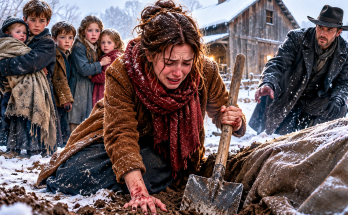
The grave was unfinished.
My children were cold.
And Samuel had offered us exactly what we needed without telling me what it would cost.
That unsettled me more than I wanted to admit.
I had spent years believing that every kindness came with a condition.
Thomas had taught me that.
He could be generous when he wanted something.
He could speak gently before making a demand.
He could apologize after frightening me, then expect me to forget everything that had happened.
I had learned to distrust the beginning of a pleasant conversation.
Sometimes the soft voice was only the warning.
Sometimes the kindness was the first part of a bargain I had never agreed to make.
So I watched Samuel.
I looked for impatience.
I looked for anger.
I looked for the moment when he would remind me that I was helpless.
But he did not seem interested in making me feel small.
He was looking at the frozen ground.
At the tools we would need.
At the children who could not remain in the cold.
He seemed concerned with the work itself.
That was unfamiliar.
I looked down at my hands.
The cuts were still painful.
I remembered the first day I tried to dig the grave.
The ground had been difficult, but not impossible.
I had believed I could manage.
The second day, I had told myself I was nearly finished.
By the third, the freeze had settled deeper.
I had struck the ground until my shoulders ached.
Every day afterward, I had returned.
I could not explain why I had kept trying long after it became obvious that the shovel was not enough.
Perhaps I was afraid of what people would think.
Perhaps I was afraid of failing at the last duty I owed my husband.
Perhaps I had simply forgotten how to stop.
For years, Thomas had treated stopping as weakness.
Resting was laziness.
Questioning was disobedience.
Needing help was failure.
I had absorbed those ideas until they became part of me.
Now I was standing beside a hole that could not be finished through determination alone.
I wondered how many other parts of my life had been the same.
How many times had I believed that trying harder would change something that needed an entirely different answer?
I had tried harder to make Thomas happy.
I had tried harder to keep the children quiet.
I had tried harder to stretch the money.
I had tried harder to make the house feel peaceful.
And when those efforts failed, I blamed myself.
Perhaps I had been fighting frozen ground for years.
Only now, the frozen ground was visible.
I looked toward the grave.
The shovel lay beside it.
I felt a strange resentment toward the tool.
It had been all I possessed for the task.
I had depended on it.
I had injured myself using it.
And it had not been enough.
Samuel had stronger equipment.
A pick.
An iron bar.
Spades.
A wagon.
A team capable of pulling through the snow.
I wondered how different the last six days might have been if I had known help was available.
But I could not change those days.
I could only decide what to do now.
I looked toward the children.
Will was standing beside Jake.
The hunting knife remained in its sheath.
Maggie and Sarah held each other.
Danny was against my chest.
I looked at their faces.
They were waiting.
That was what they had done for so much of their lives.
Waited for Thomas to stop drinking.
Waited for his anger to pass.
Waited for me to say it was safe to come out.
Waited for food.
Waited for warmth.
Now they were waiting for me to choose whether we would accept help.
I did not want to keep them waiting because I was frightened of making a mistake.
I had already made the decision.
I needed to stand by it.
I looked toward Samuel.
“Mr. Brennan?”
He turned.
“Yes, ma'am?”
“I want to be clear about something.”
He waited.
“My children come first.”
He nodded.
“As they should.”
I felt my throat tighten.
The answer was so simple.
Thomas had often acted as though the children were competing with him for my attention.
If I spent too much time comforting one of them, he complained.
If I worried about food, he accused me of nagging.
If I tried to protect them from his anger, he became angrier.
Samuel had heard me say the children came first.
And he had agreed.
No argument.
No offended pride.
Nothing.
I looked at him for a moment.
“You don't know what we've been through.”
“No, ma'am.”
“You might not understand why I'm careful.”
“I don't expect you to stop being careful.”
That answer stayed with me.
He had not asked for blind trust.
He had not told me to forget what I knew.
He had simply accepted that I had reasons to protect myself.
I looked away.
I could feel tears rising again.
I hated how close they seemed.
I had spent years holding them back.
Now the smallest kindness threatened to bring them out.
Samuel glanced toward the barn.
Then back at me.
“Your husband still needs to be laid to rest.”
I nodded.
“Yes.”
“And those children need warmth.”
I looked down at Danny.
“Yes.”
He did not add anything.
Those were the two problems in front of us.
They were serious enough without making the conversation larger.
I appreciated that.
I looked toward the clouds.
The sky had grown darker since Samuel arrived.
The cold was deepening.
I knew we could not keep standing there.
I knew the grave would not finish itself.
I knew Thomas's body could not remain behind the barn forever.
But I also knew that the children could not be made to endure another afternoon simply because I wanted to prove I was capable.
I had to make peace with that.
I turned toward Will.
He was watching me closely.
I wondered what he saw.
A tired woman with bleeding hands?
A frightened widow?
A mother who had spent six days struggling with a shovel?
I hoped he saw something more.
I hoped he saw a woman who was beginning to make different choices.
I hoped he would remember that I had listened when he told me the ground was too hard.
Even if I had listened too late.
I looked at him.
“You were right earlier.”
He frowned.
“About what?”
“The shovel.”
He glanced toward the grave.
“You couldn't get through.”
“No.”
I took a breath.
“I should have listened when you told me.”
He looked surprised.
I knew why.
Thomas had rarely admitted when one of the children was right.
He considered such admissions beneath him.
I had learned to avoid disagreeing with him.
Now I wanted Will to understand that being right did not belong only to grown men.
He had seen the truth.
I had been too stubborn to accept it.
I could say that without losing anything.
“I was frightened,” I admitted.
Will looked at me.
“Of the grave?”
I shook my head.
“Of not knowing what to do.”
He was quiet.
I continued.
“I thought if I worked hard enough, I wouldn't have to ask anyone.”
Will glanced toward Samuel.
Then at my hands.
“Sometimes people need help.”
I almost laughed.
He said it so plainly.
As though he had known the answer all along.
Perhaps he had.
Perhaps children understood some things better before adults taught them otherwise.
I touched his shoulder.
“Yes,” I said. “Sometimes they do.”
Jake moved closer.
“Does that mean Mr. Brennan is going to dig?”
“He's going to help us finish.”
Jake nodded.
He seemed relieved.
I wondered whether he had been afraid I would return to the shovel again.
Perhaps he had imagined another day of standing behind the barn.
Another day of watching me struggle.
Another day of trying not to complain.
I wanted him to know that was over.
I looked toward the tool.
“I won't be trying to break that ground by myself again.”
Jake studied my face.
Then he smiled faintly.
It was such a small smile.
But it made my chest ache.
I had not seen enough smiles from my children lately.
I wanted to see more.
I wanted to hear them laugh.
I wanted to watch them play without stopping whenever they heard a man's voice.
I wanted ordinary things.
I wondered when ordinary things had become such large dreams.
Samuel moved slightly near the grave.
I looked toward him.
For a moment, the scar along his cheek caught the pale light.
I remembered his explanation.
He had once needed help.
Someone had come too late.
I could not stop thinking about those words.
I wondered whether that experience was why he had stopped at our broken fence.
Perhaps he saw something of his own past in our situation.
Perhaps he understood what helplessness felt like.
Perhaps he simply could not ride past children standing in the snow.
I did not know.
And I would not invent an answer.
But I recognized something in him.
He had spoken of loss without turning it into a demand.
He had allowed me to keep my dignity.
That mattered more than I could explain.
I looked toward Thomas's body.
I wondered what people would say if they knew I had not cried for him.
I wondered whether they would call me heartless.
A bad wife.
An ungrateful woman.
I had imagined those judgments for six days.
But standing there with my children, I began to care less about them.
The people who had not lived inside our house could not know what Thomas had become.
They had not heard Will moving quietly around the bedroom floor.
They had not seen Jake's face after a sharp word.
They had not watched Maggie and Sarah hold each other while their father shouted.
They had not seen the milk cow disappear.
They had not felt the dread of hearing a bottle placed on the table.
I had lived those moments.
My children had lived them.
That was enough.
I did not have to explain my relief to anyone.
I did not have to make Thomas into a better husband simply because he was dead.
I could bury him with dignity.
I could acknowledge that he had once been a man I loved.
I could remember the promises he made when I was nineteen.
And I could admit that the marriage had become something painful.
All those things could be true.
I looked down at Danny.
The baby moved faintly beneath my coat.
I pressed him closer.
He was one of five reasons I had to keep going.
I looked at Will.
Then Jake.
Then Maggie and Sarah.
I thought about the years ahead.
I could not picture them clearly.
I had no money set aside for a new beginning.
I had no certainty about where we would live.
I had no plan for replacing the milk cow.
I did not know how I would manage the debts Thomas left.
But I knew one thing.
I would not spend the rest of my life teaching my children that suffering was something they had to accept without question.
I would not teach them that fear was the price of having a home.
I would not teach them that a person must endure cruelty because someone once made a promise.
I had believed those things for too long.
I wanted better for them.
And perhaps, one day, I might want better for myself without feeling ashamed.
The thought surprised me.
For years, I had placed my own wishes last.
Sometimes I had forgotten them entirely.
Now I allowed myself one small hope.
That after Thomas was buried, there might be a day when I woke without dread.
A day when the children were warm.
A day when nobody shouted.
A day when I could look out across the prairie and feel something other than fear.
I knew Samuel Brennan could not promise me that future.
No stranger could.
But he had offered one thing I needed to reach it.
Help.
I looked at the shallow grave.
The ground remained frozen.
The shovel remained useless.
The clouds still gathered overhead.
Nothing about our circumstances had magically improved.
But I no longer stood there believing I had to solve everything alone.
Samuel stepped near the canvas and carefully took hold of its edge.
I watched him.
I felt my throat tighten again.
He looked toward me.
“You've had a hard six days, ma'am.”
I could not answer immediately.
He continued quietly.
“You shouldn't have had to manage all of this without another person beside you.”
I looked at my hands.
Then at my children.
I had spent years believing I was supposed to endure whatever life placed before me.
But standing beside Samuel Brennan, I finally allowed myself to question that belief.
Perhaps I had been alone for far longer than six days.
Perhaps the loneliness had begun while Thomas was still alive.
I looked toward the grave.
Then toward the living children who needed me.
I did not cry.
Not yet.
But I stopped fighting the kindness that had been offered.
And for the first time in years, I allowed another person to stand beside me without feeling that I had surrendered myself.