I had spent years feeling responsible for Thomas McAllister.
Responsible for his happiness.
Responsible for his anger.
Responsible for his drinking.
Responsible for the condition of our home.
Responsible for what other people thought of him.
Even after he died, I continued carrying that burden.
I had washed his face.
Closed his eyes.
Covered him carefully.
Prayed over his body.
Then I had spent six days trying to bury him.
I had believed that if I did everything properly, nobody could say I had failed him.
But standing beside Samuel Brennan, I began to ask myself a question.
When had Thomas ever worried so much about failing us?
I looked toward the old canvas.
My husband's body lay beneath it.
I remembered the morning I found him.
The bottle in the snow.
His stillness beside the woodpile.
The terrible quiet when I realized he was dead.
There had been no wound I could see.
No evidence of a struggle.
Only a man whose body had finally stopped.
I had stood over him waiting for grief.
It did not come.
Not in the way I expected.
Instead, I felt relief.
I had been ashamed of that relief ever since.
I believed a good wife should mourn her husband.
I believed she should remember the happy years.
I believed she should speak kindly of the dead.
But what was I supposed to do with the truth?
Thomas had hurt me.
He had frightened our children.
He had sold something we depended on.
He had made our house a place where everyone learned to listen for danger.
And I was relieved that he could no longer do those things.
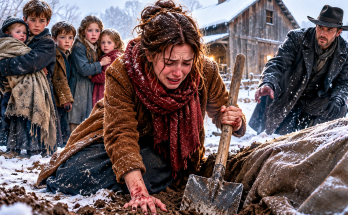
I looked down at my hands.
The injuries from digging were still there.
I wondered whether I had been punishing myself.
Perhaps I believed that suffering over his grave would make up for the absence of tears.
Perhaps I thought pain could prove I had loved him.
I did not know.
But I was beginning to understand that love did not require me to deny what happened.
I had loved Thomas once.
That was true.
He had made promises.
That was true.
We had built a family together.
That was true.
And he had become someone I feared.
That was true as well.
I did not have to choose only the pleasant memories.
I did not have to pretend our marriage had been something it was not.
I could bury him respectfully without wishing he were alive.
I could mourn what our family might have been without mourning the danger he brought into our home.
I could feel relief and sadness at the same time.
That understanding came slowly.
I had spent years being told that my feelings were wrong.
If I was frightened, Thomas said I was making too much of things.
If I was angry, he said I was ungrateful.
If I was tired, he said I did not understand how hard he worked.
Eventually, I stopped saying what I felt.
Then I stopped trusting my own feelings.
Now I was standing in the snow, trying to learn how to listen to myself again.
I looked at my children.
They were cold.
They were exhausted.
They needed help.
Those facts were more important than my shame.
I looked toward Samuel.
He had not questioned why Thomas remained unburied.
He had seen the frozen ground.
He had understood that the shovel was not enough.
He had offered tools.
I wondered how many years I had needed someone to look at my circumstances that way.
Not as proof that I was weak.
Not as evidence that I had failed.
Simply as problems requiring practical help.
I thought of the milk cow.
Three weeks before Thomas died, she had been sold.
He had done it without asking me.
Then he spent half the money in town.
I remembered how helpless I felt when I discovered what he had done.
The cow had given us something dependable.
Milk for the children.
A little security.
One less worry.
Thomas had turned that security into money and taken much of it away.
I had been angry.
But I had also been afraid to confront him.
I knew what his temper could become.
So I swallowed the anger.
I told myself we would manage.
We always managed.
That was what I said when things became worse.
We would manage.
I had said it through failed crops.
Through debts.
Through winter.
Through Thomas's drinking.
Through the nights when the children went quiet.
I had said it until the words no longer meant anything.
Now I was standing beside a grave with five children freezing behind me.
And I finally understood that managing was not the same as living.
We had survived.
But survival had cost us.
Will had lost much of his childhood.
Jake had learned to apologize for telling the truth.
Maggie had learned to hide exhaustion.
Sarah had learned to fear punishment.
And Danny was growing up in a family already carrying years of hurt.
I looked at them.
They were the people who would live with the consequences of Thomas's choices.
That was what mattered.
Not what strangers might say about me.
Not whether someone believed I had mourned properly.
Not whether I appeared strong enough.
My children needed a future.
I wanted to give them one.
I looked toward the broken fence.
Samuel's horse had come to a stop there.
I remembered seeing him for the first time.
The tall figure.
The dark coat.
The scar along his cheek.
I had been afraid before he spoke.
I had expected danger.
I had ordered the children behind me.
Will had moved beside me with the knife.
I remembered my own voice.
Sharp.
Suspicious.
Angry.
I had accused Samuel of wanting something in return for his offer.
He had told me he wanted nothing.
I had called him a liar.
The memory embarrassed me.
But I did not regret protecting my children.
I regretted only how completely fear had taken control of my thoughts.
Samuel had not demanded an apology.
He had not used my suspicion against me.
He had simply asked what I needed.
I could still hear the question.
What needed to be done?
I had looked at the grave.
And I had answered.
Thomas needed burial.
That had seemed like the whole problem.
Now I knew it was only the beginning.
The children needed warmth.
They needed rest.
They needed food.
They needed a mother who could make decisions without being frightened of a dead man's anger.
And I needed to learn how to live without believing every burden was mine alone.
I looked toward Samuel.
He was still standing near the canvas.
He had not moved closer to the children.
He had not questioned Will.
He had not tried to make himself important.
I wondered whether he knew how much his patience meant.
Perhaps he did not.
Perhaps he simply believed people deserved respect.
I found that possibility almost difficult to accept.
Thomas had made respect conditional.
I received it when I pleased him.
The children received it when they were quiet.
Even kindness could disappear if someone disappointed him.
Samuel had offered respect before he knew us.
Before we had done anything to earn his approval.
That difference stayed with me.
I looked down at Danny.
He was tucked against my chest.
I could feel how cold he remained.
The sight of his blue lips earlier had frightened me more than anything else that day.
I remembered the instant my argument with Samuel stopped mattering.
I had looked at my baby.
And I knew I had to choose.
Fear or help.
Pride or warmth.
The familiar suffering or the chance that something better might be waiting.
I had chosen help.
I wanted to stand by that choice.
I looked toward Will.
He was watching me.
I wondered whether he was still afraid of Samuel.
Probably.
But he seemed less tense than before.
His hand was no longer resting near the knife.
I noticed the change.
I wanted to believe it meant something.
I wanted him to see that a man could offer help without demanding obedience.
I wanted him to understand that strength did not require cruelty.
I wanted him to become a man who would never make his own family afraid.
That wish felt more important than anything Thomas had promised.
I reached toward Will.
He stepped closer.
"Are you all right, Mama?"
I looked at him.
He was worried about me again.
Even now.
I wanted to tell him he did not need to be.
But I knew that would not be entirely true.
I was tired.
I was frightened.
I had no money to solve all our problems.
I had no certainty about what would happen after Thomas's burial.
I could not promise everything would be easy.
So I answered honestly.
"I'm worried."
Will nodded.
"Me too."
I touched his shoulder.
"But we're going to face it together."
He looked at the younger children.
"All of us?"
"All of us."
He nodded.
I wanted him to believe that he would not have to carry everything alone.
I knew it would take time.
But the lesson had begun.
I looked toward Maggie and Sarah.
They were still holding each other.
Jake stood near them.
I wondered whether they could understand how much our lives had changed in six days.
Their father was dead.
Their home was cold.
Their future was uncertain.
And a stranger had arrived offering help.
To them, it must have seemed frightening.
To me, it was frightening too.
But it was also the first time in years that a new possibility had entered our lives.
I looked toward the northern ridge.
Eight miles away, Samuel said he had a ranch.
There was a house.
A fire.
Tools.
A wagon.
A team.
I had not seen any of it.
I did not know what the house looked like.
I did not know whether there was enough food.
I did not know whether we would be comfortable.
But Samuel had offered warmth.
That was more than I could give the children in the yard.
I looked toward the grave.
I still wanted Thomas buried before another evening passed.
I still wanted the canvas removed from behind our barn.
I still wanted to finish that final duty.
But I no longer believed I had to break myself to do it.
Samuel had offered stronger tools.
I would allow him to use them.
My children needed warmth.
I would accept the shelter he offered.
And I needed to stop blaming myself for every hardship Thomas had left behind.
That would be harder.
Much harder.
But I could begin.
I looked at my hands.
The swollen knuckles.
The dried blood.
The fingers that could barely close.
For six days, I had treated those injuries as proof that I was trying hard enough.
Now I saw them differently.
They were proof that I had gone too far without help.
I did not want my children learning to do the same.
I wanted them to know that a person could be strong and still ask for assistance.
That pain was not something to admire simply because someone endured it quietly.
That suffering did not make a person more deserving of love.
And that no one had to stay frightened just to keep a family together.
I looked toward Samuel.
He had kept his word so far.
He had respected my conditions.
He had listened.
He had offered what we needed.
I could not ask for more than that in the moment.
I took a breath.
The cold air burned my throat.
I looked at Thomas beneath the canvas.
Then at the children.
I finally understood something I had resisted for years.
My husband's failures were not mine to carry forever.
I could lay him to rest without carrying his anger into the rest of our lives.
I could remember what happened without allowing it to decide everything that came next.
And I could accept the help of a stranger without believing I had surrendered my freedom.
The grave was still unfinished.
But something inside me had finally begun to change.