I had once believed happiness required a great deal.
A good farm.
A comfortable house.
Money enough for every season.
A husband who worked hard.
Children who never knew hunger.
Those had been the things Thomas promised when we married.
I had wanted them all.
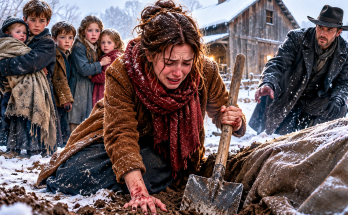
Now, standing beside his grave, I wanted something much smaller.
A warm room.
Food for my children.
A night without fear.
I looked toward Samuel Brennan.
He had offered a house with a fire.
A wagon.
A team.
Tools capable of breaking frozen ground.
He had not promised riches.
He had not promised to fix every hardship.
He had not offered a beautiful future that neither of us could see.
He had offered things that existed.
Things he possessed.
Things we needed.
I found that more comforting than the grand promises Thomas had made when I was nineteen.
I remembered the early days of our marriage.
Thomas used to speak about the future as though he could reach out and take whatever he wanted.
He imagined good harvests.
Healthy livestock.
A large family.
A home filled with plenty.
He talked about working until his hands gave out before letting us suffer.
I believed him.
I loved the confidence in his voice.
I thought a man who could imagine such a future would find a way to build it.
But imagining something was not the same as doing it.
Hard years came.
The crops failed.
The debts grew.
And Thomas began drinking.
At first, I thought the whiskey was another hardship we would overcome.
I believed he would stop.
I believed he would remember his promises.
I believed the man I married would return.
But every year, the hope grew smaller.
Then the children began learning to fear him.
That changed everything.
I could accept hardship for myself.
I could go without food.
I could wear worn clothes.
I could work through exhaustion.
But watching my children become afraid inside their own home was different.
I hated it.
I hated how helpless I felt.
I hated hearing them become silent when Thomas entered a room.
I hated seeing Will look toward the bedroom door before speaking.
I hated the way Jake apologized.
I hated how Maggie and Sarah held each other when their father's temper changed.
Yet I remained.
I remained because I was afraid of what would happen if I left.
I remained because I did not know where we would go.
I remained because there was never enough money.
I remained because I had five children depending on me.
And I remained because Thomas had convinced me we could not survive without him.
Now he was dead.
We had survived six days.
But survival had been difficult.
The grave remained unfinished.
The children were cold.
I was exhausted.
And I had reached the end of what I could do without assistance.
I looked toward Samuel again.
He had come over the western ridge on horseback.
I remembered the way he approached.
Slowly.
Carefully.
As though he knew the sight of a stranger might frighten us.
I had been suspicious of that gentleness.
I had believed it was another way of gaining control.
But he had not used it that way.
He stopped at the broken fence.
He gave his name.
He kept his distance.
And when I told him to leave, he had been willing to go.
That detail stayed with me.
Thomas had rarely accepted refusal.
If I said no, he demanded a reason.
If the reason displeased him, he became angry.
If I tried to end an argument, he followed it into another room.
I had learned that saying no was dangerous.
Samuel had listened.
He had not liked seeing the children freeze.
I could tell that.
But he had not tried to force me to accept him.
He had asked what I needed.
Then he offered to help.
I wondered whether he realized how unfamiliar that felt.
Perhaps he did not.
Perhaps respect came naturally to him.
I could not know.
But I knew how deeply I felt it.
I looked toward my children.
Will stood close to Jake.
Maggie and Sarah remained together.
Danny rested against me.
They had asked for so little.
Warmth.
Safety.
A chance to go inside.
They had not complained about the lack of money.
They had not asked why their father had sold the cow.
They had not demanded to know how I would feed them through the winter.
They simply stood in the snow and waited for their mother to find an answer.
I felt a terrible sadness.
Children should not have to make themselves so small.
They should not have to become grateful for every ordinary comfort.
I looked at Maggie.
Her face was pale.
She was trying to keep Sarah close enough to share what little warmth remained in their clothes.
I remembered when I first noticed them standing together.
Their arms were wrapped tightly around each other.
Neither girl had complained.
At the time, I thought their silence meant they were being brave.
Now I wondered whether they were afraid to speak.
I wanted to change that.
"Maggie?"
She looked at me.
"Yes, Mama?"
"What would you like most right now?"
She seemed startled.
I could see her trying to understand the question.
Then she looked toward the house.
"To be warm."
I nodded.
"Anything else?"
She hesitated.
Then shook her head.
That was all.
Warmth.
I looked toward Sarah.
"And you, sweetheart?"
Sarah rubbed her hands together.
"I want Danny to stop being cold."
My throat tightened.
Even now, she was thinking about the baby.
I looked down at him.
His face frightened me.
I needed to stop standing in that wind.
I knew that.
I looked toward Jake.
He was still rubbing his nose.
"What about you?"
He looked at his boots.
"My feet hurt."
I nodded.
"Then we need to get them warm."
He looked relieved.
I turned toward Will.
He already knew what I was going to ask.
He shrugged.
"I'm fine."
I almost smiled.
"Will."
He looked at me.
"You don't have to be fine."
He hesitated.
Then spoke quietly.
"I'm tired, Mama."
I felt tears sting my eyes.
There it was.
The truth.
My eldest boy was tired.
He had been carrying Danny.
Watching the stranger.
Protecting the younger children.
Standing beside me while I tried to dig.
He was eleven years old.
And he was tired.
I wanted to gather him into my arms.
Instead, I touched his cheek.
"Then you need rest too."
He nodded.
I looked at all five children.
Their wishes were so ordinary.
Warmth.
Rest.
Safety for the baby.
I thought of Thomas promising that our children would never know hunger.
I remembered believing he would make our lives comfortable.
Yet here they were, grateful for the possibility of a warm room.
I felt anger rise.
Not toward Samuel.
Toward the years we had lost.
Toward the promises that had become excuses.
Toward the nights my children learned to be silent.
Toward the mornings when I woke wondering what mood Thomas would be in.
I had spent so long swallowing anger that I barely recognized it when it came.
Now I felt it clearly.
I was angry that my children had suffered.
I was angry that I had been frightened in my own home.
I was angry that Thomas had sold our milk cow and spent money we needed.
I was angry that he had allowed whiskey to become more important than his family.
And I was angry that death had left me with the consequences.
I looked toward the canvas.
The anger did not make me want him back.
It made me sad that our lives had come to this.
There had been a time when I loved Thomas.
I could admit that.
There had been a time when I believed in him.
That was true too.
But love had not prevented him from hurting us.
And his death did not erase what happened.
I looked at Samuel.
He remained beside the grave.
He was a large man.
The scar on his face made him look severe at first glance.
I remembered how frightened I had been when I saw him riding toward us.
I had imagined the worst.
Now I was beginning to understand that appearances could tell me very little.
Thomas had been handsome when I married him.
He had laughing eyes.
He had spoken warmly.
And he had become the man my children feared.
Samuel had a scar.
A quiet voice.
And no reason I could see to stop for us.
Yet he had offered help.
I knew one afternoon could not reveal everything about a person.
But I could recognize the difference between words and actions.
That was something my marriage had taught me, though not in the way Thomas intended.
Promises were easy.
Kindness required action.
Samuel had offered to bring stronger tools.
He had offered his wagon.
He had offered a warm house.
I had no reason to believe he was making those offers to impress me.
He seemed to be thinking only of the work ahead.
I looked toward the northern clouds.
The weather was becoming more threatening.
I wondered whether Samuel was worried about reaching his ranch.
Eight miles was not a short distance in deep cold.
Especially with children.
But he had said his team was strong enough to travel through the snow.
I wanted to believe that.
I wanted to believe the wagon would provide a way out of the yard.
I wanted to believe there was a fire waiting somewhere north of us.
I wanted to believe my children would be warm before another night passed.
Those hopes frightened me.
Hope had disappointed me before.
But refusing to hope would not make the cold less dangerous.
I looked at Samuel.
"Mr. Brennan?"
He turned.
"Yes, ma'am?"
"You're certain about the house?"
He nodded.
"There's a fire there."
"And room for the children?"
"Yes."
I looked down at Danny.
I swallowed.
"All five?"
Samuel glanced toward them.
"All five."
I felt my shoulders loosen.
I had needed to hear it again.
I was ashamed of that need.
Then I reminded myself that Thomas had taught me to doubt promises.
I could not undo that in one afternoon.
I looked toward Samuel.
"And me?"
He met my eyes.
"You too, ma'am."
The answer was plain.
No hesitation.
No suggestion that I should be grateful enough to earn a place.
I looked away.
I did not trust myself to speak.
For years, I had worked to make a home for everyone else.
Now a stranger was offering me warmth as though I deserved it simply because I was cold.
I could barely understand that.
I thought of the house eight miles north.
I did not imagine beautiful rooms.
I did not imagine fine furniture.
I did not imagine a life without work.
I imagined a fire.
I imagined Danny's little hands becoming warm.
I imagined Sarah no longer shivering.
I imagined Jake taking off his cold boots.
I imagined Maggie resting her tired arms.
I imagined Will sitting down without watching a doorway.
And I imagined myself closing my eyes for a moment without being afraid of what would happen while I rested.
That was all.
That was enough.
I looked toward the grave.
Thomas still needed burial.
The ground still needed to be broken.
I had not forgotten that responsibility.
But I no longer believed it must be completed at the expense of the children.
I looked toward Samuel.
He was waiting for my decision.
I knew what I needed to say.
"Thank you for thinking about them."
He glanced toward my children.
"They shouldn't be out here any longer."
I nodded.
"No."
I looked down at Danny.
Then toward the four older children.
For the first time that afternoon, the choice felt clear.
We needed the warmth Samuel offered.
I did not know what waited beyond it.
But I knew the children could not remain where they were.
And I was no longer willing to mistake fear of the unknown for a reason to keep them suffering.