I had spent six days trying to put Thomas McAllister beneath the ground.
Now I was beginning to understand how much of him would remain above it.
Not his body.
Not his voice.
Not the anger that used to fill our house.
Something harder to see.
The fear he had left inside us.
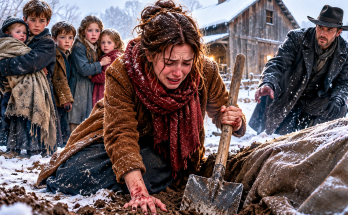
I stood beside the unfinished grave, with Danny held against my chest and the other four children gathered close.
Samuel Brennan remained near the canvas covering Thomas.
The stranger had offered to help us.
I had accepted.
Yet I could not stop waiting for something to go wrong.
That was how Thomas had taught me to live.
Whenever a good moment came, I searched for the trouble that might follow.
Whenever someone spoke gently, I wondered how long the gentleness would last.
Whenever I felt relief, I expected to pay for it.
Even standing there beside my dead husband, I could not make those habits disappear.
I looked at Samuel.
He had done nothing to frighten me.
He had not raised his voice.
He had not ordered me around.
He had not insisted that I explain myself.
He had simply offered his help.
But my body still reacted as though I were standing in front of Thomas.
My shoulders were tight.
My hands trembled.
I kept watching Samuel's face for the first sign of irritation.
I hated that.
I wanted to behave like an ordinary woman speaking to an ordinary man.
Instead, I felt as though I were being tested.
I looked toward Will.
He was doing the same thing.
His eyes followed Samuel's movements.
One hand remained close to his belt.
Thomas's hunting knife was still there.
I remembered the moment I had first noticed it.
The handle sticking out beneath Will's coat.
The way he refused to put it away.
The fear in his eyes when he said he wanted to protect us.
I had been angry when I saw that knife.
Not because Will had done something cruel.
Because he was eleven.
Eleven years old.
He should have been thinking about rabbits near the creek.
He should have been asking for biscuits.
He should have been arguing with Jake about ordinary childish things.
Instead, he was watching a grown man with the seriousness of someone who expected violence.
I had seen that expression on his face before.
Many times.
Usually when Thomas came home after drinking.
I looked away.
The realization hurt too much.
My husband had been dead for six days.
But my son was still preparing for him.
Not Thomas himself.
The kind of danger Thomas had taught him to expect.
I reached for Will's shoulder.
He turned toward me.
"Mama?"
"Come a little closer."
He stepped beside me.
I looked at his face.
His cheeks were pale from the cold.
His eyes looked tired.
I wondered when he had last felt completely safe.
I could not remember.
That frightened me.
I was his mother.
I should have known.
"You're cold," I said.
He shrugged.
"I'm fine."
I shook my head.
"You don't have to tell me that."
He looked confused.
"I can manage."
"I know you can."
I paused.
"But you shouldn't always have to."
He stared toward the barn.
I knew the words were difficult for him.
He had spent years learning that being useful was the safest way to exist.
When Thomas was angry, Will tried to help.
When the younger children became frightened, he comforted them.
When there was work, he volunteered.
He rarely asked for anything.
I had been proud of that.
Now I understood how much sadness was hidden inside my pride.
Will had become dependable because he had been forced to.
He had learned responsibility before he learned what childhood was supposed to feel like.
I wanted to tell him I was sorry.
I had already apologized for shouting earlier.
But there were bigger apologies I owed him.
For the nights he had listened through the bedroom wall.
For the times he had distracted Sarah.
For the moments he had stood between Jake and his father's anger.
For every occasion when I had needed him to be brave because I was frightened myself.
I looked into his face.
"Will, I know you've been trying to take care of everybody."
He nodded.
"You've done more than anyone should have asked of you."
He looked down.
I swallowed.
"I'm sorry for that."
His head lifted.
"Mama, you didn't make Pa angry."
The words struck me.
I had not expected him to say that.
For years, Thomas had blamed his anger on everyone around him.
If the house was noisy, the children caused it.
If supper was late, I caused it.
If money was short, the weather or the neighbors or the whole world caused it.
Thomas never seemed responsible for what he chose to do afterward.
I wondered how much of that Will had understood.
I looked at him.
"No," I said quietly. "I didn't."
He nodded.
Then he looked toward the canvas.
"But sometimes you told us to be quiet."
I closed my eyes.
There it was.
The truth I had been avoiding.
I had tried to protect the children by teaching them not to upset their father.
But in doing so, I had sometimes made them feel responsible for his behavior.
I opened my eyes.
"You're right."
Will seemed surprised.
"I was afraid of what might happen," I admitted.
He watched me carefully.
"But that didn't mean you were doing anything wrong."
His lips pressed together.
I could tell he was thinking.
Then he asked a question I had feared for years.
"Was Pa angry because of us?"
I felt my throat tighten.
I wanted to answer quickly.
But I knew this answer mattered.
"No."
Will looked at me.
"He chose how he behaved."
The words sounded strange in the cold air.
I had never said them so plainly.
"His anger wasn't your fault."
Will looked away.
For a moment, he did not speak.
Then he nodded.
I did not know whether he believed me.
Perhaps he wanted to.
Perhaps he had spent so many years accepting responsibility that he could not let it go immediately.
I understood that feeling.
I carried it myself.
I looked toward the unfinished grave.
The ground had become harder with every passing day.
I had spent six days blaming myself for not finishing.
Yet the weather had changed.
The earth had frozen.
And the shovel was not strong enough.
No amount of shame could alter those facts.
I had needed better tools.
That did not make me a bad wife.
It made me a woman facing work she could not complete alone.
I looked toward Samuel.
He remained near the barn.
I wondered whether he could hear our conversation.
If he did, he gave no sign.
He did not turn toward us.
He did not interrupt.
He allowed Will and me to speak.
I was grateful.
Thomas had never been good at allowing another person to finish a difficult conversation.
He wanted the final word.
He wanted to decide what the truth was.
And if someone disagreed, he could turn the disagreement into an argument.
Samuel seemed content to let us have our own words.
I noticed how much that mattered.
I looked down at Danny.
He had grown quieter beneath my coat.
I adjusted the fabric around him.
His cold face frightened me.
I wanted warmth for him immediately.
I wanted the same for the others.
But I was standing between two difficult duties.
My husband needed burial.
My children needed protection.
For six days, I had treated the burial as the task that must come first.
Now I knew I had been wrong.
The living could not keep waiting for the dead.
I looked toward Maggie.
She had been holding Sarah for so long that her arm must have ached.
"Maggie."
She looked up.
"Yes, Mama?"
"Are you tired?"
She hesitated.
Then nodded.
"A little."
I knew she was more than a little tired.
I could see it in the way she stood.
But I was grateful she had answered honestly.
I reached toward her.
"You've been helping Sarah all morning."
Maggie glanced at her sister.
"She was crying."
"I know."
"I didn't want her to be scared."
I felt a painful tenderness.
Maggie had learned to comfort Sarah because there had been so many frightened moments in our house.
She knew how to hold her.
How to whisper to her.
How to distract her.
I had admired that kindness.
But I had not always considered what it had cost her.
"You don't have to make everyone feel better," I told her.
She looked confused.
I almost smiled.
I had said something similar to Will.
Now I was saying it to Maggie.
Perhaps I needed to hear it myself.
I looked toward Sarah.
Her face was partly hidden against Maggie's coat.
"Sarah, sweetheart?"
She lifted her head.
I touched her cheek.
"You can come to me when you're frightened."
She nodded.
"Even if you're crying."
Another nod.
"And you don't need to apologize."
Her eyes filled.
I wanted to hold all five children at once.
I wanted to gather them together and promise that every terrible thing was finished.
But I could not make that promise.
The winter remained.
The debt remained.
Our house remained cold.
And the future was uncertain.
So I gave them the truth I could offer.
"We're going to stay together."
Sarah looked toward Danny.
"All of us?"
"All of us."
Maggie moved closer.
Jake joined her.
Will remained at my side.
For a moment, the six of us stood close enough that our coats touched.
I felt the children leaning toward me.
I knew they needed reassurance.
I needed it too.
I looked toward Samuel.
He had stepped no closer.
He still seemed willing to let me decide how we would proceed.
I remembered what he had said when I threatened him.
I had told him that if he tried to hurt us, I would fight.
He had not laughed at me.
He had not become offended.
He had accepted the warning.
That was the moment I began wondering whether his kindness might be genuine.
Not because he had promised something extraordinary.
Because he had respected my fear without trying to control it.
I looked at the scar on his cheek.
I wondered again what had happened to him.
He had spoken of a time when help arrived too late.
I did not know whom he had lost.
I did not know what he regretted.
I knew only that the memory had changed his expression.
And that he had chosen to stop when he saw us.
I thought about the people who might have ridden past.
A widow struggling beside a barn.
Five children in the cold.
A dead man beneath canvas.
It would have been easy to look away.
Samuel had not.
I did not know whether that made him different from every other man I had known.
But it made him different from Thomas in that moment.
Thomas had often been unable to see beyond his own troubles.
Samuel had seen ours.
I looked toward the shallow grave.
I had spent six days believing it held the answer to my suffering.
Finish the burial.
Cover Thomas.
Say the proper prayers.
Return to the house.
Begin again.
But there was no simple beginning waiting on the other side.
We would still have to learn how to live.
The children would need time.
I would need time.
We would have to discover what safety felt like.
We would have to learn that a raised voice did not always mean violence.
That a mistake did not require punishment.
That a child could laugh without fear.
That a woman could disagree with a man and remain safe.
I wanted those things.
I wanted them so badly that my chest hurt.
And for the first time, I allowed myself to believe that wanting them was not selfish.
I looked at Will.
His hand had moved away from the knife again.
He was watching me now instead of Samuel.
I wondered whether that was a beginning.
A small one.
Perhaps too small for anyone else to notice.
But I noticed.
I reached for his hand.
He let me hold it.
I felt his cold fingers against my injured palm.
The pain made me wince.
He noticed immediately.
"Mama, your hand."
"It's all right."
He looked doubtful.
I corrected myself.
"It hurts, but I'll manage."
He nodded.
Then he said something I wanted to remember.
"You don't have to do it all yourself."
I stared at him.
He had repeated the lesson I had been trying to teach him.
I felt tears rise.
I looked away before they fell.
Samuel was still waiting.
The grave was still unfinished.
But my son had said something Thomas never would have said to me.
And I knew that mattered more than I could explain.