I had been afraid of Samuel Brennan from the moment he appeared on the ridge.
Now I was afraid of how much I wanted to trust him.
That was the truth.
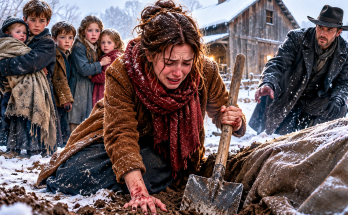
I stood beside the unfinished grave while he reached toward Thomas's canvas covering.
The wind pressed against my coat.
Danny remained tucked against my chest.
Will stood close enough that I could feel him beside me.
The others waited just behind us.
We were all watching the stranger.
And I knew that whatever happened next, the afternoon had already changed something in me.
I had allowed another person to help.
That should not have felt extraordinary.
But it did.
For years, I had believed the only way to protect my children was to carry everything myself.
If Thomas was angry, I tried to calm him.
If the food ran low, I went without.
If the children were frightened, I tried to comfort them.
If work needed doing, I did it.
I had become so accustomed to pushing through hardship that I forgot there might be another way.
Then Thomas died.
And I tried to bury him alone.
The first day, the ground had resisted.
The second day, it became harder.
By the third, the cold had settled deep into the prairie.
Still, I returned.
Every morning I picked up the shovel.
Every afternoon I told myself I would finish.
Every evening I looked at the canvas behind the barn and felt ashamed.
I had begun to believe that the unfinished grave was proof of something wrong with me.
Now Samuel stood beside it.
He did not see a failure.
He saw frozen ground.
He saw the need for stronger tools.
He saw children who needed to be warm.
And he had offered to help.
I wondered why that simple difference affected me so deeply.
Perhaps because Thomas had taught me that problems always required someone to blame.
If the crops failed, he blamed the weather.
If money disappeared, he blamed our circumstances.
If he drank too much, he blamed his troubles.
If he struck me, he blamed his anger.
And if anything went wrong in the house, he blamed me.
I had learned to expect blame before anyone spoke.
Now I stood beside a man who had not blamed me once.
I looked toward Samuel.
He had bent near Thomas's body.
His movements were careful.
He treated the canvas with respect.
I watched his hands.
They were broad.
Strong.
The sort of hands that could manage heavy work.
Thomas had possessed strong hands too.
I remembered them from our early marriage.
I remembered how safe I once felt when he held mine.
I had believed those hands would build our future.
For a time, they had worked hard.
Then they had become hands I feared.
I looked down at my own injured fingers.
The knuckles were swollen.
The cuts had dried.
I could still see blood in the creases.
I thought of all the work those hands had done.
Cooking.
Cleaning.
Caring for babies.
Keeping a household together.
Trying to protect children.
Digging a grave.
They had carried more than I ever imagined when I was nineteen.
Now they could barely close around a shovel.
I felt ashamed of their weakness.
Then I remembered what Samuel had said.
He had not called me weak.
He had said I should not have had to do everything alone.
I looked toward the children.
Will was watching Samuel closely.
His hand remained away from the knife.
I noticed that.
Perhaps he was beginning to understand that not every stranger meant danger.
Perhaps he was simply tired.
I did not know.
But I was grateful for the small change.
Jake stood beside him.
His nose was still red.
Maggie and Sarah held each other.
Danny moved faintly against my chest.
I looked at all five of them and felt a sudden, painful love.
They were the reason I had kept going.
The reason I had endured years I sometimes believed would never end.
The reason I was still standing.
But I did not want them to grow up believing that endurance was the highest form of love.
I wanted them to know love could be gentle.
That it could listen.
That it could make room for a person's fear without using that fear against them.
That it could offer help without demanding obedience.
I wanted them to learn those things before it was too late.
I looked toward Samuel.
The scar along his face was visible beneath the brim of his hat.
I wondered what had happened to him.
I wondered whether the pain in his eyes came from the same event that left the scar.
I wondered who had needed help too late.
But I knew better than to build a story from things I did not understand.
Thomas had often invented reasons for other people's behavior.
He assumed insults where none existed.
He assumed disrespect when someone disagreed with him.
He believed everyone owed him explanations.
I did not want to become that way.
Samuel had offered what he was willing to offer.
His past belonged to him.
I did not need to know every part of it to recognize the help he was giving us.
I looked toward the western ridge.
That was where I had first seen him.
At the time, I had been holding the shovel as though it could defend us.
I had ordered the children behind me.
Will had moved beside me with the knife.
I had expected trouble.
Instead, the rider stopped at the broken fence.
He removed his hat.
He gave his name.
Samuel Brennan.
I had answered him sharply.
I had accused him of wanting something from me.
I had told him to leave.
I remembered every word.
The memory made me uncomfortable.
But I also remembered how he responded.
He did not become angry.
He did not threaten me.
He did not tell me I was ungrateful.
He asked what I needed.
That question had changed the afternoon.
What did I need?
I had wanted Thomas buried.
I had wanted the children warm.
I had wanted someone to tell me there was a way through the frozen ground.
I had wanted help.
And I had been ashamed to admit it.
I looked down at Danny.
His tiny face was partly hidden beneath my coat.
I remembered seeing his blue lips.
That was the moment I stopped arguing.
I had been so afraid of trusting Samuel that I nearly ignored the danger of refusing him.
The thought still frightened me.
What if I had continued arguing?
What if I had insisted on digging?
What if I had sent Samuel away?
I looked toward the shovel.
It lay beside the grave.
I could not have finished with it.
Not before another night of cold.
Perhaps not for days.
I had known that.
But fear had made me stubborn.
I did not want to make that mistake again.
I looked toward Will.
He was standing quietly.
I wondered whether he understood why I had changed my mind.
I wanted him to understand that a person could be careful without refusing every kindness.
That trusting someone did not mean surrendering the right to say no.
That strength sometimes meant accepting help while keeping your own judgment.
Those lessons would take time.
I knew that.
But perhaps the first lesson was happening right there.
Beside the barn.
Beside the unfinished grave.
Beside a stranger who was doing what he had promised.
I looked toward Maggie.
She had her arm around Sarah.
I remembered how Sarah had asked whether we were in trouble.
The question had hurt more than I expected.
Thomas was dead.
Yet she still feared punishment.
I wondered how long it would take before she stopped asking.
I wanted to believe the answer was soon.
But I knew fear could remain long after the person who caused it was gone.
I carried my own fear.
I felt it every time Samuel moved.
Every time he spoke.
Every time I had to make a decision.
Part of me still expected him to become angry.
I kept waiting for the kindness to end.
That was not fair to him.
But it was the truth.
I could not pretend otherwise.
Samuel had given me no reason to believe he would hurt us.
Yet I still watched him.
Perhaps trust did not begin with feeling safe.
Perhaps it began with noticing what a person did while you were afraid.
I looked at the canvas.
Samuel was still holding its edge.
He was careful with Thomas.
That surprised me.
He knew nothing about the man beneath it.
He did not know about the whiskey.
He did not know about the sold milk cow.
He did not know about the frightened children.
He did not know about the blows.
He did not know that I had felt relief when I found my husband dead.
He only knew a man needed burial.
And he was willing to help.
I felt something complicated move inside me.
I had spent years wishing Thomas would become the man he promised to be.
Now another man was showing simple kindness to someone who could no longer return it.
Thomas was dead.
He could not thank Samuel.
He could not pay him.
He could not offer anything in return.
Yet Samuel still treated him with dignity.
That mattered.
I looked toward my children.
They were watching too.
I wondered what they would remember about this afternoon.
Would Will remember Samuel's scar?
Would Jake remember the horse coming over the ridge?
Would Maggie remember holding Sarah in the cold?
Would Sarah remember the stranger who offered a warm house?
Would Danny remember anything at all?
I hoped they would remember that help had come.
That their mother had accepted it.
That not every man who approached gently was hiding cruelty.
I wanted them to know the world contained more than Thomas McAllister.
That was perhaps the greatest gift Samuel had offered without knowing it.
He had shown us another possibility.
Not a promise.
Not a guarantee.
Only a possibility.
A man could be strong without frightening children.
A man could see a woman struggling and offer help without treating her as foolish.
A man could hear suspicion and answer calmly.
A man could respect boundaries he had not chosen.
A man could stand beside a grave and think first about the living.
I looked at Samuel again.
He was not trying to impress us.
He was simply there.
The wind moved his coat.
His horse waited near the broken fence.
The clouds gathered above the prairie.
The grave remained shallow.
Yet the world felt different from the way it had felt that morning.
I had woken believing I would spend another day fighting frozen earth.
I had expected pain.
Exhaustion.
Failure.
Another night with Thomas behind the barn.
Another night worrying about how much longer the children could endure.
Now a stranger had offered a way forward.
I did not know what would happen tomorrow.
I did not know whether the tools would break through the ground as easily as I hoped.
I did not know what waited eight miles north.
I did not know whether Samuel's warm house would become anything more than temporary shelter.
And I did not know how we would rebuild the life Thomas had left in pieces.
Those questions remained.
But they no longer felt like reasons to refuse help.
I had lived too long believing that fear was a warning I must always obey.
Sometimes fear was useful.
It had helped me protect my children.
It had taught me to recognize danger.
But sometimes fear was only the memory of danger that had already passed.
I was beginning to understand the difference.
I looked toward the barn.
Thomas lay beneath the canvas.
I had prayed over him.
I had washed his face.
I had closed his eyes.
I had tried to bury him with my own hands.
I had done what I could.
I did not need to keep punishing myself because I could not finish alone.
I looked toward Samuel.
He glanced up.
Our eyes met.
For a moment, I felt the familiar urge to look away.
To hide my exhaustion.
To pretend I was stronger than I felt.
But I did not.
I stood still.
My children were behind me.
My husband's body was before me.
And a stranger had offered to help us move from one terrible life into something I could not yet imagine.
I did not know whether that offer would change everything.
I only knew it had already changed one thing.
I had stopped believing that my suffering had to remain invisible.
Samuel's voice was quiet when he spoke.
"Ma'am, you've carried this far enough on your own."
I felt my eyes fill.
I looked down at my hands.
The dried blood.
The swollen fingers.
The marks left by six days of work.
Then I looked toward Will.
Jake.
Maggie.
Sarah.
And little Danny against my chest.
They had carried too much too.
I wanted to tell Samuel that he did not understand.
That this was only one small part of what we had endured.
That the real burden had begun years before Thomas died.
But I could not speak.
The words were caught somewhere behind my ribs.
I looked toward the unfinished grave.
For six days, I had believed finishing it would mean I had done my duty.
Now I understood that my duty was larger than the burial.
I had five children who needed a future.
And I was still alive to give them one.
I took a breath.
The cold air hurt my throat.
I looked at Samuel Brennan.
Then I nodded.
It was a small movement.
Almost nothing.
But it was the first time in years I had allowed someone to see that I needed help without immediately trying to take the admission back.
I still had no answers about tomorrow.
I still had no certainty about the stranger standing beside me.
But I knew I could not keep living as though Thomas's anger had the final word.
He was dead.
We were alive.
And the living needed warmth, safety, and a chance to begin again.
For once, I let that be enough.