I had thought the worst moment of my life would be finding my husband dead.
It wasn't.
The worst moment was realizing how relieved I felt.
For six days, I carried that secret.
I carried it while I washed Thomas's face.
While I closed his eyes.
While I covered him with the old canvas.
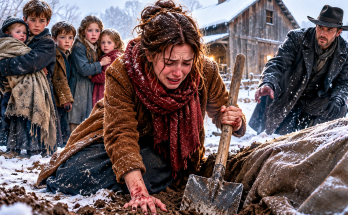
While I dug at the frozen earth until my hands split.
I believed a good wife should have been heartbroken.
I believed I ought to have missed him.
But I did not miss the man who had frightened my children.
I did not miss the whiskey.
I did not miss the shouting.
I did not miss the nights when I listened for footsteps and wondered whether it was safe to move.
I missed the man Thomas had promised to become.
That was different.
I missed the future I believed we would have when I was nineteen.
The house.
The land.
The children who would never know hunger.
The marriage where two people carried hardship together.
I had mourned that life for years.
By the time Thomas died, very little of it remained.
I looked toward his body behind the barn.
The canvas moved slightly in the wind.
For six days, I had tried to bury him.
I had believed the grave was the last thing standing between my family and a new beginning.
Now I understood that the beginning would not come simply because the ground was filled.
There was more to settle.
The children were frightened.
The house was cold.
Our milk cow was gone.
The debts remained.
And I had spent so many years being afraid that I hardly remembered how to make a decision without imagining Thomas's reaction.
I looked at my hands.
They were injured from the shovel.
The cuts were swollen.
The skin was stiff.
I remembered falling to my knees in the snow.
I remembered watching blood from my knuckles stain the white ground.
I had felt defeated.
I had believed that if I could not bury my own husband, I had failed at the last duty a wife could perform.
Now I knew better.
The ground had frozen.
The shovel was not enough.
I needed stronger tools.
That was all.
There was no shame in it.
I wished I had understood that sooner.
I wished I had not kept the children standing behind me for so long.
I wished I had not shouted at Will.
I wished I had not made Jake apologize for telling me what he noticed near the barn.
I wished I could take back the frightened look on his face.
But I could not change those moments.
I could only decide what happened afterward.
I looked toward Jake.
He stood beside Maggie and Sarah.
His cheeks were red from the cold.
His hands were hidden beneath his arms.
He had stopped complaining.
That was something I never wanted to admire again.
A child should not have to become silent because no one can help him.
I looked toward Maggie.
She was still holding Sarah.
Both girls looked exhausted.
I thought of all the times they had comforted each other when Thomas became angry.
They should have been able to come to me without wondering whether I could protect them.
I wanted to give them that certainty.
I looked toward Will.
My eldest boy.
Eleven years old.
Thomas's hunting knife hung at his belt.
I remembered the moment he refused to stand behind me when Samuel approached.
He had stepped beside me instead.
I had seen his father's stubbornness in the set of his jaw.
But the resemblance ended there.
Will was not trying to control us.
He was frightened.
He was trying to protect the people he loved.
I looked at him with a sadness I could barely bear.
He had learned to become responsible too early.
I wanted to give him permission to become a child again.
I wanted him to put the knife away.
To play.
To laugh.
To sleep without listening for danger.
I did not know how long it would take.
But I wanted to try.
Then I looked down at Danny.
My youngest.
The baby who had been shivering so badly that Maggie could barely hold him.
I remembered seeing the blue color around his lips.
That was the moment everything became clear.
I could not keep arguing with Samuel.
I could not keep digging.
I could not keep proving I was strong while my children suffered.
I had to choose what mattered.
And I had chosen them.
I looked toward Samuel Brennan.
He stood beside Thomas's covered body.
The scar on his left cheek was visible beneath his hat.
His dark coat moved in the wind.
He was a large man.
Strong.
Quiet.
A stranger I had never expected to meet.
When I first saw him coming over the western ridge, I believed he might be another danger.
I had gripped the shovel.
I had ordered the children behind me.
I had watched every movement.
I remembered how carefully he approached.
How he stopped at the broken fence.
How he dismounted.
How he removed his hat.
How he gave his name.
Samuel Brennan.
I had answered him sharply.
I had accused him of wanting something.
I had told him nobody offered help without expecting payment.
He had not become angry.
He had simply said he wanted to help.
I remembered his question.
What did I need done?
I had looked at the unfinished grave.
I had told him my husband needed burial.
He had offered to do that.
Then he had looked at the children.
And offered warmth.
I remembered every condition I gave him.
He was not to touch my children without permission.
He was not to make decisions for me.
If I wanted to leave, he would help us go.
I had even threatened him if he tried to hurt us.
I remembered how frightened I was beneath the anger.
Samuel had accepted my rules.
He had not argued.
He had not demanded gratitude.
He had not made me promise anything in return.
That was what I could not forget.
For years, Thomas had used every kindness as something he could later hold over me.
Samuel had offered help without trying to own the people receiving it.
I did not know whether I would ever fully understand why he stopped.
He had given me only part of the answer.
Once, he said, he had needed someone to come.
And help had arrived too late.
I remembered the pain that moved across his face when he spoke.
It was there for only a moment.
Then he hid it.
I did not know whom he had lost.
I did not know what had happened.
I did not know whether the scar on his face was connected to that memory.
Those were things he had not told me.
I would not pretend otherwise.
But I knew what he had chosen to do with his pain.
He had seen a family in trouble.
And he had stopped.
That mattered.
He had not turned away because helping would be difficult.
He had not decided the problem belonged to someone else.
He had stopped at the broken fence and asked what we needed.
I looked toward that fence now.
It had been damaged for some time.
Thomas had never repaired it.
I remembered being angry about that.
Another unfinished task.
Another promise left behind.
Now that broken stretch of fence was where Samuel had first entered our lives.
I did not know what would happen because of it.
But I knew the yard felt different after he arrived.
I had been alone with five children and an impossible task.
Now another adult stood beside me.
Someone with a wagon.
A team.
A pick.
An iron bar.
Spades.
And a house eight miles north where a fire was burning.
I had not seen that house.
I did not know what it looked like.
I did not know whether we would stay there beyond the shelter Samuel had offered.
I did not know what would happen after Thomas was buried.
I had no right to claim that every hardship was solved.
It wasn't.
But I no longer believed that uncertainty meant we had no hope.
I looked at my children.
They were still cold.
Still tired.
Still waiting.
But they were together.
And I was with them.
That was the one thing I knew I had to protect.
I called them closer.
Will stepped beside me.
Jake followed.
Maggie brought Sarah.
Danny remained against my chest.
I looked at their faces.
I wanted to tell them everything would be wonderful.
I wanted to promise a warm home forever.
I wanted to say they would never be frightened again.
But I had learned what empty promises could do.
So I told them something smaller.
Something true.
"We're going to accept Mr. Brennan's help."
Will nodded.
He had heard me say it before.
But I needed him to hear it again.
I needed all of them to know the decision was made.
"We're going to stay together."
Sarah looked up.
"All of us?"
I nodded.
"All of us."
Jake looked toward the grave.
"What about Pa?"
I followed his eyes.
Thomas remained beneath the canvas.
"He still needs to be buried."
Jake nodded.
I continued.
"And Mr. Brennan has offered to help us do that."
Will looked toward Samuel.
"With his tools?"
"Yes."
I looked down at my injured hands.
"The ground is too hard for the shovel."
Will glanced at the shallow hole.
He had told me that earlier.
I had become angry.
Now I understood he had only been trying to help.
I looked at him.
"You were right."
He seemed surprised.
I continued.
"I should have listened."
He lowered his eyes.
"It's all right, Mama."
I touched his shoulder.
"No. I should have listened."
I wanted him to know an adult could admit being wrong.
That was another lesson Thomas had rarely allowed.
I looked toward the younger children.
I wanted them to learn that mistakes could be acknowledged without punishment.
That someone could apologize and mean it.
That being wrong did not make a person worthless.
Those were ordinary lessons.
But in our family, they felt new.
I looked toward Samuel.
He remained quiet.
He did not interrupt our conversation.
He did not tell me to hurry.
He did not make the children feel foolish for asking questions.
He simply waited.
I wondered whether he understood how much that patience meant.
Perhaps not.
Perhaps it was ordinary to him.
I hoped it was.
I hoped there were places where kindness was ordinary.
Where a man did not need praise for listening.
Where children were not expected to hide their fear.
Where women could make decisions without being threatened.
I had not lived that way for a long time.
But I wanted to.
I looked toward the prairie.
The northern clouds were heavy.
The cold had settled into my bones.
My right boot was still split.
My hands still hurt.
I was tired enough that standing felt difficult.
Nothing about the afternoon had become easy.
But the future no longer felt entirely closed.
I had spent years believing the choices before me were to endure Thomas or face the unknown alone.
Now a third possibility stood beside the barn.
Help.
Not ownership.
Not rescue that required obedience.
Simply help.
I had not known how much I needed that distinction.
I looked toward Samuel.
He was still near the canvas.
I remembered the moment he lifted one end of the covering.
His movements had been careful.
Respectful.
He had treated Thomas's body with dignity.
Despite knowing almost nothing about him.
That had surprised me.
Then Samuel looked toward me.
His face was serious.
I could see the scar along his cheek.
He spoke quietly.
"Ma'am, this was too much for one person to handle."
I felt my throat tighten.
I wanted to tell him I had managed harder things.
I wanted to tell him I did not need pity.
I wanted to remind him that I had survived years with Thomas.
But I stopped myself.
I was tired of proving how much I could endure.
I was tired of pretending I had no limits.
I was tired of treating kindness as something dangerous.
I looked down at my bleeding hands.
Then at my children.
I had spent years protecting them as best I could.
Sometimes I had succeeded.
Sometimes I had failed.
But I had never stopped loving them.
And I had never stopped wanting something better.
That was what remained after Thomas died.
Not the promises he made.
Not the anger he left behind.
Not the money he had wasted.
My children.
Five living reasons to begin again.
I looked at Samuel.
For a moment, I saw the old pain in his face.
I remembered what he had said about help arriving too late.
I did not ask him to explain.
I understood enough.
He knew what it meant to wish someone had come sooner.
And now he had chosen to be the person who stopped.
I felt tears gather.
This time, I did not hate myself for them.
They were not tears for Thomas alone.
They were for the years we had lost.
For the young woman who had believed every promise.
For Will, who had learned to carry a knife.
For Jake, who had learned to apologize.
For Maggie and Sarah, who had learned to comfort each other when they were afraid.
For Danny, who had been shivering against my chest.
And for the possibility that my children might still know a different kind of life.
I looked toward the unfinished grave.
Thomas still needed to be laid to rest.
I would see that duty through.
But I would no longer confuse burying my husband with saving my family.
Those were two different things.
Samuel had offered to help with the first.
His warm house offered a chance to begin the second.
I did not know whether the years ahead would be kind.
I did not know how we would manage the farm, the debts, or the winter.
I did not know what Samuel Brennan would become in our lives.
The promise of a new life was still only a possibility.
But for the first time, I could imagine one.
A life where Will could be a boy.
Where Jake could tell the truth.
Where Maggie and Sarah could laugh without fear.
Where Danny could sleep in warmth.
Where I could wake without wondering whether my husband would become angry.
I had once believed Thomas would give us that life.
He had not.
Now he lay beneath canvas behind our barn, and a stranger had stopped to offer the things we needed most.
I looked at Samuel.
I wanted to thank him.
But the words would not come.
My throat was too tight.
My eyes burned.
He did not press me.
He did not ask for gratitude.
He simply remained beside us.
I looked at my children one more time.
They were alive.
They were together.
And help had come while there was still time to offer it.
I let myself feel relief.
Not shame.
Not guilt.
Relief.
My husband was dead.
The ground remained frozen.
The grave was unfinished.
But I had finally stopped believing that my children and I had to face everything alone.
And when Samuel Brennan offered his hands, his tools, and the warmth of his home, I allowed myself to accept.
I did not know where that choice would lead.
I only knew it was the first choice I had made in years without asking what Thomas would think.
For the first time, I had chosen our future over my fear.
And as I stood beside my five children, watching Samuel prepare to help with the work I could no longer do, I understood that a new life did not always begin with something grand.
Sometimes it began with a broken fence.
A stranger who stopped.
An unfinished grave.
And a mother who finally believed her children deserved more than simply surviving.
The End
Read more original stories on lastestdrama.