I knew my father wanted something from me before I even opened the folder.
He had put it beside the barbecue grill like it was nothing important.
A few sheets of paper.
A pen.
A place marked for my signature.
My father, Richard Hale, had always been good at making his decisions sound like everybody else's common sense.
This time, he was asking me to give up my house.
Not borrow it.
Not share it.
Give it up.
I had been home from a nine-month deployment only a short while, and I was still trying to understand how my family had managed to change so much while I was gone.
The house was supposed to be mine.
My grandfather had arranged that years earlier.
He had been careful about the property, although I hadn't understood how careful until much later.
When I left for deployment, I had expected to return to the same walls, the same bedroom, and the same ordinary things that made coming home worthwhile.
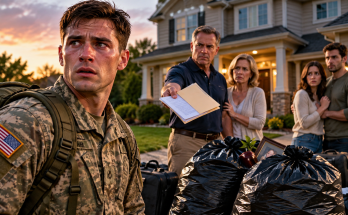
Instead, I found my belongings packed into garbage bags.
Some of those bags had been left where anyone could see them.
There were clothes I recognized by touch.
Old papers.
Personal items that had been handled by somebody who hadn't considered whether I would want them touched.
I remember looking at the plastic more clearly than I remember what anyone said.
That embarrassed me afterward.
I had spent nine months doing work that required me to remain calm under pressure, yet a few black bags had made it difficult to think.
My sister Chloe and Vance had been moved into the house.
Mom and Dad spoke as though the arrangement had already been settled.
Nobody had asked me.
Nobody seemed particularly interested in whether I agreed.
They talked about what was good for the family.
That phrase had followed me since childhood.
Usually it meant that somebody else had made a decision and I was expected to accept it without making the room uncomfortable.
I had accepted plenty of things that way.
I wasn't proud of that.
At first, I tried to convince myself there had been a misunderstanding.
Maybe my parents had assumed I would want Chloe to have a place to stay.
Maybe they had believed my grandfather's property was something all of us could use.
Maybe they simply hadn't thought beyond the immediate problem in front of them.
Those explanations were easier to live with than the alternative.
Then Dad brought out the papers.
He waited until the conversation around the barbecue had become ordinary enough that my refusal would seem like the strange part of the evening.
He placed the folder nearby.
He spoke confidently about the property.
The paperwork, he told me, would be taken care of the following day.
I looked at him.
He didn't look concerned.
He looked relieved.
That was the part I couldn't forget.
He behaved as though the difficult work was already finished and I was only being asked to complete a small formality.
I had spent years obeying his instructions before I had time to question them.
Apparently, he thought I still would.
I didn't sign.
Instead, I began looking for the documents that actually established who owned the house.
The deed was not difficult to understand once I had it in front of me.
The property had been placed in a trust for my benefit.
That didn't answer every question.
It answered one very important one.
My father couldn't simply decide the house belonged to somebody else.
Neither could my mother.
Neither could Chloe.
I wanted to take the deed straight to the family and put it on the table.
I imagined Dad reading it.
I imagined Mom finally admitting that they had made a mistake.
I even imagined Chloe apologizing and helping me move my belongings back inside.
I didn't do any of that.
There had already been money missing from my account.
Forty-five thousand dollars.
That was too much to explain as somebody accidentally paying the wrong household bill.
And I had discovered paperwork suggesting that my mother had been given authority to act on my behalf while I was deployed.
The signature wasn't mine.
I kept returning to that detail.
It was one thing for my parents to make decisions they had no right to make.
It was another thing entirely to put my name on paper and pretend I had approved them.
I took what I had to the people who could help me examine it properly.
Captain Morales understood immediately why I was concerned.
She didn't encourage me to confront my parents.
She wanted everything recorded.
Dates.
Accounts.
Documents.
Names.
I was still on active duty, and my promotion review was moving forward.
I couldn't afford to turn a family dispute into a public shouting match, especially when there were financial records and legal questions involved.
Dalton, the attorney reviewing the material, was equally careful.
He didn't promise me that the matter would be simple.
He didn't tell me what I wanted to hear.
He studied the documents and began comparing one thing against another.
That was when he found the older form.
I watched him pull it from a stack of records.
The page looked as though it had spent years in a cabinet.
Its corners were slightly discolored.
There was an official seal at the top.
Beneath it was my full name.
Dalton moved it across the desk.
I started reading.
The document said I had appointed an agent to act for me.
A power of attorney.
I had already seen something similar connected to my mother's actions during my deployment.
But this one was different.
It hadn't been prepared recently.
It was almost seven years old.
I was nineteen when it had supposedly been signed.
I remembered that year.
I was away at college, trying to balance classes with a part-time job.
I hadn't yet made a final decision about joining the military.
My parents still treated me as though I couldn't handle ordinary adult responsibilities.
Dad liked to explain financial matters in a slow voice.
Mom would tell relatives that I needed somebody watching over me.
I had hated those conversations, but I usually stayed quiet.
Part of me believed they would eventually stop treating me like a child if I behaved responsibly enough.
Looking back, that was a foolish bargain.
They were the ones deciding what counted as responsible.
And they could change the definition whenever they wanted.
I moved my eyes down the document.
The authorized agent wasn't Evelyn Hale.
My mother wasn't named at all.
Richard Hale was.
My father.
I read the name again.
Then I looked at the signature.
It was a good imitation.
Much better than the one on the document associated with Mom.
Whoever had written it had paid attention.
The slant of the letters looked familiar.
Even the last movement of the H had been copied.
But my hand didn't move that way when I signed something.
I had always written quickly.
Sometimes the letters crowded together.
Sometimes the final stroke came out uneven.
This signature looked practiced.
Every movement seemed controlled.
I could almost picture somebody stopping between letters to check whether the result looked convincing.
Dalton watched me.
“Does that look like your signature?”
“It looks like somebody tried to make it mine.”
“Did you authorize your father?”
“No.”
He waited a moment.
“Are you sure you didn't sign this while you were in college?”
I understood why he had to ask.
Seven years was a long time.
People forgot paperwork.
They forgot appointments.
They forgot signing forms at the end of busy days.
But I wouldn't have forgotten giving Dad that much authority.
“I never signed it.”
Captain Morales sat nearby.
She hadn't interrupted.
Her silence made it easier to think.
Dalton turned the paper slightly so he could examine the lower section.
He pointed out that a notary had certified the document in the county where the house stood.
The date was only three weeks after my grandfather had changed the trust.
I didn't speak immediately.
Three weeks.
That seemed far too close to be an accident.
I knew there had been a trust.
I knew my grandfather had wanted the property protected.
I hadn't known he had amended anything at that time.
Dalton looked at me.
“Did your grandfather tell you about the change?”
“No.”
“Do you know why he made it?”
“No.”
I hated having so few answers about something that belonged to me.
My grandfather had been a quiet man about money.
He rarely discussed what he owned.
He did not like people making plans based on what they might receive someday.
I had always respected that.
But as I sat in Dalton's office, I realized how little I really knew about the arrangements he'd made.
I remembered his study.
The oak desk was heavy enough that moving it required two people.
The drawers had brass handles.
Some of them stayed locked.
When my parents started arguing about my future, Grandpa sometimes called me into that room.
He would ask about my classes.
Or work.
Or something ordinary that had nothing to do with the argument outside.
I used to think he was distracting me.
Maybe he was protecting me from hearing more than I needed to hear.
When I was seventeen, he gave me a brass key.
It was small and worn smooth in places.
I held it between my fingers while he spoke.
He told me that keeping something safe sometimes meant keeping its location private.
I assumed he was talking about the safe.
I didn't ask what else he might have meant.
At seventeen, I thought there would always be another afternoon to ask him questions.
There wasn't.
Sitting in Dalton's office, I could still remember the weight of that key.
It bothered me that I remembered the object better than the conversation.
Dalton pulled my attention back to the desk.
He wanted the complete trust records.
He also wanted official examples of my real signature so that the documents could be compared properly.
The forged document, if that was what the evidence ultimately established, might have no legal effect.
But the document itself wasn't the only issue.
Somebody could have used it to get access to money.
Or to persuade a bank that my father had authority he never possessed.
I looked down at the paper.
For seven years, I had believed my parents' interference was mostly personal.
They criticized.
They pressured.
They decided things without me.
Now I was looking at evidence suggesting they had gone further.
Someone had tried to turn their control into a legal document.
I wanted to ask Dad why.
I wanted to hear his explanation while looking directly at him.
Captain Morales seemed to know what I was thinking.
“Don't confront him with this yet.”
I nodded, although it wasn't easy.
“We need facts you can rely on,” she continued.
“I understand.”
Dalton gathered the forms into a separate pile.
He reminded me not to sign anything my father brought to me.
I thought of the folder at the barbecue.
The pen.
The easy confidence in Dad's face.
“No chance of that,” I said.
But refusing to sign wasn't going to answer how he had gotten this far.
There was a reason the old document existed.
There was a reason it appeared shortly after my grandfather changed the trust.
And there had to be a reason Dad was suddenly so eager to finish the property transfer.
I looked at Dalton.
“Why would he need a power of attorney from seven years ago when Mom already had one supposedly signed during my deployment?”
Dalton didn't answer right away.
He looked toward the bank records.
“That,” he said, “is what we need to find out.”
I had come into the office hoping to prove that the house was mine.
By the time I left that conversation, I understood something more uncomfortable.
The house might have been only one part of what my parents had been trying to control.
Source: puretales.cafex.biz