I kept the brass key in my hand for another minute.
The metal had become warm against my palm.
I remembered Grandpa giving it to me when I was seventeen.
Back then, I thought he was teaching me to look after something valuable.
Now I understood he had been teaching me to ask who was entitled to control it.
I slipped the key into my pocket.
The folder remained on the desk.
I had read the documents so many times that I could almost recite the important dates.
Twenty-one years earlier, Grandpa created the trust.
Seven years earlier, somebody submitted paperwork claiming Dad could act for me.
Two months before my return, Northstar sent a warning.
During my deployment, forty-five thousand dollars disappeared from my account.
And now another proposed amendment was sitting on Grandpa's old desk.
I had spent days examining those facts separately.
They were beginning to form a picture I didn't like.
My phone was beside the folder.
I opened the photograph again.
The document title was visible.
Trust Amendment and Beneficiary Release.
Chloe's signature appeared near the bottom.
I enlarged the image until the letters became blurred.
That was all the photograph could tell me.
I could stare at it for another hour without learning what the covered paragraphs said.
I knew that.
Still, I kept looking.
It was difficult to accept that my sister might have signed something involving the trust without telling me.
Not because she owed me an explanation for every decision.
Because this concerned a house she had been told belonged to her.
A house Grandpa had legally protected for me.
I remembered our telephone conversation.
She had asked whether I was certain about the deed.
When I told her I was, she seemed surprised.
She said Mom and Dad had described the property differently.
I had believed her.
I still did.
But belief wasn't a substitute for examining her signature.
I put the phone down.
I needed the complete document.
Not another explanation from Dad.
Not a promise from Mom.
The actual pages.
I thought about calling Chloe again.
She might answer.
She might tell me what had happened.
Or she might be standing in the kitchen with Mom listening.
I couldn't know.
The unknown message had already warned me about Dad signing something.
If I started asking questions before the document was preserved, I might lose the opportunity to examine it properly.
Dalton had been clear about that.
I would follow his advice.
The hotel room was quiet.
I could hear traffic outside.
I sat on the edge of the bed and thought about my first afternoon home.
I had been tired.
Not the ordinary kind of tired that disappeared after sleeping.
Nine months away had made me long for familiar things.
I wanted to unpack.
To put my clothes where they belonged.
To walk through the house without feeling like a guest.
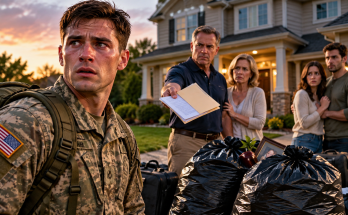
Then I found the bags.
Black plastic.
Tied at the top.
Some held clothing.
Others contained personal papers.
Things I'd kept for years had been handled and moved without my permission.
I remembered staring at them.
For several seconds, I couldn't speak.
My family treated the situation as though it was an inconvenience I needed to accept.
There were explanations about Chloe.
About Vance.
About what the family needed.
But nobody had asked whether I wanted those changes.
That was where the dispute had begun for me.
Not with a power of attorney.
Not with the missing money.
With the realization that my parents believed they could rearrange my life while I was gone.
The legal documents had shown me that the behavior wasn't entirely new.
I thought about nineteen-year-old me.
He had believed Dad's offer of financial guidance was a sign of respect.
I could remember the pride I felt when Dad told me I needed to learn how to manage my savings.
I wanted him to see that I was becoming responsible.
I didn't understand how easily that desire could be used against me.
The old power of attorney had been prepared during that period.
A signature resembling mine appeared on it.
I hadn't written it.
I hadn't authorized Dad to amend Grandpa's trust.
Yet somebody had presented the document as though I had.
I looked at the copy again.
The writing was close enough to be unsettling.
Whoever made it had paid attention to my handwriting.
But the movements were deliberate.
The final letter was too carefully formed.
I knew my signature.
I had written it thousands of times.
That wasn't mine.
I remembered Dalton asking whether I was certain.
I had said yes.
I would say yes again if anyone asked.
The notary's records made the situation worse.
She had claimed the document was signed at my parents' kitchen table.
But she couldn't produce the journal entry needed to verify my identity.
That absence didn't tell us who had written the signature.
It did raise serious questions about whether the notarization could be trusted.
I wanted those questions answered.
I wanted to know who had arranged the appointment.
Who had been present.
Who submitted the papers afterward.
I wanted the complete record.
But I wasn't going to invent those answers myself.
I had learned that much.
I moved to the escrow transaction.
Seventeen thousand five hundred dollars.
The payment went from my account toward a proposed refinancing involving the property.
The lender rejected the application.
The money was refunded.
But the refund went to an account belonging to Mom and Dad.
I had never received it.
At least, the records we reviewed showed no repayment.
I couldn't make that fact fit comfortably with Dad's lectures about responsibility.
He had spent years warning me to be careful with money.
He criticized purchases he considered unnecessary.
He liked to explain how quickly savings could disappear.
And yet a substantial amount of my money had been used in a transaction I hadn't authorized.
I thought about asking him directly.
I imagined sitting across the kitchen table.
The same table where I'd signed ordinary banking forms.
I would put the transaction record in front of him.
He would look at the amount.
I would ask where the money went.
What would he say?
Would he claim it had been reimbursement?
Would he insist I'd approved it?
Would he tell me I was remembering incorrectly?
I didn't know.
I had imagined so many conversations with him that they were beginning to feel real.
I stopped myself.
There was no point preparing an argument against an answer he hadn't given.
The records mattered.
His actual explanation would matter when he provided it.
Everything else was speculation.
I returned to the more recent transactions.
Forty-five thousand dollars.
Money taken while I was deployed.
The newer power of attorney supposedly gave Mom authority to act for me.
Again, the signature wasn't mine.
I hadn't approved the withdrawals.
I hadn't authorized her to manage the property as though it belonged to the family.
Those were the facts.
I wondered how often my parents had used my absence as an explanation.
I was overseas.
I couldn't attend meetings.
I couldn't examine paperwork in person.
That made certain things inconvenient.
It didn't make me incapable of making decisions.
If they had needed genuine authorization, they could have contacted me through proper channels.
Instead, I was looking at documents I denied signing.
That distinction was impossible to ignore.
I thought about Captain Morales.
She had insisted that everything be documented.
She understood the professional implications of the dispute.
My promotion review was underway.
I was still on active duty.
I needed to behave carefully.
For a while, I had resented that advice.
My parents seemed free to make decisions about my house.
I was the one being told not to confront them.
But I understood now.
Carefulness wasn't permission for them to continue.
It was protection against turning a serious matter into an argument nobody could properly examine.
I didn't need to prove my courage by shouting.
I needed to preserve the facts.
The hearing was the appropriate place for the trust questions to begin receiving formal attention.
I looked at the Northstar notice.
The company had identified irregular activity involving my accounts and the property.
It had tried to contact me.
I hadn't received the warning.
My mother's forwarding authorization was attached.
There was her signature.
Evelyn Hale.
It was strange how much seeing her real signature affected me.
On one document, somebody had imitated my name.
On another, Mom had signed her own.
The result was still that information intended for me had been redirected.
She couldn't describe that as something I personally approved.
At least, not without producing an authorization I had actually given.
I remembered Chloe saying Mom became upset over a Northstar letter.
She took it into Dad's office.
That detail had sounded small when Chloe first mentioned it.
Now it belonged near the center of the investigation.
I wished I'd asked more questions sooner.
Then I reminded myself that I hadn't known the letter existed.
I couldn't be responsible for investigating a warning someone had kept from me.
I could only respond once I knew.
And I was responding.
I picked up Grandpa's letter.
His handwriting made me pause.
I had spent so many years remembering him as a man who liked quiet afternoons and practical advice.
I hadn't appreciated how much effort he'd put into protecting the house.
He established the trust when I was six.
He chose an outside successor trustee.
He amended the arrangement later.
He left a letter explaining why he didn't want family pressure determining what happened to the property.
Those weren't impulsive decisions.
They required planning.
Grandpa had thought about a future I couldn't yet imagine.
I wished I could ask him what he'd known about my parents.
Had Dad already been asking about the land?
Had Mom complained that the property should benefit everybody?
Had Grandpa refused a request I never heard about?
I couldn't answer those questions.
His letter didn't accuse them of anything specific.
It warned me about pressure.
I had to respect that distinction.
I wasn't going to claim Grandpa had predicted crimes he never described.
But I could honor the choice he made.
He wanted the property protected.
He wanted me to decide what happened to it.
That was enough.
I looked at the brass key again.
It rested beside the folder now.
The worn edges caught the light.
I remembered Grandpa saying that protecting something sometimes required keeping its location private.
For years, I'd assumed he meant a safe.
Maybe he did.
Maybe he meant the trust records.
Maybe he simply wanted me to understand that valuable things attracted attention.
I couldn't know.
The key was real.
The memory was real.
Its exact meaning remained uncertain.
I had become more comfortable admitting that.
The family dispute had taught me how dangerous it was to fill missing information with the explanation I wanted.
Dad had done that for years.
He decided what Grandpa intended.
Then he repeated it until everyone accepted the story.
Mom told Chloe the property belonged to the family.
Chloe believed her.
Vance apparently received the same explanation.
And when I returned, the house had already been rearranged around that belief.
The records told a different story.
I thought about how easily that could have continued.
If I had signed the transfer at the barbecue, Dad might have obtained genuine evidence of my agreement.
He could have pointed to my signature.
He could have said I understood.
I might have spent years trying to explain that I'd agreed only because I was pressured.
I was grateful I'd stopped.
Not because I understood the entire legal situation that evening.
I didn't.
I stopped because I wanted to read the papers.
That one decision had changed the direction of everything.
I checked the time.
I gathered the documents.
There was no reason to remain in the hotel room staring at the same questions.
The trust review would require us to address them properly.
I didn't know what the proceeding would establish.
I didn't know whether Dad would admit anything.
I didn't know whether Chloe's signature would prove important.
But I knew I had something I lacked when I first returned.
A documented account of the property's legal history.
And people who could help me examine it.
I put the letter inside the folder.
I placed the brass key in my pocket.
Then I picked up the papers.
I didn't feel victorious.
Nothing had been resolved.
My belongings were still in garbage bags.
The money was still missing.
The house was still occupied by people who believed they belonged there.
And the latest proposed amendment still needed to be examined.
But I had stopped asking whether I was allowed to question my parents.
That question no longer belonged in the conversation.
The property had been placed in trust for me.
The disputed signatures required investigation.
The money required an accounting.
And the people who claimed authority needed to establish it.
I opened the hotel door.
I had no intention of signing anything merely to make the family comfortable.
Not anymore.
Source: puretales.cafex.biz