I kept thinking about one question.
Why did Dad need my signature now?
The original trust remained in effect.
Northstar had rejected the attempted amendment from seven years earlier.
The lender had refused the refinancing application.
If Dad truly believed he already controlled the property, why had he been so eager for me to sign another document?
I had asked Dalton a similar question when the investigation began.
At first, I was focused on the two powers of attorney.
One named Dad.
The other named Mom.
Both supposedly gave authority I denied granting.
The older document appeared shortly after Grandpa amended the trust.
The newer one was associated with my deployment.
I wanted to understand why my parents would need both.
The question had become more important with every record we found.
The old document apparently hadn't accomplished the change Dad wanted.
The trust remained protected.
The loan didn't go through.
Yet he continued acting as though the property belonged under his control.
He signed Chloe's lease.
He moved my family members into the house.
He expected me to approve a transfer when I returned.
Then a photograph appeared showing another proposed trust amendment.
I couldn't know the exact plan without examining every page.
But the sequence demanded an explanation.
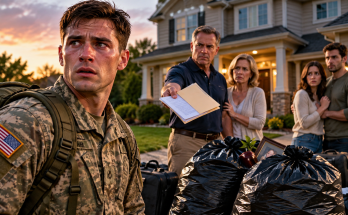
I thought about the barbecue again.
Dad had chosen a familiar setting.
People were eating.
The conversation was casual.
Nobody had been invited to a formal meeting about the property.
He placed the folder beside the grill as though it contained routine paperwork.
That was how he preferred to handle difficult decisions.
He made them look ordinary.
Then he treated questions as unnecessary complications.
I remembered the way he spoke.
Tomorrow.
The paperwork would be handled tomorrow.
He hadn't asked me what I wanted to do.
He hadn't explained Northstar's role.
He hadn't mentioned the rejected refinancing attempt.
He had simply expected cooperation.
I had almost accepted that expectation out of habit.
That realization bothered me.
I didn't remember coming close to putting my name on the page.
I hadn't done that.
But I remembered feeling the familiar pressure to stop making the family uncomfortable.
That pressure was powerful.
Dad had relied on it for years.
Mom often supported him.
She would explain that he was trying to do what was best.
If I disagreed, she asked why I couldn't appreciate his efforts.
Sometimes I apologized just to end the conversation.
Sometimes I agreed to something I didn't want.
Then the issue disappeared until the next demand.
I thought that was compromise.
Now I understood that compromise required both sides to have a meaningful choice.
My parents often made the decision first.
I was asked to accept it afterward.
The house was the clearest example.
Chloe and Vance were already living there.
My possessions had been moved.
A lease had been signed.
The family had been told the property belonged to everyone.
Then Dad asked me to transfer it.
By that point, refusing felt like creating a problem.
But I hadn't created the situation.
That distinction mattered.
I didn't move Chloe into the house.
I didn't prepare the lease.
I didn't tell Vance the property belonged to him.
I didn't pack my belongings into garbage bags.
Those were decisions made while I was away.
My refusal didn't cause them.
It exposed the fact that they hadn't been authorized.
I wished my parents would understand that.
But I couldn't build my choices around whether they accepted it.
I had to rely on the records.
The original deed showed the property was held through Grandpa's trust.
The administrator was Northstar.
Dad's claimed authority remained questionable.
The earlier attempt to alter the trust hadn't succeeded.
Those were substantial facts.
They didn't automatically settle every dispute.
But they meant the house couldn't simply be transferred because Dad announced that the family needed it.
I looked at the newer photograph again.
Trust Amendment and Beneficiary Release.
I wondered whether the document had been designed to support the same claim Dad made at the barbecue.
Perhaps it concerned the proposed transfer.
Perhaps it was intended to address Chloe's position.
Perhaps it served some other purpose connected to the trust.
I couldn't know from the visible title.
That uncertainty was frustrating.
But it was also a reason not to sign anything.
A person should understand the legal consequences of a document before agreeing to it.
That sounded obvious.
At nineteen, I hadn't understood it fully.
Dad had presented forms as something routine.
I had trusted him to explain the important parts.
Now I knew how much could depend on language buried in paperwork.
I remembered the old power of attorney.
It wasn't a simple permission slip.
It purported to give Dad authority to act for me.
The scope mattered.
The date mattered.
The authenticity of the signature mattered.
And the financial transactions connected to it mattered.
If I'd treated it as another harmless family form, I would have missed the reason Dalton became concerned.
I thought about the notary.
She had claimed to witness the signing at my parents' kitchen table.
Her inability to produce a proper identification record left serious questions.
But the problem wasn't limited to the notary.
Someone had taken the document to be used.
Someone had presented authority supposedly granted by me.
Someone had attempted to change the trust.
The entire sequence needed examination.
I couldn't identify every person involved.
I wasn't going to accuse someone merely because I suspected them.
Yet my refusal to speculate didn't make the circumstances less serious.
The money proved that.
Seventeen thousand five hundred dollars had left my account.
It went toward the attempted financing.
The refund went to Mom and Dad.
That transaction wasn't just a theoretical legal concern.
It involved actual funds.
Funds I had worked to save.
I remembered the part-time job.
The hours between classes.
The days when I tried to stretch a small amount of money until the next paycheck.
At the time, I believed saving was proof that I was becoming independent.
Now I wondered whether Dad saw my account as something he could use because he'd helped me establish it.
I couldn't know what he thought.
But I knew the transaction required an explanation.
I wasn't going to let him replace that explanation with another lecture about family responsibility.
I took out the more recent bank statements.
Forty-five thousand dollars.
I still felt a physical reaction whenever I saw the amount.
My stomach tightened.
I had been away serving for nine months.
I trusted that my accounts were secure.
I trusted that my belongings would remain at home.
And I trusted my parents not to make major decisions without consulting me.
Those assumptions had collapsed.
I didn't know where every dollar had gone.
Dalton needed the complete transaction records.
That remained unfinished.
But I knew the withdrawals weren't authorized by me.
I hadn't signed the newer power of attorney.
I hadn't asked Mom to take that money.
I hadn't agreed to finance Chloe and Vance's occupancy through my account.
If my parents believed they had permission, they needed to show it.
I thought about how easily Dad could turn that question into an argument.
He might tell me he'd paid household expenses.
He might say the money had benefited the family.
He might insist that I'd eventually agreed to similar things before.
But none of those possibilities would establish authorization for these transactions.
I was learning to keep the conversation narrow.
What document gave authority?
Who signed it?
Was the signature genuine?
What was the money used for?
Those questions weren't insults.
They were necessary.
I wished I could have explained that to my younger self.
The boy who sat at the kitchen table.
The young man who wanted Dad to be proud.
The soldier who left for deployment believing everything at home would remain safe.
I couldn't speak to those earlier versions of myself.
But I could stop repeating their mistakes.
I looked at Grandpa's letter.
He had warned me about being pressured to prove love through surrender.
It wasn't a complicated idea.
Yet it had taken years for me to understand it.
My parents often described helping family as something that should happen automatically.
They didn't ask whether the help was affordable.
They didn't ask whether I agreed with their plans.
They simply decided what was needed and expected me to contribute.
Sometimes I did.
Sometimes I resented it.
Usually I kept the resentment to myself.
I told myself that family was complicated.
Everyone made sacrifices.
That was true.
But sacrifice made without consent was something different.
Especially when it involved property and money.
I thought about Chloe.
She was not responsible for every decision Dad had made.
She might have believed the house was intended for her.
She might have signed the lease without understanding the trust.
Her fear during our call seemed genuine.
I didn't want to turn her into an enemy simply because she benefited from the arrangement.
But I couldn't ignore her role.
She lived in the property.
She signed the lease.
Her name appeared on the newer document.
Those facts required a conversation.
Not an accusation.
A conversation.
I wanted her to explain what Dad told her.
I wanted to know whether she had read the papers.
I wanted to know whether Vance understood the arrangement.
And I wanted to show her the documents Grandpa left.
I didn't know whether she'd believe them immediately.
Mom and Dad had told her a different story.
She had lived with that explanation for months.
Perhaps longer.
Changing her understanding might be difficult.
But it had to begin with the truth.
I wouldn't ask her to choose between loving our parents and acknowledging the deed.
Those things weren't mutually exclusive.
She could love them and still recognize that the property wasn't theirs.
I could do the same.
That realization mattered to me.
For days, I had felt as though investigating the fraud meant rejecting my family entirely.
I no longer believed that.
I could seek an accounting without deciding in advance what every relationship would become.
I could insist on proper legal authority without wishing harm on anyone.
I could refuse to sign the transfer without declaring that Chloe's needs were unimportant.
The facts created responsibilities.
They didn't require cruelty.
I thought about Dad again.
He might never accept that distinction.
He might continue saying I was destroying the family.
I could already hear the accusation.
But I had begun to recognize what it accomplished.
It shifted attention away from his decisions.
Suddenly I was expected to explain why I didn't trust him.
Why I wanted records.
Why I needed an attorney.
The original questions disappeared.
I wasn't going to let that happen.
I had a right to know why my name appeared on documents I hadn't signed.
I had a right to ask where my money went.
I had a right to understand what happened to property held for my benefit.
None of those rights depended on Dad being comfortable.
I checked the photograph again.
The desk was still visible.
The same oak surface.
The same brass handle.
I remembered sitting there while Grandpa sorted papers.
He used to separate them by subject.
Banking.
Property.
Personal letters.
He never mixed everything together.
I had once asked why he was so particular.
He told me that when something mattered, I should be able to find the record that explained it.
I hadn't thought about that conversation in years.
Now it seemed remarkably practical.
Dad had relied on verbal explanations.
Grandpa had kept documents.
And when the explanations began contradicting one another, the documents remained.
I folded Grandpa's letter carefully.
I didn't need him to have predicted every part of this dispute.
He had done enough.
He created the trust.
He arranged for its administration.
He left a warning about pressure.
And he trusted me to make decisions for myself.
That was what I intended to do.
I looked once more at the papers from the barbecue.
They no longer frightened me in the same way.
At first, I had seen them as evidence that my family was about to take the house.
Now I saw them as a proposed transaction requiring my genuine consent.
Without that consent, Dad couldn't simply turn his expectations into my agreement.
The legal details still needed review.
The validity of the disputed documents still needed determination.
But I could control one essential thing.
My signature.
I wouldn't give it without understanding.
I wouldn't give it because somebody was angry.
And I wouldn't give it because the family had already made plans.
I had spent years trying to earn Dad's respect through obedience.
I was finished using obedience as proof of love.
Whatever happened at the hearing, that decision was mine.
Source: puretales.cafex.biz