I had imagined the end of the dispute many times.
In some versions, Dad apologized.
He admitted he'd gone too far.
Mom explained why she'd opened my mail.
Chloe understood that Grandpa had left the property for me.
The money was returned.
My belongings went back into their proper places.
And the house became home again.
I wanted that ending.
I wanted it badly enough that I sometimes caught myself believing it was possible without anyone having to answer difficult questions.
But I knew better now.
The records were real.
The missing money was real.
The disputed signatures required examination.
And the trust couldn't be changed simply because everybody wanted the argument to stop.
I sat at the hotel desk with Grandpa's letter in front of me.
The paper had become familiar.
I knew the shape of his handwriting.
I knew where he paused between ideas.
I knew the warning he wanted me to understand.
Ownership wasn't supposed to determine a person's worth.
Family loyalty wasn't supposed to erase consent.
And I wasn't supposed to make a permanent decision because somebody demanded it.
I read the letter slowly.
Then I set it beside the original trust.
The two documents belonged together.
One explained Grandpa's legal arrangements.
The other explained the care behind them.
He had created the trust when I was six.
He had owned the land before my parents married.
He wanted the property protected for me.
Northstar became successor trustee after his death.
Those facts had remained true through years of family disagreements.
They had remained true while I was in college.
They had remained true during my deployment.
And they remained the foundation for examining what my parents had attempted.
I thought about the older power of attorney.
Someone had signed my name.
Not perfectly.
But carefully enough to suggest deliberate imitation.
The document named Dad as my authorized agent.
I hadn't signed it.
I hadn't agreed to change the trust.
The notary's incomplete records raised additional questions.
The proposed amendment had not been accepted.
The attempted refinancing failed.
Those were important protections.
They meant Grandpa's arrangements hadn't simply disappeared when somebody presented questionable paperwork.
But the financial consequences were still unresolved.
Seventeen thousand five hundred dollars had left my account.
The escrow company received it.
The lender rejected the transaction.
The refund went to my parents.
No repayment to me appeared in the records we'd reviewed.
That money mattered.
It represented years of decisions I had made while trying to become independent.
I remembered working during college.
Saving what I could.
Trying not to ask Dad for help.
I wanted to prove I could take care of myself.
I hadn't known that an account he'd helped me open would later become part of an investigation.
I thought about how proud I'd been of that account.
How pleased I was when Dad said I was learning responsibility.
Now the memory carried a different weight.
I couldn't change what happened seven years earlier.
I could insist on an accounting.
That was what I intended to do.
The newer transactions required the same care.
Forty-five thousand dollars had been taken during deployment.
The power of attorney associated with Mom wasn't signed by me.
I hadn't authorized the withdrawals.
Dalton was examining the records.
I wanted every transaction traced.
I wanted the bank documents reviewed.
I wanted to know who claimed authority to move the money.
I couldn't promise myself it would all be recovered.
I couldn't claim a legal finding that hadn't yet been made.
But I could refuse to let the matter disappear beneath another explanation about family needs.
That was an outcome I could control.
I looked at the notice from Northstar.
Two months before my return, the administrator had identified concerns about irregular activity involving my accounts and the trust property.
The company tried to reach me.
The correspondence was redirected to the house.
Mom signed the forwarding authorization.
I hadn't received the warning.
That fact still hurt.
While I was overseas, I had trusted my family to keep ordinary things safe.
My mail.
My room.
My belongings.
My house.
Instead, I returned to discover that important information had been kept from me.
I thought about Mom standing at the kitchen counter.
Opening envelopes.
Sorting letters.
Telling everyone she was organizing the household.
I remembered how grateful I used to feel when she handled small things for me.
I didn't want to erase those memories.
But I couldn't allow them to excuse what happened now.
Helping someone didn't mean taking control of their affairs without permission.
And being a parent didn't automatically provide authority over an adult child's finances.
I wished she'd understood that.
Perhaps she would someday.
I couldn't decide that for her.
I turned to Chloe's lease.
Her name appeared beside Vance's.
They had been given permission to occupy the house by someone claiming to act as trustee.
Dad had signed the approval.
The original trust records named Northstar.
That contradiction needed to be addressed.
I didn't know what would happen to Chloe and Vance's living arrangement.
I didn't know whether they would remain temporarily.
I didn't know whether a lawful agreement could be arranged.
Those decisions required proper authority and clear terms.
But I knew what wouldn't happen.
I wasn't going to sign over the property simply because they had already moved in.
Their presence mattered.
Their needs mattered.
My rights mattered too.
All of those things could be considered without pretending Grandpa's trust meant something it didn't.
I thought about Chloe's apology.
She had said she was sorry about my room.
I remembered how unexpected those words felt.
For days, I had been waiting for somebody in the family to acknowledge that moving my belongings was wrong.
She had done that.
It didn't solve the property dispute.
It didn't explain her signature on the newer amendment.
But it mattered to me.
I wanted her to understand that.
I didn't want our relationship reduced to who occupied the house.
She was my sister.
We had years of memories that existed before this conflict.
I remembered ordinary afternoons.
Conversations.
Family meals.
The small disagreements siblings have and usually forget.
I didn't want to lose all of that.
But I couldn't preserve the relationship by agreeing to something I believed was wrong.
That would only create another kind of resentment.
I wanted a relationship where we could tell each other the truth.
Even when the truth was uncomfortable.
Especially then.
I looked at the photograph again.
Grandpa's oak desk.
The stack of papers.
Trust Amendment and Beneficiary Release.
Chloe's signature.
The image remained incomplete.
I hadn't obtained the full document.
I didn't know who had prepared it.
I didn't know whether Dad had signed.
I didn't know what effect anyone intended it to have.
Those questions remained open.
I couldn't manufacture an ending in which the photograph suddenly explained everything.
It didn't.
It showed another document that needed examination.
And it reminded me why I couldn't trust a verbal explanation alone.
I put the phone away.
The unknown sender hadn't identified themselves in the messages I had.
I didn't know whether they were trying to help.
I didn't know whether they were afraid of Dad.
I didn't know whether they had access to other papers.
But I had preserved the photograph.
That was what I could do.
Dalton could examine it alongside the rest of the records.
I wasn't going to drive home in anger because an anonymous message told me to.
I wasn't going to confront Chloe before understanding what she'd signed.
And I wasn't going to accuse Vance of conduct I couldn't establish.
Those were decisions I had made.
They mattered because the situation was already painful enough.
I didn't need to add accusations that might turn out to be wrong.
I thought about Captain Morales.
She had been careful from the beginning.
She reminded me that I was still on active duty.
My promotion review was underway.
I had responsibilities that didn't disappear because my family was in conflict.
Her advice had protected me from making the situation worse.
I hadn't understood that immediately.
At first, I wanted action.
I wanted Dad confronted.
I wanted Mom questioned.
I wanted Chloe told to leave the house.
I wanted the entire arrangement reversed as quickly as possible.
But the records showed a complicated history.
Years of attempted changes.
Financial transactions.
Disputed authority.
Correspondence that hadn't reached me.
Those things couldn't be resolved through one angry conversation.
They required examination.
And I had to be patient enough to allow it.
That patience didn't mean accepting what happened.
It meant refusing to let anger decide the outcome.
I looked toward the garbage bag.
The plastic was creased and dull.
Inside were things that had once belonged in my bedroom.
I could remember the shock of finding my possessions packed that way.
That memory still hurt.
For a while, I believed the humiliation was the worst part of what happened.
Then I discovered the missing money.
The disputed powers of attorney.
The failed refinancing.
The intercepted notices.
Each revelation made the problem larger.
But the bags remained important.
They showed how my parents had treated my absence.
I was away.
So they made decisions.
I returned.
So they expected me to accept them.
That pattern had been present for years.
I simply hadn't recognized it.
I thought about the boy I'd been.
The teenager holding Grandpa's brass key.
The college student signing forms at the kitchen table.
The young soldier leaving home.
The man returning after nine months away.
Each version of me wanted the same basic thing.
To be trusted with his own choices.
I had spent years trying to earn that trust from Dad.
I thought if I worked harder, saved more, served honorably, and avoided arguments, my parents would eventually treat me as an adult.
But they had continued making decisions for me.
The problem wasn't that I hadn't proved myself.
The problem was that they didn't seem willing to surrender control.
I couldn't solve that by working harder.
I couldn't solve it by giving them another signature.
I had to change my response.
That was the hardest part.
I still wanted their approval.
Even after everything.
I wanted Dad to look at me and acknowledge that I was capable of managing the property.
I wanted Mom to understand why opening my mail hurt me.
I wanted Chloe to stop believing that my refusal meant I didn't care about her.
Those desires were real.
But they couldn't determine what I signed.
That was what Grandpa's letter finally taught me.
Love could influence a choice.
It shouldn't replace one.
I picked up the brass key.
The edges were worn smooth.
I remembered Grandpa placing it in my hand.
He told me that some things were easier to protect when people didn't know where they were.
At seventeen, I thought the lesson concerned the safe.
Now I understood that he valued careful judgment.
He wanted me to know when to ask questions.
When to seek advice.
When to keep important information secure.
And when to refuse a decision that wasn't truly mine.
I closed my fingers around the key.
I wished he were still alive.
I wished I could tell him I'd finally read the letter properly.
I wished I could sit beside his oak desk one more time and ask what he meant all those years ago.
But I couldn't.
What I had was his handwriting.
The trust he'd created.
And the responsibility he had left me.
That would have to be enough.
I put the key beside the letter.
Then I looked at the documents from the barbecue.
Dad had expected me to sign.
That was the moment I kept returning to.
He had believed the final step was close.
Perhaps he thought I'd agree because the family was gathered.
Perhaps he thought I'd accept his explanation without reading.
Perhaps he believed the arrangements he'd made while I was deployed left me no practical choice.
I couldn't know every part of his reasoning.
But I knew what happened.
I didn't sign.
I asked for the records.
And those records revealed questions reaching back seven years.
I was no longer standing beside the grill wondering whether refusing made me selfish.
I understood why the proposed transfer needed careful legal review.
I understood the original trust.
I understood that Dad's earlier attempt to change it had failed.
I understood that my finances had been affected by transactions I hadn't authorized.
And I understood that my family had been acting on an account of Grandpa's wishes that contradicted the documents.
Those discoveries didn't settle everything.
The trust hearing still needed to address the formal concerns.
The financial investigation still required completion.
The disputed signatures needed examination.
Chloe's newer document needed to be obtained and reviewed.
My parents still needed to explain their actions.
I wasn't going to pretend otherwise.
There were consequences ahead that none of us could fully predict.
The relationships might change.
The financial losses might remain disputed.
The house might not feel like home for a long time.
And even if the property was protected, that wouldn't erase what happened to my trust in my family.
I knew that now.
A legal document could establish ownership.
It couldn't make somebody apologize sincerely.
A bank record could trace money.
It couldn't restore the years I spent believing my parents would never misuse my confidence.
A hearing could examine authority.
It couldn't decide what kind of brother or son I wanted to be afterward.
Those choices were still mine.
I wanted to protect the house.
I wanted my money accounted for.
I wanted the truth.
I also wanted to avoid becoming someone who measured every family relationship only by what it cost him.
Grandpa had warned against that too.
The property wasn't supposed to define my life.
It was supposed to give me the freedom to build one.
I folded his letter carefully.
I returned the trust records to the folder.
I checked that the bank statements were in order.
Then I placed the photograph where it could be examined with the other evidence.
Everything I had was together.
Not everything was answered.
But I had stopped confusing uncertainty with helplessness.
I could continue asking questions.
I could refuse to sign.
I could rely on proper legal counsel.
I could preserve the records.
And I could allow the facts to determine what happened next.
I looked at the garbage bag one final time.
For nine months, I had imagined coming home.
I thought home meant familiar walls.
A bedroom.
A place where my things belonged.
I hadn't expected to learn that a home could be legally mine while the people inside treated me as though I had no say.
That had been painful.
But it had also forced me to recognize something I'd avoided for years.
I didn't need my parents' permission to be responsible for my own life.
I didn't need Dad's approval to ask where my money went.
I didn't need Mom's agreement to protect my correspondence.
And I didn't need Chloe's understanding before refusing to transfer property I hadn't chosen to give away.
I wanted those relationships to survive.
But they would have to survive the truth.
Not another forced agreement.
I put the brass key in my pocket.
Then I picked up the folder.
The papers weren't a final judgment against anyone.
They were the evidence that would have to be examined.
I wasn't going to exaggerate what they proved.
I wasn't going to ignore what they showed.
And I wasn't going to put my name on another document merely because someone told me the family expected it.
Grandpa had trusted me with the right to choose.
After everything that happened, I finally understood what protecting that choice required.
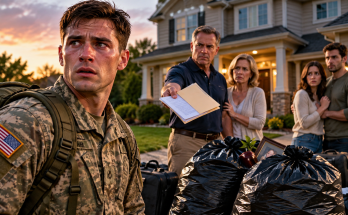
I had come home to find my belongings in garbage bags.
I had discovered that people I loved had been making decisions about my house and money without my consent.
And I had found documents that demanded explanations no family argument could replace.
The legal questions were not all settled.
The missing money had not been accounted for completely.
The newest amendment still needed examination.
But one decision was final.
I would not sign away my grandfather's house under pressure.
Whatever happened next, that choice belonged to me.
Source: puretales.cafex.biz
The End
Read more original stories on lastestdrama.