I arranged the documents in one final stack.
The oldest page was at the bottom.
The newest evidence rested on top.
For a moment, I simply looked at them.
It was difficult to believe how much of my life they represented.
Twenty-one years of trust records.
Seven years of unanswered financial questions.
Nine months of deployment.
Several days of discovering what had happened while I was gone.
All reduced to paper.
I had always thought important family conflicts happened through conversations.
People argued.
They raised their voices.
They said things they regretted.
Sometimes they apologized.
Sometimes they didn't.
But this conflict had been developing through documents.
Forms I hadn't signed.
Transfers I hadn't approved.
Notices I hadn't received.
A lease I hadn't authorized.
And now another proposed amendment bearing Chloe's signature.
I thought about how quietly all of it had happened.
There had been no dramatic announcement seven years earlier.
Dad hadn't called me at college and said he was trying to refinance Grandpa's property.
Mom hadn't explained that money would be taken from my account.
I had gone to classes.
Worked my shifts.
Thought about my future.
Meanwhile, records had been created that affected mine.
That realization was hard to accept.
But it also explained why I needed the formal review.
The truth couldn't depend on who spoke first at the dinner table.
It needed to be established from the evidence.
I looked at the original trust.
Grandpa had created it when I was six.
He had owned the land before my parents married.
He wanted to preserve it for his descendant.
He chose me.
I hadn't earned that decision.
I hadn't asked for it.
I was a child.
He simply wanted to make provision for me.
I thought about how Dad described ownership.
He often made it sound like a reward for being responsible.
The person who worked hardest or managed the most deserved the final decision.
But Grandpa's trust wasn't based on my adult accomplishments.
It wasn't something Dad could withdraw because he disapproved of me.
It was an arrangement created by the property owner.
Grandpa had the right to make it.
And the trust records showed that he had.
That fact felt simple now.
It hadn't felt simple when I came home.
My parents had spent so much time describing the house as a family resource that I almost felt guilty calling it mine.
Even after reading the deed, I wondered whether I was being unreasonable.
Maybe I should have let Chloe stay.
Maybe I should have accepted Dad's plan.
Maybe the property would cause less trouble if I simply agreed.
Those thoughts hadn't disappeared entirely.
I still cared about my sister.
I still wanted the family to stop fighting.
But I finally understood that avoiding conflict wasn't the same as making a fair decision.
I couldn't agree to something simply because refusal made other people uncomfortable.
That wasn't what Grandpa wanted.
I picked up his letter.
The handwriting seemed almost gentle compared with the legal language surrounding it.
He hadn't written instructions about every possible dispute.
He hadn't tried to predict what I would do.
He simply warned me to make choices carefully.
To seek advice.
To remember that love shouldn't require surrendering something under pressure.
I read those ideas again.
They felt more important than the house itself.
For most of my life, I had believed being a good son meant making my parents comfortable.
If Dad was disappointed, I tried harder.
If Mom was upset, I apologized.
If Chloe needed something, I looked for a way to help.
I had treated their feelings as responsibilities I needed to manage.
That wasn't entirely wrong.
People who love one another should care about each other's feelings.
But there had to be a limit.
I couldn't make myself responsible for every disappointment my family experienced.
I couldn't protect Chloe from the consequences of paperwork she'd signed without understanding.
I couldn't protect Dad from questions about financial transactions.
I couldn't protect Mom from having to explain why she'd redirected my mail.
Those were matters each person had to answer for.
I didn't have to be cruel.
I didn't have to seek revenge.
I simply had to stop accepting responsibility for choices that weren't mine.
I looked toward the window.
The day outside seemed ordinary.
That still surprised me.
Something enormous was happening in my life, yet people were continuing with their routines.
Cars moved.
Doors opened.
Someone somewhere was probably making lunch.
I remembered that feeling from deployment.
You could be dealing with a serious problem while ordinary life continued around you.
It wasn't a contradiction.
It was simply how the world worked.
I turned back to the desk.
The folder from the barbecue was among the records.
I thought about Dad's expression when he placed it beside the grill.
He'd been certain.
That was what I remembered most clearly.
Not anger.
Not worry.
Confidence.
Almost relief.
He had behaved as though the difficult part was behind him.
I wondered what he'd expected me to do.
Perhaps he assumed I'd accept Mom's explanation.
Perhaps he believed I'd avoid a public disagreement.
Perhaps he thought nine months away had made me less interested in the property.
I couldn't know.
His motives were still his to explain.
But the decision had been mine.
And I hadn't signed.
That was the moment the familiar family pattern had stopped working.
I hadn't raised my voice.
I hadn't threatened him.
I had simply declined to give him the agreement he expected.
Then I looked for the records.
I thought about how small that action seemed.
One refusal.
One question about the deed.
One decision to ask for professional help.
Those choices had exposed years of paperwork I never knew existed.
I wouldn't pretend I'd handled everything perfectly.
I had been angry.
Sometimes I still was.
I had made assumptions about what people were thinking.
I had struggled to separate Chloe's actions from my parents' influence.
I had wanted quick answers when the evidence required careful examination.
But I had also listened.
I had allowed Dalton to question my memories.
I had accepted Miriam's explanations even when they revealed uncomfortable facts.
I had followed Captain Morales's advice to avoid confrontation.
I was learning.
I wished I had learned sooner.
But I couldn't change that.
I thought about the hearing again.
Northstar had requested a formal review because of irregular activity involving the trust and my financial accounts.
I hadn't initiated the review.
The administrator had already identified concerns.
The notices had been sent.
They hadn't reached me properly.
My mother had signed a forwarding authorization.
A handwritten note claimed that a family trustee was acting for an unavailable beneficiary.
I knew those records would need close examination.
I wanted the identity of the person who wrote the note established.
I wanted to know what authority had been claimed.
And I wanted to understand how the correspondence had been handled.
Those questions were important independently of the dispute over my room.
The trust existed to protect property.
It couldn't function properly if the beneficiary was prevented from receiving essential information.
I thought about Grandpa appointing Northstar as successor trustee.
He had made that choice deliberately.
He hadn't left Dad in charge of everything.
That didn't mean Grandpa had stopped loving his son.
It meant he'd chosen a different legal arrangement.
Those were not the same thing.
For years, I'd treated a disagreement with Dad as a personal rejection.
Maybe Grandpa had understood that legal authority could be separated from family affection.
Maybe that was why he'd arranged outside administration.
I couldn't know his full reasoning.
But I could respect the structure he created.
I took out the old power of attorney.
The forged signature was still there.
I examined it carefully.
It looked more familiar than I wanted.
Whoever had signed had copied details of my handwriting.
The final stroke.
The slant.
The shape of the letters.
But it wasn't mine.
I remembered Dalton asking whether I was certain.
I had answered yes.
I would answer the same way again.
I had never authorized Dad to amend the trust.
I had never given him permission to use the house for refinancing.
I hadn't approved the escrow transaction.
Those were facts I could state without hesitation.
The recent document associated with Mom required the same examination.
I hadn't signed it.
I hadn't authorized the forty-five thousand dollars in withdrawals.
I wanted the complete account records.
I wanted to know where the money went.
I wanted any questionable signature independently reviewed.
I didn't need to invent an explanation.
The documents themselves provided the questions.
I moved to Chloe's lease.
Her name.
Vance's name.
Dad's signature.
The claim of trustee approval.
I wondered what she'd thought when he handed it to her.
Maybe she'd been relieved to have a place to live.
Maybe she believed the family had agreed.
Maybe she hadn't considered that I might return and object.
I wanted to understand.
I wanted her to explain.
I wasn't ready to accuse her of deliberately taking my property.
The evidence didn't justify that conclusion.
But I wasn't going to ignore the lease either.
It had been created the month before my return.
It showed that the occupancy arrangement was planned.
And it showed Dad had acted as though he possessed authority over the property.
That was significant.
I then opened the photograph.
Grandpa's desk appeared again.
Trust Amendment and Beneficiary Release.
Chloe's signature.
The newest document was also the least complete.
I didn't know its full contents.
I didn't know whether it had been executed.
I didn't know what effect, if any, anyone intended it to have.
And I didn't know who had warned me.
Those questions remained.
I looked at the unknown number.
No name.
No explanation.
Just the message and photograph.
I could have called.
I could have demanded answers.
But the sender might not have been willing to identify themselves.
And I didn't want to risk losing the careful approach Dalton recommended.
I kept the original message.
That was what mattered for now.
I placed the phone beside the folder.
I thought about how much the house had changed in my mind.
Before deployment, it had been home.
When I returned, it felt like something taken from me.
During the investigation, it became the center of a financial and legal dispute.
Now, after reading Grandpa's letter, I was beginning to see it differently.
It was something he'd entrusted to me.
Not a test of whether I loved my family.
Not a prize I needed to defend through anger.
A responsibility.
Something I needed to understand before deciding what to do with it.
That thought gave me a steadier feeling than anything Dad had said.
I didn't know whether I'd live there forever.
I didn't know whether Chloe and Vance would eventually leave.
I didn't know what relationship I'd have with my parents after the review.
Those were questions for later.
For now, the property had to be protected from unauthorized decisions.
The finances had to be accounted for.
The disputed documents had to be examined.
And the truth had to be established.
I couldn't skip those steps.
I remembered the first night at the hotel.
I sat on the bed looking at the carpet.
I felt as though the family I'd known had become unfamiliar.
Everything was changing.
I wanted somebody to reassure me that things would return to normal.
But normal had included years of accepting decisions made for me.
Maybe returning to normal wasn't what I needed.
Maybe I needed something different.
A relationship with my family where questions weren't treated as betrayal.
Where helping someone was a choice.
Where financial authority came from genuine consent.
Where a person's signature meant what it was supposed to mean.
I didn't know whether Mom and Dad were capable of accepting that.
I hoped they were.
Hope wasn't evidence.
I knew that now.
But I hadn't stopped hoping.
I still wanted to believe they could explain what happened.
I still wanted Chloe to understand why I refused the transfer.
I still wanted to remember Grandpa without feeling angry about the house.
Those hopes didn't require me to surrender the truth.
I could keep them while insisting on proper records.
I could love people while refusing their demands.
That was something Grandpa had tried to teach me.
I finally understood.
I picked up the brass key I'd kept among my belongings.
It was small.
The metal was worn.
I held it in my palm.
I remembered Grandpa placing it there when I was seventeen.
At the time, I thought he was giving me access to something important.
Now I realized the lesson had always mattered more than the object.
Protect what you're responsible for.
Understand what you hold.
Don't let somebody else decide its value simply because they speak with confidence.
I closed my fingers around the key.
Then I put it away.
The trust records were ready.
The bank statements were together.
The photograph was preserved.
Grandpa's letter was safe.
I couldn't control what the review would establish.
I couldn't control what my parents would say.
But I could control whether I signed something I didn't understand.
I could insist on examining the records.
And I could refuse to confuse silence with peace.
I looked at the folder one last time.
There were still unanswered questions.
Real ones.
Not questions invented to keep a story going.
Who had forged the signatures?
What had happened to the missing money?
Why had my mother intercepted the notices?
What authority did Dad believe he possessed?
What had Chloe signed?
And what would the complete trust records establish?
I couldn't answer them yet.
I wouldn't pretend I could.
But I was no longer the nineteen-year-old who signed paperwork because his father said it was necessary.
I was no longer the son who believed every disagreement had to end with an apology.
I was responsible for my own decisions.
My grandfather had trusted me with that responsibility.
I intended to live up to it.
Whatever the documents ultimately revealed, I would not sign away the house merely to make my parents comfortable.
Not because Dad expected it.
Not because Mom called me selfish.
And not because everyone else had already arranged their lives around the assumption that I would surrender.
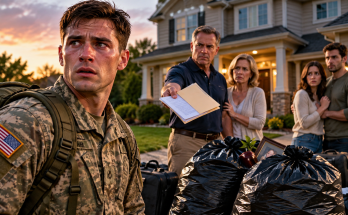
I had come home to find my possessions in garbage bags.
I had nearly allowed that humiliation to define the entire dispute.
But the records had shown me something larger.
My family had been making decisions about my property for years.
The proper response wasn't to make another hurried decision.
It was to establish the truth.
I closed the folder.
For the first time, that felt like enough.
Source: puretales.cafex.biz