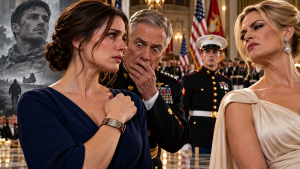
CHAPTER 1 — THE WOMAN THEY DIDN’T WANT IN THE FRONT ROW
Nobody noticed the young woman standing alone near the back of the enormous military hall.
Not at first.
She wore a simple navy-blue dress that had been carefully ironed the night before. Her shoes were old but polished, and her dark brown hair was tied neatly behind her head.
On her left wrist was a faded leather bracelet.
Its metal plate had been scratched by time, but one name remained clearly visible.
ELIAS MORROW.
Beneath the name were four numbers.
04:17.
The woman touched the bracelet gently, as if reassuring herself that it was still there.
Her name was Nora Bennett.
She was thirty-two years old, an emergency room nurse, and a former military combat medic.
Seven years earlier, she had returned from an overseas humanitarian mission carrying a secret she had never been able to explain.
Today, however, was supposed to be a happy occasion.
Her younger brother, Andrew Bennett, was receiving his commission as an officer in the United States Marine Corps.
Nora had helped raise him.
When their father worked long hours, she made his breakfast, helped with his homework, and sat beside him when nightmares kept him awake.
When Andrew was seventeen and announced that he wanted to join the military, Nora had been the first person to tell him he could do it.
She had also been the one who paid for his first formal suit.
Now, years later, she stood inside a beautiful ceremonial hall surrounded by military officers, wealthy donors, decorated veterans, and proud families.
But she wasn’t standing beside her own family.
She had been told to stay away.
“Nora.”
The sharp voice made her turn.
Vivian Bennett approached in an expensive cream-colored dress, carrying a designer handbag. Her diamond earrings caught the light from the crystal chandeliers.
Vivian was Nora’s stepmother.
She was also the president of a prestigious charitable organization called the Meridian Relief Foundation.
In public, people admired Vivian for her generosity.
At home, Nora knew another woman entirely.
“Why are you standing here?” Vivian asked.
Nora glanced toward the reserved seats.
“I was looking for Dad and Andrew.”
“They’re busy.”
“The ceremony hasn’t started yet. I only wanted to congratulate him.”
Vivian’s eyes moved slowly over Nora’s dress.
“You’re not seriously planning to sit with us looking like that, are you?”
Nora lowered her gaze for a moment.
“What’s wrong with my dress?”
“Nothing, if you’re attending a church picnic.”
“Vivian, I came to support my brother.”
“And you can support him from the back.”
Nora stared at her.
“What?”
Vivian leaned closer.
“The front rows are reserved for important guests. Military leaders. Foundation sponsors. Families who understand the importance of appearances.”
“I’m his sister.”
“And I am his mother.”
The words were spoken quietly, but they hurt more than if Vivian had shouted.
Nora glanced toward her father, who stood near the stage speaking with a group of businessmen.
He saw her.
For a moment their eyes met.
Then he looked away.
That small movement hurt almost as much as Vivian’s words.
“Please,” Nora whispered. “Just today, can we not do this?”
Vivian’s smile disappeared.
“You should be grateful you were invited at all. After everything that happened overseas, this family has worked very hard to protect its reputation.”
Nora became still.
Seven years.
Seven years of rumors.
Seven years of people whispering about a disastrous military relief operation.
Seven years since a good man had died under circumstances no one wanted to investigate.
Nora’s fingers tightened around her bracelet.
Vivian noticed.
Her expression changed.
“What are you doing wearing that old thing?”
“It’s important to me.”
“It makes you look ridiculous.”
“I’m not taking it off.”
For a moment, Vivian studied the engraved metal.
Something dark flickered behind her eyes.
Then she turned away.
“Stay in the back, Nora. Don’t embarrass us.”
Nora watched her stepmother walk toward the front row.
She swallowed her tears.
Then she whispered to the bracelet, so softly that no one else could hear:
“I promised I wouldn’t forget.”
She did not know that, within the hour, the name on her wrist would become the most important name in the building.
And the woman who had just humiliated her would have a very good reason to be afraid.
CHAPTER 2 — THE MAN WHO DISAPPEARED SEVEN YEARS AGO
Seven years earlier, Nora had been serving as a combat medic during Operation First Light, an international humanitarian mission in a country devastated by a massive earthquake.
Entire villages had disappeared beneath rubble.
Roads were broken.
Hospitals had collapsed.
Thousands of people were waiting for medicine, food, and evacuation.
Nora had been twenty-five years old.
She was brave, but she was also inexperienced enough to believe that people in positions of authority always made the right decisions.
That belief changed when she met Sergeant Elias Morrow.
Elias was a military logistics specialist assigned to coordinate medical supply convoys.
He was thirty years old, broad-shouldered, with serious gray eyes and an oddly gentle smile.
He was the kind of man who would give his last bottle of water to a frightened child, then insist he wasn’t thirsty.
The first time Nora met him, he was repairing a broken radio outside a temporary field hospital.
“You’re the new medic?” he asked without looking up.
“Depends. Are you going to give me another impossible assignment?”
He smiled.
“Probably.”
She laughed.
From that moment, they became friends.
Over the following months, they worked together through emergencies that neither would ever forget.
They carried injured children through flooded streets.
They organized evacuation flights.
They slept on floors, drank terrible coffee, and learned to recognize one another’s footsteps.
Elias had an unusual habit.
Whenever a mission became dangerous, he checked his watch.
Then he said the same thing.
“Remember, Bennett. It’s always darkest before the people with courage turn on the lights.”
Nora would roll her eyes.
“That doesn’t even make sense.”
“It will one day.”
Then one night everything changed.
A convoy carrying desperately needed medical supplies disappeared.
Official reports claimed that the vehicles had been ambushed.
Millions of dollars in equipment were declared lost.
Within days, investigators announced that Sergeant Elias Morrow had been involved in diverting the supplies.
Nora refused to believe it.
She had worked beside Elias.
She had seen him give away his own food.
She had watched him carry strangers to safety while explosions shook the ground.
He was not a thief.
When she confronted him, Elias looked more frightened than she had ever seen him.
Not frightened for himself.
Frightened for her.
“Nora, listen carefully,” he said.
They were standing beside an abandoned clinic just before sunrise.
“The supply convoy wasn’t attacked where they say it was.”
“What do you mean?”
“The trucks were redirected before they reached the mountain road.”
“By whom?”
Elias glanced toward the entrance.
“I can’t tell you yet.”
“You have to report it.”
“I have.”
“Then what happened?”
He looked into her eyes.
“Someone buried the report.”
Nora felt cold.
“Who?”
Elias did not answer.
Instead, he removed a narrow leather bracelet from his pocket.
Attached to it was a small flattened metal plate.
His name had been engraved on the outside.
ELIAS MORROW.
Beneath it:
04:17.
“What is this?” Nora asked.
“Something I want you to keep.”
“Why?”
“Because if anything happens to me, people will try to tell you a different story.”
Nora shook her head.
“Stop talking like that.”
“Promise me you won’t throw this away.”
“Elias—”
“Promise.”
She took the bracelet.
“I promise.”
He fastened it around her wrist.
For the first time, she noticed that the underside of the metal was marked with several tiny scratches.
She assumed they were damage from the field.
Elias held her hand a moment longer than necessary.
Then he said, “The truth doesn’t disappear just because powerful people close their eyes.”
Four hours later, Elias left with a small reconnaissance team.
By evening, the military reported an explosion at an abandoned warehouse.
Elias Morrow was declared dead.
His body was recovered from the ruins.
The investigation was closed.
Nora attended his memorial.
She stood in the rain while an honor guard folded the flag.
And when an officer quietly suggested that Elias had betrayed his uniform before his death, something inside her broke.
She demanded another investigation.
She submitted written objections.
She requested records.
Every door closed.
Eventually, exhausted and grieving, she left military service and became a civilian nurse.
But she never removed the bracelet.
Not once.
And now, seven years later, it had brought her back into a room filled with the same kind of powerful people who had ignored her.
Only this time, the truth was coming for them.
CHAPTER 3 — THE MOMENT THE ENTIRE ROOM WENT SILENT
The ceremony began at eleven o’clock.
A military band played as the guests stood.
Flags lined the walls.
Rows of officers sat beneath bright lights while families waited proudly for their loved ones to receive their commissions.
Nora stood near a side doorway, where she could see the stage without disturbing anyone.
Her brother Andrew was seated among the new officers.
When he spotted her, his face brightened.
He gave her a small wave.
Nora smiled and waved back.
For a moment, the painful conversation with Vivian disappeared.
She remembered Andrew as a little boy who had once been afraid to sleep without the hallway light on.
Now he was wearing a Marine Corps uniform.
She felt her eyes fill with tears.
Then the master of ceremonies announced the arrival of General Samuel Ward.
The crowd stood.
General Ward was a respected military commander in his late sixties.
His silver hair was neatly combed, and medals covered the left side of his dress uniform.
He had spent decades in military service.
Few people in the audience knew that, seven years earlier, he had also overseen parts of Operation First Light.
Even fewer knew that he had recently reopened a confidential investigation connected to that mission.
The general stepped toward the microphone.
“Ladies and gentlemen,” he began, “today we celebrate more than rank. We celebrate responsibility, service, and the courage to do what is right when doing so is difficult.”
Nora listened quietly.
Then she noticed something strange.
A maintenance worker near the side entrance was moving too quickly.
He kept glancing toward the overhead lighting equipment.
Nora followed his gaze.
One of the large decorative lighting fixtures suspended above the stage appeared to be trembling.
At first, she thought it was an illusion.
Then she heard a sharp metallic crack.
Her heart stopped.
“EVERYONE, MOVE!”
The shout escaped her before she realized she was speaking.
A second later, the lighting fixture came crashing down.
Glass exploded across the stage.
Screams filled the hall.
The general disappeared beneath falling decorations and twisted metal.
People rushed toward the exits.
Chairs overturned.
Security officers shouted orders.
Some guests dropped to the floor.
Others stood frozen.
Nora ran forward.
“Nora!” Andrew shouted from the front row.
But she was already climbing onto the stage.
The general lay beneath a partially collapsed support frame.
Blood ran from a wound near his forehead.
He was conscious, but his breathing sounded strained.
A security officer grabbed Nora’s arm.
“Ma’am, you need to get back!”
“I’m a trauma nurse and a former combat medic,” she answered. “Call emergency medical services. Now!”
Her voice was so firm that he immediately released her.
Nora knelt beside the injured general.
“Sir, my name is Nora. Can you hear me?”
His eyes moved toward her.
“Yes.”
“Good. Don’t try to move.”
She checked his breathing and circulation while another officer helped stabilize the damaged structure so it could not shift.
The general winced.
“Chest,” he whispered.
“I know. Help is coming.”
She kept him still, spoke calmly, and continued monitoring his condition while directing nearby officers to clear space for the arriving medical team.
Then the general grabbed her wrist.
Nora assumed he was frightened.
“You’re going to be all right, sir.”
But he wasn’t looking at her face.
He was staring at her bracelet.
His fingers tightened around the old leather.
His expression transformed.
For a moment, the pain seemed to disappear from his eyes, replaced by unmistakable horror.
“Where…” he whispered.
Nora leaned closer.
“Sir?”
“Where did you get that?”
She followed his gaze.
“My bracelet?”
The general swallowed.
“The name.”
Nora felt a cold sensation spread through her chest.
“Elias Morrow.”
The general’s face drained of color.
He looked at her as if he had just seen someone rise from the grave.
“Who are you?” he demanded.
“Nora Bennett.”
His breathing became ragged.
“Nora…”
He repeated the name, almost to himself.
Then he whispered something that would change her life forever.
“That man was never supposed to be found.”
Nora froze.
“What did you say?”
The general’s hand trembled.
“Don’t let them take the bracelet.”
“Who?”
His eyes moved toward the front row.
Toward the wealthy guests.
Toward the woman in the cream-colored dress.
Vivian Bennett.
“Don’t trust…” the general began.
But before he could finish, his eyes closed.
“General?”
Nora checked him immediately.
“GENERAL, STAY WITH ME!”
Medical personnel rushed onto the stage.
And while the entire hall struggled to understand what had happened, Nora looked toward her stepmother.
Vivian was standing perfectly still.
She was no longer worried about appearances.
She was staring at Nora’s wrist.
And for the first time in Nora’s life, the woman who had always looked down on her appeared terrified.
CHAPTER 4 — THE SECRET BEHIND THE METAL PLATE
General Ward survived the journey to the hospital.
His condition was serious but stable after emergency treatment.
Nora expected to give a statement, answer questions, and return home.
Instead, two military investigators approached her in a private waiting room.
One was Captain Iris Lane, a sharp-eyed woman in her forties.
The other was an older man wearing a dark civilian suit.
“Ms. Bennett,” Captain Lane said, “the general has requested that you remain here.”
“Why?”
“He wants to speak with you when he’s able.”
Nora folded her arms.
“About Elias Morrow?”
The two investigators exchanged a glance.
That was enough.
Nora stood.
“I spent seven years trying to get someone to talk to me about Elias. Seven years. If you know something, you’re going to tell me.”
Captain Lane studied her.
Then she asked, “May I see your bracelet?”
Nora took a step backward.
“No.”
“We aren’t going to take it.”
“That’s what the general warned me about.”
Captain Lane’s expression changed.
“He warned you?”
Nora hesitated.
Then she nodded.
“He told me not to let anyone take it.”
The captain became silent.
Finally, she pulled out a chair.
“Please sit down.”
Nora remained standing.
The captain sighed.
“Seven years ago, Sergeant Morrow was accused of diverting nineteen containers of emergency medical supplies during Operation First Light.”
“I know.”
“What you don’t know is that his accusation was based on records that had been altered.”
Nora felt her pulse quicken.
“Altered by whom?”
“We’re still establishing the full chain of responsibility.”
“Don’t give me another official answer.”
Captain Lane lowered her voice.
“Those supplies were never lost in an ambush.”
Nora stared at her.
“They were transferred to privately operated warehouses under the authority of a relief foundation.”
Nora suddenly stopped breathing normally.
She already knew the name.
“The Meridian Relief Foundation?”
Captain Lane nodded.
The room seemed to spin.
Meridian.
The organization her stepmother had spent years building.
The foundation whose charity galas were photographed for newspapers.
The same foundation that had recently donated hundreds of thousands of dollars toward the military ceremony.
“No,” Nora whispered.
“Ms. Bennett—”
“No. Vivian was involved in humanitarian fundraising, but she wasn’t running the military convoys.”
“She didn’t need to.”
The investigator in the dark suit placed a folder on the table.
Inside were copies of cargo manifests.
Banking records.
Foundation invoices.
And one photograph.
It showed a line of military supply trucks parked beside a large warehouse.
Standing in front of them was Sergeant Elias Morrow.
Beside him was a man in civilian clothing.
Nora recognized that man instantly.
Victor Sloane.
Victor was the Meridian Foundation’s director of international operations.
He had attended family dinners.
He had once helped Andrew apply for a scholarship.
He had always been polite to Nora.
And seven years ago, he had told her that Elias was a disgrace.
Nora pressed a hand against her mouth.
“Victor…”
Captain Lane nodded.
“He’s under investigation.”
Nora looked down at the photograph again.
“Then why did the general recognize my bracelet?”
Captain Lane held out her hand.
“May I show you something?”
Nora hesitated, then carefully removed the bracelet herself and placed it on the table.
The captain turned over the metal plate.
She pointed toward a row of tiny markings near the clasp.
Nora had seen those marks thousands of times.
She had never understood them.
“Do you know what these numbers are?” Lane asked.
“No.”
“They’re part of a cargo seal identification.”
Nora frowned.
“A what?”
“Certain shipments used numbered metal seals to show whether the containers had been opened during transit. A broken seal would have to be recorded.”
Nora looked at the worn metal.
“Elias made the bracelet out of one?”
“That’s what we believe.”
Lane placed a photograph beside it.
The photograph showed a damaged cargo seal recovered from a different convoy.
Its design matched Nora’s bracelet.
Then the captain turned to a page in the folder.
Nora saw a serial number.
MRF-118-706.
The same number engraved faintly beneath the clasp.
Nora’s eyes filled.
“What does it mean?”
Captain Lane took a slow breath.
“It means the seal from one of the supposedly stolen shipments may have survived.”
“But Elias was accused of stealing it.”
“Yes.”
“And?”
The captain looked directly at her.
“The official report says that container was never opened before the alleged ambush. But we have a separate checkpoint photograph showing it open hours earlier.”
Nora stared at the bracelet.
Elias had carried evidence.
He had turned part of it into something she would never throw away.
Not because he expected her to understand it immediately.
But because he knew she would protect it.
Tears slid down her cheeks.
“He knew,” she whispered.
Captain Lane nodded.
“He suspected the records would be destroyed.”
Nora closed her fist around the bracelet.
“Then why did the general say Elias wasn’t supposed to be found?”
Captain Lane did not answer.
A voice came from the doorway.
“Because the report of his death was never as certain as we told you.”
Nora turned.
General Samuel Ward stood in the doorway, supported by a hospital attendant.
His face was pale.
A bandage covered his forehead.
But his eyes were clear.
And he was looking directly at her.
CHAPTER 5 — THE GENERAL’S CONFESSION
“Leave us,” General Ward said quietly.
Captain Lane hesitated.
“Sir, the doctor said—”
“Five minutes.”
The captain nodded.
The room emptied, leaving Nora and the general alone.
For several seconds, neither spoke.
Then Nora asked the question she had carried inside her for seven years.
“Did Elias really die?”
General Ward closed his eyes.
“I don’t know.”
Nora felt her knees weaken.
“What?”
“The warehouse explosion was real,” he said. “And remains were recovered. But the identification process was compromised.”
“Compromised how?”
“The medical records used to identify Sergeant Morrow were incomplete. A witness later reported seeing a badly injured man removed from the area before the fire spread.”
Nora shook her head.
“No. They buried him. I was there.”
“I know.”
“I watched them fold his flag.”
“I know.”
Her voice rose.
“Then how can you stand here and tell me you don’t know whether he died?”
General Ward lowered himself into a chair.
“Because I signed a report I should never have signed.”
The words struck harder than any excuse.
Nora stared at him.
“You knew?”
“I knew there were unanswered questions.”
“And you did nothing?”
“I believed I was preventing a larger security disaster. I was told that continuing the investigation could endanger people still working in the region.”
“Who told you?”
Ward looked away.
“Victor Sloane supplied much of the information through Meridian’s government liaison.”
Nora felt something inside her turn cold.
“Victor?”
“He claimed Morrow had been working with a criminal network. He presented photographs, witness statements, and documents that appeared legitimate.”
“And you believed him.”
“Yes.”
“You destroyed Elias’s reputation.”
“I signed the report.”
“You let his family bury him.”
Ward’s eyes filled with shame.
“Yes.”
Nora stepped away.
She wanted to scream.
For years she had believed that Elias’s death was the terrible result of a dangerous mission.
Now she was being told that powerful people had transformed uncertainty into certainty because it was convenient.
“Why tell me now?” she asked.
Ward reached into his jacket and withdrew a small envelope.
“Because six months ago, a former Meridian employee contacted me.”
Nora looked at the envelope.
“He told me the medical supply theft was only one part of a larger operation. He provided warehouse records, financial documents, and evidence that falsified reports had been used to silence witnesses.”
“What happened to him?”
“He’s in protective custody.”
“And Elias?”
The general hesitated.
“The informant claimed that a man matching Elias Morrow’s description was kept alive after the explosion.”
Nora gripped the table.
“Where?”
“We’ve been trying to establish that.”
“Seven years?”
“No. We only received this information recently.”
“Why would they keep him alive?”
Ward’s expression darkened.
“Because Morrow may have known where the original shipment records were hidden. And because the people involved believed he could identify every person who authorized the diversions.”
Nora stood completely still.
For seven years she had mourned a man who might have been suffering somewhere, waiting for help.
Then something else occurred to her.
“The ceremony.”
Ward looked up.
“You were going to expose Meridian.”
“I was going to authorize a new formal inquiry. Captain Lane had arranged to receive the final supporting documents after the ceremony.”
“And someone tried to kill you.”
Ward said nothing.
Nora looked toward the hospital window.
Beyond the glass, reporters were gathering outside.
Military police officers guarded the entrances.
And somewhere in the city, Vivian Bennett was probably telling everyone how frightened she had been.
Nora clenched her fists.
“The lighting fixture didn’t fall by accident.”
“We suspect sabotage,” Ward said.
“Then whoever did it might come back.”
“Security is handling that.”
Nora looked him straight in the eyes.
“With respect, General, security handled Elias’s investigation seven years ago.”
Ward lowered his gaze.
He had no answer.
CHAPTER 6 — THE STEPMOTHER’S TERRIBLE MISTAKE
That evening, Vivian Bennett arrived at the hospital.
She moved through the private corridor with the confident expression of a woman accustomed to being welcomed everywhere.
But when she saw Nora standing outside General Ward’s room, her smile vanished.
“Nora.”
“Vivian.”
“What are you doing here?”
“I helped save the general.”
“Yes, everyone has heard.”
Vivian glanced toward the guards.
“Your father and I are very proud.”
Nora almost laughed.
“Proud?”
“Of course.”
“This morning you told me I wasn’t good enough to sit with the family.”
Vivian’s face tightened.
“Not now.”
“Why not?”
“Because this is a very serious situation.”
Nora stepped closer.
“You’re right. It is.”
She lifted her wrist.
Vivian’s eyes immediately dropped to the bracelet.
And Nora knew.
She had seen that look before.
Seven years earlier.
When Elias first disappeared.
“You recognize this, don’t you?” Nora asked.
Vivian swallowed.
“Of course. You’ve worn that ugly thing for years.”
“That’s not what I asked.”
“Nora, please don’t cause a scene.”
“Did you know Elias Morrow?”
Vivian became perfectly still.
“I knew of him.”
“Through Victor Sloane?”
A flicker of panic crossed Vivian’s face.
“Who told you that name?”
Nora stared at her.
“Victor used to come to our house.”
“He worked for the foundation.”
“And Elias discovered that the foundation was diverting medical supplies.”
Vivian looked around.
“Lower your voice.”
“Why?”
“Because people are listening.”
“Then maybe they should.”
Vivian grabbed Nora’s arm.
“You have no idea what you’re talking about.”
Nora pulled away.
“I know Elias was accused of stealing supplies that disappeared through your foundation.”
“That accusation had nothing to do with me.”
“I know his death investigation was compromised.”
Vivian’s lips parted.
“And I know someone tried to kill General Ward today.”
For the first time, Vivian had no immediate response.
Her eyes moved toward the hospital room.
Then she whispered, “You should have stayed away from the ceremony.”
Nora felt the words settle heavily in her chest.
“Why?”
Vivian turned to leave.
Nora followed.
“Vivian. Why didn’t you want me there?”
“Because you always complicate everything!”
The corridor became silent.
A nearby nurse looked up.
Vivian realized she had raised her voice.
She forced herself to smile.
“You’re exhausted, dear. Go home.”
Nora shook her head.
“No.”
“Nora—”
“For seven years, you made me feel ashamed of questioning what happened to Elias.”
Vivian’s face hardened.
“He was not your husband. He wasn’t even family.”
“He was a good man.”
“He was a soldier who got himself involved in something he didn’t understand.”
Nora stopped breathing for a second.
The statement was too specific.
Too bitter.
Too revealing.
“You knew what he was investigating.”
Vivian said nothing.
Nora stepped back.
“Oh my God.”
Vivian’s confident expression collapsed.
“You don’t understand what happened,” she whispered.
“Then explain it.”
Vivian’s eyes filled with tears.
“It started with one shipment. Victor said the foundation was in financial trouble. He said transferring a portion of the medical equipment to another contractor would keep the entire relief program operating.”
“And you agreed?”
“I didn’t know people would die.”
Nora looked at her in disbelief.
“You diverted emergency medical supplies from earthquake survivors.”
Vivian covered her mouth.
“Victor said they had replacement supplies coming.”
“But they didn’t.”
“No.”
The silence between them became unbearable.
Nora remembered the children lying on hospital floors.
The families begging for antibiotics.
The wounded people who had waited too long for treatment.
And Elias, standing in the cold before dawn, telling her that the trucks had been redirected.
“You knew,” Nora said.
Vivian began crying.
“I tried to stop Victor once I understood.”
“Did you?”
“He told me it was too late. He said our names were on the documents. He said if the truth came out, Meridian would collapse and your father would lose everything.”
Nora’s blood went cold.
“My father?”
Vivian closed her eyes.
“He signed some of the transportation contracts.”
Nora staggered backward.
Not only Vivian.
Her father.
The same man who had watched her cry at Elias’s memorial.
The same man who had told her to stop asking questions and move on.
Vivian reached toward her.
“Nora, please. Think about Andrew. Think about what this would do to his career.”
Nora stared at her.
And then she understood something terrible.
Vivian had used Andrew’s ceremony to keep her quiet.
Her family had treated her as an embarrassment because they were afraid of what she remembered.
Nora gently removed Vivian’s hand.
“Elias died trying to protect people he didn’t even know.”
Her voice trembled.
“And you let the world call him a criminal to protect your money.”
Vivian began to sob.
“Nora—”
But Nora was already walking away.
And this time, she would not turn back.
CHAPTER 7 — THE MESSAGE HIDDEN IN PLAIN SIGHT
At 9:40 that night, Captain Lane received an urgent message.
A former logistics officer had confirmed the existence of a second warehouse used during Operation First Light.
The facility was located outside the city of Bellhaven, near an abandoned coastal freight terminal.
According to archived records, it had once been operated by a Meridian-affiliated security company.
But ownership had changed repeatedly over the years.
The current records listed it as vacant.
Nora was sitting beside Andrew when Captain Lane entered.
“Ms. Bennett, we need to ask you another question about Sergeant Morrow.”
Andrew looked up.
“What happened?”
Captain Lane placed an old photograph on the table.
It showed Elias beside a portable communications unit.
“When Morrow disappeared, he was believed to have recorded a conversation involving the diverted shipments.”
Nora nodded slowly.
“He always carried a radio recorder.”
“Did he ever tell you where he kept important recordings?”
Nora tried to remember.
Seven years of memories rushed through her head.
The field hospital.
The smell of rain on canvas.
Elias repairing radios.
His terrible coffee.
Then one sentence returned to her.
It’s always darkest before the people with courage turn on the lights.
Nora touched her bracelet.
“04:17.”
Captain Lane looked at her.
“What?”
“That’s the time engraved under his name.”
“We know.”
“No. You don’t understand.”
Nora stood.
“Elias used to wake up before dawn to check the radio logs. He said the clearest emergency signals often came just before the morning transmissions became crowded.”
She closed her eyes, concentrating.
“Once, when he was teaching me to review a recording, he said that if I ever needed to find an important transmission, I should search by the exact minute, not the date.”
Captain Lane leaned forward.
“Did he mention a specific recording?”
Nora shook her head.
“But the night before he disappeared, he told me the convoy had been redirected.”
She looked down at the plate.
“04:17 might not be a memory of the time he gave me the bracelet. It could be the time he recorded something.”
The captain was already reaching for her phone.
Within minutes, investigators began searching the surviving communications archives.
Most of the files had been copied, moved, or reclassified over the years.
Many were missing.
Then a technician found an old audio log.
It was a short recording timestamped 04:17 on the morning of the disputed convoy transfer.
The voices were distorted by static.
But several sentences were clear.
One man was asking why emergency medical shipments were being rerouted.
Another answered that the vehicles had received updated authorization from Meridian’s operations director.
Then came a third voice.
A familiar voice.
Elias Morrow.
“This transfer is unauthorized,” he said. “These medicines belong at the field hospitals.”
Nora covered her mouth.
Seven years.
She hadn’t heard his voice in seven years.
Then another man spoke.
“If you want to keep breathing, Sergeant, you’ll forget what you saw.”
Captain Lane replayed the recording.
Nora recognized the voice immediately.
Victor Sloane.
The audio continued.
Elias responded calmly.
“You can threaten me. But the records have already been copied.”
A loud noise followed.
Then static.
The recording ended.
Nora was crying.
Andrew wrapped an arm around her shoulders.
“We found it,” he whispered.
But Captain Lane looked troubled.
“What is it?” Nora asked.
The captain studied the transcript.
“Morrow said the records had been copied.”
“Yes.”
“If Victor believed that, he would have spent years trying to recover them.”
Andrew frowned.
“And if Elias knew where the copies were…”
Captain Lane nodded.
“He would have been valuable alive.”
Nora’s heart began hammering.
Then her phone rang.
An unknown number.
She almost ignored it.
But something made her answer.
“Hello?”
At first there was only breathing.
Then a man’s voice spoke.
“You should have listened to your stepmother.”
Nora froze.
“Who is this?”
“You have something that doesn’t belong to you.”
She looked at her bracelet.
“Victor?”
The man laughed softly.
“Give us the bracelet and stop asking questions.”
“Where is Elias?”
Silence.
Nora’s throat tightened.
“Where is he?”
The voice turned cold.
“If you want your brother to enjoy his new commission, you’ll stop looking for ghosts.”
The call ended.
Nora stood motionless.
Andrew slowly rose from his chair.
“What did he say?”
She looked at her younger brother.
For the first time since entering the military, Andrew saw genuine fear in her eyes.
But the fear was not for herself.
It was for him.
CHAPTER 8 — THE BROTHER WHO REFUSED TO LOOK AWAY
Andrew Bennett had spent most of his childhood watching Nora protect other people.
He remembered the nights she worked overtime to pay his school expenses.
He remembered how she defended him when older boys bullied him.
He remembered the year she returned from overseas and stopped sleeping through the night.
He had been too young to understand why she sometimes sat alone in the kitchen holding a worn bracelet.
Now he understood.
And he was furious.
For years, Vivian had told him that Nora was unstable because of her wartime experiences.
She said Nora was obsessed with a disgraced soldier.
She said the military investigation had been thorough.
Andrew had believed some of it.
Not because he wanted to hurt his sister.
But because he had trusted the adults around him.
Now, sitting in the hospital, he felt ashamed.
“I’m sorry,” he said.
Nora looked at him.
“For what?”
“For not asking more questions.”
“Andrew—”
“No. I should have.”
He took her hands.
“You were there for me every time I needed someone. And when you needed somebody to believe you, I just told you to move on.”
Nora’s eyes filled.
“You were a kid.”
“I’m not anymore.”
He straightened.
“And I’m not going to let these people threaten you.”
Captain Lane entered with two military police officers.
“We’ve traced part of the call,” she announced.
“Victor?” Nora asked.
“We believe it originated through a communications service connected to one of his companies.”
“Then arrest him.”
“We’re moving on the evidence we have.”
Andrew suddenly remembered something.
“Wait.”
He reached into his pocket and opened his phone.
“Before the ceremony, I was taking photos backstage.”
Captain Lane frowned.
“Of what?”
“My commissioning group. The officers. The stage.”
He scrolled through the images.
Then stopped.
“Here.”
The photograph showed several workers near a service door.
One man was standing beside a ladder.
He wore a dark maintenance uniform.
Andrew enlarged the image.
On the man’s chest was a small identification badge.
MERIDIAN EVENT SERVICES.
Captain Lane leaned forward.
“Where did you take this?”
“About fifteen minutes before the accident.”
“Did you notice anything unusual?”
“He was arguing with another worker. I thought they were discussing equipment.”
Andrew opened a short video he had recorded accidentally while walking toward the stage.
The camera moved.
Voices echoed.
Then a man in the background said:
“Mr. Sloane said the general doesn’t get to finish his announcement.”
Nobody spoke.
Andrew replayed it.
The sentence was unmistakable.
Captain Lane took out her phone.
Within minutes, investigators were moving.
The contractor’s employees were being located.
Access records were being preserved.
Victor Sloane’s travel details were flagged for investigators.
And for the first time, Nora realized that the people who had tried to silence her were losing control.
But the greatest discovery had not yet been made.
At 2:13 in the morning, Captain Lane received a call from an investigator working on the abandoned Bellhaven terminal.
He had found archived payment records for a private medical transport company.
Over several years, that company had billed Meridian-affiliated businesses for the long-term care of an unidentified male patient.
The records described the patient as suffering from injuries sustained in an industrial explosion.
His medical file had been kept under a false name.
Patient 417.
Nora stopped breathing.
04:17.
The numbers on her bracelet.
Captain Lane looked at her with tears in her eyes.
“Nora…”
“Don’t say it unless you know.”
The captain swallowed.
“We don’t know yet.”
Nora pressed both hands over her heart.
“Is he there?”
“We’re checking the location now.”
Andrew stood beside her.
Nora whispered the same words again.
“Please let him be alive.”
CHAPTER 9 — THE ROOM AT THE END OF THE HALLWAY
The search of the Bellhaven property began before dawn.
Investigators arrived with a lawful search warrant and local law enforcement support.
The building appeared abandoned from the outside.
Its windows were boarded.
Its sign had rusted.
And the main entrance was locked.
But behind the old freight terminal stood a smaller building that had been converted into a private medical facility.
Records showed that a handful of patients had been housed there over the years.
Most had eventually been transferred elsewhere.
One had remained.
Patient 417.
The staff claimed they were caring for a severely injured man who had no surviving family.
His room was at the end of a narrow hallway.
When investigators entered, they found a man sitting near a window.
His hair was streaked with gray.
His face was thinner than the photograph in the military files.
A long scar ran beside his neck.
He appeared older than his thirty-seven years.
The man looked up.
For a moment, he said nothing.
Then he noticed the name on an investigator’s identification card.
United States Army Criminal Investigation Division.
His hands began to tremble.
“Are you here about the trucks?” he asked.
The investigator approached slowly.
“Sir, can you tell me your name?”
The man stared at him.
For seven years, he had been instructed not to use his real name.
He had been told that the people he loved were dead.
That no one believed him.
That leaving the facility would put innocent people in danger.
He swallowed.
“My name…”
His voice cracked.
“My name is Sergeant Elias Morrow.”
The investigator went still.
Elias looked toward the window.
“Is the war over?”
The investigator knelt beside him.
“Sergeant, you’ve been missing for seven years.”
Elias closed his eyes.
A tear rolled down his cheek.
“Seven…”
He whispered the number as if it belonged to someone else’s life.
Then his eyes opened again.
“There’s a woman.”
The investigator leaned closer.
“A woman?”
“She was a medic.”
“What’s her name?”
Elias struggled to speak.
“Nora.”
He began crying.
“Nora Bennett.”
The investigator’s expression softened.
Elias grabbed his sleeve.
“Please…”
His voice broke.
“Please tell me she got home.”
CHAPTER 10 — THE CALL THAT BROKE SEVEN YEARS OF SILENCE
Nora was sitting in an empty hospital consultation room when Captain Lane returned.
Andrew stood immediately.
The captain’s face looked different.
There was exhaustion in her eyes.
But there was also something else.
Something Nora hadn’t seen in seven years.
Hope.
“Nora,” Lane said gently.
Nora stood.
“Did you find him?”
The captain nodded.
Nora stared at her.
“Alive?”
“Yes.”
The room became completely silent.
Nora looked at Andrew.
Then at Captain Lane.
Then back at Andrew.
“No.”
Her voice was barely audible.
“No, don’t do that to me.”
Captain Lane stepped closer.
“We’ve confirmed his identity through available records and additional verification. Elias Morrow is alive.”
Nora made a small, broken sound.
For seven years, she had dreamed of hearing those words.
Now that they were real, her mind could hardly understand them.
“Where is he?”
“He’s receiving medical care.”
“Can I see him?”
“When his doctors say he’s ready, yes.”
Nora covered her face.
She began crying so hard that Andrew had to hold her.
There were no words.
No beautiful speech.
No dramatic declaration.
Just seven years of grief breaking open at once.
Finally, she whispered, “Does he remember me?”
Captain Lane smiled through her own tears.
“He asked for you.”
Nora looked up.
“He did?”
“He wanted to know whether you made it home.”
Nora broke down again.
Hours later, a nurse arranged a brief video call with Elias’s permission.
Nora sat facing the screen.
Her hands were trembling.
Then the image appeared.
At first, she saw only a hospital pillow.
A curtain.
The edge of a window.
Then a man leaned into view.
Older.
Thinner.
Scarred.
But his eyes…
They were the same.
“Elias?”
He stared at the screen.
His mouth opened.
No words came.
Nora touched the glass.
“It’s me.”
Elias began crying.
“Nora…”
She laughed and sobbed at the same time.
“You look terrible.”
He gave a weak smile.
“You always knew how to make a man feel welcome.”
She shook her head.
For a moment, they were back in the field hospital, teasing each other over terrible coffee.
Then Elias noticed something.
Her wrist.
The old leather bracelet.
He stared at it.
“You kept it.”
Nora looked down.
“Every day.”
His eyes filled.
“Even after they told you…”
“Every day,” she repeated.
He closed his eyes.
Nora whispered, “I thought you were dead.”
“I know.”
“I searched for you.”
“I know.”
“I thought I had failed you.”
Elias slowly shook his head.
“No.”
His voice cracked.
“You were the only person I was sure would remember.”
Nora wiped her tears.
“I never forgot.”
Elias pressed a hand against his chest.
Then he whispered the words she had dreamed of hearing one more time.
“The light came back.”
CHAPTER 11 — WHEN THE TRUTH FINALLY CAME OUT
The investigation did not end with Elias’s rescue.
It became larger.
Much larger.
Federal investigators uncovered a network of fraudulent shipping contracts, concealed financial transfers, and falsified relief records.
Medical equipment intended for disaster victims had been redirected through private warehouses and sold through unauthorized channels.
Several companies had profited.
Public officials and contractors had helped conceal the scheme.
Victor Sloane was arrested after investigators secured evidence connecting him to the financial operation and the attempt to sabotage the ceremony.
The investigation also exposed how Elias had been held under a false identity.
After surviving the warehouse explosion, he had been treated at a private facility controlled by people connected to the operation.
His injuries and lengthy recovery had left him vulnerable.
Instead of helping him return home, the people responsible had kept him isolated.
They repeatedly told him that the military considered him a criminal and that returning would endanger Nora.
When he tried to challenge those claims, his access to outside communication was restricted.
He remained there for years.
A prisoner disguised as a patient.
When investigators reviewed the facility’s records, they discovered billing entries, internal correspondence, and witness statements that helped explain how the deception had continued.
Vivian Bennett’s foundation came under investigation.
Her board suspended her.
Financial auditors began tracing years of transactions.
Nora’s father admitted that he had signed documents without properly verifying the shipments they authorized.
His cooperation did not erase his responsibility.
Nor did it erase the years he had remained silent while Nora suffered.
One afternoon, he came to Nora’s apartment.
He looked older than she remembered.
“Nora,” he said quietly, “I don’t know how to ask you to forgive me.”
She stood in the doorway.
“Then don’t.”
He lowered his head.
“I was afraid.”
“I know.”
“I thought if the foundation collapsed, the family would lose everything.”
Nora’s eyes filled.
“You were worried about losing money.”
Her voice shook.
“And I was losing the only person who believed me.”
Her father began crying.
“I should have listened.”
“Yes,” she whispered.
“You should have.”
He reached for her hand.
She stepped back.
Not because she hated him.
But because she had spent too much of her life allowing other people’s guilt to become her responsibility.
“I hope you tell the truth,” she said.
“Even when it costs you.”
Then she closed the door.
For the first time, Nora understood that forgiveness did not have to happen just because someone apologized.
And love did not require pretending that betrayal had never occurred.
CHAPTER 12 — THE CEREMONY THAT CHANGED EVERYTHING
Three months later, a new ceremony was held at a military installation.
This time, Nora was not told to stand at the back.
This time, no one questioned her dress.
No one asked her to hide her bracelet.
No one told her she didn’t belong.
She sat in the front row beside Andrew.
General Ward, still recovering, had insisted on attending.
An official review had corrected the false accusations against Elias Morrow, and additional inquiries into the responsible agencies remained underway.
During the ceremony, General Ward approached the microphone.
“Several months ago,” he began, “an accident that we now have reason to believe was deliberate nearly took my life.”
The hall fell silent.
“A medical professional acted with courage under extraordinarily difficult circumstances. She helped me when others were struggling to understand what had happened.”
Nora lowered her eyes.
“But what most people did not know,” the general continued, “was that this woman had already spent seven years fighting for a truth that many of us failed to pursue.”
He looked directly at her.
“Nora Bennett.”
Andrew squeezed her hand.
“Would you please stand?”
Nora hesitated.
Then she rose.
The room applauded.
She felt uncomfortable with the attention.
But the general continued.
“Years ago, Sergeant Elias Morrow was accused of betraying the people he had sworn to serve. Those accusations were wrong.”
A murmur moved through the audience.
“He was a man who challenged the diversion of supplies meant for the sick and injured. He paid a terrible price for that courage.”
General Ward paused.
“And while the institutions responsible for finding the truth failed him, one woman refused to forget his name.”
Nora touched the bracelet.
Tears filled her eyes.
The general stepped away from the microphone.
Then he did something that surprised everyone.
He stood directly in front of Nora.
And lowered his head.
“Ms. Bennett,” he said, his voice carrying through the quiet hall, “I signed a report that helped close the wrong investigation. I cannot undo those years. But I can acknowledge my failure.”
Nora stared at him.
The general continued.
“You were right to demand answers. You deserved to be heard.”
The room erupted in applause.
Andrew stood beside her.
Then the officers rose.
One by one, the audience joined them.
Nora began to cry.
For seven years, she had been treated as a woman who could not let go of the past.
Now the truth was finally being spoken publicly.
But there was one more surprise.
General Ward looked toward the side entrance.
“Ladies and gentlemen, there is someone else who wanted to be here today.”
The doors opened.
A man stepped into the hall.
He wore a dark suit.
He walked slowly, supported by a cane.
His hair was touched with gray.
A faint scar was visible above his collar.
Nora stopped breathing.
Elias.
He looked across the room until his eyes found hers.
Then he smiled.
The same gentle smile she remembered from the field hospital.
Nora covered her mouth.
Elias began walking toward her.
The audience became completely silent.
When he reached her, he stopped.
For a moment, neither moved.
Then Elias looked at her bracelet.
“Still wearing that old thing?”
Nora laughed through her tears.
“Some idiot gave it to me.”
He smiled.
“Must have been a handsome idiot.”
“The worst.”
She stepped forward.
Elias opened his arms.
And they embraced.
Not as two people from a perfect fairy tale.
But as two survivors who had lost seven years and somehow found their way back to the same room.
Nora cried against his shoulder.
Elias held her tightly.
“I’m home,” he whispered.
She nodded.
“I know.”
And around them, hundreds of people rose to their feet.
The applause continued for a long time.
CHAPTER 13 — SEVEN YEARS LATER, ONE PROMISE KEPT
Recovery was not easy.
Elias had survived, but survival had left scars that could not be erased by a ceremony.
He required medical rehabilitation.
He had nightmares.
Sometimes he woke up confused, uncertain whether he was still locked inside the private facility.
There were days when he could barely speak about what had happened.
Nora understood those silences better than most people.
She never forced him to explain everything at once.
Instead, she sat beside him.
Sometimes they talked for hours.
Sometimes they said nothing.
They learned how to know each other again.
The woman Elias remembered was twenty-five years old.
The woman beside him was thirty-two.
She had become stronger in some ways and more cautious in others.
And Nora had to accept that the man who returned was not exactly the man she remembered.
They had lost years they could never recover.
But they still had the chance to build something new.
Six months after his rescue, Elias invited Nora to visit a small hill overlooking a quiet river.
It was a beautiful evening.
The sky was changing from orange to purple.
Nora sat beside him on a wooden bench.
For a while, they watched the water.
Then Elias looked at her bracelet.
“Can I ask you something?”
“Of course.”
“Why did you really keep it?”
Nora smiled faintly.
“You made me promise.”
“I know.”
“But that wasn’t the only reason.”
He waited.
Nora looked across the river.
“When they told me you were a criminal, I remembered the man who carried injured children out of collapsed buildings.”
Elias lowered his gaze.
“When they told me you had stolen medicine, I remembered you giving away your last bandages.”
Her voice softened.
“When they told me you were dead, I remembered how you always believed people were worth saving.”
She touched the metal plate.
“Keeping this was my way of refusing to let them decide who you were.”
Elias’s eyes filled.
He reached for her hand.
“I thought about you every day.”
Nora turned toward him.
“Every day?”
He nodded.
“Sometimes I couldn’t remember the date. Sometimes I couldn’t even remember how long I’d been there.”
His voice trembled.
“But I remembered that I had given you something with my name on it.”
He looked at the bracelet.
“And I told myself that as long as you had it, at least one person in the world knew who I really was.”
Nora began crying quietly.
Elias wiped a tear from her cheek.
Then he smiled.
“Besides, I always said you’d eventually understand why I gave it to you.”
She laughed.
“You’re still impossible.”
“And you’re still stubborn.”
They sat close together while the first stars appeared.
After a while, Nora asked, “What does 04:17 really mean to you?”
Elias looked toward the horizon.
“It was the time of the recording. The first proof that the convoy had been redirected.”
“I know that now.”
“But it meant something else, too.”
Nora waited.
Elias smiled.
“That morning, before I left, the sun was just beginning to rise. I’d spent the whole night wondering whether anyone would believe me.”
He squeezed her hand.
“Then I thought of you. I knew you would.”
Nora leaned her head against his shoulder.
“And you were right.”
“Yes,” he whispered.
“I was.”
EPILOGUE — THE NAME THAT COULD NEVER BE ERASED
A year after the truth began to emerge, Nora and Elias helped establish a small charitable medical program for communities affected by disasters.
They named it The First Light Project.
Its mission was simple.
Provide emergency medical care where it was needed most.
Publish transparent records of donated supplies.
And make sure that the people delivering humanitarian assistance were never punished for reporting wrongdoing.
Andrew volunteered whenever his military responsibilities allowed.
General Ward supported the project and continued cooperating with the investigations into Operation First Light.
The Meridian Foundation was dismantled and its remaining legitimate charitable assets were handled through legal proceedings.
The people responsible for the fraud and confinement faced the consequences determined by the courts.
And Nora?
She continued working as a nurse.
She never cared much for expensive clothing.
She still preferred a simple dress and comfortable shoes.
And every morning before leaving for work, she checked the same old bracelet.
The leather had been repaired.
The metal had been cleaned.
But the engraving remained unchanged.
ELIAS MORROW.
04:17.
One afternoon, a young nursing student noticed it.
“That’s a beautiful bracelet,” the student said.
Nora smiled.
“Thank you.”
“Was it a gift?”
“Yes.”
“From someone special?”
Nora looked through the hospital window.
Outside, Elias stood beside Andrew, laughing about something.
For a moment, she watched them.
Then she turned back to the student.
“From someone the world told me to forget.”
The student looked confused.
Nora smiled gently.
“People can be wrong about someone for a very long time.”
She touched the bracelet.
“But that doesn’t make their judgment the truth.”
That evening, when Nora returned home, Elias was waiting on the porch.
He had made dinner.
Badly.
The kitchen smelled faintly of burned bread.
Nora laughed.
“You’re never going to learn how to cook, are you?”
Elias grinned.
“Some things are impossible.”
She kissed his cheek.
Then he took her hand and looked at the bracelet.
“Ready to take it off yet?”
Nora pretended to think.
“Maybe when you learn how to make coffee.”
Elias laughed.
They walked inside together.
And as the door closed behind them, the last sunlight fell across the metal plate.
The name still shone.
Not because the bracelet was expensive.
Not because it belonged to a powerful family.
But because it carried something no lie, no humiliation, and no number of lost years had been able to destroy.
The truth.
And the promise of one woman who had refused to forget it.
THE END.