I barely remember the drive home.
I remember the steering wheel beneath my hands.
I remember stopping at traffic lights and watching the colors change.
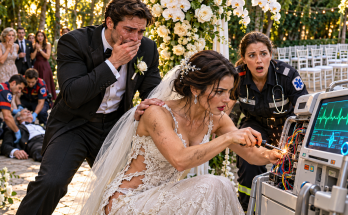
And I remember Lana sitting beside me in her damaged wedding dress, looking out the passenger window.
Neither of us spoke.
Several times, I considered asking her about the paramedic.
Each time, I decided against it.
I didn't trust myself to have that conversation while driving.
My hands were gripping the steering wheel so tightly that my knuckles had turned pale.
I loosened my fingers.
A few moments later, I realized I was gripping it just as hard again.
The woman beside me had saved her uncle's life.
I should have been overwhelmed with pride.
Part of me was.
But another part of me couldn't stop hearing the words spoken by that paramedic.
Chief executive.
Patent holder.
Doctor.
I had never heard anybody address Lana that way before.
For eighteen months, I had believed she spent her nights working as a hospital maintenance technician.
I had defended that occupation at my parents' dining table.
I had surrendered my inheritance rather than allow my father to use it against her.
I had accepted that our marriage would require careful financial planning.
Now I wondered whether any of those assumptions had been correct.
Eventually, we reached the apartment.
Lana gathered the torn fabric of her dress before getting out of the car.
I waited for her.
We walked inside together.
Our apartment looked exactly as we had left it.
The familiar kitchen counter.
The modest furniture.
The ordinary surroundings in which we had spent so many happy evenings.
Nothing had changed.
And yet I felt as though I had returned to a completely unfamiliar place.
I closed the door.
Lana stood near the kitchen.
She put her things down without looking at me.
I noticed the dark mark still visible on her cheek.
I had always found those marks rather endearing.
That night, looking at it made my chest hurt.
I finally spoke.
“Who exactly are you, Lana?”
She closed her eyes.
For several seconds, she didn't answer.
Then she released a long breath and moved closer to the kitchen counter.
“I'm the person you married.”
I shook my head.
“Please don't do that.”
She looked at me.
“I heard what he said.”
“I know.”
“He called you a doctor. He said you owned the patent for that machine.”
She nodded slowly.
I waited.
She rested both hands against the counter.
“I founded Apex Biomedical Holdings.”
I stared at her.
She continued before I could respond.
“I'm also its chief executive officer.”
The words sounded so ordinary coming from her that I struggled to comprehend them.
She might have been explaining what time she needed to leave for work.
Instead, she was telling me that the occupation I had associated with her for eighteen months wasn't the occupation she actually held.
I looked around our apartment.
The modest kitchen.
The inexpensive furnishings.
The ordinary life we had been living.
I couldn't reconcile any of it with what she was saying.
“What does that mean financially?”
I hated asking the question.
It sounded exactly like something my father would have asked.
But I needed to understand the extent of what she had concealed.
Lana lowered her eyes.
“I hold seventy-three medical patents.”
I said nothing.
“And my personal assets are valued at approximately one billion, two hundred million dollars.”
I stared at her.
I genuinely thought I might have misunderstood the number.
“One point two billion?”
“Yes.”
“Billion?”
“Yes, Harrison.”
I took a step backward.
There wasn't enough money in my imagination to make that figure feel real.
My father had spent his life accumulating wealth and demonstrating its importance to everybody around him.
The woman standing in my kitchen apparently possessed more money than he could ever reasonably expect to acquire.
And she had been eating inexpensive burgers with me.
She had been splitting restaurant bills.
She had been wearing the same old canvas jacket.
I thought about the bank statement she had shown me.
The conversation about her savings.
My concern that paying for our wedding might leave her financially vulnerable.
I felt foolish.
Painfully foolish.
“So the wedding money wasn't a problem for you.”
“No.”
“The venue discount?”
She looked away.
I understood.
I walked a few steps across the kitchen.
Then I turned back.
“How long were you going to keep doing this?”
She didn't answer immediately.
I could feel my anger growing.
“Were you ever planning to tell me?”
“Yes.”
“When?”
She opened her mouth.
Then she closed it again.
I pressed my palms against the counter.
“We got married today, Lana.”
“I know.”
“We stood in front of your entire family and promised to build a life together.”
My voice began shaking.
“And I didn't even know what you did for a living.”
She looked genuinely ashamed.
“I should have told you.”
“Eighteen months.”
She nodded.
I repeated the number because I couldn't seem to get beyond it.
“Eighteen months, and you let me believe something that wasn't true.”
“Harrison, the work I described was real.”
“That isn't the point.”
She went quiet.
I remembered the night at my parents' house.
The silver fork striking the china.
My mother's expression.
Sterling laughing into his napkin.
My father's question about whether I intended to marry a janitor.
“You sat there while they insulted you.”
Lana looked at me.
“You listened to my father talk about people who worked with their hands as if they were worthless.”
“Yes.”
“You knew he was completely wrong about you.”
She straightened.
“He would have been wrong even if I really had been a janitor.”
I stopped.
She was right.
But my anger hadn't disappeared.
“You could have told me afterward.”
“I could have.”
“When he threatened the inheritance. When he offered you ten thousand dollars to go away.”
She nodded again.
I thought about the thirty-seven empty chairs.
That was the memory that hurt most.
“I lost my entire family while defending something that wasn't even true.”
Lana's expression changed.
For the first time since we entered the apartment, she raised her voice.
“Your family didn't abandon you because I concealed my money.”
I looked at her.
“They abandoned you because they thought my occupation made me inferior.”
She stepped toward me.
“I didn't tell your mother to contact those relatives. I didn't tell your father to threaten you. I didn't make Sterling laugh at me.”
I knew that.
Somewhere underneath my anger, I knew every word she was saying was correct.
But I was still struggling with the fact that my wife had withheld something so fundamental.
“You watched me go through all of that.”
“Yes.”
“And you said nothing.”
She looked down at her wedding dress.
When she spoke again, her voice was quieter.
“I was afraid.”
I almost laughed.
Not because her fear was amusing.
Because I couldn't imagine what somebody possessing that much money could possibly fear in a relationship with someone like me.
She noticed my expression.
“You don't understand what my life has been like.”
“Apparently, I don't.”
She accepted the remark without arguing.
For a while, neither of us spoke.
Then she pulled herself together.
“I've spent the last ten years meeting men who were interested in what they could obtain from me.”
I listened.
“Sometimes they wanted access to the company. Sometimes they wanted introductions. Sometimes they were interested in my money.”
She rubbed her forehead.
“Even when somebody appeared genuinely interested in me, I eventually discovered that my position was part of the attraction.”
I looked at the floor.
She continued.
“It's difficult to explain how exhausting that becomes.”
Her voice broke slightly.
“You start wondering whether anybody would want you if everything else disappeared.”
I thought about my father's office.
The manila folder.
The amount written on the wedding paperwork.
He had assumed that money could determine my choice.
Lana had apparently spent years wondering whether money had determined everyone else's choices about her.
She looked at me.
“That night at Chicago Memorial, I wasn't there as part of the regular maintenance staff.”
I waited.
“I was inspecting a prototype scanner. I wanted to see what was happening with the equipment myself.”
She glanced at her hands.
“I'd been working around the machinery. That's why my clothes looked the way they did.”
I remembered her standing beside the vending machine.
The grease.
The tool belt.
The black pager.
She hadn't been pretending to understand machinery.
She really had been working.
The difference was that she had been there as the person responsible for developing and overseeing it.
“Then I saw you,” she said.
“You looked absolutely miserable.”
Despite everything, I could remember the moment clearly.
The terrible coffee.
My exhaustion.
The way she had listened.
“I brought you something to drink. And you treated me like somebody worth talking to.”
She wiped beneath one eye.
“When you asked me to dinner, you had no idea what my name meant.”
I didn't respond.
“You didn't know about my patents or my position. You didn't know whether being with me could improve your financial situation.”
She paused.
“You just wanted to see me again.”
There were tears on her face now.
I had seen her remain composed while my family insulted her.
I had watched her take control during a frightening medical emergency.
But standing in our little apartment, she was struggling to finish her sentences.
“I wanted to keep that feeling.”
Her hands trembled slightly.
“And the longer I waited to explain everything, the more frightened I became that telling you would destroy it.”