Exactly one year later, I sat in the living room of the home Lana and I had purchased together.
It was in the suburbs.
A quiet place.
Somewhere we could return after long working days without feeling that the outside world needed something from us every minute.
Sunlight came through the windows.
I had a cup of black coffee beside me.
Across the room, I could see the familiar things we had chosen together.
Nothing needed to demonstrate our financial position.
Nothing had been selected because somebody important might visit and form an opinion about us.
We had chosen a home that felt comfortable.
A place where we could live.
That distinction mattered more to me than it probably would have mattered before our wedding.
I had grown up inside an enormous stone mansion.
There had been iron gates outside.
Expensive furniture inside.
A formal dining room large enough to accommodate gatherings my mother considered socially important.
People had admired that house.
My father had been proud of it.
But I had rarely felt entirely comfortable there.
I remembered sitting at the mahogany table and wondering what subject might become another criticism of my life.
I remembered avoiding conversations about the buildings I designed because Sterling would inevitably find something amusing about my ambitions.
I remembered watching my mother examine people before deciding how warmly to greet them.
The house had possessed nearly everything money could purchase.
It hadn't possessed the one thing I wanted most.
A feeling that I belonged there without having to earn it.
The home Lana and I shared was different.
When I walked through the door, I didn't wonder whether my income was sufficient.
I didn't wonder whether my professional accomplishments would satisfy somebody else's expectations.
I didn't need to conceal my enjoyment of ordinary things.
I could simply be myself.
That was something I had wanted for a very long time.
The year following our wedding hadn't been entirely effortless.
Lana and I had needed to adjust to the fact that the privacy we once enjoyed was gone.
People knew who she was.
They knew we were married.
They knew far more about my relationship with my family than I would ever have voluntarily shared.
The recording from our wedding had reached an audience neither of us could have imagined.
For a while, it seemed impossible to separate our names from what happened that evening.
I understood why the story attracted attention.
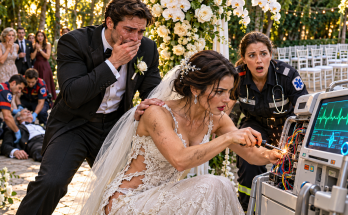
A bride tearing her wedding gown to repair emergency medical equipment was an extraordinary image.
The revelation of her identity made it even more unusual.
And my family's behavior gave strangers something else to discuss.
But Lana and I still needed to continue living after the attention diminished.
We had jobs.
Responsibilities.
A marriage that required more than admiration from people who had watched a recording.
We had agreed that honesty would become a foundation of our relationship.
Not honesty only when it was convenient.
Not honesty only when the truth was easy to explain.
The difficult kind.
The kind that required admitting when something frightened us.
Lana had kept that promise.
Over the following months, I became much more familiar with the responsibilities she carried.
Apex Biomedical Holdings was an enormous company.
Its operations involved people and institutions whose needs extended far beyond anything I had imagined when we first met.
There were patents.
Contracts.
Technical developments.
Decisions that affected equipment used in hospitals.
I came to appreciate why her telephone had buzzed at such unusual hours.
I understood the complicated messages I had glimpsed during our early dates.
I understood the remarkable precision with which she spoke about machinery.
But one thing hadn't changed.
She still enjoyed doing the practical work herself.
There were still occasions when she came home exhausted.
There were still marks on her hands after she spent time around equipment.
Sometimes I would notice her hair tied back in the same untidy way I remembered from the hospital basement.
Those details made me smile.
The world knew her as Dr. Lana, founder and chief executive of Apex Biomedical.
I knew her as my wife.
The woman who had once stood beside a broken vending machine and offered a stranger something warm to drink.
Learning the truth about her achievements hadn't erased that memory.
If anything, it had made it more meaningful.
She had been doing important work that night.
She had possessed responsibilities I couldn't have begun to understand.
And she had still found a few minutes to help somebody sitting alone in a hospital corridor.
That was the woman I loved.
As for me, I eventually established my own independent architecture practice.
It was something I had wanted to do for a long time.
The idea had existed before my marriage.
Before my engagement.
Before I understood anything about Lana's wealth.
I wanted to build an organization centered on the kind of work that mattered to me.
Community projects.
Public spaces.
Buildings that served people rather than simply demonstrating how much money had been spent constructing them.
I took the necessary steps to make that ambition a reality.
And I did it without accepting corporate funding from Lana.
That was important to me.
Not because I believed there was anything shameful about spouses helping one another.
Lana had already helped me in ways that had nothing to do with money.
But I wanted my practice to stand on the strength of my work.
I wanted to earn the trust of the people who hired me.
I wanted to make decisions without wondering whether somebody else's company had purchased my independence.
My father would probably have considered that approach foolish.
He would have asked why I wasn't taking advantage of the extraordinary connection available to me.
He would have seen Lana's corporation as a source of opportunity.
A way to accelerate growth.
A way to obtain contracts.
I understood the possibilities.
I chose not to pursue them.
There was a particular satisfaction in knowing that the work I did belonged to the practice I had built.
When I sat over drawings, I wasn't trying to impress Marshall Vance.
When I discussed a community project, I wasn't worried about Sterling's opinion of its profitability.
I was doing what I had wanted to do when I first became an architect.
And I was proud of it.
Lana understood that.
She never suggested that I should abandon my independence because she could make my professional life easier.
She respected the work.
She respected my decisions.
That was precisely what I had promised to give her in our wedding vows.
I received the same consideration in return.
There was another project we developed together.
One that grew directly from what happened at the reception.
The failed medical unit had nearly prevented Arthur from receiving the treatment he urgently needed.
That experience remained difficult to think about.
I could still remember the warning sound.
The red light.
The fear on the paramedic's face when the equipment wouldn't function.
I could remember Lana tearing her dress because its fabric was preventing her from moving freely.
And I could remember the relief when the medical crew confirmed that Arthur had a pulse again.
The equipment eventually worked because somebody with extraordinary knowledge happened to be standing nearby.
But most emergencies wouldn't unfold with the person who developed the equipment present.
That was a frightening thought.
Reliable medical technology depended on more than inventions.
It depended on inspections.
Maintenance.
Proper oversight.
People willing to perform the practical work necessary to keep important systems functioning.
Those people rarely received the attention they deserved.
My father had considered maintenance work an unsuitable occupation for his daughter-in-law.
Yet on our wedding night, the ability to repair a machine had helped save a man's life.
I couldn't forget that irony.
Neither could Lana.
We decided to use the attention surrounding our wedding to establish a charity supporting underfunded hospital maintenance programs.
We directed millions of dollars toward that purpose.
Not toward making our names more recognizable.
Not toward demonstrating our position in society.
Toward helping institutions maintain the equipment patients and medical professionals depended upon.
It was meaningful work for both of us.
Lana understood the technology.
I understood the importance of properly functioning buildings and the systems they contained.
We both understood what could happen when necessary practical work was overlooked.
I thought often about the people responsible for maintaining hospitals.
The workers whose hands looked like Lana's had when we first met.
People who might spend an entire night repairing equipment and receive little acknowledgment the following morning.
People whose work became noticeable only when something stopped functioning.
They deserved respect before emergencies demonstrated how essential they were.
They deserved adequate resources.
They deserved the opportunity to do their jobs properly.
Our charity gave us a way to support that.
It also allowed something useful to grow from an experience that had initially brought so much pain into our lives.
The public attention eventually became less overwhelming.
People moved on to other stories.
Our wedding was no longer something everybody seemed determined to discuss.
Lana and I could concentrate more fully on our work and our marriage.
That suited us both.
We had never wanted to become a public spectacle.
We wanted a life together.
Meanwhile, my father's business continued struggling.
The loss of the Apex contract hadn't created the financial problems he faced.
Those problems had existed beforehand.
But without the opportunity he had spent six months pursuing, he couldn't achieve the recovery he had hoped for.
Approximately six months before I sat in that living room, his venture capital firm ceased operating.
The business he had spent years building was gone.
I learned that he had been forced to sell the suburban estate.
The enormous house with the iron gates.
The oak doors.
The staircase from which he had descended holding his bourbon when Lana first came to dinner.
All of it belonged to somebody else now.
My parents moved into a much smaller condominium.
I imagined how difficult that change must have been for them.
My father had spent his life measuring success through the things he could accumulate.
My mother had spent hers measuring it through the company she could keep.
Losing their previous circumstances meant losing much of what they believed defined them.
My mother's position among her country club acquaintances deteriorated as well.
People who once welcomed her into their social gatherings began distancing themselves.
The email she had circulated privately had become publicly associated with her character.
The reputation she had attempted to protect by boycotting our wedding had suffered because of the boycott itself.
I didn't celebrate that.
I wasn't pleased to know that my parents were miserable.
There was no victory for me in imagining them sitting inside a condominium, surrounded by the consequences of their choices.
I would have preferred a different outcome.
I would have preferred for my father to remain successful while learning that people mattered more than financial opportunities.
I would have preferred for my mother to keep her friendships without believing they were more important than her children.
I would have preferred a brother whose affection didn't depend on professional standing.
Those things would have been worth far more to me than knowing their business and social circumstances had deteriorated.
But I couldn't make those choices for them.
And I had stopped trying.
I hadn't spoken to Marshall, Bernardet, or Sterling since the afternoon at the coffee shop.
Not once.
I had maintained the boundary I established when I left.
There were occasions when I thought about them.
Of course there were.
They had been part of my life for twenty-nine years.
Memories didn't simply disappear because I decided that further contact was unhealthy.
Sometimes I remembered the house.
Sometimes I remembered family dinners.
Sometimes I wondered whether my father had thought about the check after I walked away.
But I didn't feel the old compulsion to make things right for him.
I didn't feel responsible for rescuing the relationship by accepting conditions I couldn't live with.
I could remember them without returning to them.
That was something I had needed to learn.
Sitting in my living room that afternoon, I looked at the coffee beside me.
Black.
Ordinary.
Nothing particularly impressive.
I took a sip.
It made me think about the first cup Lana had brought me.
The hospital coffee had been considerably worse.
I could still remember the warmth of the paper cup against my cold fingers.
I had been sitting alone, waiting for news about somebody I loved.
She had seen me.
She hadn't known my surname.
She hadn't known about my father's company.
She hadn't asked whether helping me might improve her circumstances.
She had simply noticed that I was having a terrible night.
And she had done something kind.
My family had never understood how important that moment was.
They would have understood the patents.
They would have understood the one-point-two-billion-dollar fortune.
They would have understood the contract opportunities associated with Apex Biomedical.
But the coffee?
They probably would have considered it insignificant.
I knew that it wasn't.
I heard Lana moving nearby.
When she entered the room, I noticed the silver ring on her hand.
She still wore it.
A simple piece of jewelry that had cost only what I could comfortably afford when I proposed.
Nothing about her extraordinary success had made it less meaningful to her.
She sat beside me.
I moved slightly to make room.
For a while, we sat together without speaking.
There was no particular reason to fill the silence.
We were comfortable.
I reached for her hand.
She looked at me and smiled.
I thought about the garden again.
September fourteenth.
The white orchids.
The wild lilies.
The rented tuxedo.
Thirty-seven empty chairs.
For months before our wedding, I had believed those chairs represented everything I stood to lose.
Now I understood they had also shown me what I could stop chasing.
I didn't need to spend my life convincing people that I deserved their affection.
I didn't need to accumulate wealth to justify my choices.
I didn't need an inheritance to establish my worth.
And I didn't need Lana's fortune to explain why marrying her had been the right decision.
She could have been exactly the maintenance worker I originally believed her to be.
I would still have chosen her.
We might have rented a smaller apartment.
We might have held our wedding at city hall.
We might have spent years saving for a home.
None of that would have made our marriage less valuable.
Because the life I wanted wasn't defined by the amount of money available to us.
It was defined by how we treated each other.
By whether we could tell the truth.
By whether we could respect each other's work.
By whether we stayed when things became difficult.
I looked at Lana.
The woman who had stood beside me at the altar.
The woman who had knelt beside her uncle.
The woman who had walked into a boardroom and refused to allow family connections to determine the future of her employees' retirement savings.
The woman who still wore my modest silver ring.
I squeezed her hand.
She squeezed mine in return.
There were no financial conditions attached to that gesture.
No expectations.
No hidden demands.
I had spent so much of my life believing that belonging was something I needed to purchase through obedience.
I had finally found a place where that wasn't necessary.
My father had taken away fifty thousand dollars because he believed it would make me surrender the woman I loved.
A year later, I sat beside her in a home filled with the quiet certainty I had always wanted.
He had never understood what I was looking for.
It wasn't his company.
It wasn't his estate.
It wasn't the inheritance he had threatened to remove.
It was this.
A meaningful day's work.
A peaceful place to come home to.
A woman whose hand I could hold without wondering what she expected me to become.
I finished my coffee and set the cup down.
Lana rested her head against my shoulder.
Outside, the afternoon continued quietly.
And inside our home, there was nothing missing.
The End
Read more original stories on lastestdrama.com.