I had always assumed my father's business was financially secure.
He certainly wanted everybody to believe it was.
Marshall never spoke about failure as something that might happen to him.
Failure belonged to other people.
People who lacked discipline.
People who made poor decisions.
People who didn't possess the intelligence he attributed to himself.
Whenever he discussed investments, he did so with enormous confidence.
Sterling had adopted the same attitude.
Neither of them appeared interested in admitting uncertainty.
Even when they criticized somebody else's financial judgment, they spoke as though their own judgment were beyond question.
What I discovered after my wedding was that the firm had been in serious trouble.
Several investments had gone badly.
The losses were substantial.
The business that supported my father's expensive lifestyle was approaching insolvency.
He and Sterling had been trying to prevent that reality from becoming public.
The expensive offices remained.
The immaculate suits remained.
The appearance of extraordinary success remained.
But beneath all of it, the firm was struggling to survive.
I thought about that later.
My father had threatened to remove me from the family trust while his own financial position was deteriorating.
He had spoken about protecting my future while desperately attempting to protect his own.
He had offered Lana ten thousand dollars to disappear from my life.
And he had done all of that while depending upon a business opportunity he didn't yet know how to secure.
That opportunity involved a substantial employee pension fund.
A major biomedical corporation was considering financial management arrangements.
The contract would have been extremely profitable.
More importantly for my father, securing it could have provided the firm with the financial stability it urgently needed.
Marshall and Sterling had spent six months pursuing access to the company's decision-makers.
Six months of preparing proposals.
Six months of attempting to demonstrate their firm's capabilities.
Six months of waiting for an opportunity to present their services to the executives responsible for making the decision.
They finally obtained that opportunity.
The meeting was scheduled for two o'clock on the afternoon following our wedding.
I wasn't present.
What happened inside that room became known to me afterward.
And when I learned about it, I found myself thinking repeatedly about the dinner where my father had first met Lana.
Because the woman he was about to encounter was exactly the same person.
Only the surroundings had changed.
Marshall and Sterling arrived at a downtown Chicago skyscraper.
They were shown into a large corporate boardroom.
There were enormous windows and a polished mahogany conference table.
It was the kind of environment in which my father usually felt comfortable.
Expensive furniture.
Professional surroundings.
People discussing enormous amounts of money.
But this meeting was different from the negotiations he was accustomed to controlling.
He needed the contract.
The other company didn't need him.
That difference mattered.
He and Sterling took their places at the table.
They had prepared their proposal carefully.
They understood the financial importance of the opportunity.
Neither of them could afford to leave without making a favorable impression.
At that time, they hadn't fully appreciated what was happening publicly.
The wedding recording was spreading.
My mother's message was circulating.
People were criticizing their business.
But the two men remained focused on the meeting they had spent months trying to obtain.
They believed they were finally about to meet the head of an extraordinarily valuable corporation.
A person whose approval could determine the future of their firm.
The boardroom doors opened.
Lana entered.
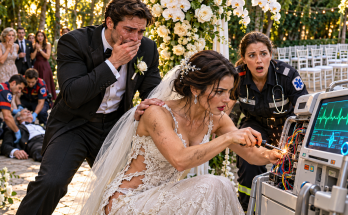
She was no longer wearing the damaged gown in which she had saved Arthur.
She wasn't wearing the heavy canvas overalls in which I had first met her.
She wore a sharply tailored Tom Ford suit.
Her appearance reflected the professional responsibilities she carried.
Several corporate executives accompanied her.
There were also three attorneys dealing with federal matters.
She carried a leather folder.
My father rose from his chair.
He was preparing to introduce himself.
Then he recognized her.
For a moment, he couldn't respond.
I wish I could say I was surprised by that reaction.
But I understood it perfectly.
He had spent months attempting to reach the leadership of Apex Biomedical.
And he had spent weeks attempting to prevent his son from marrying the woman who led it.
Those two parts of his life had just collided.
Sterling recognized her a moment later.
The expensive pen he had been holding fell onto the table.
Neither man seemed capable of continuing with the introductions they had prepared.
Lana didn't behave as though anything unusual had happened.
She walked toward the head of the conference table.
She placed her folder down.
She remained standing.
My father was still on his feet.
The man who had once questioned whether she was suitable to sit at his dining table was now waiting for her to decide whether his business deserved her confidence.
She addressed him formally.
“Mr. Vance.”
He struggled to respond.
“Lana?”
She didn't acknowledge the familiarity.
“I've completed my review of your proposal concerning the management of our employee pension assets.”
Her voice was calm.
The other executives remained attentive.
Sterling looked between her and his father.
Neither of them had prepared for this possibility.
I thought about the hours they must have spent discussing the contract.
The presentations.
The negotiations.
The documents.
The assurances they intended to offer.
They had imagined meeting somebody they needed to impress.
They had never considered that they had already met her.
Worse, they had already demonstrated their character to her in considerable detail.
My father had called her a janitor.
Sterling had laughed at her occupation.
They had attempted to pay her to end her engagement.
They had used financial threats to pressure me into leaving her.
And now they wanted her to trust them with the retirement funds of the people employed by her company.
Lana opened the leather folder.
“The proposal involves a significant financial commitment.”
My father nodded quickly.
“Yes. We've prepared a very competitive arrangement.”
She continued before he could elaborate.
“However, we've decided not to proceed.”
Silence.
My father appeared unable to understand the answer.
Perhaps he had expected her to discuss revisions.
Perhaps he believed there was room for negotiation.
He tried to speak.
Nothing useful came out.
Lana remained composed.
There was no shouting.
No theatrical display of anger.
She didn't need to remind him loudly about what had happened at his house.
The circumstances already made that impossible to forget.
“We expect the organizations responsible for our employees' retirement assets to demonstrate sound judgment.”
She looked directly at him.
“We also expect professional conduct consistent with our company's principles.”
My father finally managed to speak.
“I'm sure we can address any concerns.”
Lana looked at him.
“I'm afraid our concerns aren't limited to the figures in your proposal.”
I thought about those words when I heard them later.
My father had always believed everything could be resolved through financial arrangements.
If he wanted someone to cooperate, he offered money.
If he wanted somebody to obey him, he threatened to withdraw money.
If someone presented an inconvenience, he attempted to determine how much it would cost to make that inconvenience disappear.
Here, he was facing a decision that involved more than numbers.
Lana continued.
“The values your firm has demonstrated are incompatible with the standards we require.”
There was something familiar about the language.
It closely resembled the way my mother had described our marriage.
My mother had declared that attending our wedding would conflict with the principles she and my father represented.
Now those same principles were becoming a reason another organization refused to do business with them.
Lana didn't need to invent an argument.
She used the standards my parents had so proudly announced themselves.
My father looked toward the other executives.
Perhaps he hoped somebody would intervene.
Perhaps he thought the presence of additional decision-makers might create an opportunity to appeal the rejection.
Nobody offered him that opportunity.
Lana had arrived with the appropriate personnel.
The decision had been made.
Sterling remained unusually quiet.
I remembered how confidently he had spoken in my father's office.
How certain he had been that I couldn't afford to marry Lana.
How ridiculous he had considered the idea of sacrificing my inheritance for somebody who repaired machinery.
Now his firm's survival depended on convincing that same woman to approve an enormous contract.
And he had nothing to say.
Lana placed her hands lightly against the conference table.
“Financial expertise alone isn't sufficient for this partnership.”
She looked at my father.
“We have to be confident that the people handling these funds possess the judgment and integrity appropriate to that responsibility.”
He swallowed.
She continued.
“Your organization hasn't met that standard.”
Then came the remark that must have been particularly difficult for Marshall to hear.
She explained that his firm's conduct had become both professionally and financially discreditable.
It was almost exactly the accusation my parents had directed at our marriage.
They had called my decision a disgrace.
They had suggested that marrying Lana would undermine our family's reputation.
Now their own behavior had undermined something considerably more valuable to them.
Lana removed the rejection documents from her folder.
She placed them on the table.
Then she moved them toward my father.
There was no invitation to submit a revised proposal.
No discussion of another appointment.
No suggestion that the matter could be resolved through a private conversation between family members.
The contract was being declined.
My father looked down at the paperwork.
I imagined him sitting there with the same helpless expression I had worn while reading my mother's email.
Except that my mother's message had informed me my family wouldn't support my marriage.
These documents informed my father that the business opportunity he desperately needed was no longer available.
He looked up.
“Surely we can discuss this.”
Lana closed her folder.
“The review is complete, Mr. Vance.”
He tried to continue.
She didn't allow the conversation to become another of his negotiations.
She turned slightly toward the exit.
“Your parking arrangements will be taken care of before you leave.”
That was the final instruction.
Ordinary.
Administrative.
Almost painfully polite.
Then she walked out of the boardroom with her executives and attorneys.
My father and Sterling remained behind.
For six months, they had pursued that meeting.
It had ended within a matter of minutes.
The woman they had considered unsuitable for their family had rejected their company as unsuitable for hers.
When I learned about the encounter, I sat quietly for a while.
I wasn't particularly interested in imagining my father's embarrassment.
I understood that his position was serious.
There were financial responsibilities attached to his company.
There were employees whose livelihoods depended on its continued operation.
The situation was larger than a family argument.
But I also understood that Lana had employees of her own.
Their retirement funds deserved protection.
She couldn't responsibly entrust those assets to an organization merely because its managing director happened to be her husband's father.
That would have been another form of the favoritism my family practiced.
They had always expected relationships to create financial advantages.
Lana had refused to give them one.
The distinction mattered to me.
She hadn't needed my father's approval at the dinner table.
She didn't need his friendship now.
She had evaluated an organization that wanted her business and concluded it didn't meet her company's requirements.
For my father, however, the rejection meant something much more personal.
His company was already struggling.
His public reputation was deteriorating.
His wife had become the subject of widespread criticism.
And the contract he had hoped would save the firm had just been declined by the daughter-in-law he had refused to accept.
By five that afternoon, my telephone was ringing almost continuously.
I looked at the screen.
My mother's name appeared.
Then disappeared.
Then appeared again.
I didn't answer.
A message arrived from Sterling.
I opened it.
There were several paragraphs.
His language was remarkably different from the language he had used in my father's office.
There was no joke about my salary.
No suggestion that I couldn't afford a wedding.
No remark about marrying beneath the family.
Instead, he wanted to apologize.
He wanted an opportunity to explain.
He wanted me to understand that things had become complicated.
I put the telephone down.
It rang again.
This time, it was my father.
I watched his name until the call ended.
Another notification appeared.
A voicemail.
I remembered the message he had left at eleven forty-five on the night before my wedding.
He hadn't sounded desperate then.
He hadn't wanted a conversation.
He had simply instructed me to cancel the marriage and informed me that I would receive nothing from him.
Now he was trying repeatedly to reach me.
By the time I finished looking through the notifications, my mother had called twenty-two times.
My father had left six messages.
Sterling had continued sending lengthy apologies.
I sat with the telephone in my hand.
Seventy-five invitations.
Not one response.
Thirty-seven chairs.
Not one relative.
And now, less than twenty-four hours after discovering Lana's position, my family suddenly remembered how to contact me.
I understood exactly why.