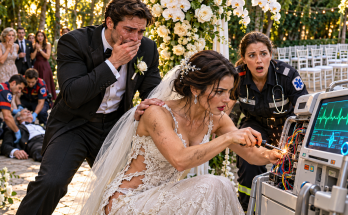
Lana looked down at the skirt of her wedding dress.
The fabric restricted her movement.
There was no time to gather it neatly or ask someone to help her.
She took hold of the silk.
Then she tore it.
The sound was surprisingly loud.
I watched the beautiful white gown split along one side.
She moved toward the medical console without giving the damaged dress another glance.
I stood a few feet away.
Everything seemed to happen much faster than I could understand it.
The paramedic was still attempting to get the machine working.
The warning tone continued.
Arthur remained on the floor.
The crew was trying to manage the emergency while dealing with equipment that wasn't responding properly.
Lana reached the console.
The lead paramedic turned toward her.
“Ma'am, you need to move away.”
She didn't.
Her attention remained on the screen.
He reached toward her shoulder, trying to prevent her from interfering.
She turned to face him.
“Let go of me.”
Her voice was completely different from the one I had heard at our altar.
There was nothing gentle about it.
She wasn't pleading for access to the machine.
She sounded like somebody accustomed to being responsible for it.
The paramedic hesitated.
Lana looked back at the display.
“The controller isn't getting through its startup sequence.”
She spoke rapidly.
She referred to a specific component and a software update that apparently should have been installed.
I recognized neither the technical terms nor the significance of what she was saying.
The paramedic clearly recognized enough to be surprised.
He looked at the warning screen.
Then he looked at her.
Lana asked him for a surgical clamp and a particular screwdriver.
He stared at her for another moment.
She repeated the request.
This time, there was an unmistakable urgency in her voice.
He retrieved the tools.
I couldn't believe what I was witnessing.
My wife stood in the middle of our wedding reception, wearing a torn gown and holding medical repair tools.
Only a short time earlier, I had been dancing with her beneath golden lights.
Now she was concentrating on a piece of advanced emergency equipment while a trained medical crew watched.
She opened the metallic housing.
Inside was a complicated collection of components and wiring.
I knew enough about technical systems through my architecture work to appreciate how sophisticated the equipment was.
I also knew immediately that I wouldn't have been able to identify anything useful inside it.
Lana appeared to know precisely where to look.
She didn't search aimlessly.
She didn't ask for instructions.
She examined the internal components and began working.
Her movements were quick.
Controlled.
Deliberate.
I watched her hands.
Those were the hands that had passed me a cup of coffee in a hospital basement.
The hands that had held mine when my father insulted her.
The hands I had taken at the altar.
I had always known she was good at repairing things.
But this was beyond anything I had imagined.
There was no uncertainty in the way she handled the machine.
It was almost as though she already understood its entire internal arrangement.
As though she had seen every component before.
The paramedic stood close enough to observe what she was doing.
He seemed increasingly astonished.
Lana continued concentrating on the malfunction.
Around her, the other medical workers remained focused on Arthur.
I kept looking between them.
I wanted the machine to work.
I wanted Arthur to survive.
And somewhere beneath that fear, another feeling was beginning to develop.
Confusion.
Who exactly had I married?
I hated myself for thinking about that while a man's life was in danger.
But the question appeared before I could prevent it.
Lana had described her job as maintenance.
I had accepted that description.
I knew she repaired sophisticated hospital equipment.
I knew she understood engineering terminology.
I knew her phone received complicated messages at unusual hours.
None of those details had seemed particularly concerning when considered separately.
Watching her now, they began to fit together in a way I couldn't explain.
She continued working inside the unit.
There was a brief flash of sparks.
Several guests recoiled.
I saw tiny dark marks against the white fabric of her wedding dress.
Lana didn't step away.
She didn't even look down.
She kept her attention on the equipment.
The metallic panel remained open.
The small tools moved in her hands.
The paramedic watched with an expression that had changed from irritation to complete disbelief.
Then the console responded.
The display illuminated.
Information began appearing on the screen.
The warning that had prevented the equipment from starting was finally gone.
Lana studied the monitor.
She spoke briefly to the paramedic, confirming that the emergency function was available again.
The crew immediately resumed the procedure they had been unable to perform.
They prepared the equipment for Arthur.
The paramedic instructed everyone to move clear.
I stepped backward.
Lana moved enough to give the medical workers room.
For a moment, nobody around us seemed to breathe.
The treatment was administered.
Arthur's body reacted.
I remember gripping my own hands so tightly that my fingers hurt.
There was a brief silence.
The medical workers checked him.
I looked at their faces, trying to determine whether what they had done had worked.
Then one of them spoke.
“There it is.”
Another checked Arthur again.
“We've got a pulse.”
The words seemed to move through the room.
His pulse had returned.
His condition was stabilizing.
The change in the atmosphere was immediate.
Someone began sobbing.
Another relative covered her face.
People reached for one another.
A few began applauding through their tears.
I felt my knees weaken.
Arthur was alive.
The terrible blue appearance of his face was beginning to improve.
The medical workers continued attending to him.
They prepared to transport him to the hospital.
I stood nearby, struggling to process the fact that we had just watched him come so close to dying.
Lana put down the tools.
There was grease on her cheek.
Her gown was torn.
The beautiful fabric had dark marks on it.
She looked exhausted.
But she didn't seem concerned about her appearance.
She watched the crew prepare Arthur for transport.
She wanted to make sure he was receiving the attention he needed.
That was where her focus remained.
I wanted to go to her.
I wanted to put my arms around her.
But before I could move, I noticed the lead paramedic.
He hadn't turned away from the medical console.
He was staring at the open housing.
His eyes moved across the repaired equipment.
Then he looked at Lana.
The expression on his face was difficult to describe.
He seemed to be reconsidering something.
He looked at the screen again.
Then back at my wife.
I could almost see him trying to reconcile two different pieces of information.
The woman standing in front of him was wearing a wedding dress.
But she had just demonstrated knowledge of the machine that apparently made no sense to him.
“Ma'am?”
Lana turned.
He hesitated.
“What you did there…”
He looked toward the console.
“The system is protected. Ordinary service personnel don't have that level of access.”
I listened.
His words made my stomach tighten.
He continued.
“The developers are the people authorized to perform that kind of intervention.”
Lana didn't answer immediately.
He studied her face more closely.
Recognition began replacing his confusion.
His mouth opened slightly.
He looked genuinely shocked.
“Wait a second.”
He took a small step toward her.
“Dr. Lana?”
I thought I had misheard him.
Doctor?
I looked at my wife.
She remained perfectly still.
The paramedic's attention was fixed on her.
“You're the woman from Apex Biomedical.”
Nobody nearby interrupted him.
I could hear the distant movement of the crew preparing Arthur's stretcher.
But my entire attention had shifted toward that conversation.
The paramedic looked at the machine one more time.
“You're their chief executive. You developed this equipment.”
I felt something inside my chest drop.
Chief executive.
He wasn't describing her as a maintenance technician.
He wasn't describing her as an engineer employed by the manufacturer.
He was identifying her as the person who ran the company.
And, according to him, she held the patent for the machine she had just restored.
I looked at Lana.
I expected her to correct him.
I expected her to explain that he had confused her with somebody else.
Perhaps they shared a name.
Perhaps she worked with the real developer.
There had to be some explanation that would bring the situation back within the boundaries of everything I understood about my life.
Instead, she wiped her cheek.
The grease spread slightly beneath her fingers.
Then she addressed the paramedic.
“Your department needs to explain why this equipment was deployed without the required update.”
He nodded quickly.
“Yes, ma'am.”
She continued.
“Tell the person responsible for your service that I expect this to be corrected.”
There was no uncertainty in her voice.
She spoke about the company's contracts.
She spoke about the federal funding connected to the equipment.
She made it clear that another failure of this kind would have serious consequences for the organizations involved.
The paramedic listened without interrupting.
He looked nothing like the man who had attempted to pull her away from the console minutes earlier.
He wasn't questioning her qualifications anymore.
He was accepting her authority.
“Understood, Doctor. I'll report it.”
She gave a short nod.
He returned to the rest of the crew.
I remained standing where I was.
Doctor.
Chief executive.
Patent holder.
The words repeated themselves inside my head.
I tried to remember whether Lana had ever directly described herself as a hospital employee.
She had said she maintained equipment.
She had spoken about hardware.
She had explained that she dealt with problems when machinery stopped functioning.
She had never given me a formal job title.
I had supplied one in my own mind.
And she had allowed me to believe it.
I thought about the first evening at the diner.
Her technical explanations.
Her telephone.
The confidence with which she had handled the rude waitress.
I thought about her reaction when my father offered to pay her ten thousand dollars to leave me.
She hadn't seemed insulted by the amount.
She had seemed offended by the idea that somebody believed money could determine our relationship.
I thought about the bank statement she had brought out after I lost the wedding fund.
The botanical garden.
The extraordinary reception.
Her explanation about the venue discount.
Everything I had accepted without question suddenly felt different.
I looked at the torn wedding dress.
I could remember how gently I had held its fabric while we danced.
Now there were marks from the equipment she had worked on.
Her uncle was being taken toward the conservatory doors.
The medical crew moved quickly.
Lana watched them leave.
The sounds of the ambulance gradually faded.
Around us, her relatives were still comforting one another.
Some were crying with relief.
Others were trying to make sense of what had happened.
A young cousin stood nearby holding a smartphone.
I had noticed her recording portions of the reception earlier.
At that moment, the phone was still raised.
I saw the screen briefly.
I didn't understand the significance of it.
Not then.
She had captured a short recording of the emergency, Lana's intervention, and the remarkable conversation that followed.
The clip lasted approximately fifteen seconds.
It contained enough to identify Lana.
Enough to show the damaged wedding dress.
Enough to capture the paramedic's recognition and the authority with which she responded.
I had no idea what the girl intended to do with it.
My attention was on my wife.
Lana turned toward me.
Our eyes met.
For the first time that evening, she looked genuinely uncomfortable.
Not frightened by the medical emergency.
Not embarrassed by her ruined gown.
Uncomfortable because I had heard what the paramedic said.
She knew it.
I knew it.
And neither of us appeared ready to speak.
I walked toward her.
I looked at her face.
There was still a little grease near her cheek.
It reminded me painfully of the moment I had proposed.
I had offered her a silver ring in a hospital corridor because I believed I understood the woman standing in front of me.
Now, on our wedding night, I didn't know how much of that understanding had been accurate.
She reached toward me.
I took her hand.
It was a familiar gesture.
Yet something about it felt different.
I was enormously grateful that she had saved Arthur.
I was proud of the courage she had demonstrated.
I was also beginning to feel betrayed.
Those emotions existed beside one another, and I didn't know how to separate them.
The celebration couldn't continue as though nothing had happened.
The emergency had left everybody shaken.
The reception ended shortly afterward.
There was no return to the carefree dancing.
No attempt to recreate the happiness of the previous three hours.
People had other concerns now.
Arthur was on his way to the hospital.
His family wanted to know how he would recover.
And I needed to understand why a paramedic had addressed my bride as the head of a medical technology company.
Eventually, Lana and I left the conservatory.
Her gown was still torn.
I was still wearing my rented tuxedo.
We had entered that room as newlyweds expecting to celebrate our marriage.
We left it carrying questions that neither of us could avoid.
I opened the car door for her.
She sat in the passenger seat.
I walked around to the driver's side and got in.
For a moment, I rested my hands against the steering wheel.
I looked straight ahead.
Lana remained quiet beside me.
I didn't start asking questions in the parking area.
I didn't want an explanation surrounded by frightened relatives and the remains of our wedding celebration.
I wanted to hear it somewhere private.
Somewhere she wouldn't have to worry about anybody else listening.
So I started the car.
We drove toward our little apartment.
And for the first time since meeting Lana, I found myself afraid of what she might tell me when we were finally alone.