My telephone started vibrating shortly before six the following morning.
I turned over.
For a moment, I didn't remember why I felt so exhausted.
Then the previous evening came back to me.
Arthur on the floor.
Lana standing beside the medical console.
The paramedic recognizing her.
Our conversation in the kitchen.
I reached toward the nightstand.
The telephone stopped vibrating.
Then it started again.
I picked it up.
There were forty-two missed calls.
I stared at the number.
My first thought was Arthur.
I wondered whether something had happened after the ambulance reached the hospital.
I sat upright immediately.
Then I began looking through the notifications.
The calls weren't all from Lana's relatives.
There were unfamiliar numbers.
Messages from people I hadn't heard from in a long time.
There were repeated attempts to contact me from people who had ignored my wedding invitations.
I couldn't understand what I was seeing.
For weeks, I had struggled to get a single response from my family.
Now my telephone couldn't remain silent for more than a few seconds.
I opened one of the messages.
It contained a recording.
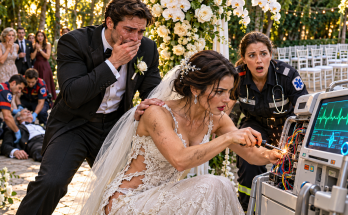
The first image showed Lana in her wedding dress.
I recognized the conservatory immediately.
The golden lights.
The crowded tables.
The large medical unit beside Arthur.
I pressed play.
The recording was short.
Approximately fifteen seconds.
But it showed enough.
There was Lana working on the equipment.
There was a brief flash of sparks.
Then there was the lead paramedic looking at her with an expression of unmistakable recognition.
His voice identified her as the person responsible for Apex Biomedical.
The recording captured part of her response.
Her instructions were firm.
Her appearance made the whole scene even more remarkable.
A bride in a torn white dress, standing beside expensive medical equipment, talking to emergency personnel with the authority of somebody who understood exactly what had gone wrong.
I watched the clip again.
I noticed details I hadn't been able to concentrate on the previous evening.
The people standing behind her.
The astonishment on the paramedic's face.
The dark marks across her dress.
The teenage cousin who filmed it had shared the recording publicly shortly before midnight.
Her caption explained that the bride had saved her father's life.
It also explained that Lana was the billionaire chief executive of a biomedical company.
The combination had attracted an enormous amount of attention.
I looked at the view count.
Three million.
I thought I might have read it incorrectly.
The recording had been available for only a few hours.
I refreshed the display.
The number continued increasing.
Messages appeared beneath it faster than I could read them.
People were praising Lana's composure.
Some were discussing the equipment.
Others were expressing disbelief that someone could possess that much wealth and still be willing to kneel on a floor in an expensive wedding dress to help a relative.
I looked at Lana.
She was beside me.
I showed her the recording.
“Your cousin put this out last night.”
She looked at the screen.
Then she looked at the number of views.
Her expression became serious.
I couldn't blame her.
She had spent considerable effort keeping her private life separate from her public position.
Now millions of people were watching footage from our wedding.
The privacy she had protected for so long had disappeared in a matter of hours.
My telephone vibrated again.
I placed it facedown.
For the first time, I understood how difficult the following days might become.
I had spent my adult life avoiding the kind of public attention my parents valued.
I was an architect.
My professional life involved plans, buildings, and practical discussions.
I wasn't accustomed to strangers taking an interest in my marriage.
Now people were attempting to identify the groom standing somewhere outside the frame.
That groom was me.
It didn't take them long.
My surname began appearing in discussions about the recording.
People identified my profession.
They found connections between me and my father's venture capital firm.
They discovered that Marshall Vance was my father.
They began examining information about our family.
I watched this happen with growing discomfort.
I hadn't invited anybody to investigate my parents.
I hadn't shared my mother's email.
I hadn't told the public about the wedding fund.
Those things belonged to an extraordinarily painful part of my private life.
But once people began searching, the connection between my marriage and my family became a subject of considerable interest.
Then the second disclosure appeared.
Somebody had published a screenshot.
I recognized it before I finished reading the accompanying explanation.
It was my mother's email.
The same message my younger cousin had forwarded to me.
The same careful language about family principles and acceptable standards.
The same request that our relatives refuse to attend.
I stared at it.
The original message had been sent to a large group of people.
Any one of those recipients could have retained a copy.
Apparently, one of my relatives had decided to make it public.
The person who shared it remained anonymous.
I understood later that it came from a cousin who had long resented my mother's attitude toward other people.
The screenshot appeared alongside the wedding recording.
Its accompanying explanation was direct.
My family had refused to attend because they believed the bride worked in hospital maintenance.
The woman they had rejected turned out to be a self-made billionaire.
I sat very still.
There was something deeply unsettling about seeing those words exposed to strangers.
When I first read my mother's message, I had been alone in my kitchen.
I had felt humiliated.
I had wondered how many relatives agreed with her.
Now people who had never met us were reading the same words and reaching their own conclusions.
The response was overwhelming.
Some people focused on the hypocrisy.
My father had built a career around identifying valuable business opportunities.
Yet he had failed to recognize the professional accomplishments of the woman sitting at his dinner table.
Others criticized my mother's fixation on social status.
They pointed out that the occupation she considered embarrassing involved keeping hospital equipment functioning.
Several people expressed anger on behalf of maintenance workers generally.
Those reactions stayed with me.
My family had behaved as though working with one's hands was evidence of failure.
The public response made it clear that many people understood how essential such work actually was.
I remembered Lana's stained overalls.
The black pager.
The tools hanging from her belt.
I remembered the coffee she had brought me.
Nothing about those memories had ever seemed embarrassing to me.
I couldn't understand why my parents had been incapable of seeing what I saw.
By late morning, the recording had spread far beyond its original audience.
Large publications were reporting on the wedding.
Business reporters were examining Lana's previously private personal life.
People who followed developments in medical technology recognized her name.
Articles appeared describing the marriage of a highly successful but unusually private biomedical executive.
Some focused on the extraordinary emergency at the reception.
Others focused on the contrast between Lana's wealth and her ordinary appearance.
I found the attention difficult to process.
The previous day, I had stood at an altar looking at thirty-seven empty chairs.
Now millions of people were discussing the woman I had married.
There was a strange unfairness in how quickly everything had changed.
Lana had been worthy of respect before anybody knew she was wealthy.
She had been kind before the public saw her repair the medical unit.
She had possessed exactly the same intelligence when my father insulted her.
Nothing about her fundamental character had changed overnight.
Only people's knowledge of her financial circumstances had changed.
I thought about the relatives who had ignored the invitations.
I wondered how many of them were now watching the recording.
How many were reading my mother's email alongside comments criticizing it.
How many were realizing that their loyalty to my parents had made them participants in something they couldn't easily explain.
I didn't feel particularly triumphant.
I felt tired.
I would have preferred for them to attend my wedding.
I would have preferred thirty-seven occupied chairs to ten million strangers expressing sympathy.
But I couldn't change what had happened.
By noon, the recording had reached approximately ten million views.
The number seemed impossible.
My telephone continued receiving messages.
My father's firm's public business pages were filling with criticism.
People were questioning the judgment and character of the individuals responsible for managing money at the company.
They were calling my parents arrogant.
They were accusing them of looking down on ordinary working people.
They were pointing out the absurdity of a venture capitalist dismissing one of the country's extraordinarily successful entrepreneurs as somebody unworthy of marrying his son.
I read several comments.
Then I stopped.
I didn't want to spend my first full day of marriage watching strangers insult my family.
Whatever my parents had done, they were still people I had known my entire life.
Seeing their public humiliation wasn't the same as receiving an apology.
It didn't return the hours I had spent waiting for replies.
It didn't fill the empty chairs.
It didn't undo the voicemail my father had left at eleven forty-five.
Those things were permanent.
Lana remained remarkably composed despite the attention.
I could see her professional instincts taking over.
The woman who had stood beside Arthur the previous evening was accustomed to dealing with complicated situations.
Her telephone was receiving messages, too.
There were professional matters requiring her attention.
I knew that her life wasn't going to stop because we had just gotten married.
And for the first time, I understood the scale of those responsibilities.
She wasn't simply responding to maintenance requests from a hospital.
She was responsible for a corporation whose technology affected patients, medical workers, and institutions.
That realization made me consider everything she had balanced during our relationship.
The late nights.
The interrupted dinners.
The unusual messages.
What I had assumed were the inconveniences of a demanding maintenance job had actually been part of overseeing an enormous enterprise.
I understood why people wanted access to her.
I understood why she had valued being able to sit in a diner without being recognized.
And I understood why the recording represented such a significant change for her.
By early afternoon, the attention surrounding our wedding was still increasing.
My parents' reputation was suffering publicly.
Their friends and business associates could no longer pretend not to know what they had done.
My mother had intended her email to remain within a carefully controlled social circle.
Instead, it had become evidence of the very behavior she usually concealed beneath polished manners.
My father had expected his financial influence to keep everybody obedient.
He hadn't anticipated someone making the situation public.
I thought that embarrassment would be the most serious consequence they faced.
I didn't yet know the condition of his company.
I didn't know that several disastrous investments had left his firm in desperate financial trouble.
And I didn't know that Marshall and Sterling had spent the previous six months pursuing a contract they believed could rescue everything.
At two that afternoon, they were sitting inside a downtown boardroom, waiting to meet the executive whose decision could determine whether their firm survived.