I didn't immediately know what to say.
Lana remained near the kitchen counter.
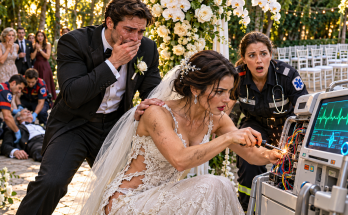
Her wedding dress was still torn along one side.
There were dark marks across the white fabric.
It seemed strange that neither of us had thought about changing clothes.
We were still dressed for the happiest day of our lives.
And we were having the most difficult conversation of our relationship.
I looked at her.
“Did you think I would start treating you differently?”
She nodded.
“Yes.”
“After everything we'd been through?”
“I didn't want to find out.”
Her honesty hurt.
I sat down.
For a moment, I concentrated on the familiar kitchen table rather than her face.
This was where I had written the wedding invitations.
Where I had read my mother's message.
Where I had accepted the reality that nobody from my family was coming.
Lana stood on the other side of that same table.
I thought about how many evenings we had spent there discussing ordinary things.
My architecture projects.
Her working hours.
Our plans for the weekend.
The life we imagined building together.
I had believed there was nothing unusual about any of it.
And from her perspective, perhaps that ordinary life had been precisely what she wanted.
She wasn't interested in expensive restaurants.
She didn't seem particularly concerned with luxury clothing.
She had genuinely enjoyed walking through public parks with me.
None of those experiences suddenly became false simply because she had the money to do something more extravagant.
I knew that.
But I also knew I deserved to have understood the circumstances of the person I was marrying.
“Lana, I understand being careful when you meet somebody.”
She listened.
“But we weren't strangers anymore.”
“I know.”
“You could have trusted me.”
She lowered her head.
“I should have.”
There was no attempt to excuse herself this time.
No explanation about why the timing had been difficult.
Just an acknowledgment.
I appreciated it.
For a while, I stared at the silver ring on her finger.
I had chosen it because I thought an expensive diamond would make her uncomfortable.
That part of my understanding had apparently been accurate.
She had never wanted a diamond.
Not because she couldn't afford one.
Because she didn't need one.
I wondered whether she had understood how much thought I had put into that modest purchase.
Judging by the way she cried when I proposed, I believed she had.
That memory belonged to us.
Her money couldn't alter what had happened in that hospital corridor.
She had accepted my ring.
She had wanted to marry me.
I looked back at her.
“When my father gave me that ultimatum, did you know what I would choose?”
She shook her head.
“No.”
“Were you waiting to see what I'd do?”
Her expression tightened.
“I wasn't trying to arrange some kind of test.”
I stayed quiet.
“But when you came home and told me you'd refused him, I understood something I hadn't been able to believe before.”
“What?”
“That you were willing to lose something substantial rather than lose me.”
She sat down opposite me.
Her eyes were red.
“You thought I was somebody with a modest salary and a difficult job. You didn't expect me to compensate you for what your father was taking away.”
I remembered standing inside that glass office.
The view over Chicago.
Sterling putting down his tablet.
My father waiting for me to reconsider.
I hadn't thought about what Lana might eventually earn.
I hadn't wondered whether marrying her would provide some future financial advantage.
I had simply known that I wanted her in my life.
She continued.
“You walked away from fifty thousand dollars and your inheritance because you loved me.”
She looked down.
“I can't describe what that meant to me.”
I took a breath.
“I didn't do it to prove anything.”
“I know.”
“I wasn't trying to impress you.”
“I know that, too.”
Her voice became barely audible.
“That's why it mattered.”
I sat there for a long time.
I was still hurt.
There was no point pretending otherwise.
But something about the anger had begun to change.
I had spent the drive home thinking about Lana's deception as though it belonged in the same category as everything my father had done.
Both had withheld something.
Both had allowed me to make decisions without a complete understanding of the circumstances.
But their reasons were different.
My father had used his fortune to make people obey him.
Lana had concealed hers because she wanted relationships that weren't controlled by it.
That difference didn't erase her mistake.
It did help me understand it.
I remembered the way she had comforted me after the dinner at my parents' house.
She hadn't mocked them.
She hadn't mentioned what she could have done to them financially.
She hadn't suggested calling somebody powerful to teach them a lesson.
She had put her arms around me.
She had told me we could build our own life.
I remembered the bank statement.
She had offered to help pay for our wedding without mentioning how insignificant the expense was to her.
She had allowed me to object.
She had understood that I didn't want to take advantage of her.
Even tonight, while her uncle lay on the floor, she hadn't cared about protecting an expensive dress.
She had cared about keeping him alive.
Those were important things.
They told me something about the woman I had married that the number one billion, two hundred million couldn't tell me.
I looked toward her damaged gown.
“Is that machine really yours?”
She nodded.
“The company developed it. I'm responsible for the underlying patented technology.”
I shook my head slowly.
I remembered the paramedic's expression.
He had initially tried to prevent her from approaching the equipment.
Then he had handed her the tools.
Then he had listened to her instructions with the unmistakable respect of somebody who understood exactly who she was.
I thought about the knowledge required to create something capable of saving a person's life.
I had spent years designing buildings.
I understood the satisfaction of seeing something function as intended.
I also understood the responsibility that accompanied creating something other people depended upon.
Lana had apparently devoted much of her life to that responsibility.
Her work was considerably larger in scale than I had imagined.
But it wasn't fundamentally different from the work she had described to me.
She made things function.
She solved problems.
And she cared when somebody else's negligence prevented important equipment from working.
I had admired those qualities before knowing her position.
I admired them now.
“Why were you actually repairing equipment yourself?”
She seemed surprised by the question.
“Because sometimes I need to see what's happening firsthand.”
I thought about her overalls.
The grease on her hands.
The late nights.
She hadn't simply put on work clothes to create an appearance.
She had been doing real work.
The things I admired about her weren't inventions.
She understood machinery because she had spent years working with it.
She could repair sophisticated equipment because she understood its development.
She hadn't needed to impress me with a title.
I had already been impressed by the person.
That realization loosened something inside me.
I thought about my mother looking at Lana's shoes.
My father dismissing her occupation.
Sterling describing her as someone beneath the family.
They had all been wrong.
Not because Lana was secretly wealthy.
Because nothing they had seen entitled them to treat her the way they had.
A hospital maintenance worker would have deserved exactly the same respect.
I would have married Lana if she had earned a modest hourly wage.
I would have married her if the botanical garden had been beyond our budget.
I would have married her at city hall with nobody watching.
That was why I had said yes to our future.
Her hidden fortune didn't change that answer.
But there was still something I needed her to understand.
“I don't want another surprise like this.”
She looked at me.
“I need to know the important things about your life.”
“You will.”
“Even the things you're afraid might upset me.”
She nodded.
“I understand.”
I looked at her hands resting against the table.
“Especially those things.”
She began crying again.
“I'm sorry, Harrison.”
I believed her.
She wasn't apologizing because I had discovered something financially inconvenient.
She was apologizing because she understood she had hurt me.
There was a vulnerability in her expression that I hadn't seen before.
I realized she had been carrying a considerable amount of fear throughout our relationship.
Every month that passed had made telling me the truth more difficult.
Every new memory had given her something else she was afraid of losing.
I wished she had handled it differently.
I wished I hadn't learned about her identity in a room full of wedding guests.
But I didn't wish I had chosen another woman.
That distinction became increasingly clear as I sat there.
I got up from the table.
Lana watched me.
For a moment, I think she believed I was going to leave the room.
Instead, I walked toward her.
She stood.
I looked at her face.
The woman who had brought me coffee.
The woman who had accepted my silver ring.
The woman who had stood before thirty-seven empty chairs and made me feel that I wasn't alone.
All of those women were the same person.
She was also a scientist, an inventor, and the head of an extraordinarily valuable company.
I was going to need time to understand that part of her life.
But I already understood the part that mattered most to me.
I put my arms around her.
She released a breath that sounded as though she had been holding it for a very long time.
Then she began crying against my shoulder.
I held her.
The torn dress pressed against my rented tuxedo.
There was nothing glamorous about the moment.
Nobody was applauding.
There were no photographers arranging our positions.
We were simply standing together in our little kitchen.
“I love you,” I told her.
She tightened her arms around me.
“I love you, too.”
I hadn't forgiven her because she was a billionaire.
I hadn't decided that her fortune compensated for the pain she had caused.
The money wasn't what made me stay.
It was the same thing that had made me refuse my father's offer.
I wanted a life with her.
I wanted that life to be honest.
And I believed we could still have it.
Eventually, we grew quiet.
I rested my cheek against her hair.
For the first time since the paramedic recognized her, I felt able to breathe normally.
The evening had been exhausting.
Arthur's collapse.
The failed medical equipment.
The revelation.
Our argument.
Everything had happened within a few hours.
I wanted us both to get some rest.
Whatever practical questions remained could be discussed when we weren't physically and emotionally exhausted.
I thought the truth was finally something we could deal with privately.
I believed we would wake up the following morning and begin sorting through what our marriage would look like now that everything was out in the open.
At that point, I had almost forgotten about the teenage cousin holding her telephone near the medical console.
I had seen her recording.
But it hadn't seemed important compared with everything else happening in the conservatory.
I didn't know that she had already shared the recording.
I didn't know that, shortly before midnight, people I had never met were beginning to discover exactly what had happened at our wedding.
Inside our apartment, Lana and I had finally stopped keeping the truth between us.
Outside it, that same truth was becoming impossible to contain.