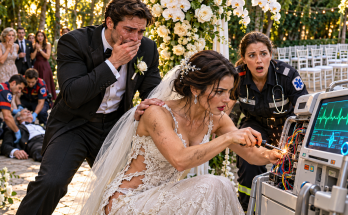
The reception took place inside a glass conservatory on the botanical garden grounds.
By the time we entered, the afternoon light had begun to fade.
The glass ceiling reflected the last of the daylight.
Small golden lights had been arranged overhead.
As evening approached, they became more noticeable.
The room felt warm and welcoming.
I looked around at the tables.
The catering arrangements had been adjusted as requested.
There weren't thirty-seven unused plates waiting for my relatives.
There weren't drinks poured for people who had decided to stay home.
The guests who had come occupied the space comfortably.
I appreciated that the coordinator had handled everything without making the changes feel obvious.
Lana stood beside me, holding my hand.
Her wedding dress brushed against my trousers.
She looked around at her relatives.
Then she looked at me.
“Ready?”
I smiled.
“Definitely.”
We walked into the reception together.
Her family welcomed us loudly.
There was applause.
People stood from their seats.
Several relatives came forward to embrace us.
I found myself surrounded by people whose affection seemed remarkably uncomplicated.
They congratulated me.
They wished us happiness.
Nobody asked about the wedding fund.
Nobody questioned what I earned.
Nobody suggested that I should be grateful to have married into their family.
They simply welcomed me.
I hadn't realized how unfamiliar that feeling was until I experienced it.
At my parents' formal gatherings, affection had generally been restrained.
People spoke carefully.
They watched one another.
Even compliments often carried some expectation.
Here, people laughed when something amused them.
They hugged one another without checking who was watching.
They didn't appear worried about whether their happiness looked sophisticated.
I loved it.
There were older relatives talking across the tables.
Younger cousins moving between groups.
Children who seemed determined to explore every part of the conservatory.
The music filled the room.
I watched Lana greet her family.
There was a softness in her expression that I recognized from our quieter evenings together.
She was comfortable around these people.
They knew her.
And they were delighted to see her happy.
I remembered how my mother had looked at her shoes when we entered the family mansion.
I wished my mother could understand how little that inspection had revealed about the woman standing beside me.
But I no longer wanted to spend the evening imagining what my parents might think.
They weren't there.
The people in front of me were.
I concentrated on them.
The food was wonderful.
There was more care in the arrangements than I had expected when Lana first insisted on covering the wedding.
I occasionally found myself wondering how long she had been saving.
I knew her work hours were demanding.
I knew she rarely spent money on herself.
The old canvas jacket.
The worn denim.
The inexpensive meals we shared.
I had imagined those habits were the reason she had managed to put enough money aside.
Still, looking around the conservatory, I felt an enormous amount of gratitude.
She had wanted to give us a memorable day.
She had succeeded.
When I thanked her, she brushed it aside.
“Enjoy yourself, Harrison.”
I looked at her.
“I mean it. You did all this.”
“We did.”
She squeezed my arm.
“Now stop worrying about it.”
I smiled.
It was exactly the sort of thing she would say.
She had never enjoyed prolonged discussions about what things cost.
Whenever I tried to make too much of something she had done for me, she usually redirected my attention toward enjoying it.
So I tried.
I ate.
I talked.
I accepted the champagne people offered me.
And when Lana's family pulled me toward the dance floor, I went.
I wasn't particularly concerned with how I looked.
Nobody else seemed concerned, either.
There was laughter when somebody missed a step.
People danced with relatives of different generations.
The children moved around them without any understanding of rhythm.
It was everything a family celebration ought to have been.
I found myself laughing more freely than I had in weeks.
At one point, I looked toward Lana.
She was smiling at me from nearby.
I walked over to her.
She placed her hand against my shoulder.
“You look happier.”
“I am.”
“Good.”
We danced.
I held her carefully, aware of the delicate fabric of her wedding gown.
She rested against me.
For a while, neither of us spoke.
There was nothing particularly important to say.
I didn't need to explain how relieved I felt.
She understood.
I didn't need to tell her that her family's kindness had affected me.
She could see it.
We were surrounded by music, conversation, and the warm light coming through the conservatory.
I allowed myself to enjoy being married.
That sounds obvious now.
But there had been so much conflict leading up to the wedding that I had almost forgotten the celebration was supposed to be joyful.
Every discussion with my father had been about what I would lose.
Every communication from my mother had concerned what I was supposedly doing to the family.
Even the invitations had become a source of anxiety.
Now I could finally experience the part they had all tried to take away from me.
Happiness.
It wasn't something they could withdraw from a trust.
It wasn't something my mother could cancel with an email.
And it wasn't dependent on anybody sitting in those thirty-seven chairs.
As the evening continued, I became increasingly comfortable among Lana's relatives.
Her uncles spoke to me like they had known me for years.
Her aunts made sure I had eaten enough.
Her cousins encouraged me to join them whenever the music changed.
There was no sense that I needed to prove myself.
I was Lana's husband.
That was sufficient.
I thought about the dining room at my parents' house.
The expensive table.
The carefully folded napkins.
The silence that had followed Lana's explanation of her work.
My family had possessed nearly everything people associated with success.
And yet I couldn't remember feeling as welcome in their home as I felt among these people.
For almost three hours, I barely thought about the events that had brought us there.
I wasn't angry.
I wasn't grieving.
I wasn't planning how to respond if somebody contacted me.
I was simply having a wonderful evening.
Then, at eight-thirty, everything changed.
The sound came from table number four.
A woman's voice.
It rose above the music with such obvious terror that conversations stopped almost immediately.
“Somebody help! Please! Arthur!”
I turned toward the table.
For a fraction of a second, I couldn't understand what I was seeing.
A chair had moved backward.
Several people were standing.
Someone was looking down at the floor.
Then I saw a man lying beside the table.
Arthur.
Lana's uncle.
He was a heavyset man in his late sixties.
His hand was near his chest.
His face looked terribly wrong.
The champagne glass slipped from my fingers.
I heard it break against the marble floor.
I barely noticed.
Lana was already moving.
I followed her toward table four.
The music stopped.
The room filled with the sounds of frightened people trying to understand what was happening.
“Call an ambulance!”
“Is he breathing?”
“Arthur!”
Somebody knelt beside him.
Another guest tried to make room.
Chairs scraped across the floor.
A few people backed away with their hands covering their mouths.
Arthur wasn't responding.
His skin had lost its normal color.
The bluish appearance of his face frightened me more than anything I had ever seen.
Someone said they couldn't find a pulse.
A guest began chest compressions.
I stood nearby, unable to think clearly.
I had spent hours beside a hospital waiting room when my friend had been injured.
But that had been different.
I hadn't witnessed the accident.
I hadn't watched somebody suddenly collapse in front of me.
There had been walls and doors separating me from the emergency.
Here, there was nothing between me and Arthur.
He was lying on the floor.
His family was terrified.
And I had no idea what to do.
Lana knelt beside him.
I expected her to become overwhelmed.
He was her uncle.
Only moments earlier, she had been celebrating with the people she loved.
Instead, something about her changed.
Her face became intensely focused.
The warmth and softness I had seen throughout the evening disappeared beneath an expression of absolute concentration.
She assessed what was happening.
Then she spoke.
“Keep the compressions going. Don't stop.”
Her voice was clear.
Firm.
Everyone nearby heard her.
The person performing the compressions continued.
Lana looked toward the people gathered around Arthur.
“Give him some room. The ambulance crew will need space.”
People moved almost immediately.
I watched her in astonishment.
There was no hesitation in her movements.
She wasn't merely trying to appear calm.
She seemed to understand exactly what mattered and what didn't.
The difference was remarkable.
Several relatives were crying.
Someone continued calling Arthur's name.
Lana remained beside him.
She spoke only when necessary.
I found myself remembering the first evening we had spent together at the diner.
The way she had looked at the waitress.
The quiet authority that had appeared without warning.
I had admired it then.
Now I saw that same quality under circumstances where somebody's life depended on people remaining focused.
I knew she worked around hospital equipment.
I assumed she had witnessed emergencies before.
That explanation made sense to me.
I held on to it.
The minutes seemed extraordinarily long.
I kept looking toward the conservatory entrance.
Somebody had contacted emergency services.
I knew help was coming.
But knowing that didn't make waiting any easier.
Lana stayed near Arthur.
The guest continued performing chest compressions.
I tried not to look directly at his face.
Around us, the celebration had completely disappeared.
Half-finished drinks remained on the tables.
The golden lights continued shining overhead.
The decorations hadn't changed.
But nobody was looking at them anymore.
There was something terrible about seeing an emergency unfold in a room that had been prepared for happiness.
A few moments earlier, we had been dancing beneath those lights.
Now a family was gathered around a man who might never stand up again.
I felt helpless.
Eventually, I heard the sirens.
The sound grew louder as the ambulance approached the garden.
Somebody hurried toward the entrance.
People shifted to create a clear path through the conservatory.
Approximately six minutes had passed since Arthur collapsed.
It felt considerably longer.
Four emergency medical workers entered the room.
They moved quickly toward Arthur.
With them came a large rolling medical unit.
It was unlike the portable equipment I had imagined an ambulance crew might bring.
The console was substantial.
It had a screen, several controls, and a metallic housing that looked incredibly expensive.
I later learned much more about that machine.
At the time, I only understood that it was designed to help people facing exactly the kind of emergency Arthur was experiencing.
The lead paramedic directed the people around him.
“Step back. We need access.”
Lana made room for the crew.
The professionals took their positions.
One of them prepared the equipment.
Another concentrated on Arthur.
I felt a little of the pressure inside my chest ease.
These people knew what they were doing.
They had arrived with the necessary equipment.
I wanted desperately to believe everything would be all right.
The lead paramedic reached toward the medical console.
I watched him operate its controls.
The screen responded briefly.
Then something went wrong.
The display flickered.
A red warning light appeared.
There was a piercing electronic sound.
I looked from the machine to the paramedic.
He tried again.
The equipment remained unresponsive.
His expression changed.
One of the other medical workers looked toward him.
“What happened?”
“It's not completing startup.”
He tried to get the unit working.
The warning continued.
I looked at Arthur.
Then I looked at the large machine beside him.
It was supposed to help save his life.
Instead, it stood there flashing a warning that nobody seemed able to resolve.
The paramedic called for the backup equipment.
Another member of the crew spoke urgently about Arthur's heart rhythm.
The tension in the room increased.
I didn't understand the technical problem.
I understood that they were running out of time.
Lana was watching the console.
Her eyes moved across its screen.
Then across the housing.
I saw her expression change again.
She wasn't looking at the equipment like somebody encountering an unfamiliar machine.
She looked like somebody recognizing a problem.
I remembered the stained overalls.
The tools around her waist.
The messages filled with technical language.
The nights she spent at Chicago Memorial repairing equipment.
I looked at the medical unit.
Then I looked at my wife.
She rose from beside her uncle.
And in that instant, I understood that she wasn't going to stand back and wait.