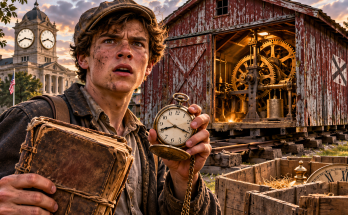
We left the clock room while Ellis continued inspecting the movement.
The stairs seemed even narrower on the way down.
I kept one hand near the wall and took my time.
Leah helped Ruth.
Nobody wanted the excitement upstairs to become a reason for carelessness elsewhere in the building.
When we reached the lawn, people were already watching the cooperative crew prepare one of the glass dials.
I joined them.
The original dial had been taken from its protective packing under Ellis's direction.
Its pale surface looked enormous outside the freight shed.
Five feet across.
I understood that measurement differently now that I could see it beside the equipment that would carry it toward the tower.
The old painted circle on the south face of the courthouse was clearly visible.
Its hands remained at eight seventeen.
I wondered how many people standing beside me had ever known the tower without that particular arrangement.
Probably none.
The appearance of the courthouse had become so familiar that changing it seemed almost unnatural.
Yet the painted clock had never been the intended result.
It was what the town had accepted when the intended result had become unaffordable.
The bucket crew prepared the glass carefully.
Ellis made certain that the people handling it understood its condition.
It wasn't new material that could be reordered if somebody damaged it.
It had been manufactured for this building in 1931.
The packing had protected it through decades of storage.
We needed to protect it through a few more minutes of examination.
I looked toward Grant.
He was watching the equipment.
His nephew stood nearby.
I could see June and Everett farther across the lawn.
Ruth remained beside Leah.
The dial began rising.
People followed it with their eyes.
There was very little conversation.
The closer the glass came to the tower, the more clearly I could compare its size with the painted circle.
I held my breath.
I didn't realize I was doing it until the dial reached the appropriate height.
Its circumference corresponded almost exactly with the old clock face.
The difference between the two was barely apparent from the ground.
Somebody near me began clapping.
Then somebody else joined in.
Within a few seconds, applause had spread across the lawn.
I looked at the glass.
I had expected the measurements to match.
The original drawing had already established the dial's intended size.
But seeing it beside the courthouse made the entire discovery feel different.
There was no longer an abandoned building on one side of town and an unfinished tower on the other.
The two belonged to the same story.
People could see that for themselves.
I glanced toward Leah.
She was smiling.
Ruth was looking upward with both hands held together.
I felt something I hadn't allowed myself to feel during the previous weeks.
Relief.
The shed hadn't been full of broken agricultural equipment.
The newspaper hadn't accounted for everything that happened to the canceled order.
And I hadn't spent all that money protecting machinery that had no connection to the courthouse.
The evidence was right above us.
The glass wasn't being permanently installed that day.
Ellis had already explained that substantial restoration work would be necessary before the clock could safely operate.
The movement needed examination.
Old protective grease needed to be removed.
The mechanisms connecting the four faces needed attention.
Every component would have to be checked.
The dial was brought back down for cleaning and eventual installation.
I watched until it was safely returned to the ground.
Some of the applause continued even after it had been lowered.
That made me smile.
People had spent their entire lives looking at those painted hands.
Now they had seen what the tower was supposed to look like.
It wouldn't happen immediately.
But for the first time, it could happen.
I looked toward the courthouse entrance.
I thought about the mechanism resting on its four original bolts.
I thought about the pendulum components and the fragile piece of spring steel Ellis had warned us about.
There was still plenty of work ahead.
I hoped the county would find a way to complete it.
The financial arrangements hadn't been settled.
The machinery had been moved for examination and possible installation, not because I had already agreed to give it away.
June had been clear about that from the beginning.
The county would need to make its decisions properly.
I would need to make mine.
For a little while, I allowed myself to concentrate on what we had established that day.
Then I thought about Tuesday.
The utility deadline.
I felt the excitement leave my stomach.
It embarrassed me that those two things could exist side by side.
A historic clock had reached its destination.
People were applauding.
And I didn't know how Leah was going to pay an eight-hundred-forty-dollar shortfall by the following afternoon.
The amount seemed especially small beside the machinery we had discovered.
But the size of the amount wasn't the issue.
Having it was.
I walked over to Leah.
She looked at me.
"What is it?"
"Nothing."
She knew me well enough not to believe that.
I glanced toward the clock tower.
"I just wish we had a little more time."
She understood.
"We'll see what happens."
She wasn't asking me to solve it while people stood around celebrating.
She wasn't going to spoil the moment for Ruth.
We stayed on the lawn a little longer.
Then we returned home.
The shed looked different without the freight.
I could stand in the main entrance and see the places where the crates had been held.
The braces remained.
There were marks on the floor where the packing arrangement had rested.
I walked slowly through the empty space.
It was the first time I had been able to appreciate how much room those crates had occupied.
The little office at the back remained unchanged.
I went inside and looked at Albert's desk.
I opened the drawer.
The pocket watch was still there.
I held it briefly.
Then I wrapped it again and returned it to its place.
I wasn't ready to decide everything that needed deciding.
I knew only that the watch wasn't going to be treated like an interchangeable part of the machinery.
It had belonged to somebody.
I knew who that somebody was.
Later that evening, Richard Hale arrived from Minneapolis.
He had heard about the discovery and seen footage from the opening of the crates.
His interest was in historic American tower clocks.
Unlike the people who had suggested the freight might contain a broken cream separator, Richard understood the importance of what Ellis had identified.
He wanted to discuss buying it.
We sat at Leah's kitchen table.
The same table where she had shown me the figures for the electricity bill.
The pencil she'd used was an ordinary thing.
The scratches in the tabletop were ordinary, too.
Richard was about to discuss an amount of money that had never been discussed at that table before.
He began by explaining why the discovery interested him.
The manufacturer's name mattered.
The age of the movement mattered.
But the most unusual thing was that the clock had apparently never been installed.
It hadn't spent decades operating in a tower.
It hadn't been removed after being replaced by modern equipment.
It hadn't been separated into pieces that collectors later had to find individually.
The original machinery had survived with its associated parts.
All four glass dials were present.
The shipping documents had remained with the freight.
Even the original packing arrangement had helped establish its history.
Richard explained that finding so many related components together was uncommon.
Finding them in that condition made the clock particularly desirable to somebody who collected historic mechanisms.
I listened without interrupting.
There was something strange about hearing the same details Ellis had treated as preservation concerns described in terms of financial value.
The four glass dials.
The original papers.
The manufacturer's plate.
The shipping frames.
Every one of those things had survived because Albert Finch hadn't permitted anyone to disturb the shipment.
Now Richard was explaining what their survival might mean to me.
He didn't criticize the county.
He didn't suggest I had done something foolish by bringing the mechanism to the courthouse tower.
He simply wanted to purchase it.
I waited for him to name a price.
He looked at me.
"I can offer fifty-eight thousand dollars."
I thought I had heard him correctly.
Still, I asked him to repeat it.
"Fifty-eight thousand."
I glanced at Leah.
She had gone very still.
Richard explained that payment could be made by bank transfer.
He could organize the collection that week.
I looked down at my hands.
Fifty-eight thousand dollars.
Travis's offer of twenty-five hundred had seemed almost impossible to refuse.
This was more than twenty times that amount.
I didn't know how to react.
I had spent sixty-five dollars buying the building.
I had worried about twenty-eight dollars for railroad ties.
I had stood beside the kitchen table staring at seven dollars in a coffee can.
Now a man was offering me fifty-eight thousand dollars for the freight those decisions had helped preserve.
I looked toward the refrigerator.
The utility notice was still attached to it.
That piece of paper had influenced nearly every decision I had made about the shed.
It wouldn't be a problem anymore if I accepted Richard's offer.
Neither would several other things we had been worrying about.
I could tell Leah was thinking about those things.
The roof over the back bedroom needed attention.
Winter would eventually arrive.
There were always expenses waiting for somebody who lived without much financial security.
I needed reliable transportation for my work.
I had been thinking about training after high school.
Fifty-eight thousand dollars could help with all of it.
I tried to picture a bank account containing that amount.
I couldn't.
I could picture paying a bill without first calculating how much money would remain.
I could picture Leah having the option to work fewer nights.
I could picture purchasing tools without worrying that one unexpected household expense would make me regret it.
Those were the things that made Richard's offer feel real.
Not anything extravagant.
Not an expensive house.
Not a new sports car.
Ordinary security.
The kind of security that had always seemed to belong to other people.
Richard waited while I considered the number.
I appreciated that he didn't attempt to fill the silence.
I looked at Leah again.
She was sitting with her hands resting on the table.
She didn't tell me what to do.
I wished, briefly, that she would.
It would have been easier to accept the money if she had asked me to.
I could have told myself I was doing it for her.
It would have been easier to refuse if she had insisted the clock remain in town.
I could have told myself I was following her wishes.
Instead, I had to make a decision that belonged to me.
Richard's offer was straightforward.
He wanted the complete clock assembly and its associated historical documentation.
He was prepared to handle the arrangements required to remove it.
The movement could be taken out of the courthouse tower before restoration began.
I thought about the nut Ellis had turned onto the old bolt.
That nut could be unscrewed.
The movement could be lifted again.
The glass dials could be returned to their shipping frames.
It was technically possible.
The realization bothered me more than I expected.
That morning, I had watched the machinery fit precisely where the original drawing indicated.
That afternoon, I had heard people applaud when the glass dial matched the painted circle.
Now I was sitting at our kitchen table considering whether to have everything removed.
I couldn't pretend the money wasn't important.
It would have been dishonest to act as though fifty-eight thousand dollars meant nothing to me.
It meant more than almost anything I had ever been offered.
I needed time to consider what else the decision meant.
I looked at Richard.
"Could I have until tomorrow?"
He agreed.
There was no argument.
No attempt to make the offer conditional on an immediate answer.
He appeared to understand that the clock represented something complicated to me.
When the discussion ended, I remained at the kitchen table.
Leah was quiet.
I looked at the spot where Richard had been sitting.
Fifty-eight thousand dollars.
The figure stayed in my head.
I imagined what accepting it would change for us.
Then I imagined what accepting it would change at the courthouse.
The tower would become empty again.
The four bolts would project from the floor without a purpose.
The painted faces would remain at eight seventeen.
I didn't know whether the county would ever find another mechanism suited to that building.
Perhaps it would.
Perhaps the restoration would become somebody else's project many years later.
But the machine manufactured for that particular tower would be gone.
I could make that happen with a single decision.
I got up from the table.
Outside, the empty freight shed stood between the clothesline and the garden.
I walked toward it and stopped beside the open entrance.
There were no crates inside now.
They had finished the journey Albert Finch had believed they would eventually make.
I looked back toward the kitchen window.
The unpaid notice was somewhere behind it.
For the first time, I understood that discovering something valuable didn't necessarily make the next decision easier.
It had given me a choice between two things that mattered.
And I couldn't pretend either one was unimportant.