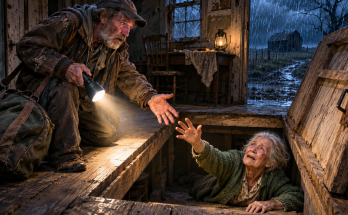
Dad didn't stop contacting me after I told him I wasn't returning to the farmhouse.
Some messages were easier to read than others.
When he asked how school was going, I could answer.
When he asked about my diabetes, I usually gave him a simple response.
But whenever the conversation turned toward coming home, I felt myself becoming tense.
The word home had changed.
I didn't know how to explain that to him.
For most of my childhood, home had meant the farmhouse.
It was where my belongings were kept.
Where I had eaten dinner.
Where I had grown up with Brin.
It contained good memories alongside the difficult ones.
But after the storm, thinking about that house always brought me back to the front door.
I could hear the lock.
I could remember the rain.
I could remember standing outside and trying to decide how long Dad would leave me there.
Those memories didn't disappear because he wanted me back.
Elena never told me I had to stop speaking with him.
She didn't discourage me from remembering the good parts of our relationship.
She understood that he was still my father.
But she also understood that I needed room to recover without being pressured.
The child welfare agency continued reviewing the circumstances surrounding my hospitalization.
There were safety arrangements to consider.
There were discussions involving adults who understood the responsibilities and legal issues better than I did.
I wasn't expected to manage those matters myself.
That was reassuring.
For years, I had sometimes felt as though my wellbeing depended entirely on how effectively I could persuade someone to help me.
Now there were people whose responsibility was to make sure I received appropriate care.
I didn't have to convince them that diabetes was serious.
I didn't have to explain why being outside in freezing rain without medical supplies was dangerous.
They already understood.
And they didn't dismiss my concerns simply because the person involved was my father.
As the weeks continued, I began settling into my routine with Elena.
School became more important to me again.
Before the storm, I had often struggled to concentrate when things were difficult at home.
I would sit with my books open while thinking about whether Dad was angry or whether Colleen would complain about something.
Sometimes I worried about supplies I might need.
Sometimes I worried about what was happening in the kitchen.
There was always something competing for my attention.
Now, at the little table beside the window, I found that I could spend longer periods concentrating.
The difference wasn't dramatic at first.
I simply noticed that I was finishing things.
I could read a page without immediately thinking about something else.
I could work through an assignment without listening for an argument.
I could prepare what I needed for the following day without worrying that somebody would search my belongings.
It felt unfamiliar.
And good.
I returned to school as my recovery and circumstances allowed.
There was something comforting about ordinary lessons.
An assignment had instructions.
A question usually had an answer.
If I made a mistake, there was a way to correct it.
My family situation wasn't nearly that straightforward.
At school, I could spend part of the day thinking about something other than the investigation.
That mattered to me.
I didn't want what had happened during the storm to become the only important thing about my life.
I was still fifteen.
There were subjects I enjoyed.
Books I wanted to read.
Things I wanted to understand.
I had plans that had nothing to do with the farmhouse.
For a while, I had almost forgotten those plans existed.
My attention had become so focused on the things happening around me that I hadn't been thinking much about what I wanted for myself.
Elena encouraged me to continue with school.
She asked about my work when I came home.
Not in a way that made me feel she was checking whether I deserved approval.
She was interested.
Sometimes I told her about what I had been reading.
Sometimes I complained about an assignment.
Sometimes I didn't have much to say.
She accepted those differences.
I began realizing that ordinary conversations could help a person feel secure.
There didn't always need to be a significant discussion.
Sometimes sitting near someone who was interested in your day was enough.
One afternoon, I was working at the table when I became aware that I needed to attend to my blood sugar.
I stopped what I was doing.
My first instinct was to finish the assignment before dealing with anything else.
Then I caught myself.
There wasn't a reason to delay taking care of myself.
Nobody was waiting for me to prove that schoolwork mattered more than my health.
I put my pen down.
I checked what I needed to check.
I followed the care plan I had been given.
And then I returned to my work.
It was an ordinary sequence of events.
But I remembered how often I had felt embarrassed about needing to interrupt something because of diabetes.
That afternoon, I didn't apologize.
I simply continued with my day.
When Elena came into the kitchen, she asked whether everything was all right.
"Yes."
And it was.
I hadn't needed her to solve anything.
But I appreciated knowing that if I did need help, I could ask.
That was becoming one of the most important differences between the apartment and the farmhouse.
I wasn't trying to avoid depending on anyone at all.
I was learning that asking for help didn't make me less capable.
The financial investigation continued during that period.
More records were being examined.
The attorney responsible for reviewing the trust wanted proper explanations for the expenses that had been identified.
Elena occasionally told me about developments.
She was careful not to make those conversations more complicated than they needed to be.
I knew there had been an initial contribution of eighty-five thousand dollars.
I knew that approximately thirty-one thousand six hundred dollars in withdrawals had required further explanation.
I knew some transactions appeared connected to expenses that weren't clearly for my benefit.
And I knew the adults responsible for the account were disagreeing about what had happened.
Those were the established facts.
There were still questions.
I had to learn to tolerate those questions without inventing answers.
Sometimes I wanted Elena to tell me exactly why Dad had kept the trust secret.
I wanted her to explain whether the money was the reason he had prevented us from knowing each other.
There were reasons to wonder about those things.
But wondering wasn't the same as knowing.
Elena would acknowledge that distinction.
"I think the records will help us understand more."
I would nod.
Then I would return to whatever I had been doing.
It was frustrating.
I wanted a clear explanation.
I wanted something that would make all the painful things fit together.
But life didn't become simple just because I finally had access to part of the truth.
I began attending counseling as part of my recovery.
At first, I wasn't sure what I was supposed to say.
Talking about family problems felt uncomfortable.
Even after everything had happened, I still had a strong instinct to keep certain matters private.
I worried that if I described Dad's behavior honestly, I would sound disloyal.
I worried that people might think I was exaggerating.
I worried that I would remember something incorrectly and make the situation worse.
Those worries made it difficult to begin.
But I continued attending.
Gradually, I found it easier to talk about how I felt rather than trying to provide a perfect explanation of every event.
I talked about the hospital.
I talked about the rain.
I talked about hearing the door lock behind me.
Sometimes I found myself discussing things that had happened long before the storm.
The way Dad spoke about my medical expenses.
The way I had tried to make myself less noticeable when adults were upset.
The way I had automatically apologized when somebody became impatient.
Those habits hadn't developed in one evening.
They had accumulated over years.
I was beginning to understand that.
There were moments when I felt embarrassed describing them.
I couldn't believe how many times I had accepted blame simply to end an uncomfortable conversation.
But I was trying to be fair to the younger version of myself.
I had been a child.
I had depended on the people whose approval I was trying to keep.
I hadn't known another way to manage those situations.
Understanding that helped.
It didn't make every memory easier.
But it helped me stop interpreting every difficulty as evidence that I had failed.
One day, I came home from counseling and sat at the kitchen table for a long time.
Elena was nearby.
She asked whether I wanted to tell her how the appointment had gone.
I said I was still thinking about it.
She nodded.
I looked at my hands.
"Do you think I apologize too much?"
She considered the question.
"Sometimes."
I felt uncomfortable hearing that.
She continued gently.
"I think you're used to worrying about how other people are feeling."
I nodded.
"Is that bad?"
"Not by itself."
She sat down.
"But your feelings matter as well."
I looked at her.
I had heard versions of that idea before.
I understood it when it applied to other people.
Applying it to myself remained difficult.
I thought about Brin.
When she had asked whether I hated her, I had wanted to reassure her immediately.
I thought about Dad crying at the hospital.
I had almost felt guilty for not comforting him.
And I thought about Colleen standing beside my bed, refusing to answer questions.
My first instinct had been to stop asking.
All those reactions had something in common.
I had been more concerned about the discomfort of the people around me than about what I needed.
I didn't want to continue living that way.
Elena wasn't asking me to become unkind.
She wasn't telling me to ignore other people's feelings.
She was helping me understand that consideration didn't need to come at my own expense.
The conversation stayed with me.
Over the following days, Dad sent another message asking whether I might be ready to reconsider where I was living.
I read it while sitting beside the kitchen window.
For a moment, I started composing a long explanation.
I wanted to tell him about counseling.
About school.
About how comfortable I was becoming with Elena.
I wanted to explain why returning would be difficult.
Then I stopped.
He already knew what had happened.
He knew I had been hospitalized.
He knew the safety arrangements were being reviewed.
And I had already told him I wasn't ready to return.
I didn't need to produce another defense of that decision.
I wrote a simple answer.
I told him I was staying with Mom.
I sent the message.
Then I put my phone down and returned to my schoolwork.
It was the first time I had answered that question without spending the rest of the afternoon worrying about how he would react.
I still cared about his feelings.
I just wasn't willing to make my safety depend on them.