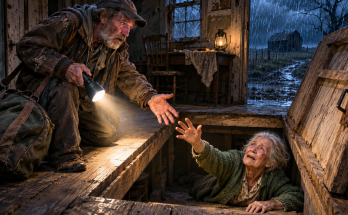
By late January, Linda was discussing a possible resolution to the criminal case.
Daniel's attorney had been in communication with the prosecutors.
There were several matters under consideration.
Eventually, Daniel agreed to acknowledge responsibility by pleading guilty to selected offenses involving Ruth's confinement and the financial misconduct.
Other allegations would be dealt with through the negotiated agreement and related proceedings.
I didn't pretend to understand every legal distinction.
I asked Linda only what I needed to know.
For Ruth, the important thing was that Daniel would no longer be denying responsibility for everything that had happened.
There would be a formal acknowledgment of certain wrongdoing.
There would also be consequences.
Ruth listened to Linda's explanation at her kitchen table.
The old notebook Walter had kept was nearby.
So was a cup of tea that had been sitting untouched for quite a while.
When Linda finished explaining the anticipated proceedings, Ruth asked a simple question.
“Will I be allowed to say something?”
Linda nodded.
She explained that Ruth would have an opportunity to describe the effects of Daniel's conduct.
Ruth considered that.
“What am I supposed to include?”
“Whatever you believe the court needs to understand.”
Ruth looked toward the window.
I wondered how somebody could put the experience of those days into a statement.
The confinement had lasted more than two days.
But its effects extended far beyond the moment when I opened the basement door.
Ruth had lost money.
She had lost confidence in her ability to trust people.
For a while, she had even lost access to her own home.
Perhaps most painfully, she had discovered things about Daniel that she could never forget.
Linda suggested taking some time to write down what she wanted to express.
There was no need to finish it immediately.
Ruth agreed.
Over the following days, I occasionally found her sitting at the kitchen table with a pen and several sheets of paper.
Sometimes she was writing.
Other times, she was staring at something she had already written.
I didn't ask to read it.
Those words belonged to her.
She had spent enough time having other people interfere with her affairs.
I wasn't going to become another person who assumed access to her private thoughts.
One evening, she mentioned that she had written four pages.
“Seems rather a lot.”
“You've got quite a bit to say.”
She shook her head.
“Some of it's just me trying to understand things.”
She tapped the papers.
“I don't think the judge needs every memory I've got of that boy.”
I nodded.
The next time she mentioned the statement, she had reduced it to two pages.
Eventually, she decided a single page was sufficient.
She folded it and placed it inside a plain white envelope.
“That should do it.”
I looked at the envelope.
“Are you comfortable with what you've written?”
“As comfortable as I'm likely to be.”
She placed it beside Walter's notebook.
Then she asked whether I would accompany her to court.
“Of course.”
“Tom and Margaret are coming, too.”
I was glad.
Ruth didn't need to face that experience surrounded only by people whose involvement was professional.
She deserved to have familiar faces nearby.
On the morning of the proceedings, I prepared myself carefully.
I wore the clean shirt Emily had given me.
I checked the weather before leaving the cottage.
Winter had settled firmly over the farm.
There was frost along the edges of the fields, and the air was cold enough to make my hands ache.
I walked toward the farmhouse.
Ruth was ready when I arrived.
She wore a navy dress and an older coat.
She mentioned that Walter had purchased the coat for her many years earlier.
It was in good condition.
She had evidently looked after it.
The white envelope was in her hand.
She checked that she had it before we left.
Then she checked again.
I understood.
Sometimes the most difficult part of a frightening occasion was the time spent getting ready for it.
You checked ordinary objects because there was nothing else you could control.
The courthouse was an older stone building.
Inside, the ceilings were high, and the corridors seemed unusually wide.
Our footsteps echoed as we walked.
Linda met Ruth and explained where we needed to go.
Tom and Margaret stayed close.
I noticed Ruth looking around whenever a door opened nearby.
She wasn't saying much.
I didn't try to distract her with unnecessary conversation.
When we entered the courtroom, Ruth took her place.
Linda remained available to assist her.
Tom, Margaret, and I sat behind.
There was a box of tissues within reach.
I remembered seeing one in the office where I had been interviewed.
Apparently, the people responsible for arranging these rooms understood that paperwork and legal questions were only part of what happened inside them.
Eventually, Daniel entered.
I hadn't seen him since the encounter at the Harpers' house.
The difference in his appearance surprised me.
His hair was shorter.
He had lost weight.
The confident man who had stood beside his expensive SUV demanding access to the farmhouse seemed absent.
Daniel looked toward the front of the courtroom.
He didn't look in our direction.
I watched Ruth.
Her hands were folded over the white envelope.
She remained still.
Whatever she was feeling, she wasn't showing much of it.
The proceedings began.
The prosecutor described the evidence supporting the negotiated agreement.
The discussion included the circumstances of Ruth's confinement and the financial wrongdoing Daniel was acknowledging.
There were references to documents and investigative findings.
Some of the details were already familiar to me.
Others were presented in the particular language required by the legal process.
Daniel answered questions.
His voice was quieter than I remembered.
There was none of the aggressive certainty he had displayed when accusing me of wanting his aunt's money.
The judge made sure he understood the agreement and the consequences of entering his pleas.
Daniel confirmed that he did.
I looked at the back of his head.
For a moment, I remembered the photograph Ruth had shown me of him as a boy.
Standing beside Walter.
Smiling.
Waiting to learn something about the farm.
I wondered what Ruth was remembering while she listened.
Then I reminded myself that I couldn't know.
Her grief belonged to her.
Eventually, she was invited to address the court.
She rose carefully.
Linda was nearby.
Ruth removed the folded sheet from the envelope.
Her fingers looked unsteady for a moment.
Then she opened the paper.
She looked toward the front of the courtroom and began.
“Walter and I had no children of our own.”
Her voice carried clearly.
“When Daniel was growing up, we were fortunate enough to be part of his life.”
Daniel remained seated.
Ruth continued.
“We helped him because he mattered to us. We weren't keeping an account of what he owed.”
She looked down at her statement.
“We didn't care whether he became a rich man.”
She paused.
“We cared about the kind of man he would become.”
Nobody moved around us.
I could hear the faint sound of paper whenever Ruth adjusted her grip.
She explained that she had trusted Daniel with certain household responsibilities because she believed he would treat that trust with care.
She had remembered the child he had been.
She had remembered how much affection existed between him and Walter.
She had never imagined needing protection from him.
Then she spoke about the basement.
“After I fell, I asked him to help me.”
Her voice changed slightly.
“He left me there.”
She looked toward Daniel.
“I kept thinking that he would come back once he'd had time to calm down.”
Daniel stared at the table in front of him.
Ruth continued.
“I called for him until I could hardly make a sound.”
She took a breath.
“He knew where I was. He knew I was injured.”
Her fingers tightened around the paper.
“And he chose not to return.”
I felt Margaret move slightly in the seat beside me.
Tom remained looking straight ahead.
Ruth looked down at the remaining lines.
“A man I had never met heard me.”
She glanced toward us.
“He was going through difficulties I knew nothing about.”
I lowered my eyes.
“He didn't have a house of his own. He didn't have much food or money.”
Her voice became steadier.
“But he shared the little water he had with me.”
I thought about that nearly empty plastic bottle.
I hadn't attached any particular significance to giving it to her at the time.
She had been thirsty.
I had water.
The decision had seemed obvious.
Now I was hearing her describe it in a courtroom.
She continued.
“That man didn't have to care what happened to me. He didn't know my family or what I owned.”
She looked toward Daniel again.
“I wasn't asking my nephew for money. I wasn't asking him to sacrifice his future.”
Her expression tightened.
“I was asking him to help me stand up.”
For the first time during her statement, I noticed Daniel lowering his head.
Ruth looked back at her page.
She explained that the financial losses were serious.
The disputed sale of the farm had threatened her ability to remain in the home she and Walter had established together.
But money wasn't the only thing that had been taken from her.
She had been frightened inside her own house.
She had been made to question whether people would believe her.
Her age had repeatedly been used as an excuse to dismiss what she said.
“I'm an older woman,” she told the court.
“I'm not somebody who has stopped belonging to herself.”
She paused.
“I should be allowed to decide where I live and what happens to the things I've worked for.”
I thought about the documents Daniel had brought on Tuesday.
The authority he wanted.
The purchase agreement Ruth had discovered.
The signature that looked so much like her own.
Everything seemed connected to the simple principle she was describing.
She wanted her decisions to remain hers.
Ruth reached the final portion of her statement.
“Punishing Daniel won't give Walter back to me.”
She looked toward the front.
“It won't return the years when I believed I could trust my nephew.”
She folded the paper slightly.
“What I want is to live without being afraid of him.”
Her voice became quiet.
“And I want him to understand that the people who love him aren't possessions he can use however he chooses.”
She stopped.
For a moment, she remained standing.
Then she folded the statement and returned to her seat.
Margaret reached for her hand.
I looked at the white envelope.
Ruth had started with four pages.
She had reduced everything to one.
I doubted that adding another hundred pages would have made the meaning any clearer.
The proceedings continued.
I listened, although my mind occasionally returned to Ruth's statement.
I remembered her sitting behind the screen door at the Harpers' house.
Her walking aid in both hands.
Daniel standing outside, insisting that she was confused.
There had been a time when she couldn't confront him without trembling afterward.
Now she had spoken about his conduct in a courtroom while he sat within hearing distance.
She hadn't shouted.
She hadn't insulted him.
She hadn't asked for anything beyond accountability and safety.
At a subsequent sentencing proceeding, Daniel received a prison sentence.
He was also subject to restitution obligations and restrictions designed to protect Ruth.
The precise legal arrangements were handled through the appropriate proceedings.
I didn't need to know every detail to understand that the situation had changed.
Daniel could no longer return to Ruth's house and behave as though nobody had the authority to stop him.
The financial recovery was more complicated.
Linda explained that restitution obligations didn't guarantee the immediate return of the missing money.
Some losses might never be recovered entirely.
Ruth accepted that possibility reluctantly.
She had spent too many years working beside Walter to be indifferent about sixty thousand dollars or more in questionable transactions.
Still, she understood that recovering every dollar couldn't be the condition upon which she allowed herself to begin living again.
The disputed property transaction was resolved separately.
Ownership of the farm was not transferred.
The proposed sale Daniel had pursued without Ruth's agreement would not take her home away from her.
When Linda confirmed that outcome, Ruth looked toward Walter's notebook.
“Then it's still mine.”
“Yes,” Linda told her.
Ruth sat quietly.
There was no dramatic celebration.
She simply rested her hand on the notebook.
I understood why that gesture meant more than any announcement.
The property was worth a considerable amount of money.
But the value that mattered to Ruth couldn't be calculated from acreage or development potential.
There were maples Walter had planted.
There was a porch swing.
There were rosebushes he used to complain about.
There was a green tractor standing beneath the barn roof.
Those things were staying where they belonged.
After the sentencing proceedings, we stepped outside the courthouse.
Light snow had begun falling.
Ruth paused near the stone steps.
Margaret stood beside her.
Tom looked toward the parking area.
I asked Ruth how she was feeling.
She considered the question carefully.
“I'm unhappy about what he's become.”
I nodded.
She pulled Walter's old coat closer around herself.
“But I don't think I have to spend every day worrying about what he'll do next.”
She looked at the falling snow.
“That feels good.”
I understood.
Relief didn't require her to stop grieving for the relationship she had once shared with Daniel.
Both feelings could exist.
She could be saddened by his imprisonment and grateful for the protection it provided.
She could remember the little boy in the photograph without forgetting the adult who had left her injured downstairs.
Nobody needed to persuade her to choose between those memories.
We began walking toward the vehicles.
Ruth moved slowly.
The ankle still bothered her occasionally, particularly during cold weather.
I offered my arm.
She accepted it.
We reached the parking area without discussing the case any further.
She had spent enough time listening to people examine her worst experiences.
Before getting into the vehicle, she looked toward the courthouse one more time.
Then she turned away.
“Let's go back to the farm.”
We did.