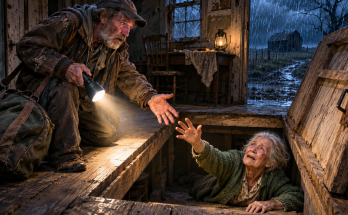
His name was George.
He was sixty-two years old, and the first thing he did when I arrived at his apartment was apologize.
“Sorry you had to bring that all the way over here.”
I was carrying one end of a small dining table.
It was a sturdy piece of furniture that had been donated through the community assistance organization.
There were a few marks on its surface.
Otherwise, it was in perfectly respectable condition.
“It's no trouble,” I told him.
George stepped aside.
The apartment was small.
There wasn't much furniture inside.
I noticed the amount of open space near the kitchen window.
It reminded me of the cottage before Tom brought over the table from his garage.
George pointed toward the window.
“I thought it might go there.”
We carried it into position.
He examined the space around it.
Then he helped me adjust the table until it stood where he wanted it.
“That's nice.”
He ran his hand across the surface.
“I'll make sure it stays in good shape.”
I looked at him.
“I'm sure you will.”
He apologized again.
He seemed uncomfortable accepting something that somebody else had provided.
I recognized that discomfort.
I had felt exactly the same way when Margaret placed a bowl of soup in front of me.
At the time, I hadn't been able to explain why receiving a meal made me feel as though I owed her an apology.
Looking at George, I understood it more clearly.
He had spent most of his life providing for himself.
Accepting assistance meant acknowledging that there had been a period when he couldn't.
That was difficult for him.
It had been difficult for me, too.
He told me he had suffered an injury at work.
His income had been interrupted.
The resulting financial difficulties had eventually left him without accommodation he could afford.
For several months, he had lived in his car.
He spoke about those months quietly.
There was no dramatic presentation.
He simply described what had happened.
I listened.
He mentioned the difficulty of finding somewhere to sleep comfortably.
The constant concern about where he could leave his vehicle.
The way ordinary expenses accumulated even when there was almost nothing available to pay them.
I remembered being surprised by how expensive it could become to have nowhere to live.
You couldn't prepare inexpensive meals if you didn't have access to a kitchen.
You couldn't properly store things you purchased.
You sometimes spent money getting from one place to another simply because there was nowhere you could remain.
Even keeping your clothes clean became an expense requiring planning.
George seemed reluctant to discuss the worst details.
I didn't press him.
There was no reason he needed to tell me everything before being allowed to keep a table.
He looked around his apartment.
“It's getting there.”
I nodded.
“Looks like a good place.”
He smiled slightly.
“Better than the driver's seat.”
There was a little humor in his voice.
I laughed.
He did too.
Then he asked whether I would like some coffee.
I had other things to do that afternoon.
But nothing required me to leave immediately.
So I accepted.
George appeared pleased.
He went into the kitchen and prepared it.
I sat at the table we had just positioned.
The window overlooked the area outside his apartment.
There was enough daylight coming through the glass to make it a comfortable place to sit.
I understood why George had chosen that particular spot.
Sometimes having somewhere to look outside while drinking coffee was a considerable improvement over how a person had previously lived.
George returned carrying two cups.
He placed one in front of me.
“Hope it's strong enough.”
I tasted it.
“Just fine.”
He sat across from me.
For several minutes, we discussed the weather.
Then he mentioned some roadwork in the area.
I told him about driving between maintenance assignments and encountering delays.
Somehow, that led to a conversation about old trucks.
He knew a fair amount about vehicles.
I told him about the Ford Bill had sold me.
George smiled.
“They'll keep running a long time if you look after them.”
“That's what I'm counting on.”
He laughed.
There was nothing unusual about the conversation.
Two men talking about familiar things over coffee.
But I remembered how rarely I had experienced anything like that during my months without a home.
People generally spoke to me because there was something they needed to determine.
Whether I could remain somewhere.
Whether I was eligible for assistance.
Whether I had enough money to purchase something.
Whether I had identification.
I understood why those conversations were necessary.
But after a while, I missed being spoken to simply because another person wanted some company.
There were days when nobody asked me a question that wasn't connected to my circumstances.
Nobody asked what I thought about the weather.
Nobody wanted to know whether I understood how an old engine worked.
Those conversations had disappeared along with the apartment and the job.
Sitting at George's table, I wondered whether he had missed them, too.
He asked what had led me to become involved with the organization.
I explained that I worked in maintenance.
Repairing donated furniture was something I could do without much difficulty.
Then I told him there was another reason.
“I've been without a place to live myself.”
He stopped moving his coffee cup.
“You have?”
I nodded.
“Last year.”
He looked at me for several seconds.
“I wouldn't have guessed.”
I smiled.
“What would you have expected me to look like?”
He laughed.
Then his expression became more serious.
I could see him reconsidering something.
Perhaps he had assumed I had spent my entire life comfortably employed and securely housed.
My clean clothes and the old truck parked outside didn't tell him much about what had happened the previous autumn.
I told him about losing Helen.
About the job disappearing after the management change.
About falling behind on the rent and eventually surrendering the apartment.
I didn't describe every difficult experience.
But I told him enough to explain why the organization mattered to me.
He listened carefully.
When I mentioned that I had eventually found work again, he nodded.
“That's good.”
I told him it hadn't happened immediately.
There had been people who helped me.
There had been opportunities I wouldn't have found if those people hadn't offered assistance.
And there were still financial problems I was gradually correcting.
George looked down at his cup.
“Does it stop feeling strange?”
I waited.
He gestured toward the apartment.
“Being here. Having somewhere again.”
I thought about my first night in the cottage.
The refrigerator waking me.
Helen's photograph beside the bed.
The key lying next to it.
I remembered how difficult it had been to believe I wouldn't be asked to leave the following morning.
“After a while, you get used to some of it.”
He nodded.
Then he asked whether things generally became easier.
I didn't want to promise him something I couldn't guarantee.
His circumstances were his own.
I didn't know what his recovery from the workplace injury would involve or what employment opportunities might eventually be available to him.
But I knew that some difficulties became more manageable once you had a stable place from which to address them.
“Certain things do,” I said.
He looked up.
“And it helps when you don't insist on handling every problem by yourself.”
George considered that.
He smiled faintly.
“I'm not particularly good at asking.”
“Neither was I.”
He laughed.
I finished my coffee.
We continued talking for a little while before I needed to leave.
As I stood, George thanked me again.
I pointed toward the table.
“Enjoy it.”
He nodded.
“I will.”
I didn't tell him to remember how fortunate he was.
I didn't ask him to promise that he would never need assistance again.
Those weren't conditions attached to receiving a piece of furniture.
The table was there because somebody had donated it, because the organization had arranged for him to receive it, and because I had been available to help deliver it.
He was entitled to sit at it without feeling that he needed to justify his presence.
We shook hands.
Then I went outside.
I climbed into my Ford and started the engine.
Before leaving, I looked toward the apartment window.
I could see the edge of the table we had positioned.
I hoped George would have many ordinary mornings sitting there.
Coffee.
Breakfast.
A newspaper, perhaps.
Whatever he enjoyed.
I hoped he would eventually stop noticing that the table had come from somebody else's generosity and begin thinking of it simply as his table.
That was how I thought about the one in my cottage now.
Tom had given it to me.
But whenever I sat down for dinner, I didn't feel as though I was borrowing a little corner of his life.
I had a life of my own.
The table was part of it.
Driving back toward the farm, I remembered Margaret standing in her kitchen that first night.
Her blue dressing gown.
The slippers.
The bowl of chicken soup.
I remembered how difficult it had been to swallow those first few mouthfuls.
I had expected questions.
Where had I gone wrong?
Why hadn't I saved more money?
Why hadn't I contacted my daughter?
Why was a man of my age walking around with nowhere to sleep?
Margaret could have asked any of those things.
Instead, she recognized that I needed something to eat.
Tom had done something similar when he offered me work.
He didn't require me to prove that I had always made good decisions.
He watched me repair a door.
He noticed that I knew what I was doing.
Then he offered to pay me for completing other jobs.
Neither of them had treated me as somebody whose past needed to be examined before I could receive ordinary kindness.
I hadn't realized how much that meant until I encountered George.
I had seen the way he looked at the table.
I had heard him apologize for receiving it.
I knew what those gestures meant because I had made them myself.
Helping him wasn't particularly difficult.
Making him feel comfortable enough to drink coffee and discuss trucks had required even less effort.
I was glad I had stayed.
When I reached the farm, Ruth was sitting near her front window.
I parked and went inside after putting away my tools.
She asked how the afternoon had gone.
“Delivered a table.”
She smiled.
“Did they like it?”
“He seemed very pleased.”
I told her about George.
I explained that he had spent months living in his vehicle following a workplace injury.
Ruth listened.
Then she shook her head.
“Doesn't take much for things to go wrong, does it?”
“No.”
She looked toward the kitchen.
“I suppose most of us believe we've planned well enough to prevent that.”
I nodded.
I had believed it.
I had paid rent for nineteen years.
I had worked steadily for more than two decades.
I hadn't expected to become homeless.
But I hadn't expected Helen's illness, either.
Or the loss of my job.
The circumstances that had brought me to Ruth's farmhouse hadn't been part of any plan.
Ruth looked toward the folder where she kept information concerning her contribution to the organization.
“I'm glad that fellow has somewhere now.”
“So am I.”
She stood and offered me something to drink.
I accepted.
We sat at her kitchen table.
The wall-mounted telephone was still beside the refrigerator.
I occasionally noticed it when I visited.
There had been a night when I lifted its receiver and heard absolutely nothing.
Now it worked.
Ruth could contact people whenever she wanted.
Something that simple had once stood between her and immediate assistance.
I looked toward the telephone.
Then I thought about George living inside his car and the amount of effort required to obtain things most people didn't have to think about.
Ruth and I had both learned that a person's independence could depend on practical arrangements that seemed insignificant until they failed.
A telephone.
A reliable vehicle.
A functioning lock.
A secure place to live.
We didn't need to discuss that lesson aloud.
It was visible around us.
Later, I walked back toward the cottage.
The afternoon light was beginning to fade.
I passed the barn.
Through the opening, I could see Walter's old tractor.
It hadn't moved since the first time Ruth showed it to me.
Noah had been fascinated by it during his visit.
Ruth had enjoyed explaining its history to him.
I stopped for a moment.
The machine looked worn.
There were repairs it would certainly need before anybody considered putting it back into operation.
But I remembered Ruth telling me how much she missed hearing Walter working around the farm.
She had spoken about the tractor several times.
Not because she expected to resume farming with it herself.
Because the sound belonged to a period of her life she remembered fondly.
I thought about that while standing near the barn entrance.
I knew how much familiar sounds could mean.
There were times when I would have given a great deal to hear Helen moving dishes around our old kitchen.
Or calling from another room to ask whether I intended to finish repairing something I had started.
I couldn't recover those sounds.
But there was a possibility that Walter's old tractor could run again.
It would need to be examined carefully.
Some parts would probably require replacement.
Tom understood farm equipment considerably better than I did, and I knew I would need his assistance.
I wasn't going to make promises to Ruth before establishing whether the work was manageable.
Still, the idea stayed with me.
I walked around the machine, looking at what I could see without disturbing anything.
Then I stepped back.
Walter had once taught Daniel how to repair part of an engine.
Ruth had shown me the photograph.
I remembered the pride on the young boy's face.
The tractor belonged to memories that existed long before Daniel's financial misconduct and the terrible events in the basement.
I wanted Ruth to have something from those earlier years that didn't immediately lead back to what he had done.
The machine couldn't bring Walter back.
Nothing could.
But perhaps she could hear something familiar again.
The following day, I mentioned the idea to Tom.
He listened while I described what I had noticed.
“Could be quite a job.”
“I figured it might be.”
He smiled.
“Worth having a proper look, though.”
I nodded.
We agreed to examine it together.
There was no urgency.
We both had other responsibilities.
We could work on it during weekends when we had time.
I returned to the cottage that evening feeling pleased.
I had spent the afternoon before carrying a table into George's apartment.
Now I was considering another project.
A year earlier, I hadn't known where I would sleep the following night.
These days, I occasionally needed to remind myself not to start too many things at once.
It was a pleasant problem to have.
I placed my keys beside Helen's photograph.
Then I sat at the little dining table and looked through my work schedule.
There was plenty to do before the weekend.
But I was already looking forward to meeting Tom in the barn.
I had seen what a simple piece of furniture could mean to somebody who had lost nearly everything.
I wondered what hearing that old engine might mean to Ruth.