From Ruth's porch, I could see the little vegetable garden beside my cottage.
It wasn't much to look at by that time of year.
The growing season was coming to an end.
But the small wooden sign Sophie had painted during her last visit remained near the front steps.
It read, in uneven lettering, “Grandpa's Garden.”
Some of the letters were larger than others.
The spacing was particularly interesting.
She had been enormously proud of it when she finished.
I hadn't corrected anything.
There wasn't a professionally manufactured sign in the country that I would have exchanged it for.
Ruth noticed me looking toward it.
“She certainly wanted everybody to know who that garden belonged to.”
I smiled.
“She takes these things seriously.”
Ruth laughed.
We continued sitting together.
The afternoon was becoming cooler.
I could hear leaves scraping against the driveway whenever the wind moved them.
It reminded me of the previous October.
I thought about the man who had walked along that county road carrying a worn duffel bag.
I remembered what he had believed about himself.
That his useful years were finished.
That his daughter would be better off if she didn't know how badly he was struggling.
That losing his employment and his apartment had somehow reduced what he was worth as a person.
I had believed those things with surprising certainty.
Nobody had sat me down and explained that I no longer mattered.
But after enough disappointments, I had reached that conclusion myself.
I had watched people pass me without looking in my direction.
I had experienced the discomfort of explaining that I didn't have a current address.
I had avoided conversations because I couldn't bear another question about what I intended to do with my life.
Eventually, I stopped asking myself that question.
I had become concerned primarily with getting through another day.
Now I looked at the garden sign Sophie had made.
My old Ford stood beside the cottage.
The curtains Margaret had given me were visible through the windows.
Inside was the little table Tom had contributed.
There was a photograph of Helen beside the bed.
None of those things had appeared because I suddenly acquired a fortune.
I hadn't discovered money hidden in the farmhouse.
Ruth hadn't given me ownership of her property.
Bill hadn't offered me an enormous salary.
There had been no single solution that corrected everything.
Instead, there had been opportunities.
People willing to offer them.
And the gradual realization that I needed to accept them.
I was still paying down debts.
There were occasional weeks when an unexpected expense made things difficult.
I still worried about the future sometimes.
I wasn't particularly young.
I understood that my ability to perform demanding maintenance work wouldn't remain unchanged forever.
But those concerns were no longer reasons to believe my life was finished.
They were matters to consider and prepare for.
There was a difference.
Ruth sat quietly beside me.
After a while, she looked toward the barn.
“I think Walter would've enjoyed seeing that tractor running today.”
“I reckon he would have.”
She smiled.
“Probably would've had a few suggestions about how you repaired it.”
I laughed.
“Tom had plenty of those.”
She laughed with me.
Then she rested her hands in her lap.
I noticed she was wearing the emergency alert device around her neck.
It had become an ordinary part of her clothing.
She no longer seemed embarrassed by it.
I was glad.
Using something that could summon assistance didn't make her less independent.
It helped her remain independent.
The same principle applied to the people who visited her.
Margaret could bring something over without taking control of the household.
Tom could check whether everything was functioning without deciding how Ruth should spend her morning.
Linda could advise her without making decisions Ruth was entitled to make herself.
I could repair something without expecting access to her property beyond what she authorized.
Those relationships worked because everybody understood where their responsibilities began and ended.
Daniel hadn't respected those boundaries.
He had treated Ruth's affection as though it entitled him to things she had never agreed to surrender.
She had nearly paid for that misunderstanding with her life.
But she hadn't allowed what happened to turn her against everybody else.
That was something I admired about her.
She remained cautious.
She examined paperwork carefully.
She didn't ignore her discomfort when something seemed wrong.
But she still welcomed friends into her kitchen.
She still attended church.
She still gathered with the women who came to sew on Wednesdays.
She had even found a way to help strangers through the county assistance organization.
Daniel had damaged her trust in him.
He hadn't managed to destroy her ability to care about other people.
I hoped she understood what an accomplishment that was.
We watched the afternoon light fading across the fields.
Eventually, Ruth stood.
“I suppose I'd better go inside before it gets too cold.”
I offered my arm.
She took it.
We walked toward the farmhouse entrance.
The porch boards beneath our feet were sound.
The door closed properly.
The exterior lights would come on when somebody approached after dark.
I had worked on those things during the weeks following her return.
They had seemed like particularly important repairs then.
They still did.
At the entrance, Ruth looked toward me.
“Thank you for today.”
I smiled.
“You've already said that.”
“I know.”
She squeezed my arm.
“Thought I'd say it once more.”
I nodded.
“You're welcome.”
She went inside.
I remained on the porch for a moment before walking toward the cottage.
The old barn was visible beyond the yard.
Walter's tractor stood silently beneath its roof.
It had made Ruth happy that morning.
I hadn't been able to stop thinking about the expression on her face when the engine started.
There had been tears.
But they weren't the tears I remembered from the basement or the hospital.
She had heard something that reminded her of a man she loved.
For several minutes, she had been able to enjoy the memory without having to explain anything to anybody.
I was pleased we had given her that opportunity.
I reached my cottage and unlocked the door.
The familiar humming from the refrigerator greeted me.
I had occasionally considered repairing whatever was responsible for that noise.
But the appliance continued functioning, and there were generally more urgent jobs waiting.
Besides, the sound no longer bothered me nearly as much.
It was part of the place.
I removed my jacket and hung it up.
Then I prepared something simple to eat.
While I was sitting at the little table, I decided to telephone Emily.
I reached for my phone without hesitation.
There had been a time when I stared at her number for nearly twenty minutes before finding the courage to press a button.
Now calling her was one of the easiest things I did.
She answered.
“Hi, Dad.”
“Hello, sweetheart.”
I asked how everybody was doing.
She told me about the children's week.
There were school activities.
Things Michael had been dealing with.
Ordinary household matters that required attention.
Then she passed the telephone to Noah.
He began explaining something that had happened at school.
I listened while he worked his way through the details.
Occasionally, I asked a question.
That generally encouraged him to provide several additional details.
I enjoyed hearing his voice.
He eventually remembered the tractor.
“Did you get it working, Grandpa?”
“Yes, we did.”
“Really?”
“This morning.”
He sounded delighted.
I told him that Tom had helped me and that Ruth had enjoyed hearing the engine again.
Noah immediately wanted to know whether he could see it during his next visit.
“Of course.”
Then Sophie wanted the telephone.
She told me about her schoolwork before asking whether I had looked after her garden sign.
“I can see it from my window.”
“Is it still there?”
“Exactly where you put it.”
She appeared satisfied.
Then she began telling me something else.
I didn't particularly care whether the things she described were important.
They were important to her.
That was enough.
Michael spoke to me briefly afterward.
There was a cabinet at their house that needed attention.
He wondered whether I could take a look during my next visit.
I smiled.
“Happy to.”
He thanked me.
I thought about the years when my ability to fix things had seemed like the most reliable part of my identity.
There had been a period after losing my job when I believed that ability no longer mattered.
Now my son-in-law was asking me about a cabinet.
Bill had work scheduled for the coming week.
There were occasional furniture repairs waiting at the assistance organization.
Ruth sometimes needed something done around the farmhouse.
I wasn't short of opportunities to use what I knew.
But even if nobody had asked me to repair anything, I would still have been entitled to speak with my family.
I understood that now.
Emily returned to the telephone.
“What are you doing for Thanksgiving?”
I hadn't made every arrangement yet.
But I knew I wanted to spend some of the holiday with them.
I also wanted to spend time at the farm.
I told her that.
“Sounds like you're going to have a busy Thanksgiving.”
“Looks that way.”
She laughed.
“That's nice, Dad.”
I agreed.
We discussed the arrangements a little longer.
Then she told me to take care of myself.
I promised I would.
After ending the call, I sat quietly at the table.
Thanksgiving.
There had been a time when the approach of the holidays filled me with dread.
I couldn't imagine celebrating without Helen.
I worried about the things I couldn't afford.
I worried about what Emily might ask.
Eventually, I began avoiding the people with whom I had once spent those occasions.
Now I had two places where I was welcome.
I had grandchildren expecting to see me.
I had people across the yard who would enjoy sharing a meal.
And I had enough confidence to make plans.
I didn't need the holidays to resemble the ones Helen and I had celebrated before her illness.
Those years were gone.
But that didn't mean everything worth celebrating belonged to the past.
I stood and cleared the dishes.
Then I walked into the bedroom.
The drawer beside the bed contained several things I had carried through my most difficult months.
An old photograph of Helen.
My father's pocketknife.
And a faded envelope.
I opened the drawer and removed the envelope.
It had once contained the last forty-seven dollars I possessed.
I remembered counting that money.
I remembered trying to decide how long I could make it last.
Every purchase had required consideration.
Food.
Transportation.
Something that might help me remain warm.
There hadn't been enough money to solve the problem that stood behind all those smaller problems.
Eventually, I had become a man walking along unfamiliar roads because there was nowhere else I needed to be.
I had kept the envelope even after my circumstances improved.
There was nothing valuable about it.
The paper was creased.
The edges had become worn.
But whenever I looked at it, I remembered how uncertain my life had been when I carried it.
I also remembered how certain I had been that things couldn't improve.
That was what made the envelope important to me.
I hadn't kept it because I wanted to punish myself with memories of those weeks.
I kept it because I never wanted to forget how wrong I had been about my future.
I returned it to the drawer.
Then I picked up my father's pocketknife.
It was another ordinary object that had survived the changes in my life.
I examined it briefly before putting it back.
Finally, I took out the photograph of Helen.
I looked at her face.
I had seen that photograph countless times.
Some days, it had made me feel almost unbearably lonely.
Other days, it reminded me of something amusing she had said or done.
That evening, I simply felt affection.
I thought about the nineteen years we had spent in the apartment.
The unreliable windows.
The worn carpet.
The crooked Christmas tree.
Emily bringing her first boyfriend home.
Helen's final birthday beside the kitchen window.
I would have given a great deal to return to any ordinary afternoon when she was healthy and we still assumed there would be countless afternoons like it.
But I could no longer do that.
I had spent months trying to live as though refusing to move forward might somehow keep those years from ending.
It hadn't worked.
It had only made the remaining parts of my life more difficult to recognize.
I looked around the bedroom.
The cream walls.
The secondhand bed.
The lamp beside the photograph.
A pair of clean work boots near the door.
I thought about the grandchildren visiting.
I remembered Emily laughing beneath Walter's maple trees.
I remembered Sophie carrying her little basket of flowers.
I thought about Ruth standing beside the tractor that morning.
There had been so many moments during the previous year that I hadn't expected to experience.
And none of them required me to forget Helen.
She was present in the way I thought about my family.
In the habits I still carried.
In the stories Emily and I could finally tell without immediately becoming overwhelmed.
I missed her.
I expected I always would.
But I had stopped believing that missing her required me to abandon everything else.
I rested the photograph against my hand.
Then I spoke aloud.
“We got through it, love.”
The room remained quiet.
I hadn't expected an answer.
I simply wanted to say it.
For a long time, I had thought of the future Helen and I planned as something that had been taken entirely away from me.
Now I understood that some parts of it could still exist.
I could live somewhere peaceful.
I could grow vegetables.
I could sit outside and listen to birds.
I could spend time with our grandchildren.
It wouldn't be the retirement we had imagined together.
But it was a life.
And it was mine to live.
I returned the photograph to its place beside the bed.
Then I checked the front door.
The lock worked.
I looked through the window before closing the curtains.
Across the yard, the farmhouse lights glowed.
Ruth was inside.
She had her own arrangements for the evening.
She could decide when to finish whatever she was doing and when to go to bed.
There was nobody waiting to take those decisions away from her.
The land remained hers.
Daniel was serving the consequences imposed through the legal proceedings.
There were still financial matters that couldn't be corrected completely.
The restitution process wouldn't restore the years during which Ruth had trusted him.
His apology hadn't returned everything he took from her.
But she was no longer waiting for him to decide whether she would be allowed to live in her own house.
She was living there.
That was the outcome she had wanted most.
I looked toward the barn.
It stood quietly beneath the darkening sky.
The tractor had been restored to operation.
The engine had reminded Ruth of Walter.
Tomorrow, she might walk outside and look at it again.
Or she might remain in the kitchen and work on her sewing.
Whatever she chose, the choice belonged to her.
I closed the curtains.
Then I turned off the lamp in the living area and went into the bedroom.
I placed my keys beside Helen's photograph.
The same simple routine I had followed so many times since moving into the cottage.
I climbed beneath the blankets.
From the kitchen came the occasional sound of the refrigerator.
There were little noises from the old building as the temperature changed outside.
Nothing that frightened me.
Nothing that required me to collect my belongings.
Nobody was going to announce that I needed to leave.
There weren't strangers sleeping a few feet away.
There was no reason to worry about whether the coming night would become colder than I could endure.
I closed my eyes.
Home.
It had taken me a long time to feel comfortable using that word again.
The apartment had been home because Helen and I shared a life there.
The cottage had become home because I had learned to continue living after that life changed.
People occasionally asked whether I believed something had deliberately brought me to Ruth's farmhouse.
I never knew how to answer.
Perhaps there was some larger meaning in what happened.
Perhaps the circumstances were simply an extraordinary coincidence.
I couldn't prove either explanation.
I knew only that the weather had been terrible.
I knew I had been tired and hungry.
I knew the farmhouse appeared empty and that its damaged entrance allowed me to get inside.
I had intended to sleep there until morning.
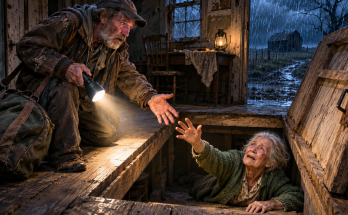
Then I heard something beneath the floor.
I hadn't expected that sound to lead me toward a future I had stopped imagining.
I hadn't known the woman downstairs would become my friend.
I hadn't known her neighbors would give me a meal, somewhere to sleep, and an opportunity to earn money.
I hadn't known I would eventually find work with Bill or rent the little cottage behind the barn.
All I knew at the time was that somebody needed assistance.
And I could provide a little of it.
I could give her water.
I could open a door.
I could walk toward the road and look for somebody with a working telephone.
Those actions didn't require me to have money.
They didn't require an impressive job title.
They didn't require me to own a house or wear clean clothes.
I could do them even when almost everything else in my life had gone wrong.
That was something I carried with me whenever I encountered somebody whose circumstances reminded me of my own.
Sometimes, while driving between maintenance assignments, I noticed people standing near the road with worn bags.
I remembered how easily I could have been one of them.
I remembered how little anybody passing me would have known.
They wouldn't have known that I had worked in the same profession for twenty-six years.
They wouldn't have known about Helen or Emily.
They wouldn't have known that I understood how to repair a troublesome door or recognize a problem with an old heating system.
They would have seen my clothes.
My exhaustion.
My bag.
Perhaps that was all they would have noticed.
I tried to remember that there was always considerably more to a person's life than whatever difficulty happened to be visible.
George had reminded me of that.
Ruth had reminded me of it, too.
And Margaret had understood it the moment she placed a bowl of soup in front of me.
I couldn't solve every problem somebody else experienced.
I couldn't promise that kindness would always produce the kind of extraordinary change it had produced in my life.
But I could refuse to treat somebody's hardship as the complete explanation of who they were.
I knew how much that mattered.
There had been a night when I was convinced I had nothing useful left to offer anybody.
Then a frightened woman whispered from beneath a farmhouse floor.
She didn't know my employment history.
She didn't know how much money remained in my wallet.
She didn't know whether I had an address.
She only knew that somebody had finally heard her.
I opened the door she couldn't open herself.
In the months that followed, she and the people around her helped me find my way back to a life I had nearly given up on.
Ruth remained in the farmhouse where she and Walter had spent their years together.
I lived in the little cottage beyond the barn.
We had our own routines.
Our own responsibilities.
Our own front doors.
And whenever I looked across the yard at the light in her kitchen, I remembered what it meant that we were both still there.
Alive.
Safe.
Home.
I reached toward the bedside table and touched the key beside Helen's photograph.
Then I let my hand rest.
There was work waiting for me the following morning.
There were people I intended to see.
There were plans for Thanksgiving.
For the first time in a long while, the years ahead didn't seem like something I merely needed to endure.
I wanted to find out what they contained.
I turned onto my side and settled beneath the blankets.
Outside, the farmhouse lights eventually went dark.
Ruth had gone to bed.
The fields were quiet.
And the man who had once searched for somewhere to spend a single night finally fell asleep in a place where he belonged.
The End
Read more original stories on lastestdrama.com.