Ruth invited me over for supper that evening.
When I entered her kitchen, two bowls were already on the table.
She had prepared stew.
Steam rose from the bowls while she carried over some bread.
I removed my coat and sat down.
For a while, we discussed the weather.
There had been enough snow to leave a light covering across the yard.
The roads would probably require some attention before the following morning.
It was a relief to talk about something that didn't involve Daniel.
Ruth asked whether Bill had scheduled much work for me during the coming week.
I told her about several maintenance jobs.
She listened with the same interest she showed whenever I discussed ordinary things.
I asked whether she needed anything repaired before the weather became colder again.
She considered it.
“Nothing I can think of.”
Then she smiled.
“That's unusual, isn't it?”
I laughed.
Most older houses had something requiring attention.
But Ruth's farmhouse was functioning considerably better than it had when I first entered.
The doors closed properly.
The kitchen was warm.
There was lighting outside.
The utilities were working.
She could pick up a telephone and contact somebody whenever she needed assistance.
Those changes had taken time.
The changes inside Ruth were taking longer.
After dinner, she placed her spoon beside the empty bowl.
“There's something I'd like to do.”
I looked up.
“Another repair?”
“Not exactly.”
She stood and reached for her cane.
I waited while she moved toward the hallway.
Then I realized where she was going.
She stopped several feet from the basement entrance.
The door was closed.
I remained beside her.
She looked at the handle.
“I haven't opened it myself since that night.”
I had been downstairs while completing certain repairs.
Other people had also entered when necessary.
Ruth hadn't.
Whenever she needed something from below, somebody else retrieved it.
She rarely went near the entrance.
There were practical reasons for avoiding the stairs while her ankle recovered.
But I knew the injury wasn't the only reason.
She had once stood in that hallway and heard a familiar door close behind her.
She had expected the person on the other side to return.
That expectation had nearly cost her life.
Now the door belonged entirely to her again.
Still, the sight of it frightened her.
“You don't have to open it tonight,” I said.
Ruth nodded.
“I know.”
She moved a little closer.
I stayed where I was until she looked toward me.
“Would you stand here?”
“Of course.”
She reached toward the handle.
Then she stopped.
Her fingers were trembling.
For a moment, I thought she might turn away.
I wouldn't have blamed her.
Nobody had given her a deadline for overcoming what happened.
There wasn't a correct number of weeks after which she should suddenly feel comfortable near that staircase.
I didn't tell her to hurry.
I didn't take hold of the handle for her.
She had asked me to stand beside her.
That was all.
Eventually, she reached forward again.
Her hand closed around the handle.
The door opened slowly.
Light illuminated the staircase.
There was a new handrail along the wall.
The old bolt was gone.
Ruth looked down.
Her face became pale.
I remained close enough to help if she needed me.
But she didn't reach for my arm.
She simply stood there, looking at the steps.
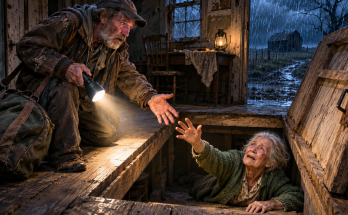
I remembered how different they had appeared beneath my flashlight.
The basement had been almost completely dark.
I hadn't known what I would discover at the bottom.
Now the entire staircase was visible.
Ruth looked toward the place where she had fallen.
Her breathing became uneven.
She waited.
Gradually, she seemed to regain some composure.
After nearly a minute, she drew the door toward herself.
It closed gently.
She left her hand on the handle.
“I don't want to go down there today.”
“All right.”
She looked at me.
“But I wanted to open it.”
I nodded.
She moved her hand from the handle to the wooden frame.
“This is my home.”
The way she said it was different from the way she had spoken about the farmhouse during the investigation.
There was no question in her voice.
No need to convince anyone.
No desperate explanation of why she should be permitted to remain there.
She was making a statement about something that belonged to her.
I smiled.
“Always was.”
She looked at the door again.
Then she turned toward the kitchen.
We went back and finished clearing the dishes.
I didn't mention how proud I was of her.
It didn't seem necessary.
She knew what she had accomplished.
Opening a door might have appeared insignificant to somebody who hadn't seen her in the basement.
I knew better.
Later, I returned to my cottage.
The refrigerator was humming.
I took off my boots and sat beside the small table Tom had given me.
Helen's photograph was visible through the bedroom doorway.
I thought about Ruth's hand resting against the basement frame.
I understood why reclaiming that part of her house mattered.
After losing our apartment, I had spent months wishing I could return to familiar rooms.
But living somewhere wasn't only a matter of possessing furniture and knowing which cupboard contained the plates.
It was knowing that you could open and close your own doors.
Knowing that you decided who entered.
Knowing that, when you turned off the light at night, you could expect to wake up in the same place.
Those freedoms had once seemed too ordinary to notice.
I noticed them now.
Winter gradually began loosening its grip on the farm.
The mornings remained cold for quite a while.
But the afternoon light lasted longer.
There were days when I could work outside without feeling that my fingers might freeze around a tool.
Then spring arrived.
Yellow daffodils appeared near Ruth's farmhouse.
The maple branches began producing new leaves.
The fields changed color.
Birds returned to the trees outside my cottage.
One morning, I woke before sunrise.
I made coffee and carried the cup onto my front porch.
There was mist above the pasture.
The ground smelled damp.
Somewhere nearby, birds were already making noise.
I sat on the steps.
Across the yard, a light came on in Ruth's kitchen.
I smiled.
She was beginning another day in her own house.
I was beginning one in mine.
I looked toward my old Ford.
It was parked near the cottage.
There were tools inside it that I would need later.
A few months earlier, the thought of owning a dependable vehicle again would have seemed almost impossible.
Now I sometimes complained when the driver's door required a little extra effort to close.
It amused me how quickly ordinary inconveniences returned once the larger ones became manageable.
I hadn't become wealthy.
I hadn't suddenly escaped every financial obligation from my previous life.
There were still debts requiring attention.
I still had to be careful with money.
But my circumstances no longer changed completely whenever I encountered a small unexpected expense.
There was something in my savings account.
Not a tremendous amount.
Enough to begin feeling that the next week wasn't entirely beyond my control.
Bill had gradually increased my hours.
The part-time arrangement had developed into full-time employment.
He trusted me with more responsibilities as he became familiar with my work.
I appreciated that trust.
During my first weeks working for him, I had worried that some small mistake might end the arrangement.
I had become so accustomed to losing things that I found it difficult to believe a good situation could last.
Eventually, I stopped approaching every work assignment as though it might be my final opportunity.
I simply did the job properly.
If I could repair something safely, I repaired it.
If the work required somebody with different qualifications, I explained that.
I didn't recommend replacing equipment that could still function with reasonable maintenance.
Several customers began asking Bill to send me specifically when they needed assistance.
He mentioned that to me one afternoon.
“They seem to like the way you explain things.”
I shrugged.
“People ought to know what they're paying for.”
He nodded.
“Keep doing what you're doing.”
That was all.
But I thought about his words during the drive back to the farm.
I had once believed that losing my maintenance position meant losing whatever value my experience had accumulated over twenty-six years.
The knowledge hadn't disappeared.
The opportunity to use it had.
I was grateful to have found another opportunity.
I began dealing with the debts that remained from my previous circumstances.
There were telephone calls I had avoided making for a long time.
There were letters I needed to understand.
There were repayment arrangements to discuss.
Some conversations were uncomfortable.
Others were considerably more manageable than I had feared.
A local assistance organization helped me understand certain resources and sort through records I hadn't known how to manage during the worst months of my homelessness.
I wished I had known about some of those resources earlier.
But I also recognized that knowing assistance existed wouldn't necessarily have been enough.
Back then, I had struggled even to admit that I needed it.
Now I could sit across from somebody, explain my circumstances, and ask what options were available.
I didn't particularly enjoy discussing my financial difficulties.
I had simply stopped treating every question as an attack on my character.
There were problems to solve.
Some would take considerable time.
I could work on them without believing they defined everything else about me.
Ruth was developing a new routine of her own.
She arranged for an independent professional to help oversee her accounting.
Linda assisted her in reviewing her estate documents.
They discussed protections that would allow Ruth to retain control of her affairs.
I wasn't involved in decisions she hadn't invited me to discuss.
Nor did I want to be.
She had already experienced what happened when somebody close to her assumed too much authority.
I was her tenant.
I occasionally performed maintenance work under the arrangements we had established.
We were also friends.
None of those things required me to know the details of every account she owned.
Ruth continued leasing much of the farmland.
That arrangement provided income without requiring her to undertake the physical demands of managing the agricultural work herself.
She knew the land well.
She understood the leases.
Whenever she needed advice, she could obtain it independently.
For the first time since I met her, the financial discussions she described weren't always about correcting something Daniel had done.
Sometimes they were simply about managing the property.
That pleased her.
Another change concerned church.
Margaret had mentioned how much Ruth used to enjoy attending before Daniel began discouraging contact with people outside the farmhouse.
As Ruth became more comfortable going out, she decided to return.
Margaret offered to drive her.
I saw them leave one Sunday morning.
Ruth was dressed neatly.
Her cane was beside her.
She appeared slightly nervous.
When she returned, she told me how the morning had gone.
“Everybody wanted to talk.”
I smiled.
“That's a good thing, isn't it?”
“Mostly.”
Several people had become emotional when they saw her.
Some apologized for accepting Daniel's explanation that she had gone somewhere to receive care.
Ruth hadn't blamed them.
She understood how convincing he could be.
She had believed him herself for far longer than any of them.
One thing she particularly enjoyed was being asked ordinary questions again.
People wanted to know how her ankle was recovering.
They asked about the rosebushes.
They asked whether she intended to join certain activities again.
Not every conversation concerned the investigation.
She appreciated that.
Before long, several women began gathering at her farmhouse on Wednesdays.
They brought sewing materials and spent part of the day drinking coffee and talking.
Sometimes I heard laughter from the kitchen when I passed the house.
It was a sound I had never associated with the property during those first dark weeks.
The sewing room was being used for sewing again.
The wardrobe remained in the same place.
But Ruth no longer had to think of it only as the place where important documents had been hidden from Daniel.
It was becoming an ordinary room in her home.
Tom generally visited on Friday mornings.
Margaret came regularly.
Ruth knew she could contact them if she needed assistance.
But there were also plenty of occasions when she simply enjoyed being alone.
Sometimes I ate supper with her.
Other evenings, I prepared something at the cottage and kept to myself.
We didn't maintain an arrangement that required us to spend every available hour together.
I was grateful for that.
After Helen died, I had occasionally confused solitude with loneliness.
I assumed every evening spent by myself would be painful.
There were still evenings when it was.
But there were also quiet nights when I enjoyed listening to the radio, preparing food, or sitting beside the window with a cup of coffee.
I began understanding that I could enjoy my own company without being abandoned.
There was a difference between having nobody to call and choosing not to call anybody for a few hours.
Emily and I spoke every Sunday.
The conversations became easier.
Sometimes she asked about work.
Sometimes I asked about the children.
Occasionally, we talked about Helen.
I no longer tried to change the subject whenever her name came up.
Emily had memories of her mother that were different from mine.
Listening to them helped me remember that Helen's life had touched more people than just me.
I was still her husband in the sense that she would always remain part of my history.
But I was also somebody's father.
Somebody's grandfather.
Somebody's employee.
A tenant.
A neighbor.
A friend.
I had stopped recognizing those parts of myself during the months when I was most desperate.
They were gradually becoming familiar again.
One Sunday, after speaking with Emily, I went outside.
The evening light was falling across the farmhouse.
I noticed Ruth moving near her rosebushes.
She was examining the plants, deciding what needed attention as the weather became warmer.
I walked toward her.
“Need a hand?”
She looked up.
“Not yet.”
I smiled.
“All right.”
She returned her attention to the garden.
I stood there for another moment.
Then I went back toward the cottage.
I liked hearing her say that.
There had been a night when Ruth needed somebody desperately and had almost lost the ability to ask.
Now she could accept assistance when she wanted it.
She could refuse when she didn't.
And nobody was going to punish her for either decision.
I reached my front steps and sat down.
The farm was quiet.
For once, nothing urgently required fixing.
I finished my coffee while Ruth tended her flowers.
We were both home.
And we were both free to decide how to spend the rest of the afternoon.