Part 1
I came home from cardiac rehab nine days early and found a stranger in my bathrobe on my front porch.
“Checkout’s at 11,” he said.
My son had listed my house on Airbnb while I was gone.
And my sixteen-year-old granddaughter was sleeping in my old pickup in the driveway.
In January.
My name is Floyd Haskins. I’m seventy-four, a retired lineman from Duluth, Minnesota.
I’ve been raising my granddaughter, Avery, since she was eight. Her mother passed. Her father, my son Darren, decided parenting “wasn’t his thing.”
He lives forty minutes away with his wife, Tina.
In November, I had a heart attack shoveling snow.
Triple bypass. Then six weeks of inpatient cardiac rehab in Minneapolis.
Darren promised he’d move into my house and take care of Avery while I was gone.
“Don’t worry about a thing, Dad,” he said. “Focus on your heart.”
I called Avery every night.
Every night she said, “I’m fine, Grandpa.”
My rehab doctor discharged me early on a Thursday. I didn’t call ahead. I wanted to surprise my girl.
My neighbor Gus drove me home from the bus station.
When we pulled up, there was a minivan in my driveway with Iowa plates.
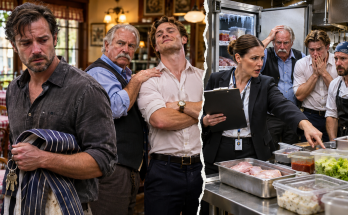
A man I’d never seen stood on my porch drinking coffee. He was wearing my plaid bathrobe.
“Can I help you?” he asked.
“This is my house.”
He laughed politely. “I think you’ve got the wrong place, sir. We booked through Airbnb. Checkout’s at 11.”
He showed me his phone.
There was my house. My kitchen. My recliner. My late wife’s quilt on the bed.
“Cozy Lakeside Cabin. $189/night. Superhost: Darren.”
Forty-one reviews.
I looked past him into my house.
Strangers’ suitcases in my hallway. Kids’ toys on my living room rug.
“Where’s Avery?” I asked.
The man looked confused. “Who?”
Gus touched my arm and pointed toward the side of the driveway.
My old blue pickup was parked under the pine tree.
The windows were fogged over from the inside.
I walked to it as fast as my new heart would let me.
I opened the door.
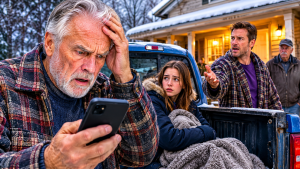
Avery was curled up in the back seat in two sleeping bags and her winter coat. A space heater was plugged into an extension cord running through the garage window.
She sat up when she saw me. Her nose was red. Her lips were chapped.
“Grandpa? You’re not supposed to be home yet.”
“How long have you been sleeping out here?”
She looked down.
“Since right after Christmas. Dad said the house was booked every weekend. He said the guests would freak out if a teenager was inside. He gives me twenty bucks to go to McDonald’s.”
It had been nineteen below that week.
I called Darren.
He picked up on the fourth ring. I could hear a TV in the background.
“Dad! Hey. How’s rehab?”
“I’m standing in my driveway.”
Silence.
“Okay,” he said slowly. “Before you get upset—”
“Avery is sleeping in a truck.”
“She’s fine. She’s sixteen. It’s an adventure. Do you know what that house makes? Four grand a month. Somebody had to cover your medical bills.”
“My medical bills are covered by Medicare.”
“Well, then somebody had to cover my bills,” he snapped. “You’re not going to live forever, Dad. That house is going to be mine anyway.”
Then Tina’s voice in the background.
“Tell him the truth, Darren. He’s not going to be able to live alone anymore.”
I hung up.
I didn’t yell.
I helped Avery out of the truck. I asked the man in my bathrobe, very politely, if we could sit in the kitchen for a few minutes.
Then I opened my laptop.
Darren had set up the Airbnb account years ago, when he helped me “get on the internet.”
He’d used my email.
I logged in.
There was a message thread pinned at the top. It wasn’t from a guest.
It was from someone named “Pam — Northland Realty.”
The last message was from yesterday.
“Confirming Saturday’s showing at 10. Has the old man’s stuff been cleared out yet?”
For a moment, nobody in the kitchen spoke.
The Airbnb guest, whose name turned out to be Mark, stood by the sink with my robe hanging open over a Minnesota Vikings T-shirt.
Gus leaned over my shoulder.
Avery sat at the table with both hands wrapped around a mug of cocoa.
I read the message again.
Then again.
There are sentences that change depending on how many times you look at them.
The first time, I saw the words.
The second time, I understood them.
The third time, I realized my son had expected me to come home to somewhere else.
I clicked on the thread.
Pam had written three days earlier.
> Darren, I still need written authority from the owner before we can proceed with an offer.
Darren had replied:
> My father has already agreed. He’s recovering and gets confused with paperwork, so I’m handling everything.
Pam:
> I need either his signature or valid power of attorney.
Darren:
> Working on it. In the meantime, the buyers are eager. They’re only in town this weekend.
The room seemed to tilt.
My chest tightened.
Avery jumped out of her chair.
“Grandpa?”
“I’m fine.”
“You said that’s what people say when they’re not fine.”
I looked at her.
She was right.
That sentence had become our family motto without anybody meaning for it to.
“I’m angry,” I said. “That’s different.”
Gus pulled out the chair beside me.
“Sit anyway.”
I sat.
Mark quietly took off my bathrobe and folded it over the back of a chair.
“For what it’s worth,” he said, “we didn’t know.”
“I know.”
“My wife and kids are upstairs packing. We can be out in twenty minutes.”
“You paid for the night?”
“Through Sunday.”
“Then you shouldn’t have to lose your money.”
He glanced toward the window, where snow had started drifting sideways.
“Sir, I think we’ll survive a hotel.”
There was something almost ridiculous about being reassured by a man who had been wearing my pajamas five minutes earlier.
But I liked him for trying.
I opened another tab.
The Airbnb calendar was booked nearly solid for six more weeks.
Some dates had guest names.
Some had notes.
And then I saw something else.
A block of three weekdays in February was labeled:
**CLEANOUT / STORAGE**
I clicked it.
No guest.
No reservation.
Just a private note Darren had added:
**Dad’s personal items. Sort before sale.**
I stared at those words until the letters blurred.
Avery looked over my shoulder.
Her face changed.
“Grandpa, I didn’t know.”
“I know you didn’t.”
“I swear.”
“I know.”
She began crying anyway.
Quietly.
That hurt worse than the message from Pam.
I shut the laptop.
“Tell me everything,” I said.
Avery wiped her cheeks with her sleeve.
“About what?”
“About what happened while I was gone.”
Her eyes went to Gus.
Then to Mark.
Then back to me.
“You’ll get mad.”
“I’m already mad.”
“At me.”
That stopped me.
“Avery.”
She looked down at her cocoa.
“The first week Dad stayed here.”
“All right.”
“He brought Tina. They slept in your room. Then they started talking about how empty the house was going to be once I went to college.”
“You’re a sophomore.”
“I know.”
“What else?”
“He kept taking pictures.”
“For Airbnb?”
“I thought so.”
She hesitated.
“Then one night I heard Tina asking what the place would be worth if they replaced the kitchen counters.”
I felt a slow chill that had nothing to do with January.
“Did they say anything to you directly?”
“Dad said I should start getting used to the idea that you might need assisted living.”
My hand tightened around the arm of the chair.
“And what did you say?”
“That you’d hate it.”
Avery gave a tiny, miserable laugh.
“He told me sometimes adults have to make choices kids don’t understand.”
Gus made a sound under his breath.
I looked at Avery.
“What happened after Christmas?”
She stared at the table.
“That’s when the guests started coming every weekend. Dad said I could stay at his house.”
“That’s where you should’ve been.”
“I tried.”
Something in the way she said it made my stomach drop.
“Tina said their spare room was her office.”
I closed my eyes.
Of course.
“She said there wasn’t enough space with her work stuff. Dad said the truck was temporary. He put the heater in there. He said I could use the downstairs bathroom when there weren’t guests.”
“How many nights?”
“I don’t know.”
“Avery.”
“Maybe twelve?”
She thought.
“Fourteen?”
Outside, snow whispered against the kitchen window.
I had spent forty years repairing power lines during winter storms. I knew what cold did. Not just to pipes and cables.
To people.
It took away choices one degree at a time.
“Why didn’t you tell me?”
“I didn’t want you to worry.”
“I’m your grandfather. Worrying about you is part of the contract.”
“You had just had your chest cut open.”
That shut me up.
She lifted her eyes.
“Every time I called, you sounded tired. And Dad kept saying stress could kill you.”
There it was.
Not a threat.
Something worse.
A reasonable-sounding sentence used exactly the wrong way.
“So I thought,” she continued, “if I told you, you’d leave rehab early.”
I almost smiled.
“Well.”
She gave me a watery look.
“You did anyway.”
“Apparently my timing is excellent.”
That earned a real laugh.
Small, but real.
I reached across the table and took her hand.
“We’re going to fix this.”
“How?”
“I don’t know yet.”
That was the truth.
At seventy-four, I had finally learned that saying “I don’t know” wasn’t the same as surrendering.
Sometimes it was where a sensible plan started.
Mark’s wife came downstairs with two kids and three suitcases.
We settled the practical problems first.
They would leave.
I would contact Airbnb.
Gus would take Avery to his house while I made calls.
I refused that last part.
“She stays with me.”
“You just left cardiac rehab,” Gus reminded me.
“And she just left a truck.”
Neither of us argued after that.
At four that afternoon, a customer-service representative froze the listing.
At five, I called my bank.
At six, I changed every password I could think of.
At seven, Gus brought over chicken noodle soup and a handwritten list titled:
**THINGS DARREN MAY HAVE ACCESS TO**
My bank.
My utility account.
My email.
My phone plan.
My tax records.
My insurance.
I stared at the list.
“People used to just steal your chainsaw.”
“Technology,” Gus said, “has broadened the criminal imagination.”
“Don’t call him a criminal.”
Gus raised an eyebrow.
“Yet,” I added.
Avery sat on the living room floor sorting mail.
I had six weeks’ worth.
Most was junk.
One envelope wasn’t.
She held it up.
“Grandpa?”
It came from Northland Realty.
My name was typed on the front.
Not Darren’s.
Mine.
I opened it.
Inside was a copy of something titled **Comparative Market Analysis**.
Estimated sale range:
$438,000 to $465,000.
There were photographs of my house.
Notes about repairs.
A list of recent sales in the neighborhood.
And a cover letter.
Mr. Haskins,
It was a pleasure speaking with your son regarding your interest in downsizing. Per his request, I’ve enclosed a printed copy of the market analysis in case electronic correspondence is inconvenient during your recovery.
I stopped reading.
“Downsizing,” Avery whispered.
I turned the page.
At the bottom, written in blue pen, were four words.
**Need Dad’s signature Saturday.**
The handwriting wasn’t Pam’s.
I knew whose it was.
Darren’s.
I had seen it on birthday cards, permission slips, and a thousand forgotten notes stuck to refrigerators.
Before I could say anything, someone knocked.
Three slow knocks.
Avery stiffened.
Gus went to the window.
“Car I don’t recognize.”
I stood carefully.
“Stay here.”
“Grandpa—”
“I’m answering my own door.”
The woman outside looked to be in her early fifties. Gray wool coat. Snow on her shoulders. Leather portfolio under one arm.
“Mr. Haskins?”
“Yes?”
“I’m Pamela Voss. Northland Realty.”
Behind me, Gus muttered something.
Pam looked confused.
Then relieved.
“Oh, thank goodness.”
“That depends on why you’re here.”
She lowered her voice.
“Your son told me you were still in Minneapolis.”
“He tells people a lot of things.”
Her expression changed.
Not dramatically.
Just enough.
“I think,” she said, “you and I need to talk.”
We sat at the kitchen table.
The same table where my wife, Ellen, used to pay bills on Sunday afternoons.
Pam opened her portfolio.
“I want to be very clear,” she said. “Your house is not listed for sale.”
“Not yet.”
“Correct. I refused to list it without your direct authorization.”
“That’s comforting.”
“But Darren contacted me almost three weeks ago. He said you had decided not to return here after rehab.”
Avery was standing in the doorway.
Pam noticed her.
“Are you Avery?”
Avery nodded.
Pam’s face fell.
“He told me you were living with him.”
The silence afterward said enough.
Pam looked at me.
“Mr. Haskins, I’m sorry.”
“Did Darren forge anything?”
“Not that I’ve seen.”
“Did he try?”
She hesitated.
“He emailed me a draft power of attorney yesterday.”
My stomach tightened.
“A draft?”
“It wasn’t signed or notarized.”
“So it meant nothing.”
“Legally, yes.”
“Then why do you look worried?”
Pam slowly opened her portfolio again.
“Because the form itself wasn’t what concerned me.”
She slid a printed email across the table.
The sender was Darren.
The attachment had been labeled:
**HASKINS_POA_FINAL.pdf**
Underneath, Darren had written:
> We’ll get Dad’s signature this weekend. His doctor agrees he shouldn’t be making major decisions alone anymore.
I looked up.
“My doctor?”
Pam nodded.
“He gave me a name.”
I read it.
Dr. Samuel Keating.
I had never heard of him.
“That’s not my doctor.”
Pam’s expression went still.
Avery stepped closer.
“Then who is he?”
Nobody answered.
Pam took another page from the folder.
“This is why I came tonight instead of waiting until Saturday.”
She slid it toward me.
It was an email she had received that morning.
From Dr. Samuel Keating.
Or somebody using that name.
The message was brief.
> Mr. Darren Haskins has been assisting his father through a period of cognitive instability following major cardiac surgery. In my professional opinion, Mr. Floyd Haskins may not presently understand the consequences of complex financial decisions.
Below that was a phone number.
And a clinic name.
**Lakeview Behavioral Health.**
I knew that name.
Not because I had ever been treated there.
Because my late wife had.
Twenty years earlier.
After our daughter died.
I looked at Darren’s email again.
At the clinic.
At Pam.
Then at Avery.
And suddenly I remembered something from the week before my heart attack.
Darren had come over for coffee.
He had asked casual questions.
Whether I ever misplaced things.
Whether I had trouble remembering appointments.
Whether I ever felt confused after waking up.
I had laughed.
I’d told him every man over seventy loses his glasses while they’re sitting on his head.
He hadn’t laughed.
He had written something in his phone.
At the time, I thought nothing of it.
Now I knew better.
Pam gathered her papers.
“There’s one more thing.”
I almost didn’t want to hear it.
“What?”
“The phone number in that email?”
“Yes.”
“I called it.”
“And?”
“It belongs to Lakeview Behavioral Health.”
“So the doctor is real.”
“Dr. Keating is real.”
Pam looked straight at me.
“But he says he has never evaluated you.”
Avery exhaled.
I felt strangely relieved.
Then Pam continued.
“He did, however, recognize your son’s name.”
My relief vanished.
“How?”
Pam paused.
“Darren was his patient.”
And for the first time since I had stepped into my driveway, I wondered if this was bigger than greed.
Part 2
I did not sleep much that night.
Avery did.
That mattered more.
I put fresh sheets on the guest bed across from mine and stood in the doorway until her breathing settled into the steady rhythm I remembered from when she was nine.
Back then she had nightmares.
She would wake calling for her mother.
I never knew what to say.
So I sat beside her until morning.
You learn, raising a child, that presence is a language.
Sometimes the only one that works.
At two in the morning, I walked downstairs.
The house felt different after strangers had lived in it.
Not ruined.
Just shifted.
My coffee mugs were in the wrong cupboard.
A chair had moved.
Somebody had put artificial lemons in Ellen’s blue bowl.
I took them out one by one and set them on the counter.
Maybe it was foolish.
But I needed one thing to be where it belonged.
At seven, I called Lakeview Behavioral Health.
They would not discuss Darren.
I expected that.
They would confirm that Dr. Keating had not evaluated me.
That was enough.
At eight, Pam called.
“I’ve canceled the Saturday showing.”
“Good.”
“I’ve also documented that you have not authorized me to market the property.”
“Better.”
She hesitated.
“Mr. Haskins, Darren called me last night.”
“What did he say?”
“That you were confused and angry.”
“I am angry.”
“I noticed.”
Despite myself, I smiled.
“He also asked me not to contact you again.”
“And?”
“I told him you own the house.”
I liked Pam.
At nine-fifteen, Darren arrived.
He did not knock.
He tried his key.
It no longer worked.
I had changed the deadbolt at seven-thirty.
He stood on the porch rattling the handle.
Then he knocked.
“Dad.”
I opened the door but left the storm door latched.
His hair was uncombed.
He wore a winter jacket over sweatpants.
“You changed the locks.”
“Yes.”
“Seriously?”
“Yes.”
“This is ridiculous.”
“Maybe.”
“Avery here?”
“Yes.”
“I want to talk to her.”
“She doesn’t want to talk to you.”
His face flickered.
That one landed.
“I’m her father.”
“That fact has required remarkably little of you.”
He looked away.
“Can I come in?”
“No.”
His head snapped back.
“Dad.”
“You rented my home without permission.”
“You knew I was helping with the place.”
“I knew you were checking the pipes and shoveling the sidewalk.”
“I made money for you.”
“You kept the money.”
“I was going to settle up.”
“You tried to sell the house.”
“I did not.”
“Pam was here.”
The color left his face.
For several seconds, we listened to the wind move through the pine branches.
Then Darren sighed.
“All right.”
That surprised me.
No denial.
No argument.
Just exhaustion.
“I talked to a realtor.”
“And pretended I’d agreed.”
“I thought you would.”
“That’s an unusual definition of consent.”
“You’re seventy-four.”
“So?”
“You had a heart attack alone in the yard.”
“I had a heart attack shoveling wet snow.”
“You could’ve died.”
“Yes.”
His jaw tightened.
“You say that like it means nothing.”
“It means I almost died. It does not mean I became incompetent.”
“I never said incompetent.”
“You told Pam I was confused.”
“I said you were having trouble after surgery.”
“I wasn’t even out of rehab.”
“I was trying to plan.”
“For yourself.”
“For everybody.”
I laughed once.
Darren flinched.
That told me more than yelling would have.
Behind me, a stair creaked.
Avery was listening.
Darren saw her.
“Aves.”
She stayed on the stairs.
“Hey.”
She said nothing.
He softened his voice.
“I’m sorry you got stuck in the truck longer than I expected.”
“Stuck?”
“I mean—”
“You put me there.”
“I gave you a heater.”
“It shut off twice.”
Darren stared at her.
“What?”
“The extension cord tripped.”
His face changed.
For the first time, he looked frightened.
“Why didn’t you call me?”
“I did.”
“I never got—”
“I texted.”
He pulled out his phone.
Avery walked down three steps.
“I texted you January third. January fifth. January eighth.”
“I didn’t see them.”
“You sent me a thumbs-up.”
Darren lowered the phone.
No one spoke.
Then Avery said, “Do you know what the worst part was?”
He looked at her.
“It wasn’t being cold.”
She gripped the railing.
“It was seeing people inside. Families. Kids eating cereal at Grandpa’s table. And knowing you thought they belonged there more than I did.”
Darren opened his mouth.
Nothing came out.
Avery went upstairs.
I watched him absorb it.
Good.
Some truths deserved silence afterward.
“Who is Dr. Keating?” I asked.
Darren’s face hardened again.
“Pam had no right.”
“She had every right to check a medical claim you were using to influence a property transaction.”
“It wasn’t like that.”
“Then tell me what it was like.”
His shoulders dropped.
“I saw Keating a few years ago.”
“For what?”
“That’s private.”
“You made it relevant.”
He looked past me into the house.
“I was having panic attacks.”
That was not the answer I expected.
“After what?”
“After Mom died.”
“Your mother died twelve years ago.”
“I know.”
“You saw him a few years ago?”
“Yes.”
I tried to remember.
Darren had gone through a rough patch around then.
He changed jobs twice.
Stopped answering calls.
Showed up at Christmas late and left early.
I had thought he was being Darren.
Maybe that had been unfair.
He rubbed his face.
“I called Keating last month.”
“Why?”
“To ask what happened when older people became unstable after surgery.”
“Did he tell you I was unstable?”
“No.”
“Did he send that email?”
“No.”
“So you did.”
He did not answer.
“Darren.”
“I wrote it.”
The words seemed to freeze between us.
“You impersonated a doctor.”
“I never sent it to a hospital.”
“That does not improve the sentence.”
“I sent it to Pam because she wouldn’t listen.”
“Good for Pam.”
“You don’t understand.”
“I’m trying.”
“No, you’re waiting to tell me I’m a disappointment.”
I stared at him.
“That’s what you think this is about?”
“It’s always what it’s about.”
“I haven’t called you a disappointment.”
“You never had to.”
For one breath, I was no longer standing across from a forty-seven-year-old man.
I saw a teenage boy at our kitchen table, tapping a pencil against unfinished homework.
I saw myself coming home after a sixteen-hour storm shift.
Tired.
Short-tempered.
Certain that providing food and heat counted as the whole job.
“Darren,” I said, quieter now, “why did you think selling my house would solve anything?”
He looked toward the street.
“I’m in trouble.”
“What kind?”
He shook his head.
“Money?”
Silence.
“How much?”
“Dad.”
“How much?”
“Enough.”
“Gambling?”
“No.”
“Drugs?”
“No.”
“Then what?”
He laughed bitterly.
“You always do this.”
“Do what?”
“Turn everything into a repair job.”
“I was a lineman.”
“That isn’t what I mean.”
He looked me in the eye.
“You think if you identify the broken wire, everything makes sense.”
I said nothing.
“People aren’t wires.”
“No.”
“You can’t always reconnect them.”
“No.”
He took a breath.
“Tina and I bought into a business.”
“What business?”
“A home-renovation franchise.”
I nearly smiled.
“Don’t.”
“I didn’t.”
“You were going to.”
“I was thinking.”
“We put in almost everything. Then the company collapsed. There are lawsuits. Customers demanding refunds. We personally guaranteed some loans.”
“How much?”
He looked ashamed.
“Two hundred and eighty thousand.”
I sat down on the porch bench.
Not because of my heart.
Because my knees needed it.
Darren remained standing.
“I thought if we sold your place, you could move somewhere easier. A condo. Assisted living if you needed it. There’d be enough left to help me stabilize things.”
“So you were going to spend the proceeds from my house.”
“Some.”
“Without asking.”
“I knew you’d say no.”
“That’s generally why people skip asking.”
His mouth tightened.
“I didn’t want to lose everything.”
“And I was acceptable collateral.”
He looked away.
That was answer enough.
Later, after Darren left, I found Avery in Ellen’s old sewing room.
She was sitting cross-legged on the carpet with a cardboard box in front of her.
“What’s that?”
“Stuff Grandma kept.”
Ellen had saved everything.
Birthday cards.
Receipts.
School photos.
Instruction manuals for appliances we no longer owned.
Avery held up a photograph.
Darren at seventeen.
Me beside him.
We were standing in front of the blue pickup.
The same truck Avery had been sleeping in.
“He looks like you,” she said.
“No.”
“You have the same eyebrows.”
“That’s not enough evidence.”
She smiled.
Then her expression turned serious.
“Did Dad tell you why?”
“Some of it.”
“You believe him?”
“I believe the debt.”
“Do you forgive him?”
“Those are different questions.”
She placed the photo back in the box.
“I don’t.”
“You don’t have to decide today.”
“What if I never do?”
“Then you don’t.”
She studied me.
“You mean that?”
“Yes.”
“Grandma would say family is family.”
“Your grandmother said many things.”
Avery almost laughed.
“She also threw a gravy boat at me once.”
“What?”
“Missed by two feet.”
“Why?”
“I bought her a vacuum cleaner for our anniversary.”
Avery stared at me.
“You deserved it.”
“History agrees.”
She dug through the box again.
Then stopped.
“What’s this?”
She held up a sealed envelope.
My name was written on it.
In Ellen’s handwriting.
**FLOYD — IF DARREN EVER ASKS ABOUT THE CABIN**
I felt the air leave the room.
“What cabin?” Avery asked.
I took the envelope.
The paper had yellowed along the edges.
Ellen had been dead twelve years.
I had never seen it before.
My hands were not as steady as I wanted them to be.
Inside was a single page.
Floyd,
If you are reading this, Darren has probably learned enough to start asking questions.
I should have told you years ago.
The land near Knife River was never sold.
I put it in a trust.
Not for Darren.
For Avery.
I stopped.
Avery leaned closer.
“What?”
I kept reading.
There is something Darren has never understood about what happened after Lisa died. If he finds out about the trust before Avery is old enough to understand the whole story, he may think I was punishing him.
I wasn’t.
I was protecting her.
Floyd, the papers are in the safe-deposit box.
And there is one more thing you need to know.
Darren is not the only person with a claim.
I read the line twice.
Avery whispered, “What does that mean?”
I did not know.
But my dead wife had just left us a mystery.
And somewhere in Duluth, my son was drowning in debt while trying to sell the wrong house.
Part 3
The bank opened at nine.
Avery was dressed by seven-thirty.
“You have school.”
“So?”
“So people generally attend it.”
“My grandfather discovered a secret inheritance from his dead wife.”
“It’s not an inheritance yet.”
“Secret trust.”
“Still school.”
She stared at me.
“I slept in a truck for two weeks and still got my chemistry homework done.”
I considered that.
“Fine.”
“Really?”
“One morning.”
She grabbed her coat.
“Before you change your mind.”
Gus drove.
My cardiologist had specifically told me not to drive until my follow-up appointment, advice I considered excessively cautious until I remembered I had recently been unconscious in a snowbank.
At the bank, a woman named Denise led us downstairs.
The safe-deposit box was narrow and surprisingly heavy.
Inside were deeds, photographs, tax documents, and a blue accordion folder labeled in Ellen’s handwriting.
**KNIFE RIVER**
Avery sat beside me as I opened it.
The first document was a deed.
Thirty-six acres north of Duluth.
Wooded property.
A small cabin.
Lake access.
Transferred into the **Ellen Haskins Family Trust** thirteen years ago.
Beneficiary:
Avery Haskins.
Trustee:
Floyd Haskins.
Successor trustee:
A woman named **Marianne Cole**.
I did not know anyone by that name.
Behind the deed was a letter.
Not to me.
To Darren.
It had never been sent.
Darren,
I am writing this because every conversation we have about Lisa turns into an argument, and arguments have become the only language you seem to believe I speak.
You believe I blame you for what happened.
I do not.
But I do believe you ran away from responsibility afterward.
Those are not the same thing.
Lisa asked me, months before she died, to make sure Avery always had something that could not be taken from her by someone else’s panic, debt, grief, or bad decisions.
That was her wording.
Someone else’s panic.
Someone else’s debt.
Someone else’s grief.
Someone else’s bad decisions.
I looked at Avery.
Her eyes were wet.
“My mom said that?”
“According to your grandmother.”
She nodded for me to continue.
I placed the letter down.
There were more documents.
Property taxes paid every year from an account I did not recognize.
Cabin insurance.
Maintenance receipts.
And checks signed by Marianne Cole.
“She’s been taking care of it,” Avery said.
“Looks like it.”
“Who is she?”
“No idea.”
Gus, who had been pretending not to read over my shoulder, cleared his throat.
“I might.”
I turned.
“What?”
He looked uncomfortable.
“I knew a Marianne Cole once.”
“When?”
“Long time ago.”
“How long?”
“Thirty years.”
Avery leaned forward.
“Who was she?”
Gus looked at me.
“Lisa’s friend.”
My daughter.
Avery’s mother.
“Why have I never heard her name?”
“Because she and Lisa had a falling-out.”
“About what?”
“Darren.”
That was becoming an irritatingly common answer.
We found a phone number in the folder.
I called from the bank parking lot.
A woman answered on the third ring.
“Hello?”
“Is this Marianne Cole?”
“Yes.”
“My name is Floyd Haskins.”
Silence.
Then a whisper.
“Oh.”
Not surprise.
Recognition.
“You know who I am.”
“I do.”
“I found Ellen’s trust documents.”
Another silence.
“I wondered when that would happen.”
“We need to talk.”
“Yes.”
“When?”
“Now, if you want.”
She lived twenty minutes north.
We drove along the lake.
Winter had turned Superior into a sheet of gray steel under a low white sky.
Marianne lived in a small house overlooking the water.
She opened the door before we reached it.
She was about sixty.
Silver hair.
Wool sweater.
The kind of face that looked younger when she smiled.
She looked first at me.
Then at Avery.
Her hand rose to her mouth.
“You look like Lisa.”
Avery stiffened.
People had told her that before.
But this was different.
Marianne looked as if she had seen a ghost step out of a car.
Inside, she brought coffee for Gus and me and tea for Avery.
No one touched any of it.
“I should have contacted you,” Marianne said.
“Yes.”
“I promised Ellen I wouldn’t unless something happened to her and you needed help with the trust.”
“She died twelve years ago.”
“I know.”
“I could have used the information.”
“She believed you knew.”
“I didn’t.”
Marianne closed her eyes briefly.
“She never told you?”
“No.”
Avery held the letter.
“Why did Mom want me to have the cabin?”
Marianne looked at her for a long time.
“Because she loved it.”
“That’s it?”
“No.”
“What else?”
Marianne folded her hands.
“The cabin belonged to your mother.”
“Before Grandma?”
“Yes.”
“How?”
“Lisa bought it with money she inherited from your great-grandfather.”
I remembered.
Ellen’s father had left modest sums to both children.
Darren spent most of his on a motorcycle and a trip west.
Lisa bought something she never told me about.
Apparently, thirty-six acres.
“She wanted a place where you could grow up knowing you had roots,” Marianne continued.
Avery looked puzzled.
“She knew she was going to die?”
The question was so plain that everyone in the room stopped moving.
Lisa had died in a car accident.
No warning.
No illness.
“She didn’t know,” Marianne said gently. “But she was worried.”
“About Dad?”
“Yes.”
Marianne looked at me.
“Floyd, there’s something you don’t know about the months before Lisa died.”
I felt suddenly tired.
“I’m beginning to suspect there’s quite a list.”
“Darren was borrowing money.”
“What kind of money?”
“From Lisa.”
My jaw tightened.
“He told her it was for work. Then for rent. Then for legal bills.”
“Legal bills?”
“He’d gotten mixed up with a contractor who was being investigated for insurance fraud.”
The room went quiet.
“Was Darren involved?”
“Not knowingly, according to Lisa.”
I exhaled.
That sounded more like the Darren I knew.
Careless.
Overconfident.
Easily persuaded by anybody who promised easy money.
Not evil.
Just permanently convinced consequences were temporary.
“Lisa paid some of his debts,” Marianne said. “Then more appeared. She started worrying that if something happened to her, Darren would eventually pressure you for whatever Avery inherited.”
Avery stared at the floor.
“She predicted this?”
“Not exactly.”
But close enough.
Marianne stood and walked to a cabinet.
She returned with another envelope.
“Ellen gave me this the week she created the trust.”
Inside was a photograph.
Lisa.
Darren.
Marianne.
And another man I did not recognize.
They stood in front of the Knife River cabin.
On the back, Lisa had written:
**The last good summer.**
“Who’s the man?” I asked.
Marianne’s expression changed.
“Caleb Morris.”
“Friend?”
“Lisa’s.”
Something in her tone made Avery look up.
“My mom’s boyfriend?”
“No.”
“Then who?”
Marianne took a breath.
“Her business partner.”
Avery frowned.
“Mom had a business?”
“She was trying to start one.”
I had known my daughter worked in bookkeeping.
I had not known about a business.
“What kind?”
“Outdoor education.”
That surprised me.
“Lisa wanted to run weekend programs for families,” Marianne said. “Hiking. Nature classes. Small retreats. The cabin was supposed to be the beginning.”
“Why did it stop?”
“Because Lisa died.”
“And Caleb?”
“He disappeared from our lives.”
“Why?”
Marianne looked at Avery.
“Because Darren blamed him for the accident.”
The room went still.
I knew Darren blamed himself.
At least I thought he did.
Lisa had been driving home late from the cabin the night she died.
There had been freezing rain.
Her car went off Highway 61.
No other vehicle was involved.
No mystery.
No scandal.
At least that was the story I had carried for twelve years.
“Why would Darren blame Caleb?”
“Because Caleb was supposed to drive her home.”
Avery sat up.
“Why didn’t he?”
Marianne’s face tightened.
“They argued.”
“About what?”
“The property.”
I felt something in me sink.
“Here we go again.”
Marianne gave a sad smile.
“Yes.”
According to Marianne, Caleb wanted Lisa to use the land as collateral for a loan.
Lisa refused.
They argued.
Caleb left.
Lisa drove herself.
The weather worsened.
She died less than an hour later.
“So Darren hated him,” Avery said.
“Yes.”
“Did Dad know about the trust?”
“No. Ellen was determined he wouldn’t.”
“Why?”
“Because by then Darren was convinced the cabin should belong to him.”
I rubbed my forehead.
“Why would he think that?”
“Because Caleb had told him something.”
Marianne looked at me.
“He said Lisa had promised to divide the land between Avery and Darren.”
“Did she?”
“I don’t know.”
Avery asked the obvious question.
“Then who’s the other person with a claim?”
Marianne stood.
“I think that’s Caleb.”
She went to her desk and returned with an envelope.
Certified mail.
Received three weeks ago.
The letter was from an attorney representing Caleb Morris.
It claimed Caleb had invested $42,000 into improvements on the property and retained an ownership interest based on an unsigned partnership agreement.
“He waited twelve years?” I asked.
“Apparently.”
“Why now?”
Marianne shook her head.
“I couldn’t figure it out.”
Avery looked at me.
“I can.”
We both turned toward her.
“Dad.”
I felt the pieces rearrange.
Darren was in financial trouble.
He contacted a realtor about my house.
Around the same time, somebody made a claim against Avery’s cabin.
I pulled out my phone.
“Call him,” Avery said.
I did.
Darren answered.
“What?”
“Did you contact Caleb Morris?”
Silence.
Then:
“Who told you that name?”
So there it was.
“Yes or no.”
Another pause.
“Yes.”
Avery closed her eyes.
“Why?”
“I was looking for options.”
“For what?”
“Money.”
“Did you tell him about the trust?”
“No.”
“Then how did he know?”
“I told him Mom never sold the land.”
“That was enough.”
Darren exhaled sharply.
“Dad, listen. Caleb told me he had money in that place.”
“So?”
“So if there’s value tied up there and he has a legitimate claim—”
“It belongs to Avery.”
“Maybe.”
Across the room, Avery flinched.
I heard it in Darren’s voice.
That word.
Maybe.
The same way he had spoken about my house.
As if ownership were flexible whenever he needed it to be.
“Do not contact Caleb again.”
“Dad.”
“I mean it.”
“You don’t get to control everything.”
“No.”
I looked at Avery.
“But I do get to protect what belongs to her.”
I ended the call.
Marianne sat beside Avery.
“There’s something else.”
I almost laughed.
“Of course there is.”
She handed me a folded photocopy.
A partnership agreement.
Unsigned.
Lisa Haskins and Caleb Morris.
Their names appeared on the first page.
The proposed ownership division was printed on the last.
Lisa: 60%.
Caleb: 40%.
If valid, Caleb’s claim could be serious.
But below the percentage split, Lisa had written a note by hand.
**Not acceptable. Avery gets everything if anything happens to me. Talk to attorney Monday.**
Monday never came.
Lisa died Sunday night.
Avery stared at the handwriting.
“My mom knew.”
“Knew what?”
“That she didn’t want him to have it.”
Marianne nodded.
“I think so.”
Gus finally spoke.
“Then this may be less about money than leverage.”
“Meaning?” I asked.
“If Caleb knows Darren is desperate, maybe he sees an opening.”
That afternoon, I called an attorney.
Her name was Nora Bell.
She practiced estate law in Duluth.
Pam recommended her.
After reviewing the trust documents, Nora gave us the first genuinely good news in days.
“The trust is strong.”
“How strong?”
“Very.”
“And Caleb?”
“An unsigned draft agreement is not nothing, but it’s far from proof of ownership.”
“So Avery keeps the property.”
“Most likely.”
Avery relaxed for the first time all day.
Then Nora turned to me.
“There’s another issue.”
“Darren.”
“Yes.”
She slid the trust agreement forward.
“If he attempts to interfere with trust assets, you have authority as trustee to block him.”
“I intend to.”
“Good.”
“But?”
Nora tapped a paragraph.
“Ellen included a secondary provision.”
I read it.
If Avery died before twenty-five without children, the property passed not to Darren.
Not to me.
Not to Ellen’s estate.
To Marianne Cole.
“That’s odd,” I said.
“Yes.”
Avery frowned.
“Why Marianne?”
Nora looked at her.
“Probably because Ellen wanted to make absolutely certain your father never had a financial incentive tied to the property.”
The sentence landed badly.
I saw it happen.
Avery went pale.
“No,” Nora said quickly. “I’m not suggesting danger. Only legal planning.”
“I know.”
But once an idea enters a room, you cannot always escort it back out.
That night, Avery barely spoke.
At home, she stood at the kitchen window.
“Grandpa?”
“Yes?”
“Do you think Dad loves me?”
Of all the questions I had answered that week, this was the hardest.
“Yes.”
She turned.
“You didn’t even think about it.”
“I’ve thought about it for years.”
“Then why does he act like this?”
I searched for the right words.
“Because loving someone and knowing how to care for them are not the same skill.”
She looked outside again.
“I don’t want to become like him.”
“You won’t.”
“How do you know?”
“Because you ask yourself that question.”
She considered that.
Then my phone rang.
Unknown number.
I answered.
“Floyd Haskins?”
“Yes.”
“My name is Caleb Morris.”
Across the room, Avery froze.
“I think,” he said, “you and I have both been lied to about what Lisa intended.”
“What do you want?”
“Ten minutes.”
“For what?”
“To show you something Ellen never saw.”
I almost hung up.
Then he said the one sentence that changed everything.
“Lisa signed the partnership agreement the night she died.”
Part 4
I told Caleb no.
Then I called Nora.
“Good,” she said.
“Good that I called you or good that I told him no?”
“Both.”
“What if he really has a signed copy?”
“Then he can send it to me.”
“He claims Lisa signed it the night she died.”
“And claims are free.”
I liked Nora.
She had the calm tone of someone who spent her days watching families turn grief into paperwork.
“Do not meet him alone,” she continued.
“I’m seventy-four, not twelve.”
“You are a trustee in a disputed property matter.”
“That’s a less flattering way of saying the same thing.”
“Floyd.”
“I hear you.”
Caleb emailed the document the next morning.
Lisa’s signature was there.
I knew her handwriting.
Or thought I did.
Nora refused to draw conclusions.
“We’ll have it examined.”
Avery sat beside me in Nora’s office.
“Does that mean he owns forty percent?”
“Not automatically.”
“But maybe.”
“Yes.”
She nodded.
I watched her do something she had been doing since childhood.
Take bad news.
Fold it into a smaller shape.
Put it somewhere inside herself.
“Can we still visit the cabin?” she asked.
“Yes,” Nora said.
“As long as you don’t exclude Caleb if his claim turns out to be legitimate.”
Avery looked at me.
“I want to see it.”
So Saturday morning, instead of hosting a real estate showing at my house, we drove north.
Gus came.
Marianne met us there.
The road to the cabin was barely plowed.
Snowbank walls rose along both sides.
The property sat among birch and pine, quiet beneath winter.
When the cabin appeared, Avery stopped walking.
It was smaller than I expected.
Green siding.
Stone chimney.
A porch sagging slightly at one end.
A brass bell by the door.
Marianne handed Avery the key.
“You should open it.”
Avery did.
Inside, dust and cedar greeted us.
There were two bunk beds.
A cast-iron stove.
Shelves filled with field guides.
On one wall were pencil marks recording heights.
Names and dates.
Lisa.
Darren.
Marianne.
Caleb.
Later:
**Avery — 2 years old.**
Avery touched the mark.
“I was here.”
“Yes,” Marianne said.
“You brought me?”
“Your mother did.”
“Why doesn’t Grandpa know?”
Marianne glanced at me.
“Lisa was upset with the family then.”
“That was during the year she barely spoke to us,” I said.
I remembered it.
I had treated it as a phase.
Now I wondered how much of my children’s lives I had dismissed because I was tired.
Avery wandered toward the fireplace.
A photograph sat on the mantel.
Lisa holding baby Avery.
Behind them, sunlight through pine trees.
Avery took it down.
“I’ve never seen this.”
“You can have it,” Marianne said.
“No.”
Marianne blinked.
“It belongs here.”
I looked at my granddaughter.
She was beginning to understand something I had learned late.
Possession was not always the same as belonging.
Around noon, a vehicle came up the road.
Dark SUV.
Caleb stepped out.
I was ready to be angry.
That became difficult when I saw him.
He looked ordinary.
Late fifties.
Heavy winter coat.
Glasses.
No villain’s smile.
No expensive watch.
Just a man with snow caught in his beard.
Marianne stiffened.
“You shouldn’t be here.”
“I told Floyd I wanted to talk.”
“I told you no,” I said.
“Yes.”
He looked at the cabin.
“I came anyway.”
Nora would have disliked that.
I disliked it too.
But Avery stepped onto the porch.
“Are you Caleb?”
He looked up.
His face changed.
“You must be Avery.”
“Did you own this place with my mom?”
He considered the question.
“I thought I did.”
“Did she sign the agreement?”
“Yes.”
“Why does her note say she didn’t want you to have anything if she died?”
His eyes moved to Marianne.
“You found the draft.”
“Yes.”
Caleb took off his gloves.
“Because the agreement we signed was different.”
Marianne laughed without humor.
“Convenient.”
“I brought the original.”
He opened a folder.
I did not touch it.
“Send it to my lawyer.”
“I already did.”
That annoyed me.
“You have her information?”
“Darren gave it to me.”
Of course he did.
Caleb looked at Avery.
“Your mother and I were trying to build something here.”
“She died.”
“Yes.”
“And then you disappeared.”
His jaw tightened.
“Your father threatened to sue me.”
Avery folded her arms.
“For what?”
“He believed I caused the accident.”
“Did you?”
“No.”
“Were you supposed to drive her?”
“Yes.”
“Why didn’t you?”
Caleb looked toward the lake through the trees.
“Because I was angry.”
That was the first answer he gave that I believed completely.
“We argued. I left. Twenty minutes later I turned around.”
“What happened?”
“She was gone.”
Avery swallowed.
“If you’d stayed—”
“I know.”
No defense.
No excuse.
Just two words.
I know.
For the first time, I saw something in him I recognized.
A person who had been rehearsing the same impossible correction for twelve years.
“I left Duluth after the funeral,” he said. “I couldn’t stand being here.”
“And the property?” I asked.
“I signed documents transferring my interest to Lisa’s estate.”
Marianne stared.
“What?”
Caleb nodded.
“I never claimed the land.”
“Then why now?”
“Because Darren found me.”
There it was again.
“He told me the trust was being dissolved.”
“It isn’t.”
“I know that now.”
“He told you what else?”
“That you were selling everything.”
I closed my eyes.
My son had been creating a version of reality for each person he met.
To Pam, I was confused.
To Caleb, the trust was dissolving.
To Avery, the house was temporarily rented.
To me, he was handling things.
Every lie was small enough to sound practical.
Together, they formed a life that never existed.
Caleb held up the folder.
“The document I sent Nora isn’t proof I own forty percent.”
“No?”
“It’s proof I once did.”
He opened to the final page.
There was Lisa’s signature.
His.
And one paragraph at the bottom:
**Upon death or permanent incapacity of either partner, all ownership interest in the Knife River property shall transfer to the named beneficiary designated in that partner’s estate plan.**
“Lisa named Avery,” Caleb said.
Avery stared.
“So you’re not trying to take it?”
“No.”
“Then what do you want?”
Caleb looked ashamed.
“Money.”
At least he admitted it.
“For what?”
“Darren told me the trust owed me reimbursement for improvements.”
“Does it?” I asked.
“No.”
“Then why ask?”
“Because I’m not doing well either.”
He looked toward the cabin.
“My wife has early-onset Alzheimer’s.”
The sentence quieted everybody.
“I stopped working full-time last year,” he continued. “Savings are going faster than I expected. When Darren called and said there might be money still owed to me from the property, I wanted to believe him.”
Marianne crossed her arms.
“You hired a lawyer.”
“I did.”
“Threatened the trust.”
“Yes.”
“Without checking anything.”
“Yes.”
Caleb looked at Avery.
“I’m sorry.”
She did not say it was okay.
I was glad.
Apology did not require immediate absolution.
We spent an hour going through old documents.
By two o’clock, Nora called.
She had reviewed the original partnership agreement Caleb emailed.
“It actually helps us,” she said.
“So his claim is weak?”
“Very.”
Caleb nodded from across the table.
He seemed relieved.
Avery noticed.
“You don’t actually want the land.”
“No.”
“Then why are you relieved?”
“Because your mother wanted you to have it.”
That was when something in Avery softened.
Not forgiveness.
Maybe only recognition.
On the drive home, she sat quietly in the back seat.
Then she said, “Everybody was scared.”
Gus looked at her in the mirror.
“Who?”
“Dad. Caleb. Grandma. Mom. Grandpa.”
“Leave me out of this.”
“You had a heart attack and didn’t tell anybody you’d been getting chest pain for two weeks.”
Gus smiled.
“Kid has you there.”
“Drive.”
Avery leaned her head against the window.
“Everybody got scared and made decisions for somebody else.”
I thought about that.
Ellen hid the trust.
Lisa hid the cabin.
Caleb left.
Darren lied.
I had hidden symptoms.
Avery hid the truck.
Different reasons.
Same habit.
Silence dressed as protection.
When we reached home, Darren was sitting on my front steps.
He stood when he saw us.
Avery stopped walking.
“I need to talk to Dad,” Darren said.
“No,” she replied.
He looked at her.
“I need to talk to both of you.”
She hesitated.
Then went inside.
Darren followed me to the kitchen.
He looked terrible.
Not physically.
Defeated.
“Tina left.”
I said nothing.
“She went to her sister’s.”
“I’m sorry.”
“Are you?”
“Yes.”
That surprised him.
“I’m angry with you,” I said. “I’m not rooting for your life to collapse.”
He sat down.
For several seconds, we heard Avery moving upstairs.
Then Darren said, “The bank is calling the business loan.”
“How long do you have?”
“Thirty days.”
“What happens?”
“We lose the house.”
His house.
Not mine.
The distinction mattered.
“What do you want from me?”
He looked at his hands.
“I don’t know.”
“That’s new.”
“I came to ask for money.”
“Also not new.”
He almost smiled.
Then his face crumpled.
Not theatrically.
One moment, he was sitting upright.
The next, he bent forward with his hands over his face.
“I messed everything up.”
I sat across from him.
“Yes.”
He laughed once through tears.
“Thanks.”
“I’m not going to lie to comfort you.”
“I know.”
“I’m also not going to buy you out of this.”
“I know.”
“Do you?”
He nodded.
“I talked to a bankruptcy attorney.”
That surprised me.
“What did they say?”
“That we have options.”
“We.”
“Me and Tina.”
“Good.”
“She says she’s done unless I stop trying to solve everything secretly.”
“Also good.”
He looked up.
“I thought if I fixed the money problem first, nobody would have to know how bad it was.”
There it was.
The Haskins family tradition.
Hide the problem.
Solve it alone.
Call it protection.
I saw myself in him and disliked the view.
“When did the business start failing?”
“Last spring.”
“You could’ve called.”
“You would’ve lectured me.”
“Probably.”
“You would’ve said I was irresponsible.”
“Possibly.”
“You would’ve been right.”
“That’s never stopped you before.”
He smiled despite himself.
Then he looked toward the stairs.
“Will Avery ever forgive me?”
“I don’t know.”
“Can you tell her I’m sorry?”
“No.”
His face fell.
“You tell her.”
“She won’t talk to me.”
“Then wait until she will.”
“I’m not good at waiting.”
“I noticed.”
He stood.
At the door, he turned.
“Dad?”
“Yes?”
“I did one more thing.”
I closed my eyes.
“What?”
“When I was using your email account, I saw messages from a law firm.”
“What law firm?”
“Harker and Wynn.”
“I don’t know them.”
“They’ve emailed you four times since October.”
“For what?”
“I thought it was spam.”
“Was it?”
“No.”
“How do you know?”
“Because they called me yesterday.”
I stared at him.
“Why would they call you?”
“They were trying to reach you.”
He swallowed.
“They represent someone named Miriam Haskins.”
I had not heard that name in fifty-one years.
Not since my older sister disappeared from our family after an argument with our father.
I had been twenty-three.
She had been twenty-six.
“What did they want?”
Darren’s voice was quiet.
“She died last month.”
I sat down.
Darren continued.
“And according to the lawyer, she left you something.”
“What?”
“A letter.”
He paused.
“And half ownership of a property in Two Harbors.”
I thought of Ellen’s note.
Darren is not the only person with a claim.
For days, I had assumed she meant Caleb.
Maybe I had been wrong.
Because Darren added one final sentence.
“The other half belongs to Avery.”
Part 5
The lawyer’s office occupied the second floor of an old brick building downtown.
Avery came with me.
So did Darren.
I had not invited him.
Avery had.
That surprised both of us.
“Why?” I asked her in the car.
“Because if this is family stuff, he should hear it from the same person we do.”
Darren sat in the back seat.
“I can hear you.”
“That’s the idea,” Avery said.
Something had changed in her.
Not healed.
Changed.
There is a difference.
Healing closes wounds.
Change teaches you how to carry them.
Harker and Wynn had been trying to reach me because my sister, Miriam, had died in October.
She had lived quietly in Wisconsin for decades.
No husband.
No children.
Almost no contact with our family.
The attorney, Ms. Wynn, placed a thin folder in front of me.
“Your sister left very specific instructions.”
“Did she?”
“Yes.”
“And the property?”
“A duplex in Two Harbors.”
I blinked.
“Duplex?”
“One unit is rented. The other is vacant.”
“How did Avery become half-owner?”
Ms. Wynn looked at her.
“Through your mother.”
Avery stiffened.
Again.
Every road seemed to lead back to Lisa.
Apparently, Lisa had found Miriam years earlier.
They had exchanged letters.
Then visits.
Neither told me.
That stung more than I expected.
Miriam had given Lisa a half-interest in the duplex because Lisa helped her during an illness.
When Lisa died, that interest passed to Avery.
The paperwork had existed for years.
But because Avery was a minor, Miriam had continued managing the property.
“Why didn’t anyone tell me?” I asked.
Ms. Wynn handed me an envelope.
“Your sister explains.”
Miriam’s handwriting was older than I remembered.
But recognizable.
Floyd,
You will probably be angry that Lisa found me and you did not.
You may even decide I should have come to you.
Maybe I should have.
But too much time had passed, and pride is a habit that becomes harder to break the longer you practice it.
Lisa did not come to me asking for money.
She came asking questions about our family.
She wanted to understand why we stopped speaking.
I told her the truth.
Our father left the property in Two Harbors to both of us.
You never knew because I signed your share back to him after our argument.
He later left the whole property to me.
I have regretted that for most of my life.
I stopped reading.
“My father owned a duplex?”
Ms. Wynn nodded.
I laughed.
It was not funny.
“I spent fifty years thinking Miriam left because she hated us.”
Ms. Wynn said nothing.
The letter continued.
Lisa convinced me that regret is only useful if it changes what happens next.
So I gave her half.
After she died, I kept the promise I made to her.
Avery’s share is hers.
My remaining half goes to you.
But Floyd, there is a condition.
I lowered the letter.
Darren groaned.
“Of course there is.”
Avery elbowed him.
I kept reading.
Do not sell it for one year.
Not because the building matters.
Because I want the two of you to have time to decide what family property means when nobody is desperate.
That sentence sat in the center of the table.
Nobody desperate.
For the first time in weeks, I understood what all these houses and cabins had really become.
Not property.
Pressure.
Money had turned every room into a question.
Who owned what?
Who deserved what?
Who could be rescued?
Who owed whom?
Ms. Wynn reviewed the numbers.
The duplex had no mortgage.
The downstairs tenant had lived there nine years.
Rent covered taxes, insurance, and most maintenance.
The building was not a fortune.
But it was stable.
That word felt valuable.
Stable.
Afterward, we walked along the lake.
Darren shoved his hands into his coat pockets.
“So what are you going to do?”
“With the duplex?”
“Yes.”
“Nothing today.”
He nodded.
That, too, was new.
No proposal.
No scheme.
No suggestion.
Avery stopped near the railing.
“Dad?”
Darren looked at her.
“I’m mad at you.”
“I know.”
“I don’t want you coming over whenever you want.”
“Okay.”
“I don’t want you asking Grandpa for money.”
His eyes flicked toward me.
“Okay.”
“And I don’t want you pretending bad things aren’t happening because you think we can’t handle them.”
He swallowed.
“Okay.”
She stared at him.
“That’s all you’re going to say?”
“I’m trying something new.”
“What?”
“Listening.”
Avery looked suspicious.
Then almost smiled.
It was not reconciliation.
But it was not nothing.
Over the next month, life became less dramatic.
Which was exactly what we needed.
Airbnb refunded the remaining reservations and removed Darren’s listing.
I changed accounts, passwords, locks.
Nora documented the Knife River trust properly.
Caleb formally withdrew his claim.
He and Marianne began speaking again, cautiously.
Avery returned to school.
I returned to cardiac rehab twice a week in Duluth.
Darren filed for bankruptcy protection for the business debt.
Tina came back home after he agreed to financial counseling.
They did not magically become happy.
That would have been too easy.
They started telling each other the truth.
Which was harder.
One Tuesday evening, Darren came to my house.
He knocked.
I noticed that.
He waited.
I noticed that too.
I let him in.
He put an envelope on the table.
“What’s this?”
“Airbnb money.”
“How much?”
“Everything I still had.”
I opened it.
Cashier’s check.
$8,460.
“That’s not everything.”
“No.”
“What happened to the rest?”
“Bills.”
I looked at him.
“I’ll pay it back.”
“I’m not expecting miracles.”
“I’m not asking you to.”
He sat.
“I also wrote Avery a letter.”
“Give it to her yourself.”
“I was hoping—”
“No.”
He nodded.
“Right.”
Avery came home ten minutes later.
She saw him.
Stopped.
Then set down her backpack.
“Hi.”
“Hi.”
He held out the envelope.
She looked at it.
“What is it?”
“Not an excuse.”
She took it.
That night, she read it alone.
I never asked what it said.
Two days later, she texted Darren.
That was all I knew.
And enough.
In March, when the snow softened, Avery and I visited the Knife River cabin again.
Just us.
She brought a notebook.
“What are you writing?”
“Ideas.”
“For?”
“The cabin.”
I raised an eyebrow.
She pointed to an old shelf of nature books.
“Mom wanted to do outdoor programs.”
“Apparently.”
“What if we did something like that?”
“We?”
“You have lots of free time.”
“I’m retired.”
“Exactly.”
“That means I worked enough.”
She ignored me.
“Maybe one weekend a month. Families. Kids. Hiking. Art. Stuff Grandma would like.”
“Your grandmother hated hiking.”
“Fine. Stuff Mom would like.”
I looked around.
The roof needed work.
The porch leaned.
The chimney should be inspected.
It would cost money.
Take effort.
Create problems.
For once, that did not frighten me.
“What would you call it?”
Avery smiled.
“I don’t know.”
Then she looked toward the door.
On the wall beside it was an old wooden sign.
Faded letters.
Almost invisible.
I rubbed the dust away.
**LISA’S LANDING**
Avery went quiet.
“Well,” I said, “maybe she already named it.”
That spring, we fixed the porch.
Gus helped.
Marianne brought lunch.
Even Caleb came once, though he mostly held boards and apologized for being in the way.
Darren came too.
The first day he arrived, he stood near the driveway holding a toolbox.
Avery saw him.
Neither spoke.
Then she said, “We need the rotten boards pulled up.”
He nodded.
“Okay.”
No hug.
No dramatic reunion.
He worked six hours.
At the end of the day, Avery handed him a bottle of water.
That was enough.
Some relationships do not repair with speeches.
They repair with repeated evidence.
Board by board.
Month by month.
In June, we held the first family nature day at Lisa’s Landing.
Nine children came.
Four parents.
One toddler cried because a frog looked at him.
Avery led a scavenger hunt.
I taught kids how electrical lines work and was informed this was “not technically nature.”
I disagreed.
Gus burned hot dogs.
Marianne showed old photographs of Lisa.
At sunset, Avery sat beside me on the porch.
“You tired?”
“Yes.”
“Heart tired?”
“No.”
“Old tired?”
“Watch yourself.”
She laughed.
Down by the fire pit, Darren was helping a little boy fix the strap on his backpack.
He had been coming regularly.
Not every weekend.
Not enough to pretend the past never happened.
Enough to show up.
Avery watched him.
“Do you trust him?”
I considered it.
“Not with my passwords.”
She laughed.
“I mean really.”
“I trust what he does more than what he promises.”
She nodded.
“That seems fair.”
“What about you?”
“I don’t know yet.”
“Also fair.”
She leaned against my shoulder.
For several minutes, we watched Lake Superior turn orange.
Then my phone buzzed.
An email.
From Ms. Wynn.
I almost ignored it.
Then I saw the subject line.
**Regarding Miriam Haskins Estate — Additional Document Located**
My stomach tightened.
Avery noticed.
“What?”
“Lawyer.”
“That word never brings anything fun.”
I opened the message.
Ms. Wynn had been sorting the final contents of Miriam’s safe-deposit box.
She found an envelope incorrectly filed under my father’s estate.
It was addressed to me.
The handwriting was not Miriam’s.
It was my father’s.
Inside, according to Ms. Wynn, was a letter and an old property map.
The map showed three parcels along the North Shore.
The Knife River land.
The Two Harbors duplex.
And one more property.
A narrow strip of lakefront thirty miles farther north.
No owner was listed on the copy.
Only a handwritten note:
**For Floyd — when he finally understands why Miriam left.**
I read the sentence twice.
Avery leaned closer.
“What does it mean?”
“I have no idea.”
She smiled.
Not because it was funny.
Because by then we had learned something.
Mysteries did not always mean disaster.
Sometimes they were simply unopened doors.
Behind us, children laughed around the fire.
Darren called Avery’s name.
Gus argued with Marianne about whether a hot dog could be considered burned if only one side was black.
The old cabin settled in the evening air.
And I thought about the winter morning when I had come home to find a stranger wearing my bathrobe.
At the time, I believed my house had been taken from me.
I had been wrong.
A house is walls.
A home is the truth people are willing to tell inside them.
Darren had nearly lost his.
Avery had nearly been pushed out of hers.
I had spent most of my life believing silence kept a family together.
Now I knew better.
Silence only preserved whatever was already broken.
I put my phone back in my pocket.
“You’re not going to read the letter?” Avery asked.
“Tomorrow.”
Her eyebrows rose.
“Who are you and what have you done with my grandfather?”
“I’m learning patience.”
“That sounds dangerous.”
“It probably is.”
She leaned against me again.
The sun touched the horizon.
Tomorrow there would be another letter.
Another piece of family history.
Maybe another problem.
But tonight, Avery was warm.
The porch was solid beneath us.
My heart was beating steadily.
And for the first time since I came home early, nobody in my family was pretending everything was fine.
We were simply there.
Imperfect.
Unfinished.
Together.
For the moment, that was enough.
And somewhere in a lawyer’s office in Duluth, a fifty-year-old letter was waiting to tell me why my sister had really walked away.