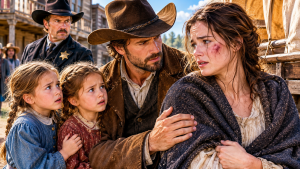
Mara’s fingers tightened around Jonas’s sleeve as she fought to keep her knees beneath her.
“Don’t let him take me back,” she whispered.
Jonas steadied her without pulling her closer than necessary.
“He won’t take you back to that post today.”
“You don’t understand.”
Her eyes darted toward Sheriff Hale.
“He isn’t finished.”
Jonas could see the sheriff watching them from the platform, his easy smile gone.
“Then we’ll hear the rest somewhere you can sit down.”
Mara shook her head, wincing at the movement.
“I shouldn’t go near your children.”
“That choice isn’t the sheriff’s to make.”
“People say I killed my husband.”
“I’ve heard what people say.”
Her grip loosened.
“Are you not going to ask whether it’s true?”
“I will. When you’re ready to answer.”
For several seconds, she studied him with an expression he could not read.
Then Ivy slipped between them.
“Papa, she’s hurt.”
“I can see that, sweetheart.”
“Can she have my place in the wagon?”
Mara made a faint sound, almost a laugh.
“That’s generous of you.”
Ivy nodded solemnly.
“I can sit beside Elsie.”
The tenderness in the child’s voice seemed to trouble Mara more than the cruelty of the crowd.
She turned away, blinking rapidly.
Jonas guided her toward the wagon, taking care not to hurry her.
Behind them, the sheriff called out.
“Don’t forget, Mrs. Quinn. I know where to find you.”
Mara stopped so abruptly that Jonas nearly stumbled.
Her face drained of color.
Then she turned back.
“You’ve made certain of that, haven’t you?”
The sheriff’s eyes narrowed.
For one dangerous instant, neither spoke.
Finally, Mara climbed into the wagon.
Jonas settled the girls behind them and took the reins.
He waited until Willow Bend had disappeared behind the bend in the road before speaking again.
“Was he the one who hurt you?”
Mara looked at her wrists.
“Some of it.”
Jonas kept his eyes on the horses.
“Did you have a chance to defend yourself?”
“He made sure nobody would listen.”
They traveled a little farther.
Then Mara said, “My husband is dead. That much is true.”
Jonas felt his stomach tighten.
“His name was Thomas.”
Her voice was flat with exhaustion.
“We were married three years.”
“And what happened?”
Mara watched the road.
“He was drinking the night he died. He was angry. I tried to get away from him.”
She paused.
“I picked up a fireplace poker.”
Jonas said nothing.
“I thought I could frighten him into leaving me alone.”
Her breath caught.
“I didn’t.”
She pressed her injured wrists together.
Jonas could hear the wheels rolling over the hard earth.
“Did you strike him?” he asked.
Mara’s eyes filled.
“I tried.”
The answer sat between them.
Not an admission of murder.
Not a denial that something terrible had happened.
Only the truth she could bear to give.
“Then the sheriff came,” she continued.
Jonas turned toward her.
“Rogan?”
She nodded.
“He was there when Thomas died.”
“Did he see what happened?”
“He knows.”
The words were barely audible.
“He knows more than anyone.”
Jonas’s grip tightened on the reins.
“Then why accuse you?”
Mara looked toward the two girls behind them.
“Because I wouldn’t give him what he wanted.”
She said no more.
Jonas understood enough to feel sick, though not enough to know the whole truth.
He had rescued a woman from a public cruelty.
But he had not yet rescued her from the man responsible for it.
“Mara,” he said carefully, “you don’t owe me an explanation for accepting shelter.”
She looked at him with sudden disbelief.
“You have two little girls. Surely you need to know whether I’m dangerous.”
“I need to keep them safe. That means listening to you, not pretending I’ve learned the truth from a crowd.”
Mara looked away.
The ranch road stretched ahead beneath the afternoon sun.
She tried to straighten, but a wave of dizziness forced her against the wagon seat.
Jonas moved his arm to keep her from falling.
“May I help you sit back?”
She nodded.
For several minutes, she remained quiet.
Then she whispered, “I remember something green.”
Jonas looked over.
“A blanket?”
“Perhaps.”
“And a song?”
Her brow tightened.
“My mother used to sing when I was frightened.”
Behind them, Elsie began humming.
Mara’s eyes widened.
She turned toward the children, trying to follow the familiar notes.
Then her face crumpled.
“I know that tune.”
Ivy smiled.
“You sang it when the snow was falling.”
Mara reached back toward the girls, but her strength failed.
Her fingers slipped from the wagon rail.
Jonas caught her shoulder as she sagged sideways.
“Mara?”
Her eyes closed.
“Don’t let him…”
The words faded.
Jonas stopped the horses, checked that she was breathing, and carefully supported her against the seat.
Elsie began to cry.
“Papa, is she going away again?”
Jonas looked at the woman whose hands had once kept his daughters alive in the snow.
He had no answer he could honestly promise.
But he knew he could not return her to Willow Bend.
He gathered the reins in one hand, steadied Mara with the other, and urged the horses toward the ranch.
The horses moved into a faster, steady trot, and Jonas kept Mara braced against his shoulder while the wagon rattled along the road.
Her breathing was shallow but regular.
Every rough patch made her flinch, even in her exhausted sleep.
Jonas knew an hour’s travel could be a long journey for someone so badly hurt.
Behind him, Elsie and Ivy had stopped talking.
That frightened him almost as much as Mara’s condition.
His daughters had been noisy, curious children before Sarah died. Since the blizzard, there were times when they became unnaturally still, as though waiting for a sound nobody else could hear.
He refused to let this day become another terrible memory they would carry alone.
“Girls,” he said gently, “tell me about the blanket.”
Ivy looked up.
“It was green.”
“Dark green,” Elsie corrected.
“And scratchy.”
“But warm,” Ivy added.
Jonas remembered the blanket recovered with them two winters earlier.
He had kept it folded in a chest upstairs.
Sarah’s blankets were familiar to him. He had recognized every one, even after the storm.
But the green wool had belonged to someone else.
He had never learned whose.
Until now, perhaps.
By the time they reached the Kincaid ranch, the sun was descending behind the pastures.
Jonas brought the wagon close to the house.
He spoke Mara’s name.
She stirred.
“Can you stand if I help you?”
Her eyes opened, unfocused.
“I think so.”
But the moment she tried, her knees gave way.
Jonas caught her.
“Would you rather I carry you?”
Mara hesitated, then nodded.
He lifted her carefully, mindful of her injured ribs.
The twins ran ahead to open the door.
Inside, the house smelled of coffee, wood smoke, and the lavender Sarah had once hung in small bundles near the windows.
Jonas carried Mara upstairs.
The guest bedroom had stood unused for two years.
He had kept it clean, but little else.
Now he lowered Mara onto the bed and drew the quilt over her.
“I’ll bring water,” he said. “The door can stay open or closed. Whichever you prefer.”
“Open,” she whispered.
Jonas nodded.
The twins approached the bedside.
Ivy looked at Mara’s bruised face.
“Did somebody hurt you because you helped us?”
Mara’s eyes filled.
“No, sweetheart. This happened much later.”
Elsie took her hand.
“Then we’ll be gentle.”
That simple promise finally broke through Mara’s defenses.
She began to cry.
Not loudly.
Not dramatically.
She merely covered her face, and the tears came as though she had spent months refusing to let them.
Jonas guided the girls downstairs so Mara could rest.
Later, after bringing clean water and attending to the wounds he could safely tend, he sat beside her bed.
“Mara, I need to ask something.”
She watched him cautiously.
“The sheriff claimed your husband was killed with a poker. You said Rogan arrived when Thomas died.”
Her fingers tightened around the quilt.
“Thomas was choking me.”
Jonas went still.
“I’d tried to stop him. I’d swung the poker, but it struck the wall. He got hold of my throat.”
She swallowed painfully at the memory.
“Then a gun went off.”
“Whose gun?”
“Rogan’s.”
Jonas stared.
Mara continued, her voice unsteady.
“Thomas fell. Rogan told me he’d saved my life.”
“And afterward?”
“He said I belonged with someone who appreciated me.”
Her eyes dropped.
“He wanted me to be grateful in ways I would not agree to.”
Jonas said nothing.
“When I refused, he changed his story. He said perhaps I had killed Thomas myself. Then he arrested me.”
“Was there a trial?”
“No.”
“Anyone willing to speak for you?”
“Nobody who mattered to him.”
Jonas rose and walked to the window.
Horses moved quietly in the gathering dusk.
He had always thought of Willow Bend as a small place with ordinary troubles.
Now he understood how much suffering a single corrupt man could hide behind a badge.
“You mustn’t keep this secret,” he said.
Mara stiffened.
“I’ve told people.”
“Then we have to find someone who will listen.”
“You speak as though truth is enough.”
He turned back.
“No. I speak as a man who knows it may not be.”
That seemed to surprise her.
After a moment, she whispered, “I have a brother.”
Jonas returned to the chair.
“What’s his name?”
“Rowan. He’s a newspaper man.”
“Where?”
“Denver, last I knew.”
“Could he help?”
Mara shook her head.
“We quarreled before I married Thomas. He warned me against the marriage, and I told him to stay away.”
Her expression darkened.
“By the time I knew he was right, I was ashamed to ask him to come back.”
Jonas leaned forward.
“Knowing someone made a mistake doesn’t give us the right to leave them suffering forever.”
She looked at him.
“Is that what you believe?”
“I hope it’s what I’d do.”
The following morning, Mara came downstairs wearing a clean dress Jonas had found among the household clothing.
She was weak, and every deep breath hurt, but she insisted on sitting at the kitchen table rather than staying in bed.
Jonas set coffee and bread before her.
She examined the room, the worn chairs, and the two little dresses waiting to be mended.
“Your wife?” she asked quietly.
Jonas nodded.
“Sarah.”
“I’m sorry.”
“So am I.”
For a moment, neither spoke.
Then Mara asked whether she might mend the dresses while she recovered.
“You don’t owe us work,” Jonas answered.
“I know.”
Her eyes met his.
“But I’d like to use my hands for something other than holding on to fear.”
He placed the sewing basket beside her.
“Then I expect Ivy’s torn hem will keep you occupied.”
It was the first time he saw her smile.
Over the next several weeks, Mara gradually recovered.
Her bruises faded. Her wrists healed. Her strength returned slowly enough that Jonas sometimes had to remind her not to overdo things.
She helped the girls braid leather, taught them to recognize garden herbs, and repaired clothing with remarkably neat stitches.
Jonas showed her how he judged a horse’s temper before approaching it.
She listened closely, then surprised him by noticing when one young mare grew uneasy near a noisy gate.
“She isn’t stubborn,” Mara observed. “She dislikes that loose hinge.”
Jonas examined it.
She was right.
He repaired the hinge that afternoon.
At supper, he thanked her.
Mara looked down at her plate.
“It’s a small thing.”
“Small things matter around here.”
He meant it.
Their days became less like an arrangement between strangers and more like ordinary life.
The girls asked Mara to sing.
Jonas found himself listening from the adjoining room.
Sometimes her voice brought back the memory of Sarah so sharply that he had to step outside.
But he did not ask her to stop.
He was beginning to understand that remembering one woman did not require shutting another out of the house.
One evening, Mara found the green blanket in the upstairs chest.
She held the heavy wool in both hands.
“I had one like this.”
Jonas watched her carefully.
“Did it belong to you?”
“My grandmother made it.”
Her hand moved across an uneven seam.
“She always stitched the corners twice.”
The room seemed to grow very quiet.
“I don’t remember giving it away,” Mara whispered.
Jonas did not press her.
But the discovery stayed with them both.
Then, early one summer evening, Ivy developed a fever.
Within an hour, she was shivering violently.
Elsie became ill soon afterward.
Jonas sent for medical help while he and Mara tended them.
They kept water near the beds, changed damp cloths, and took turns watching the girls.
Mara sat between them, speaking softly whenever they grew frightened.
As the night deepened, Ivy began to murmur.
“The green blanket.”
Mara froze.
Elsie reached blindly toward her.
“Don’t go, snow lady.”
Jonas looked up.
Mara’s hands had begun to shake.
“I remember a wagon,” she whispered.
Then another fragment came.
Snow piled against broken wheels.
Two children crying.
A woman lying motionless beneath a drift.
Mara gripped the bedpost.
“I was traveling between towns. The storm caught me on the road.”
Jonas rose.
“Mara?”
“I heard them.”
Her voice trembled.
“The girls. I followed the crying.”
The memories returned in broken pieces.
She had found the overturned wagon. She had tried to rouse Sarah and realized there was nothing more she could do for her.
But the children were breathing.
So Mara had wrapped them in her grandmother’s blanket and sheltered them as best she could.
She had sung because the girls were frightened.
She had promised help would come because they needed something to believe.
And she had stayed beside them until the cold overcame her.
“I remember lying down,” she whispered. “I remember thinking I mustn’t fall asleep.”
Her face twisted.
“Then nothing.”
Jonas reached for a chair.
Mara sat heavily.
“I woke in a neighbor’s barn days later. They said I had been found unconscious along the road.”
She looked at the twins.
“I thought the children had died. After a while, I stopped trusting the memory at all.”
Jonas knelt beside her.
“They lived.”
Tears ran down her cheeks.
“They lived.”
He let her hold his hand while the girls slept.
By morning, both children were still weak, but their fevers had eased. Jonas arranged for them to be examined and watched closely as they recovered.
When Elsie finally opened her eyes, she saw Mara beside the bed.
“You remembered?”
Mara nodded.
“I remember now.”
Ivy reached for her.
“We knew you’d come back.”
Mara embraced them carefully, overcome by the certainty in those little faces.
For Jonas, something changed that morning.
He had known Mara as a woman wronged by a cruel man.
Now he knew what she had sacrificed for his children before any of them knew her name.
Yet it was not gratitude alone that stirred his feelings.
It was the woman he had come to know in the weeks since—the one who spoke plainly, noticed small suffering, laughed at Ivy’s nonsense, and refused to let fear make every decision for her.
Three days after the girls recovered, Jonas went to Willow Bend for feed.
Sheriff Hale was waiting at the mercantile.
“I hear your house has become quite lively,” Rogan said.
Jonas kept his expression still.
“Morning, Sheriff.”
“That woman still living with you?”
“Mara has a name.”
Rogan’s smile narrowed.
“She’s still accused of murder.”
“Then bring her before a proper court.”
“I might do just that.”
The sheriff moved closer.
“Unless she begins reporting to me every week. A little private conversation would settle matters.”
Jonas understood what he was demanding.
“No.”
Rogan’s face hardened.
“Then tomorrow evening, we’ll let the town decide whether she’s fit to live among decent people.”
He stepped aside.
“Seven o’clock. Town hall.”
Jonas returned to the ranch carrying more than feed.
He found Mara outside with the twins, sorting herbs.
One look at his face told her something had happened.
“Rogan?” she asked.
Jonas nodded.
“He wants to make a public accusation against you.”
Mara lowered the bundle in her hands.
“When?”
“Tomorrow.”
The wind stirred the grasses between them.
For a moment, she said nothing.
Then she asked, “And what do you want me to do?”
Jonas took a breath.
“I think the town should hear your account. I think someone must finally say aloud what he did.”
Mara looked toward the house.
“And if they still refuse to believe me?”
“Then I’ll stand with you while we seek a lawful hearing elsewhere.”
She studied him.
“You’d risk the ranch? Your reputation?”
“I’d rather risk those than help him keep you silent.”
Mara looked down at her hands.
“I won’t have the girls placed in danger to prove I deserve to live.”
“Then we won’t ask them to confront him. Their safety comes first.”
She exhaled slowly.
“And if I choose to speak?”
Jonas held her gaze.
“Then I’ll listen.”
Mara stood for a long moment while the afternoon wind moved through her hair.
Finally, she straightened.
“I’ve spent six months being told what I am.”
Her voice steadied.
“Tomorrow, I want the town to hear who I actually am.”
Jonas nodded.
But as they turned toward the house, Mara caught his arm.
“There’s one more thing.”
He stopped.
“If I survive this, Jonas, I don’t want to spend the rest of my life being somebody’s rescued woman.”
He answered without hesitation.
“Then don’t.”
She looked into his eyes.
“I want a life I have some say in.”
Jonas took her hand only after she offered it.
“You should have had that all along.”
For the first time since arriving at the ranch, Mara believed he understood what she was asking.
She squeezed his fingers.
Then she released them, went upstairs, and took out the plain gray dress she intended to wear before Willow Bend the following night.
Mara shook the folds from the gray dress and laid it carefully across the bed.
It was the same dress she had worn through the months of humiliation following Thomas Quinn’s death, though she had repaired its torn seams.
She had thought of discarding it.
Now she wanted to wear it once more.
Not because it was fine clothing.
Because she refused to pretend that the woman who had suffered beneath Rogan Hale’s authority was someone she needed to hide.
Jonas appeared at the doorway.
“You have time to reconsider,” he said.
Mara touched the dress.
“I know.”
He remained outside the room.
“I’ll respect whatever you decide.”
She turned toward him.
“That’s why I can go.”
The next evening, Willow Bend’s town hall was crowded before sunset.
People stood along the walls and filled the benches. Others waited outside, eager for news.
Rogan Hale had spent the day telling anyone who would listen that Jonas Kincaid had taken a dangerous woman into his household.
Now he intended to make the town share his judgment.
Jonas stopped the wagon near the hall.
Elsie and Ivy remained close to their father, quieter than usual.
Mara wore her gray dress, freshly washed and carefully mended.
Jonas offered his hand as she stepped down.
She accepted it, then released him when her feet touched the ground.
She would walk into the hall on her own.
Inside, Rogan stood before the gathering.
His badge gleamed beneath the lamps.
“Mrs. Quinn,” he announced, when he saw her. “How kind of you to join us.”
Mara stopped at the front of the room.
“I came because you said the town should hear the truth.”
Rogan smiled.
“Then speak.”
For a moment she could hear nothing but her own breathing.
She had imagined this scene a hundred times while imprisoned.
In those imaginings, she always lost her voice.
But now Jonas stood a little behind her.
Not speaking for her.
Not reaching to pull her away.
Simply waiting.
Mara raised her chin.
“My husband’s name was Thomas Quinn.”
She looked across the room.
“We were married three years. When we first met, I believed he was kind.”
She spoke of his drinking.
The arguments.
The fear that slowly became part of everyday life.
She did not describe every cruel thing he had done. She had no wish to turn her suffering into entertainment.
But she told enough.
Then she described the night Thomas died.
“He attacked me,” she said. “I tried to defend myself with a fireplace poker. I missed. He caught me by the throat.”
The room grew quiet.
“Then Sheriff Hale entered the house. I heard a gunshot. Thomas fell.”
She turned toward Rogan.
“You told me you’d saved my life.”
Rogan’s smile had vanished.
“And I had,” he said.
Mara faced the crowd again.
“I thanked him. Then he demanded something I would not give. When I refused, he threatened to accuse me of the killing.”
A murmur moved through the benches.
“He arrested me. He kept me locked away. He told me I could save myself if I agreed to his conditions.”
Rogan stepped forward.
“An extraordinary tale from a desperate woman.”
He addressed the room.
“Mrs. Quinn is accused of murder. She’s willing to say anything to escape the consequences.”
Mara stood still.
“Then bring me before a court,” she answered.
A few townspeople exchanged uneasy glances.
Rogan’s expression tightened.
“You presume to tell me how to do my duty?”
“No. I’m asking you to do it.”
The words carried farther than she expected.
Jonas saw several people turn toward the sheriff.
For the first time, Rogan looked less like a man conducting a public meeting and more like one losing command of it.
He pointed at Jonas.
“This horse breeder has filled her head with hopes. He’s brought her into his home, placed her among his daughters, and now expects you to accept her account without proof.”
Jonas moved forward.
“I expect her to be heard.”
“You believe her because you’ve fallen for her.”
Jonas did not deny the feeling.
But he answered the accusation.
“Whether I care for Mara doesn’t decide whether she’s guilty. Evidence should decide that.”
Rogan scoffed.
“And where is your evidence?”
Jonas had no easy answer.
He knew what Mara had told him.
He knew the sheriff had publicly humiliated three helpless women.
He knew the twins’ rescue proved that Mara had once risked her life for strangers.
But none of that, by itself, established who had killed Thomas Quinn.
Jonas refused to pretend otherwise.
“The circumstances of Thomas’s death deserve an honest examination,” he said.
Rogan spread his hands triumphantly.
“Then you’ve brought us nothing.”
“Not quite.”
A man’s voice came from the rear of the hall.
Mara turned.
A tall, travel-worn stranger stood near the doorway, holding a leather satchel.
His dark hair was threaded with gray.
His eyes were unmistakably familiar.
Mara felt her breath catch.
“Rowan?”
The man looked toward her.
For an instant, the years between them seemed to fall away.
“Hello, little sister.”
She took one uncertain step.
Then another.
Rowan Quinn crossed the room and caught her in his arms.
Mara held him tightly.
“I thought you hated me,” she whispered.
Rowan shook his head.
“I was angry. I was never finished loving you.”
She pulled back.
“How did you find me?”
“I heard about Thomas. I tried to reach you. Then I learned the sheriff had arrested you.”
His eyes moved across the bruises that had not entirely faded.
His expression hardened.
“I started asking questions.”
Rowan turned toward the gathering.
“My name is Rowan Quinn. I work as a newspaper correspondent, and I’ve spent months investigating the sheriff’s conduct.”
Rogan moved forward.
“This is not your business.”
“My sister’s life is my business.”
Rowan opened the satchel.
He removed papers, statements, and records gathered during his investigation.
He explained that he had found accounts of payments involving the sheriff and men known for criminal dealings, along with people willing to describe Rogan’s intimidation.
He also had testimony concerning threats made against Thomas before his death.
Several townspeople leaned forward.
Rogan’s voice sharpened.
“Accusations. Nothing more.”
“Then they can be examined by authorities who don’t answer to you,” Rowan replied.
He laid the papers on the table.
Most importantly, he had located testimony placing Rogan at the Quinn house that night and accounts from women who described similar demands and threats.
Mara stared at her brother.
All these months, she had believed herself forgotten.
Yet Rowan had been searching for her while she sat behind bars.
“I couldn’t prove everything at once,” Rowan told the hall. “But I found enough to demand a real investigation. And enough to show that Mara Quinn was never given a fair hearing.”
Rogan reached for the papers.
Jonas stepped between him and the table.
“Let them be read.”
“Move,” Rogan ordered.
Jonas did not raise his fists.
He stood still.
“You wanted the town to hear the facts. Here they are.”
The sheriff looked around.
Faces that had once shown unquestioning approval were now uncertain.
Martin Cooper, the feed merchant, rose from his bench.
“I’ve heard the sheriff make threats against Kincaid,” he said.
Another woman stood.
Then another.
Not everyone accepted every allegation immediately.
Some were frightened.
Others still doubted Mara.
But the silence Rogan had depended upon was breaking.
A young deputy named Ben Holloway stepped away from the sheriff.
“Sheriff,” he said, “you need to put your hand away from your gun.”
Rogan turned on him.
“You’re taking their side?”
“I’m saying these matters require an honest inquiry.”
For a long moment, Rogan stared at his deputy.
Then his hand moved toward his revolver.
Ben and another deputy restrained him before he could draw.
The hall erupted.
People surged to their feet.
Jonas guided the twins away from the confusion, while Mara remained beside Rowan.
Rogan struggled against the deputies, shouting that the town would regret humiliating him.
But his threats no longer commanded the room.
His own men secured his weapon and placed him under guard pending review by the proper territorial authorities.
A town meeting had not made anyone guilty or innocent by vote.
But it had finally broken the sheriff’s power to prevent the truth from being investigated.
Mara stood beside the table, staring at the empty place where Rogan had stood.
Her hands were trembling.
Rowan touched her shoulder.
“You’re not alone anymore.”
She looked toward Jonas.
He stood with Elsie and Ivy near the doorway.
Both girls were watching her anxiously.
Mara crossed the hall.
Ivy reached up.
“Can we go home now?”
Mara knelt carefully.
The word home filled her with something both tender and frightening.
“Yes,” she whispered.
“We can go home.”
***
The investigation took time.
Rowan’s evidence was examined beyond Willow Bend, and further testimony was gathered from people who had previously been too frightened to speak.
Accounts of Rogan’s threats and misconduct were no longer confined to whispers.
The circumstances of Thomas Quinn’s death received the scrutiny that had been denied Mara from the beginning.
The evidence established that Mara had not killed her husband.
The charge against her was dismissed.
Rogan faced proceedings over his conduct, including his abuse of office and the death he had tried to lay at Mara’s feet.
For Mara, the official decision brought relief.
But it did not instantly remove the habits fear had taught her.
There were still nights when she woke at the smallest sound.
Still mornings when she hesitated before entering a room, as though expecting someone to order her away.
Jonas learned not to mistake those moments for rejection.
Sometimes he asked what she needed.
Sometimes he simply left the lamp burning.
And when she wished to be alone, he let her have the room to herself.
The ranch gradually changed.
Not because Mara was expected to replace Sarah.
Jonas spoke Sarah’s name openly.
He told the girls stories about their mother, about her laughter and her fondness for lavender.
Mara listened.
She never tried to erase those memories.
Instead, she helped the children preserve them.
One afternoon, Elsie asked whether loving Mara meant they were forgetting Mama.
Mara set aside the sewing in her lap.
“No, sweetheart.”
She took Elsie’s hand.
“Your mama loved you before I ever knew you. That will always be true.”
Ivy considered this.
“Can we love you, too?”
Mara smiled through sudden tears.
“I’d be very glad if you did.”
The child leaned against her.
“Good. Because we already do.”
From the doorway, Jonas heard every word.
He quietly stepped back outside.
He needed a moment to compose himself.
***
By late summer, Mara had begun helping more regularly with the ranch.
Her knowledge of herbs and gardening proved useful, though she was sensible enough to ask for guidance where she lacked experience.
She also had a careful eye for detail.
While Jonas worked with his horses, she helped keep simple records of supplies and repairs.
One evening, they sat together at the kitchen table going over expenses.
Jonas frowned at a column of figures.
“You’re better at this than I am.”
Mara examined the page.
“You’re better with a nervous horse.”
“Then perhaps we’re both useful.”
She smiled.
“Perhaps.”
He looked at her for a moment.
“Mara, I don’t want you to feel you must keep working to justify staying.”
She set down the pencil.
“I don’t.”
“Good.”
“But I do want a say in things. If I’m helping keep this place running, I want to understand how decisions are made.”
Jonas considered her words.
“That’s fair.”
“And if there’s money earned from work I do, I’d like us to agree what becomes of it.”
“Also fair.”
She watched him closely.
“You keep surprising me.”
He gave a tired smile.
“I expect you’ll have plenty of chances to tell me when I get something wrong.”
Mara laughed.
It was a full, unguarded sound.
Jonas realized he had been waiting months to hear it.
***
A few weeks later, Rowan visited the ranch.
He brought news from the investigation and stayed for supper.
Watching his sister laugh with the twins, he seemed almost unable to believe the change.
Later, while Jonas attended to the horses, Rowan found Mara near the garden.
“You look well,” he said.
“I feel more like myself.”
Rowan nodded.
“I owe you an apology.”
She turned.
“For what?”
“For leaving after our quarrel. I should have found a way to tell you I was still here.”
Mara looked across the pasture.
“I told you to go.”
“I know.”
“And you warned me about Thomas.”
“That doesn’t mean you deserved what followed.”
She swallowed.
“I used to think I could never face you again.”
“Well,” Rowan said gently, “you’ve faced worse than your stubborn brother.”
Mara laughed, then embraced him.
They stood together until the evening light softened over the ranch.
When Rowan departed, Mara watched his wagon disappear along the road.
Jonas came to stand beside her.
“Will you miss him?”
“Yes.”
“He’s welcome back whenever he likes.”
She looked up.
“Thank you.”
Jonas hesitated.
“Mara, there’s something I’d like to ask.”
Her heart began to beat a little faster.
But he surprised her.
“Are you happy here?”
She considered the question carefully.
There had been a time when she would have answered whatever seemed safest.
Now she wanted to be truthful.
“Most days, yes.”
“And the others?”
“Sometimes I still feel afraid.”
Jonas nodded.
“I understand.”
She looked toward the house.
“The difference is that now I can speak about it.”
He smiled faintly.
“That matters.”
Mara slipped her hand into his.
“Yes. It does.”
***
Autumn came gradually.
The cottonwoods near the creek turned gold.
The girls helped Mara gather the last of the garden herbs while Jonas prepared the ranch for colder weather.
One evening, after supper, the twins persuaded Jonas and Mara to walk with them to the creek.
The air smelled of dry grass and turning leaves.
Elsie ran ahead, with Ivy close behind.
Jonas and Mara followed at a slower pace.
They had grown comfortable in each other’s company.
There was still a quietness between them, but it no longer belonged to fear.
At the water’s edge, Jonas stopped.
“Mara.”
She turned.
He looked toward the girls, who were gathering fallen leaves beneath the trees.
“Two years ago, I thought I’d never feel at peace again.”
She listened.
“After Sarah died, I kept the ranch running. I fed the horses, raised the girls, repaired what needed repairing.”
He paused.
“But I forgot there was more to living than getting through another day.”
Mara’s expression softened.
“Jonas…”
“When you came here, I thought I was offering you shelter.”
He shook his head.
“Turns out, you’ve helped all of us find our way back to ordinary happiness.”
Mara looked down.
“I didn’t do that alone.”
“No.”
He took her hand.
“We did it together.”
For a long moment, neither spoke.
Then Mara said quietly, “I’m in love with you.”
Jonas stared at her.
She smiled nervously.
“I’ve been trying to find the courage to say it.”
He lifted her hand to his lips.
“I love you, too.”
The words came plainly.
Without grand promises.
Without demands.
Mara stepped closer.
When he kissed her, it was gentle and unhurried.
And when they parted, she rested her forehead briefly against his.
For the first time in years, she did not feel that loving someone required surrendering herself.
***
Several weeks later, Mara found Jonas on the porch.
The twins were inside, making a considerable amount of noise over a game.
Mara had been thinking all afternoon.
She sat beside him.
“Jonas, do you remember what I told you about not wanting to be somebody’s rescued woman?”
“Every word.”
“I still mean it.”
“I know.”
She drew a slow breath.
“But I don’t want to spend my life proving I can manage without anyone, either.”
Jonas turned toward her.
Mara took his hand.
“I want to choose a life with you.”
He watched her carefully.
“Are you certain?”
“Yes.”
She smiled.
“And I want you to choose me, knowing I will always have opinions about how this ranch is run.”
Jonas laughed.
“I’d be worried if you didn’t.”
Mara’s voice grew softer.
“Will you marry me?”
For a moment, Jonas could not speak.
He had spent so long believing his family would remain three people forever.
Now the woman sitting beside him was offering a future neither of them had expected.
He took both her hands.
“Yes,” he said.
Then, smiling through tears, he added, “Of course I will.”
She kissed him.
Inside the house, something fell with a loud crash.
Ivy shouted that Elsie had done it.
Elsie shouted that Ivy was lying.
Jonas and Mara both burst out laughing.
It seemed as good a beginning as any.
***
They married three weeks later beneath the cottonwoods near the creek.
It was a small ceremony.
Rowan attended, as did Martin Cooper and Helen, a woman from town who had been kind during Mara’s recovery.
A traveling preacher performed the service.
Elsie and Ivy carried wildflowers and took their responsibilities with extraordinary seriousness until they became distracted by a butterfly.
Mara wore an ivory dress she had sewn herself.
Jonas wore his best suit.
Neither pretended they had arrived at this day without sorrow.
Sarah remained part of the family’s story.
Thomas’s death and Rogan’s cruelty remained part of Mara’s past.
But neither past would be allowed to govern their future.
When the preacher asked for their promises, Jonas looked directly into Mara’s eyes.
“I promise to listen,” he said. “I promise to stand beside you, not over you. And when we disagree, I promise we’ll find our way through it together.”
Mara squeezed his hands.
“I promise to tell you the truth, even when I’m frightened. I promise to share the work and the good days and the difficult ones. And I promise never to forget that love is something we choose freely.”
The preacher pronounced them husband and wife.
The twins cheered before Jonas had finished kissing his bride.
Rowan laughed.
Mara laughed.
And Jonas, who had once believed his happiness had been buried with Sarah, found himself standing in the autumn sunshine with a second chance he had never dared ask for.
***
The years that followed were not without difficulties.
Horses still fell ill.
Fences still needed mending.
There were long days of work and evenings when everyone was tired and short-tempered.
But there was laughter at the supper table.
There were disagreements settled with conversation instead of fear.
There were two growing girls who learned that courage did not always mean standing without trembling.
Sometimes it meant asking for help.
Sometimes it meant refusing cruelty.
And sometimes it meant believing someone whom the rest of the world had condemned.
The green blanket remained in the family.
Mara repaired its worn edges and kept it in the upstairs chest, where the girls could take it out whenever they wished.
One winter evening, Elsie found Mara folding it.
“Do you ever wish you hadn’t gone into the snow that night?” the girl asked.
Mara looked at the familiar wool.
She remembered the overturned wagon.
The cold.
The children crying.
And the terrible uncertainty that had followed her for two years.
Then she looked at Elsie, healthy and growing, standing in the warm bedroom.
“No,” Mara answered.
“Not once.”
Ivy appeared in the doorway.
“Even though you were frightened?”
“Especially because I was frightened.”
The girls moved closer.
Mara wrapped the blanket around their shoulders.
“Being afraid doesn’t mean you have to stop caring for someone.”
Elsie considered this.
“Papa says you saved us.”
Mara smiled.
“And I say we were very fortunate to find one another again.”
Downstairs, Jonas called that supper was ready.
The twins ran toward his voice.
Mara paused at the landing.
From there, she could see the lamplight spilling across the kitchen table.
She could hear Jonas laughing as Ivy accused him of taking the largest piece of bread.
She could smell supper cooking.
There had been a time when every sound behind a closed door made her afraid.
Now she heard a household that welcomed her.
Jonas looked up when she entered.
He held out his hand.
Mara took it.
No ropes.
No sheriff deciding her future.
No bargain made over her head.
Only a life built through patience, work, forgiveness, and choices freely made.
And when the girls asked her to sing the old song about the stars and the river, Mara did.
The melody that once helped two frightened children survive the snow now filled a warm kitchen on an ordinary winter evening.
Jonas listened, his hand resting beside hers on the table.
He remembered the day the sheriff had offered three women to the crowd.
He remembered his daughters pulling at his coat.
And he remembered the battered woman who had stood before Willow Bend refusing to bow her head.
The sheriff had told him to choose a woman.
But the choice that mattered had never belonged to him alone.
Mara had chosen to leave that square.
She had chosen to trust again.
And, when she was finally free, she had chosen the life they now shared.
Outside, snow began falling softly beyond the windows.
Inside, the girls sang with Mara.