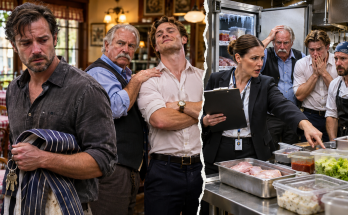
By spring, I had stopped expecting every morning to bring another emergency.
That was new for me.
For eighteen years, I'd woken up thinking about Callaway's Table before my feet touched the floor.
Even after I left, the habit followed me.
I worried about the employees.
The customers.
The unpaid bills.
And the financial documents carrying my name.
Now my mornings were different.
I still got up early.
I still thought about refrigeration temperatures and food deliveries.
I still checked what needed to be ready before customers arrived.
But I was thinking about Second Table.
A restaurant I'd chosen to build with Patrice and Emmett.
That difference had become important to me.
I wasn't working because my father expected me to rescue the family business.
I wasn't working because Colton needed somebody to clean up his mistakes.
I was working because I wanted to.
Some days, I still had trouble believing that.
The restaurant had been open long enough for us to establish a routine.
Not a perfect one.
We still had adjustments to make.
There were mornings when we needed to change how we organized the kitchen.
There were days when the dining room became busy earlier than expected.
And there were evenings when I went home tired enough to fall asleep without finishing a thought.
But I didn't feel the same weight I'd carried at Callaway's Table.
When something needed attention, we handled it together.
Patrice knew what was happening with the customers.
Emmett knew what was happening in the kitchen.
And I knew what needed to be done to keep the business moving.
Nobody had to pretend everything was fine when it wasn't.
Nobody had to hide a problem to protect somebody else's pride.
That was something I appreciated more than I could explain.
I remembered the morning Rhonda walked into Callaway's Table.
Emmett had found the cooler running at fifty-one degrees.
Colton had claimed the thermometer wasn't working.
Instead of dealing with the problem, he'd threatened Emmett for speaking honestly.
I still thought about that sometimes.
Especially when I saw Emmett checking the equipment at Second Table.
He didn't rush through the readings.
He didn't treat the records like meaningless paperwork.
He understood why they mattered.
And because he was a partner, he had the authority to address anything he found.
I had spent years wishing the people around me would take responsibility that seriously.
Now I worked beside someone who did.
One morning, I watched Emmett finish his checks.
He looked up.
“Everything's where it should be.”
I nodded.
“Good.”
That was all we needed to say.
No argument.
No excuses.
No pretending a problem would disappear if we ignored it.
I walked back into the dining room.
Patrice was getting the tables ready.
The yellow flowers Mrs. Whitaker had brought on opening day were no longer there.
But I still remembered how she had carried them through the door.
And what she'd said about my mother.
Those words stayed with me.
Sometimes I'd look at the photograph beside the register and think about that first morning.
Mom had her arm around my shoulders.
I was standing on the little blue stool.
Dad was smiling behind us.
The photograph was a reminder of a family I had once believed would always remain the same.
But it was also a reminder of how much could change.
Dad's letter was still at home.
I hadn't thrown it away.
I hadn't answered it immediately either.
I'd needed time to understand what it meant to receive an apology without being asked to do something in return.
For most of my adult life, conversations with my father had ended with a responsibility landing in my hands.
A problem at the restaurant.
A disagreement with Colton.
A payment that needed attention.
Something that couldn't wait.
But the letter hadn't asked me to fix anything.
Dad had admitted that he'd treated my loyalty as something he could rely on without considering the cost.
He'd acknowledged that he'd taken my work for granted.
And he'd accepted that I might never forgive him.
I still didn't know what forgiveness would look like.
I only knew I wasn't ready to pretend everything had been repaired.
Outside Second Table, the days slowly grew warmer.
Spring was arriving in Asheville.
Customers continued coming through our doors.
Some were people I'd known for years.
Others were new.
I liked watching them discover the place.
I liked seeing the dining room fill.
I liked hearing Emmett laugh in the kitchen.
And I liked knowing that Patrice could make decisions about the guest experience without asking whether my father would approve.
Those were ordinary things.
But ordinary things had become precious to me.
The legal proceedings were still moving forward.
Rebecca Shaw kept me informed about matters that affected me.
The dispute over my personal guarantee had already been resolved in my favor.
The lender had accepted that I hadn't authorized the financing.
That meant the sixty-three thousand dollars drawn against the credit line was no longer being treated as my personal obligation.
I was grateful for that.
But the financial consequences hadn't vanished.
They had simply remained where they belonged.
With the people and business responsible for the borrowing.
The criminal case involving Colton continued.
Dad's false certification was also part of the legal process.
And the remaining civil financial issues had to be handled separately.
I had learned enough during the investigation to understand that one decision didn't automatically settle everything.
The lender's determination about my guarantee was one matter.
The criminal proceedings were another.
The restaurant's debts were another still.
For years, I'd treated business problems as though they could all be solved by finding the right person to call.
But some things required a process.
Records.
Evidence.
Formal decisions.
And consequences that couldn't be avoided simply because they were painful.
I didn't like that.
Nobody in my family did.
But liking it wasn't the point.
Colton eventually accepted responsibility for his part in the fraudulent application as part of a negotiated resolution.
There were restitution obligations.
There were consequences imposed through the court.
And there was no way to pretend he'd simply made an innocent mistake.
I sat quietly when I learned the outcome.
I'd spent months waiting for the truth to be established.
Now it had been.
My brother had used my identity without permission.
He'd submitted a false authorization.
He'd allowed money to be borrowed while my name was presented as security.
And he had wanted me out of the restaurant so he could take control.
Those facts no longer depended on whether he was willing to admit them at a family dinner.
They had become part of a formal legal matter.
I should have felt satisfied.
Maybe some part of me did.
But mostly I felt sad.
I remembered Colton as a boy.
I remembered him calling me Nathaniel because he thought it was funny.
I remembered trying to teach him things in the kitchen.
I remembered believing he would eventually find his own place in the business.
I hadn't wanted him to fail.
That was what hurt.
I had wanted him to succeed.
I just hadn't agreed to let him succeed by taking away what I'd built.
For a while, I sat with that thought.
Then I returned to work.
There was nothing else I needed to do about his case.
Dad also faced penalties for falsely certifying the authorization.
He had admitted that he'd signed as a witness without seeing me sign anything.
He'd made a formal statement.
And he was now facing the consequences of that decision.
I thought about the day he'd come to my apartment with the photograph from 1996.
He'd looked tired.
His hands had trembled.
And for the first time, he'd told me why he had expected me to stay after giving the restaurant to Colton.
He'd believed I'd always come back.
That explanation had hurt more than I expected.
Because it was true.
I'd always returned.
No matter how exhausted I was.
No matter how unfair something felt.
No matter how much of my life the restaurant consumed.
I came back.
Dad had confused that habit with permission.
Now he was learning that my loyalty had limits.
His apology mattered.
His admission mattered.
But neither erased the financial misconduct.
I was relieved that the legal process recognized that.
Not because I wanted my father punished for the sake of punishment.
Because I needed the truth to matter even when it was uncomfortable.
Neither Dad nor Colton escaped accountability.
And I couldn't purchase peace by pretending they had done nothing wrong.
That was something I had to accept.
The old restaurant had its own final problems to resolve.
Callaway's Table never reopened under Colton.
After the health inspection, the business had remained closed while its obligations grew.
The restructuring attorney had been responsible for examining what could be done.
There were employees owed money.
Creditors waiting for payment.
Suppliers whose invoices hadn't been settled.
Catering customers seeking refunds.
And business assets that could potentially be sold.
I understood those obligations.
I'd spent years managing the financial details that kept a restaurant functioning.
But I no longer had authority over Callaway's Table.
And I wasn't willing to place myself back in charge of its debts.
That remained difficult.
Even after everything.
I knew the people affected.
I knew how important wages were to employees.
I knew what a missed payment could mean to a supplier.
And I knew how disappointing it was for customers who had trusted us with important events.
I wished things had happened differently.
But wishing didn't give me the right to interfere with the restructuring.
So I stayed out of it.
Eventually, the remaining restaurant assets were sold.
The proceeds were used to address the obligations through the formal process.
Employees and creditors received what could be recovered.
It wasn't the ending I'd wanted for Callaway's Table.
I don't think anyone had imagined it ending that way.
The place had opened in 1996.
My parents had stood outside with a hand-painted sign.
My mother had laughed in the photograph.
Dad had believed he was building something that would last.
And for years, it had.
Customers returned.
Employees learned their jobs.
Families celebrated meals together.
I grew up inside that business.
Then I spent eighteen years helping maintain it.
Now the assets were being sold to settle what remained.
I found that difficult to think about.
A restaurant isn't just equipment and furniture.
Not to the people who spend their lives working there.
It's mornings before sunrise.
It's tired employees cleaning after closing.
It's customers who always order the same meal.
It's the sound of a bell from the kitchen.
It's the smell of bread.
It's the small things people remember long after the doors close.
But those memories couldn't pay the debts.
And they couldn't undo the decisions that had led to the closure.
The building itself would have a new tenant.
Callaway's Table would no longer occupy it.
When I heard that, I sat at my apartment table for a long time.
The credit folder was nearby.
I hadn't needed to open it for a while.
But I looked at it.
That folder had once represented everything I feared losing.
My savings.
My financial security.
My ability to begin again.
Now the guarantee dispute had been resolved.
The truth about the application had come out.
And I'd already started a new restaurant.
But the old business was disappearing.
I couldn't pretend that didn't matter.
One afternoon, I drove past Callaway's Table.
I hadn't planned to stop.
I was simply passing through the area.
Then I noticed people working outside the building.
I slowed down.
The sign was being removed.
For a moment, I thought about continuing.
I could have driven away.
I didn't need to watch.
But something made me pull over.
I parked across the street.
The workers were taking down the letters.
One at a time.
I stood beside my car.
Then I crossed my arms and watched.
Callaway's Table.
The name that had been part of my life for so long.
The name I'd written on invoices.
The name I'd spoken over the phone.
The name customers recognized.
The name I'd defended when the business struggled.
Now it was being taken off the wall.
I watched the first letter come down.
Then another.
And another.
I thought about Dad painting the original sign.
I thought about my mother standing beside him.
I thought about the little blue stool.
I thought about Colton wanting the restaurant.
And I thought about the night I placed my three keys beside the register.
I had believed that walking away meant losing everything.
Now I was watching the name disappear from the building.
And I understood that leaving had only been the beginning of the loss.
The letters kept coming down.
I stayed.
I didn't try to stop the workers.
I didn't ask what would happen to the sign.
I didn't walk across the street to look inside.
I simply watched.
Eventually, the wall was bare.
There was nothing left to read.
For a moment, the building looked unfamiliar.
I had spent so many years thinking of that place as Callaway's Table that seeing it without the name felt wrong.
It was still the same building.
The same windows.
The same entrance.
But it no longer belonged to the story I'd been telling myself about my family.
I got back into my car.
I started the engine.
Then I drove away.
I made it as far as the next traffic light before my eyes filled.
I tried to keep looking ahead.
I couldn't.
I pulled into a parking lot.
Then I sat with my hands on the steering wheel.
And I cried.
Not because I wanted the restaurant back.
Not because I regretted leaving.
I cried because something I'd loved had ended.
And because I was finally allowing myself to feel the cost.
For years, I'd believed that if I kept working hard enough, I could protect the restaurant from anything.
Money problems.
Employee problems.
Family disagreements.
My father's decisions.
Colton's mistakes.
I had treated the business like something I could keep alive through effort alone.
Now the sign was gone.
And I couldn't save it.
The truth was, I no longer wanted to save it that way.
But grief doesn't always follow what makes sense.
I missed my mother.
I missed the boy who stood on the little blue stool.
I missed the years when cooking beside Dad felt simple.
And I missed believing that being useful was enough to keep my family together.
I sat there until I could breathe normally again.
Then I wiped my face.
The traffic continued outside.
People were going about their afternoons.
Nobody knew what I'd just watched.
That was fine.
I didn't need anyone to see it.
I had needed to let myself grieve.
For the building.
For the years.
For the family I thought I had.
And for the younger version of me who had believed he had to keep rescuing everyone to deserve a place beside them.
I looked down at my hands.
They were the same hands that had worked at Callaway's Table.
The same hands that had folded my apron.
The same hands that had signed the legitimate agreements for Second Table.
Nothing about them had changed.
But what I expected from myself had.
I no longer believed I had to carry an entire restaurant to prove I belonged.
I no longer believed my father's approval determined the value of my work.
And I no longer believed that protecting my family meant protecting them from accountability.
I started the car again.
Then I drove toward Second Table.
There was work to do.
Not the old work.
Not the work of making excuses.
Not the work of fixing a business somebody else had taken from my hands.
There were customers to serve.
Employees to support.
And a restaurant that existed because three people had chosen to build it together.
I was still sad.
I knew I would be sad for a while.
But I wasn't going back.
The old sign was gone.
The old business was finished.
And I was finally allowing those things to be true.