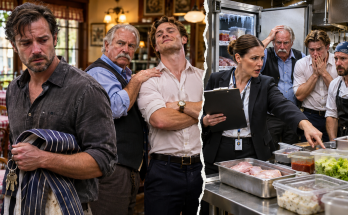
I used to believe that if I worked hard enough for my family, they would eventually understand what I was worth.
I was wrong.
It took eighteen years, one family dinner, and a restaurant inspection to make me understand how wrong I had been.
My name is Nathan Callaway.
Most people called me Nate.
For nearly half my life, I had worked at Callaway's Table in Asheville.
I knew every corner of that building.
I knew which floorboards made noise when somebody crossed the kitchen before sunrise.
I knew which refrigerator needed extra attention during summer.
I knew how many biscuits we needed on a busy Friday morning.
Those things might sound small.
But small things were what kept a restaurant running.
And for eighteen years, keeping that restaurant running had been my responsibility.
My father, Frank Callaway, owned the business.
He had opened it back in 1996, when my mother was still alive.
The restaurant had been part of our family for so long that I could barely remember life without it.
I grew up watching my parents work behind the counter.
My mother used to make room for anyone who came through the door.
Dad handled the business.
And I learned early that the kitchen was a place where I could be useful.
After my mother died when I was twelve, the restaurant became even more important to me.
It held memories I didn't want to lose.
Her voice.
Her laughter.
The little wooden stool she used to let me stand on when I was too short to reach the counter.
I suppose I started confusing the building with the family itself.
Looking back, that was where I made my first mistake.
I thought protecting the restaurant meant protecting everything my mother had left behind.
So I worked.
And worked.
And kept working.
Eventually, my job became much bigger than cooking.
I dealt with suppliers.
I organized schedules.
I handled customer complaints.
I checked invoices, trained employees, supervised the kitchen, and watched every dollar that passed through the business.
I learned how to solve problems before customers noticed them.
I learned how to keep calm when deliveries were late.
I learned how to keep people working together when everyone was exhausted.
Sometimes I paid business expenses with my own savings when the restaurant didn't have enough cash.
Twice, I did that to keep vendors paid.
I never treated those moments like favors.
I treated them as responsibilities.
Dad needed help.
The restaurant needed help.
And I believed I was supposed to provide it.
My younger brother, Colton, saw things differently.
He wanted the restaurant too.
But wanting something and knowing how to operate it were two separate matters.
I understood that.
Dad didn't always seem to.
For years, I watched my father worry about Colton finding his direction.
Colton wanted recognition.
He wanted Dad to take him seriously.
He wanted people to look at him the way they looked at me when something went wrong in the kitchen.
I never thought that was a problem.
There was room for both of us.
Or at least I believed there was.
When Colton began preparing to take a larger role in the business, I spent six months teaching him our procedures.
I explained the supplier accounts.
I showed him the kitchen checklists.
I went through the temperature records and the sanitation requirements.
I showed him the systems I'd spent years improving.
Nothing was hidden.
Nothing was kept from him.
I wanted him to succeed.
That was the part that hurt the most afterward.
I had genuinely wanted my brother to succeed.
I just hadn't realized that my family had already decided what success for him was supposed to look like.
It meant taking my place.
The decision came at a family dinner.
Dad announced that Colton would be receiving control of Callaway's Table.
The restaurant I'd spent eighteen years helping build would now be his.
I remember sitting there, trying to understand how everyone else could behave as though this were a perfectly ordinary arrangement.
Dad spoke about Colton needing an opportunity.
He spoke about the future of the family business.
But he didn't talk about the years I'd given it.
He didn't ask what I wanted.
And he certainly didn't explain what authority I would have afterward.
Jolene, my stepmother, made things worse.
She said something that stayed with me long after the dinner ended.
She treated my role as though I had merely been occupying a position until Colton was ready.
A temporary arrangement.
Eighteen years.
Temporary.
I didn't start shouting.
I didn't throw anything.
I didn't try to make my father feel guilty.
I had spent too many years holding that family together to know how to make a scene for myself.
Instead, I left the restaurant.
I folded my apron.
I put down my three keys.
And I walked away.
No speech.
No accusations.
No final attempt to prove I deserved better.
I simply stopped doing what everyone had assumed I would continue doing forever.
For the first few days, I hardly knew what to do with myself.
Without the restaurant, mornings felt strange.
There were no urgent calls about deliveries.
No messages from employees asking to change their shifts.
No invoices waiting for my approval.
No kitchen problems demanding an immediate solution.
For eighteen years, my day had begun with somebody needing something.
Now nobody was asking.
I thought the silence would feel peaceful.
Instead, it made me uncomfortable.
By the third morning, I was still wearing the same gray sweatshirt around my apartment.
I kept reaching for my phone out of habit.
I checked the time and thought about what would normally be happening in the kitchen.
Then I reminded myself that it wasn't my job anymore.
That thought should have made me feel better.
It didn't.
On the sixth day after I left, a health inspector arrived at Callaway's Table.
Her name was Rhonda.
I wasn't there to see her walk into the restaurant.
What happened that morning reached me through Emmett, one of the few people at the restaurant I trusted without hesitation.
Emmett had started working with us when he was seventeen.
Back then, he washed dishes.
Over the years, I'd taught him to cook, manage a station, and take responsibility for the food he served.
He became one of our most dependable employees.
When his mother died, I'd been there for him.
He wasn't my brother by blood.
But I cared about him like family.
And that Friday, he was standing inside a kitchen that had changed dramatically in less than a week.
Later, he told me how the inspection began.
Rhonda had looked around the preparation area.
Several food containers were sitting without covers.
Her attention moved to a tripod that had been set up nearby.
Then she asked to review the restaurant's food-safety documentation and refrigeration equipment.
Colton assured her that everything would be provided.
According to Emmett, he sounded completely certain of himself.
That didn't surprise me.
Colton had always been good at sounding sure.
He was much less comfortable when somebody wanted proof.
Rhonda wasn't there to listen to promises.
She was there to examine the actual conditions.
Colton went toward the office to collect the records.
Emmett watched him leave.
Then he made a decision that would put his job at risk.
He approached the inspector.
He told her there were problems she needed to know about.
While that conversation was beginning, I was standing in my apartment kitchen.
I had coffee grounds on the counter.
My mug was still empty.
I was looking out toward the mountains when my phone began vibrating.
Emmett.
I answered without thinking.
“What's going on?”
His voice was low.
“The inspector came.”
My hand stopped above the coffee container.
“Rhonda?”
“That's her.”
I put the scoop down.
“What did she find?”
He hesitated.
“It's worse than I thought, Nate.”
I could hear movement behind him.
Something metal struck another surface.
A voice asked about the sanitation documentation.
Emmett lowered his voice even more.
“The walk-in cooler is at fifty-one degrees.”
I stared at the counter.
“Tell me you checked that again.”
“I did.”
“With another thermometer?”
“The backup probe gave the same result.”
I closed my eyes.
Fifty-one degrees.
Not forty-one.
Not a borderline reading that might need a second check.
Fifty-one.
Food that required refrigeration had been sitting in equipment running far above the proper holding range.
And nobody seemed able to say how long it had been that way.
My mind immediately went to the customers.
Then the food.
Then the records.
That was the order my thoughts had followed for years.
I asked what Colton had said.
“He keeps saying the thermometer isn't working.”
“But you tested it.”
“Yes.”
“Then you know what the reading is.”
Emmett went quiet.
I heard someone moving behind him.
Then he said, “Colton warned me not to speak to her.”
I looked down at my phone.
“What kind of warning?”
“He said I could be fired if I told her anything without checking with him.”
For a moment, I didn't answer.
I knew how much Emmett depended on his paycheck.
I knew he wasn't somebody who could casually walk away from work without consequences.
But I also knew what could happen if unsafe food went out of that kitchen.
I pressed my fingers against the edge of the counter.
“Emmett, don't cover for something that could hurt a customer.”
He breathed out.
“I know.”
“Tell her what you've actually seen.”
“Okay.”
“And if you don't know something, just say you don't know.”
He didn't answer immediately.
Then he said, “I figured you'd tell me that.”
Something tightened in my throat.
He had called me because he still trusted what I'd taught him.
Even after I'd left.
Even after my father had decided somebody else should run the restaurant.
I could hear the fear in his voice.
I wanted to tell him everything would be fine.
But I couldn't promise that.
I didn't know what Rhonda would find.
I didn't know what Colton had changed.
And I didn't know how much damage had already been done.
Then Emmett whispered something that made me straighten.
“Your dad's here.”
A door slammed somewhere in the background.
The call disconnected.
I stood with the phone against my ear.
For several seconds, I didn't move.
My father had arrived.
Colton was under inspection.
Emmett was risking his job by telling the truth.
And I was standing across town, doing nothing.
Every instinct I'd developed over eighteen years told me to go there.
Get in the car.
Walk through the kitchen.
Find out what was wrong.
Take charge.
Fix it.
That was what I had always done.
When something failed, I stepped in.
When somebody panicked, I stayed calm.
When Dad made a decision without thinking through the details, I found a way to make it work.
I had become very good at cleaning up other people's mistakes.
Too good.
I reached for my car keys.
Then I stopped.
I stood there looking at them.
The keys to my car were in my hand.
The keys to the restaurant were gone.
And for the first time, I understood there was a difference.
I wasn't the person in charge of Callaway's Table anymore.
My father had made that clear.
Colton had accepted the authority.
Now an inspector was asking him to demonstrate what that authority meant.
I wanted to protect Emmett.
I wanted to protect the customers.
But I could not keep pretending I was responsible for a business I had been pushed out of.
I put my car keys back on the counter.
There was something else I needed to deal with first.
Something I'd been trying to understand since documents about an unfamiliar credit account had come into my possession.
I walked toward the folder where I'd kept them.
At first, those papers had seemed like another business problem.
One more account I might have to untangle.
One more financial mess with the restaurant's name attached.
But now, with Emmett's frightened voice still in my head, I looked at them differently.
I opened the folder.
The first page carried the name of the restaurant's company.
Callaway's Table LLC.
Below that was a commercial credit arrangement.
I scanned down the document.
And then I saw the person identified as the guarantor.
Nathan Callaway.
Me.
I sat down slowly.
Because I had never agreed to guarantee that account.
Not once.
And suddenly, the inspection at the restaurant was no longer the only problem my family had created.