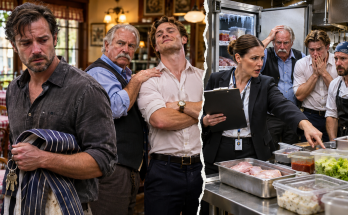
That summer, Dad called Second Table.
He didn't arrive without warning.
He didn't ask me to stop working and come meet him.
And he didn't assume that because I was his son, he could walk into my new restaurant whenever he wanted.
He called first.
I was surprised when Patrice told me he wanted to speak with me.
For a moment, I wondered whether something had happened.
Another legal problem.
Another financial obligation.
Another difficult conversation about Colton.
Those were the things I'd learned to expect from my family.
I took the call.
Dad sounded nervous.
That was unusual.
For most of my life, he'd spoken to me as though he already knew what needed to happen.
He gave instructions.
He asked questions when he wanted information.
And he expected me to understand what the restaurant required.
This time, he asked something simple.
“Would you mind if I came by for lunch?”
I stood quietly.
He didn't continue.
He didn't explain why I should say yes.
He didn't remind me that he was my father.
He waited.
That made the question feel different.
I looked toward the dining room.
Customers were eating.
Patrice was helping people find seats.
Emmett was working in the kitchen.
Everything was moving as it should.
I thought about Dad's letter.
The apology.
The photograph.
The little blue stool he'd offered to send.
I thought about the legal proceedings.
The consequences he'd faced.
The fact that Callaway's Table was gone.
And I thought about the conversation we'd had in my apartment.
The one where he'd admitted he'd expected me to stay no matter how he treated me.
I wasn't sure I was ready for another conversation.
But I wasn't afraid of seeing him either.
That was new.
I took a breath.
“You can come.”
He sounded relieved.
“Thank you.”
We agreed that he'd visit for lunch.
When the call ended, I remained still for a moment.
I didn't feel the old pressure to prepare a solution.
There was no business emergency.
No request for money.
No demand that I take Colton's side.
My father wanted to eat at my restaurant.
That was all he'd asked.
I walked back into the dining room.
Patrice looked at me.
“Everything okay?”
I nodded.
“Dad's coming for lunch.”
She waited.
I appreciated that she didn't immediately ask whether I wanted her to keep him away.
She knew things had been difficult.
But she also knew I could make my own decisions.
I told her I'd agreed to the visit.
She nodded.
“Then we'll get him a table.”
It was such an ordinary answer.
And I was grateful for it.
When Dad arrived, he looked around the restaurant.
I watched him from a short distance.
He moved slowly.
His attention went from the tables to the windows.
Then toward the kitchen.
I wondered what he saw.
A small restaurant near the River Arts District.
A dining room full of customers.
A business operating without the Callaway name.
Or the result of eighteen years of experience he'd once treated as something he could give away.
I couldn't know.
But I watched him.
Patrice approached and greeted him professionally.
She didn't treat him badly.
She didn't make him feel unwelcome.
She simply did her job.
She showed him to a table near the window.
Dad thanked her.
Then he sat down.
That mattered to me.
He was a customer.
Not the owner.
Not the person making decisions.
Not the man whose name appeared above the restaurant entrance.
A customer.
I brought his coffee myself.
He looked up when I approached.
“Thank you, Nate.”
I placed the cup on the table.
“There's cream if you need it.”
He gave a small smile.
For a moment, I felt as though we were strangers being polite.
That was uncomfortable.
But it was also easier than pretending nothing had happened.
Dad looked around again.
I could see he wanted to say something about the restaurant.
I waited.
He didn't immediately offer advice.
He didn't tell me what he would have done differently.
He simply looked at the place.
Then he reached into his coat pocket.
“I brought something.”
I glanced at his hand.
He placed a brass key on the table.
I recognized it.
The original key to Callaway's Table.
I stared at the metal.
For years, keys had been part of my daily life.
I used them to open the restaurant.
To close it.
To make sure equipment and storage areas were secure.
When I left, I'd put down three keys beside the register.
That had been my way of ending eighteen years of responsibility.
Now Dad was offering me another key.
One from the restaurant that no longer existed.
I didn't touch it.
He explained that he'd found it in his desk.
He'd kept it after the locks were changed.
He thought I might want it as a reminder.
I looked at the key for a long moment.
It was small.
Ordinary.
The kind of object people lose in drawers and forget about.
But for me, it carried too much history.
I remembered the old restaurant doors.
The mornings before sunrise.
The evenings when I stayed until everyone else had gone home.
I remembered locking up after difficult shifts.
I remembered believing that because I held the keys, the place somehow belonged to me too.
But it hadn't.
Dad had shown me that.
He'd given control to Colton.
And he'd expected me to continue working anyway.
I looked back at him.
“I don't think I need that key.”
He nodded.
I expected him to ask why.
He didn't.
He looked down at it.
Then he picked it up.
“Okay.”
He put it back into his pocket.
No argument.
No explanation about why it should matter to me.
No suggestion that I was rejecting the family by refusing it.
Just acceptance.
I hadn't realized how much I needed to see him do that.
For years, Dad had treated my decisions as something he could negotiate.
If I didn't want to do something, he'd explain why the restaurant needed me.
If I disagreed, he'd remind me what was at stake.
If I wanted time away, there was always another responsibility waiting.
Now I'd said no.
And he'd accepted it.
I pulled out the chair opposite him.
I wasn't planning to sit for long.
The restaurant was still operating.
But I wanted to talk.
Not about the key.
Not about the old restaurant.
About him.
“How have you been?”
Dad looked surprised.
I understood why.
Most of our conversations since the family dinner had involved difficult subjects.
The inspection.
The financing.
His confession.
The legal consequences.
I hadn't asked how he was doing without expecting the conversation to become painful.
Now I was asking because I wanted to know.
He looked down at his coffee.
Then he answered.
He didn't begin with excuses.
He didn't say the investigation had been unfair.
He didn't tell me that everything had happened because Colton was young or confused.
He spoke about his obligations.
The financial counseling he was attending.
The part-time work he'd taken.
And the effort he was making to pay what he owed.
I listened.
It was strange hearing my father describe a life that didn't revolve around owning a restaurant.
For decades, Callaway's Table had been his identity.
He'd opened it with Mom.
He'd spent years building its reputation.
He'd been the person customers recognized.
And he'd believed that his sons would carry it into the future.
Now the business was gone.
He was working part-time.
And he was learning how to deal with financial responsibilities that couldn't be solved by opening the doors for another day.
I wondered how difficult that was for him.
Then I reminded myself that I didn't need to make the difficulty disappear.
I could listen.
That was enough.
Dad told me Jolene had started seeing a counselor.
I looked at him.
He said she was trying to understand some of the choices she'd made.
I remembered her visit to my apartment.
The casserole.
The pearl earrings.
The way she'd cried when I asked about the credit account.
I remembered her saying she'd been afraid Colton would never find his place.
And that she'd believed Frank when he said the financing was legitimate.
I had been angry with her.
I still was, in some ways.
But I also remembered the moment she'd admitted that wanting Colton to succeed had influenced how she'd treated me.
I hoped counseling would help her understand that.
Not because I expected an apology to solve everything.
Because I wanted her to stop believing that helping one family member required sacrificing another.
Dad continued speaking.
Then he mentioned Colton.
My stomach tightened.
I hadn't spoken with my brother since the call about the forged authorization.
The one where he'd accused me of always having everything.
The one where he'd said I wasn't going to leave unless they made me.
I could still remember his voice.
I looked at Dad.
“How is he?”
Dad hesitated.
Then he admitted that Colton still blamed me sometimes.
I wasn't surprised.
Part of me had expected that.
Colton had spent years comparing himself with me.
He'd wanted Dad's respect.
He'd believed taking over the restaurant would finally prove something.
Instead, the business had closed.
The financing investigation had exposed what he'd done.
And he'd faced criminal consequences.
I could understand why he might want someone else to blame.
Understanding didn't make him right.
I looked down at my hands.
“I figured he might.”
Dad nodded.
Then he said he'd spoken to Colton about it.
I looked up.
For years, Dad had protected my brother from responsibility.
He'd explained away mistakes.
He'd insisted Colton needed another opportunity.
He'd asked me to be patient.
Now he was telling me he'd challenged him.
I wasn't sure what to expect.
Dad looked directly at me.
“I told him you didn't steal his future.”
I stayed quiet.
He continued.
He'd told Colton that I hadn't taken the restaurant from him.
I hadn't caused the financing fraud.
I hadn't made the decisions that led to the inspection violations.
Dad admitted that he and Colton had created the situation.
They had made the choices.
And they had taken from me.
For a moment, I couldn't speak.
My father had finally said something to Colton that I'd needed him to say years earlier.
Not that I was better.
Not that Colton was worthless.
Simply that I wasn't responsible for giving my brother the life he wanted.
I had worked for what I knew.
I had built my experience.
And I hadn't owed Colton the right to use my name or take my place.
I looked at Dad.
He seemed nervous again.
Maybe he expected me to become angry.
Maybe he thought I would ask why he hadn't said those things sooner.
I wanted to.
The question was there.
Why now?
Why after the business closed?
Why after the investigation?
Why after I'd spent eighteen years trying to earn the respect he had so casually given away?
But I didn't ask.
I already knew part of the answer.
Dad had believed I'd always stay.
He hadn't understood the cost until I stopped.
That didn't excuse what happened.
It explained why he had been willing to let it happen.
I looked around Second Table.
The dining room was busy.
Patrice was helping an older couple find a place to sit.
Emmett's laughter reached me from the kitchen.
The smell of fresh bread drifted through the room.
I thought about how different this place was from the old restaurant.
Not because we served food differently.
Not because the room was smaller.
But because nobody here had to pretend that their contribution belonged to someone else.
I looked back at Dad.
“I don't think things can ever be the way they were.”
He nodded.
“I know.”
He didn't argue.
He didn't say time would make everything normal again.
He didn't tell me families were supposed to forgive.
He simply accepted what I'd said.
I watched him.
For a moment, I saw the father who'd stood outside Callaway's Table with my mother in 1996.
The man who'd painted the sign.
The man who'd taught me to make biscuits.
Then I saw the man who'd signed the false witness certification.
The man who'd expected me to keep working after handing my responsibilities to Colton.
Both versions were sitting in front of me.
I couldn't separate them.
But I could decide how to deal with the person he was becoming.
I took a breath.
“We can find out what happens from here.”
Dad looked at me.
His eyes filled.
He nodded.
That was enough for the moment.
I wasn't promising to forget.
I wasn't inviting him back into every part of my life.
I wasn't saying the damage had disappeared.
I was simply leaving room for the possibility that our relationship could become something different.
Not through one conversation.
Not through a letter.
Through choices made over time.
Dad finished his lunch.
He paid his bill.
He left a tip.
And when he stood to leave, he thanked Patrice.
I watched him walk toward the door.
He didn't ask me to come outside.
He didn't make a speech.
He didn't try to embrace me in front of the customers.
He simply left.
I stayed where I was for a moment.
Then I returned to work.
There was no grand reconciliation.
No sudden return to the family we'd been before.
But something important had happened.
My father had entered my restaurant as a guest.
He'd accepted my refusal of the old key.
He'd spoken honestly about his responsibilities.
And he'd left without asking me to carry anything for him.
I thought about the brass key in his pocket.
For years, I'd believed that holding the keys to Callaway's Table meant I belonged there.
Now I had the key to Second Table.
A place where my work was recognized.
A place where my role was clear.
A place I could leave at the end of the day and return to because I chose to.
I didn't need Dad's old key.
I didn't need to reopen the restaurant we'd lost.
And I didn't need to pretend our past could be repaired by acting as though nothing had happened.
I looked toward the dining room.
A customer needed assistance.
Patrice was already helping.
Emmett was working in the kitchen.
And I had my own responsibilities waiting.
For the first time, seeing my father hadn't made me feel as though I needed to fix his life.
I could care about him.
I could listen.
And I could let him leave with his own responsibilities still in his hands.
That felt like the beginning of a different kind of relationship.
Not an easy one.
But perhaps a healthier one.
I picked up my work again.
The restaurant was busy.
And I was exactly where I wanted to be.