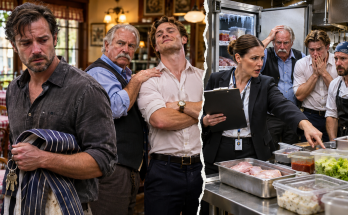
The first week after the inspection was harder than I expected.
Not because I missed working at Callaway's Table.
I missed knowing that everything was being handled.
For eighteen years, whenever something went wrong, I knew who would have to deal with it.
Me.
A supplier called about an unpaid invoice.
I handled it.
An employee needed information about a paycheck.
I found it.
A customer wanted to change a catering order.
I checked the schedule and made the arrangements.
I had built my days around solving problems before they became larger ones.
Now those problems were happening without me.
And every time I heard about another one, I felt the same familiar urge.
Call someone.
Find the paperwork.
Make a decision.
Get it fixed.
Then I remembered that I no longer worked there.
It sounded simple when I said it to myself.
It didn't feel simple.
The morning after my conversation with Colton, I sat at my kitchen table with Rebecca Shaw's instructions beside me.
The disputed credit agreement was still in its folder.
The authorization letter was with it.
So was the transaction information showing payments to Blue Ridge Hospitality Consulting.
I had already sent the important records to Rebecca.
The investigator handling my police report had also received the new material.
There was nothing more I could accomplish by staring at those pages.
But I kept opening the folder anyway.
I would read the same line.
Look at the same signature.
Then close it again.
I couldn't stop thinking about the timing.
Four months earlier, somebody had opened that credit line.
Three days before the family dinner, somebody had prepared the authorization letter.
And throughout that time, I had kept showing up to work.
I had continued training Colton.
I had continued protecting the restaurant's money.
I had continued assuming my family would tell me if something important was happening.
That was the part I couldn't get past.
It wasn't only that they'd used my name.
It was that they'd looked me in the face while doing it.
I'd sat with them.
Worked beside them.
Answered questions.
And never realized that decisions affecting my financial future were being made without me.
I felt foolish.
I know now that trusting people isn't the same as being foolish.
But that wasn't how it felt then.
I remembered all the times I'd tried to make things easier for Colton.
All the conversations about procedures he thought were unnecessary.
All the times I'd repeated an explanation because I wanted him to understand.
He had been angry that people respected my experience.
Yet he'd needed the financial identity I'd built while earning that experience.
I found that difficult to forgive.
Not because of the money alone.
Because of what it said about how he saw me.
He wanted the benefits of having me around.
He just didn't want me there.
The restaurant stayed closed.
The health department required several things before food operations could resume.
The unsafe food had to be disposed of properly.
The refrigeration problems had to be corrected.
The sanitation issues had to be addressed.
The operating procedures needed to be brought back into compliance.
And the restaurant would have to pass another inspection.
There was no shortcut.
A closed kitchen could not simply reopen because the owner was embarrassed.
I knew those requirements well.
I'd spent years following them.
I also knew that every day without service meant another day without ordinary restaurant revenue.
The bills wouldn't stop because the doors were locked.
Neither would the obligations to employees.
Or the deposits customers had already paid for future events.
I knew exactly how quickly those problems could become serious.
That knowledge was exhausting.
One morning, I caught myself thinking through the restaurant's supplier schedule.
I knew which vendors normally expected payment first.
I knew which accounts would become difficult if payments were late.
I even found myself mentally calculating which expenses Dad might be able to postpone.
Then I stopped.
I was standing in my own apartment.
The restaurant wasn't mine to manage.
And I was making an emergency financial plan nobody had asked me to make.
I sat down.
I had to admit something uncomfortable.
My family wasn't the only reason I'd spent so many years carrying everything.
I'd also made a habit of believing that nobody could manage without me.
Sometimes that belief was based on experience.
Sometimes it was an excuse to avoid letting go.
I was beginning to understand both things could be true.
Over the following days, suppliers began pressing the restaurant for payment.
The ordinary invoices were still there.
So were the expenses connected to running the business before it closed.
Dad tried to arrange repairs.
But the financing situation had become another obstacle.
The lender had frozen the disputed credit line while the fraud investigation continued.
I understood why.
The account had been opened using authorization I denied giving.
There was an active investigation.
The lender couldn't simply continue treating the arrangement as though nothing had happened.
Still, I knew what the freeze meant for the restaurant.
Dad had lost access to money he had apparently expected to use.
Colton couldn't spend his way around the problem.
And the business was already struggling to meet obligations.
Part of me felt sorry for Dad.
Then I looked at the witness signature again.
He had put himself in that position.
I hadn't.
That distinction mattered.
It mattered more every time I repeated it.
The catering customers were another problem.
Callaway's Table had booked events long before Colton took control.
Weddings.
Corporate gatherings.
Meals people had already planned and paid deposits toward.
Those customers needed answers.
Some needed refunds.
Some needed documentation showing what they'd reserved.
And I knew many of those records because I'd handled the catering arrangements myself.
For years, people had trusted me to make sure their events were properly organized.
Now the restaurant was closed, and those people were understandably worried.
I couldn't pretend they didn't exist.
But I also couldn't step back into the business and start making promises on its behalf.
That would have placed me right back in the position I'd left.
Responsible for everything.
Authorized to decide nothing.
So I found a different way to help.
I used the booking records already in my possession to give affected customers copies of their information.
I made sure they knew what the records showed.
I directed them to the business for refunds.
I didn't promise money would be returned by a particular date.
I didn't offer to cover deposits myself.
And I didn't sign documents for Callaway's Table.
That last part was difficult.
I had spent so many years trying to keep customers happy that saying I couldn't act for the restaurant felt almost rude.
But it was the truth.
I could provide information I already had.
I couldn't take responsibility for a company I no longer controlled.
When I explained that distinction, I sometimes felt guilty.
Then I remembered the financial documents.
My name had already been used once without permission.
I wasn't going to create more confusion by behaving as though I still had authority.
Former employees needed help too.
Some were trying to understand what wages they were owed.
Others wanted copies of payroll information.
Some were simply looking for another job.
Those concerns affected me differently.
I knew the people behind those questions.
I knew who had worked long shifts.
I knew who depended on consistent hours.
I knew which employees had started with very little experience and had become dependable members of the team.
I couldn't separate them from the restaurant's problems as easily as I could separate myself from its debts.
Emmett understood that.
He had already walked away.
But quitting hadn't made him stop caring about the people who remained.
We talked about what could be done without becoming involved in Colton's management.
The answer wasn't complicated.
We could help people find their own information.
We could connect them with opportunities.
We could make sure they knew where to direct questions about their final pay.
So that was what we did.
I helped former employees gather payroll records.
I made introductions where I could.
I connected Emmett and Patrice with restaurants that were looking for workers.
Patrice had been part of the restaurant's guest-service operation.
She knew customers.
She knew how to handle a busy dining room.
And she understood that making people feel welcome required more than smiling at the door.
I respected her.
I respected Emmett too.
Neither of them had needed a family name to earn that respect.
They'd earned it by doing the work.
That thought stayed with me.
At Callaway's Table, I'd spent years believing family loyalty meant accepting things I wouldn't have accepted from anyone else.
But Emmett and Patrice had shown me another kind of loyalty.
They cared about doing things properly.
They cared about customers.
And they cared about the people working beside them.
They hadn't asked me to ignore the truth to keep them comfortable.
That was a difference I was only beginning to appreciate.
During that first week, I kept expecting Dad to call again.
Every time my phone rang, I glanced at the screen.
Sometimes I felt relieved when it wasn't him.
Other times I felt disappointed.
I hated admitting that.
Even after everything I'd discovered, part of me still wanted my father to call and explain.
Not ask for repairs.
Not ask for money.
Not tell me Colton was overwhelmed.
Explain.
I wanted him to tell me why he'd signed as a witness.
I wanted to know whether he'd actually seen the authorization.
I wanted to know when he'd decided I could be pushed out of the restaurant but kept attached to its financing.
Those were not small questions.
And I knew I wouldn't get useful answers if I called in anger.
Rebecca had made that clear.
The disputed authorization was under investigation.
We needed to preserve what we had.
I shouldn't be arguing with people involved in the application.
Especially not Colton.
So I resisted.
When I wanted to call, I looked at the folder.
Then I reminded myself that the investigators were doing work I couldn't do by shouting at my brother.
It wasn't satisfying.
But it was necessary.
One evening, I sat with the notebook Emmett had rescued.
I turned through the catering recipes.
There were measurements I'd adjusted over the years.
Notes about preparation.
Little reminders that made sense only because I remembered the day I'd written them.
I found myself thinking about how often I'd treated that notebook as something ordinary.
It was just a tool.
Something I kept close because it helped me work.
But after Colton tried to have it thrown away, I saw it differently.
That book contained years of knowledge.
Some of it I'd learned from Dad.
Some from my mother.
Some from employees who'd shown me better ways of doing things.
And some from mistakes I'd made myself.
The notebook hadn't been given to me with a title.
It hadn't required anyone's approval.
I'd filled it because I cared about the work.
I ran my thumb along the edge of the pages.
For years, I'd thought the restaurant was what made that knowledge valuable.
Without Callaway's Table, I hadn't known what to do with it.
But the recipes hadn't stopped working because Dad gave Colton control.
The lessons hadn't disappeared.
And the people I'd trained hadn't forgotten everything I'd taught them.
I looked at the chef's knife sitting beside the box.
Colton had wanted it gone.
He'd wanted the notebook gone.
He'd wanted anything that reminded people of my years there removed.
Maybe he thought getting rid of those objects would help him feel like the person in charge.
But throwing away evidence of someone else's work doesn't give you their experience.
That was something I wished he'd understood.
The restaurant remained dark.
Days passed without the normal business of breakfast and dinner service.
I knew the financial pressure was growing.
I knew Dad was trying to handle problems he had always expected me to solve.
And I knew Colton was facing consequences he'd never expected to face.
But I also knew that getting involved in their financial problems would make my own situation worse.
The disputed sixty-three thousand dollars had not disappeared.
The lender was still investigating.
The payments to Blue Ridge Hospitality Consulting still needed explanation.
The authorization letter still carried the wrong version of my name.
And Dad's witness signature was still there.
I couldn't forget any of that simply because the restaurant was struggling.
There were moments when I wanted the whole matter to end quietly.
I wanted the lender to remove my name.
I wanted the restaurant to pay what it owed.
I wanted the employees to receive their wages.
I wanted customers to get their deposits back.
And I wanted my family to stop asking me to hold everything together.
Those wishes weren't contradictory.
I could want the restaurant's obligations handled without taking responsibility for them.
I could care about my father without protecting him from the truth.
I could be angry with Colton without wanting him to suffer for the sake of suffering.
That was a hard distinction to learn.
Especially for someone who'd spent years thinking there were only two choices.
Help everyone.
Or abandon them.
I was starting to understand there was a third.
I could help where I had the right and ability to help.
And I could refuse responsibilities that were no longer mine.
I didn't always get it right.
Sometimes I sat awake thinking about problems I couldn't solve.
Sometimes I almost reached for my phone.
Sometimes I felt selfish for eating dinner in my quiet apartment while people I'd worked with were dealing with uncertainty.
But I kept the boundary.
I didn't take over the restaurant's repairs.
I didn't negotiate its unpaid supplier accounts.
I didn't call the health department on Colton's behalf.
And I didn't offer to guarantee another dollar.
Near the end of that week, I looked at the old framed photograph Emmett had brought.
The original staff stood together, smiling.
We looked tired.
Happy.
Proud of what we'd built.
I remembered how much energy I'd poured into keeping that place open.
I remembered believing that if I just worked a little harder, Dad would eventually see me as more than the person who could fix things.
I set the photograph down.
I'd spent eighteen years hoping to be recognized.
Now I was beginning to do something I should have learned long before.
I was recognizing what I'd done for myself.
That didn't erase the loss.
It didn't make the financial investigation easier.
And it didn't stop me from worrying about the restaurant.
But it changed how I responded to those worries.
When I heard about another problem, I no longer immediately asked how I could repair it.
I asked whether it belonged to me.
More often than not, the answer was no.
I wasn't used to that answer.
But I was learning to live with it.
The weeks moved slowly.
Callaway's Table still couldn't resume operations.
The financial problems remained unresolved.
And my father's silence continued.
I knew he was dealing with the consequences of Colton's management.
I knew he was also tied to the false certification.
But I didn't know whether he had finally begun to understand what he'd done.
Three weeks after Rhonda's inspection, somebody knocked on my apartment door.
I opened it.
Dad stood outside.
He was alone.
He looked thinner than I remembered.
There was more gray around his temples.
And he was holding an old photograph.
For once, he hadn't come carrying a problem he expected me to fix.
At least, that was what I hoped.
I looked at the picture in his hands.
Then I looked at his face.
He asked if we could talk.
I moved aside.
I wasn't ready to forgive him.
But I was ready to hear what he had to say.