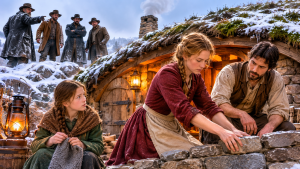
They Laughed at Her Hobbit Cabin Until It Stayed Warm at 31 Below Using Less Firewood
At 2 in the morning, an old builder dragged himself from bed, fed another log into the roaring fireplace, and stared at a thermometer that refused to rise above 47°. Across the frozen county, families were burning through their last stacks of pine. Chimneys coughed smoke back into cabins.
Bedroom walls glittered with frost. Men who had spent autumn preparing for winter were beginning to realize they had not prepared enough. But miles away, an elderly trapper was walking toward the one house everyone had laughed at.
He crossed drifts nearly to his knees, following a thin riffin of smoke toward a doorway buried in a hillside. Then he stopped. Every roof behind him carried more than a foot of snow.
This one did not. The turf above the strange house was almost bare.
Dark grass showed around the chimney, and when the old man stepped closer, he saw something even more impossible.
The snow around the doorway had melted. The men on the ridge did not lower their voices when they laughed, because they wanted the woman below to hear every word.
Whitaker Blackwood stood with his boots planted in a crust of December snow, his gloved hand pointing down the slope toward the dark seam of a doorway set into the hillside like a wound the earth had refused to close.
Beside him, Elias Renfruit rocked back on his heels with the satisfied posture of a man who had already been paid twice for the same piece of ground. Samuel Cross squinted through the low afternoon light with the polite discomfort of a man who did not want to laugh, but could not think of a good reason to stop.
Robert Dunlep, the blacksmith, said nothing at all, and his silence was the loudest thing on that ridge.
Below them, in the shallow bowl the wind had carved into the eastern face of the hill. A curved wooden door sat flush against a wall of packed clay and stacked sandstone.
Above the door, 18 in of turf lay like a heavy quilt over the roof line, and the winter grass on top of it, brittle but unbroken, moved when the wind moved, so that the whole structure seemed to breathe.
A thin ribbon of smoke lifted from a squatstone chimney set into the northern shoulder of the hill, and that ribbon did not gust or falter, which was the detail Robert Dunlap kept looking at, though he would not have been able to say why. Whitaker Blackwood cleared his throat, and the sound carried down the slope.
His words followed, unhurried and pitched to travel,”That gentleman is the dumbest, most dangerous thing I have ever seen a woman attempt in this county, and I have seen women attempt some remarkable foolishness.”
Elias Renfro’s laugh cracked open across the ridge like a green log popping in a fire. Samuel Cross looked at his boots.
Robert Dunlap kept looking at the smoke. The woman inside the hill did not answer because she did not know the men were there and because she was busy setting a second stone into the last dry course of her firebox wall while her husband held a lantern for her at an angle she had taught him to hold.
Her name was Ingred Halverson, and by the time this winter was finished, she would be spoken of in three territories, though she did not want to be spoken of anywhere, and had come to Idaho, precisely because she believed no one would bother her here.
She was 32 years old, born in a two- room farmhouse in Good Hugh County, Minnesota, the third generation of her family to be born on American soil, and she had learned the shape of an axe handle before she had learned the shape of the letter H.
Her hair was the color of pale straw after a wet autumn.
Her hands were narrower than her husband’s and stronger at the finish of any grip because a joiner’s work rewards the last quarter inch of pressure. And her father had drilled that into her before she could reach the workbench without a stool. She did not carry herself like a woman who expected to be admired.
She carried herself like a woman who expected to be interrupted and had decided long ago to keep working through the interruption.
Her husband was Silas Halverson, 35, from a lumber town in northern Wisconsin, who had spent the last two years of the previous decade laying track for the Union Pacific, and had come home with a sketchbook full of drawings no one else understood.
Silas was the taller of the two by a hands width, dark-haired, where his wife was fair, quiet in a way that made loud men wonder what he was thinking.
And he had a habit of resting one palm flat on any wall he entered, as if listening to the wood through his skin.
He was doing that now against the inner face of the sandstone wall his wife was building and his lips were moving slightly counting something only he was counting between them seated on an overturned nail keg with a mended stocking in her lap and a dark braid pulled forward over one shoulder was their daughter Marta 11 years old that November tall
for her age serious in the way that only children who have watched a parent nearly break tend to become serious Martya had spent the previous winter in the family’s first cabin on this land the ordinary one the unbuilt the ordinary way.
And she remembered exactly what 47° felt like at 3:00 in the morning when the wind found the gap under the door.
She remembered coughing until her ribs hurt. And she remembered her mother sitting up with her, one hand pressed flat to her back, saying the same three words over and over in a voice that was more promised than prayer.
Not this year. Not this year. Not this year.
Martya had recovered before Christmas of that first winter. And she did not intend to be sick again. and she watched her mother set stones now with the concentrated attention of someone who understood that this room was being built against a specific enemy she had already met.
That first Idaho winter was the reason for everything the men on the ridge were laughing at.
The Halversons had arrived in Copper Ridge County in the spring of 1,881 with a wagon, a team, a chest of tools, and enough saved money to buy 40 acres of decent bottomland from a homesteader who had decided the territory was too lonely for his wife.
They had built the ordinary cabin the ordinary way because that was what everyone said to do. Elevated log walls on loose stone peers to keep the timber off the damp ground. A central river rock fireplace with a tall chimney to pull good draft.
Plank floors with the seams chinkedked as tight as chinking would go, which was not tight enough. It had looked the day they moved in like every other cabin in the valley, and Ingred had told herself that this was reassuring. Winter had corrected her.
By January of 1,882, they’d been burning 88 lbs of firewood a day, and the interior of that cabin had refused to climb past 47° at its warmest hour.
Silas had spent his daylight not hunting, not building, not doing any of the work that would carry them into spring, but cutting and splitting and hauling and stacking wood, an endless brown river of it flowing from the treeine to the woodshed to the fire. And the fire had eaten it without gratitude.
The wind had found the gap under the raised floor, and had raced beneath the cabin day and night, stealing the heat from the underside of the planks, faster than the fire could push it down from above.
The chimney had drawn beautifully when the wind came from the west and had reversed itself, sullen and choking, whenever the wind came from the north, which was most nights, and Martya had gotten sick, and Ingred had sat up with her.
And somewhere in the small hours of one of those nights, Ingred had made a decision that she did not share with her husband for another six months because she wanted to be certain before she said it out loud.
The decision was this. The cabin was not the problem.
The way everyone built cabins was the problem. She was going to stop building cabins the way everyone built cabins. And if the county laughed at her, the county could laugh at her from inside its cold houses.
She began the way she always began, which was by reading. There was a small subscription library in Boise, 42 mi south by the freight road, and Ingred made the trip twice that summer with a list of titles copied out in her careful hand.
She was looking, though she could not have said so precisely at the start, for anyone who had already thought about the physics of a room. She found more than she expected.
She found a slim American book by a man named Orson Fowler, published back in the 50s, arguing in his stubborn, energetic pros for houses built of packed earth and gravel walls, because such walls held their temperature the way a good iron stove held its temperature.
Patient and even and unhurried, she copied out three pages of Fowler in her own hand and carried the copy home in her apron pocket.
She read a report from the territorial agricultural office on root sellers in the Snake River plane, which noted in the dry language of a government clerk that the earth 4t down held itself between 45 and 55° Fahrenheit through the deepest cold on record. She read those two sentences six times.
She had also, and this was the piece she had already known before she went looking, the memory of her paternal grandmother’s root cellar in Good Hugh County, dug straight into a lowrise behind the farmhouse, its door set at an angle into the slope, its interior cool in August and frostfree in February, its walls sweating faintly in spring and dry
as bone in autumn.
Her grandmother had stored potatoes and onions and turnips in that cellar for 40 years, and had never once lost a crop to the winter.
Ingred, 6 years old, had been sent down there in a July heatwave to fetch a jar of pickles and had stood in the dim green smelling cool for a long minute before she remembered what she had come for.
That minute had never left her. She had not known at 6 that she was standing inside a lesson. She knew now there was Silus’s sketchbook.
That was the third leg of the stool. In the fall of 1,879, working ahead of the graders on a stretch of Union Pacific right ofway in South Central Idaho, Silas had spent four evenings in the company of a Shosonyi man named in the phonetic spelling Silas had used because he had not been able to catch the pronunciation cleanly, Pawia.
Pawia had shown Silas the winter lodges his people had used along that stretch of river for as long as any grandmother could recall.
structures set half into the south-facing banks of low rises, roofed with timber and turf, entered through a short passage angled up out of the wind.
Silas had drawn them carefully with measurements paced off in his boots and had made small annotations in the margins that he had never shown to any of the other trackmen because he [clears throat] had understood without being told that they would have made a joke of it.
Ingred had found the sketchbook in the bottom of his tool chest, their first spring on the Idaho land, had opened it by accident while looking for a chisel, and had sat down on the floor of the tool shed and turned every page twice before she said a word.
When Silas came in for supper that evening, she had held the book up and had asked him one question, which was whether he remembered how the passages had been angled, and he had said yes, slightly upward, always slightly upward.
And she had nodded once and put the book on the kitchen table and served the stew.
They had not spoken about it directly again for months. They had spoken about it sideways around the edges of other conversations. The way careful people speak about a large decision they are approaching from a distance so as not to spook it.
They had walked the property together in the long evenings of that summer of 1,883. And Cilus had watched his wife look at the land the way a joiner looks at a raw plank, checking the grain of it.
And one afternoon in late October, they had followed the elkhound Frey up the low rise on the north end of their acorage and had found the place where Frey liked to sleep.
Frey was a rangy hound of no particular pedigree, gray in the muzzle, and he had a hunter’s instinct for shelter that a hunter’s wife respected.
On that October afternoon, with a wind out of the northwest that had teeth in it, though the calendar still said autumn, Fred had trotted directly off the game trail, angled across the eastern face of the little hill, and had lain down in a shallow bowl of clay and stone, where the wind quite plainly did not reach.
He had put his chin on his paws and had closed his eyes inside of a minute. Ingred had stood at the lip of the bowl, and had counted in her head the number of degrees she believed the temperature to be lower inside that hollow than outside it. She had counted 20 minutes before she moved.
Silas had stood beside her the whole time, and when she finally turned to him, he had said without preamble, the sentence that Clonessa’s small gap between the private idea and the shared one,”I have been thinking the same thing.”
They bought the four acres of hillside from Elias Renfruit.
The following week, Elias owned nearly every piece of land and copper ridge that no one else had thought to want, which included a great many rough acres of ridge and drainage and rockfall that could not be plowed or grazed, or so far as he had ever considered lived on.
He sold the Halvorsons the four acres of Bearpaw Slope at a price that would have been dear for good bottomland and was outrageous for what he privately called goat rock. And he counted the cash in front of them at the counter of his own store with the slow relish of a man performing a small piece of theater for his own benefit.
He believed as he handed over the deed that he had just sold a piece of ground twice.
first to whatever fool had originally deeded it to his father, and now to a woman who would spend one Idaho winter on it, and then walked back into his store in April, asking whether he might be interested in taking it off her hands, at which point he intended to reacquire it for a tenth of what he had just been paid.
Elias Renfruit did a great deal of his thinking a year in advance. It was one of the reasons he was the wealthiest man in the county, and one of the reasons he was so often surprised. The Halversons began digging on the 3rd of November.
The work was heavier than either of them had anticipated because the clay in the hillside was denser than the clay in the bottoms and because the frost had already begun to reach into the top 6 in of soil. Ingred kept a small tally in a leather notebook of the cubic feet removed each day.
Not because she was pleased with the numbers, but because writing them down let her stop thinking about them. The natural hollow that Frey had chosen gave them a starting depth of about 12 ft into the hill.
They excavated another eight following the curve of the harder clay rather than fighting it.
And by the middle of the month they had a rough chamber roughly 16 ft wide and 20 ft deep. Its back wall the living face of the hill itself dense and cold and steady in a way that the ordinary log walls of the ordinary cabin had never been steady.
The floor they leveled with the shovel and dressed with flat riverstone set in a bed of coarse sand so that the whole surface sat well below the frost line and was already on the day it was laid warmer to the touch than the plank floor of their first cabin had been at any hour of the previous winter.
Silas cut and quartered timber for the three walls that had to be built rather than uncovered, the east, the west, and the partial south-facing front around the doorway.
and he set the bottom log of each wall directly on the stone sill 8 in above the finished floor with no crawl space beneath it so that the wind would have nothing to race under and no gap to steal from.
When his neighbors drifting past on the road below during that first week of framing had asked him what he thought he was doing without a proper foundation, Silas had looked at them without hostility and had said each time the same short sentence,”The hill is the foundation.”
No neighbor had ever been satisfied by that answer, which was one of the reasons the neighbors had begun to gather on the ridge above and to laugh. The stone wall was Ingred’s.
She had marked the sight of it before the first shovel of clay came out of the chamber, and she had spent the second half of November gathering the sandstone for it from the outcrop that broke the surface of their own land 3/4 of a mile to the north.
She quarried it by hand and by lever, splitting the beds along their natural seams, choosing each piece for the way it would sit against the piece beneath it, hauling the smaller stones herself on a stone boat Silas had built her from oak planks, letting Silas handle only the largest of them, of which there were fewer than she had expected.
By the 28th of November, she had 6,000 lb of dressed sandstone stacked in three careful piles beside the chamber door.
And by the 5th of December, she had begun to lay them, 2 feet thick, and rising to a finished height of 6 feet along the entire length of the north wall, tight against the living clay behind it, chinkedked in every seam, with a mixture of clay and horsehair, and the finely sifted grit from the bottom of the quarry.
The firebox she set into the base of that wall on the interior side, small and deep and stonelined, an opening 18 inches wide and 24 in back, its throat angled to feed the flu that ran up through the mass of stone and out through the chimney set flush against the hillside above.
She was not building a fireplace.
She was building a battery, and she was building it against the largest piece of steady cold in the county, which was the hill itself, so that the fire would have something to charge and the room would have something to remember it by. The roof was where the neighbors stopped laughing quietly and began laughing out loud.
Silas framed it with peeled logs set close and true. And over the logs they laid a course of dressed planks, and over the planks a layer of tred canvas Ingred had traded a rocking chair for at the merkantile in September.
And over the canvas 18 in of dark top soil, hauled up the slope one wheelbarrow at a time from the bottoms, and into the top soil before the first snow.
Ingred transplanted squares of living sod cut from the hillside itself, so that the roof of the chamber would be from any distance indistinguishable from the hill it sat inside.
The sod took hold in the mild days at the end of October, and by the middle of November, the roof was already knitting itself into the surrounding ground, so that when a stranger walked up the road below and looked up at the hillside, he did not see a cabin at all.
He saw a hill with a small dark door in it and a thin stone chimney and the memory of a doorway where the earth appeared to have opened once and then closed most of the way behind whoever had gone in. The entrance was the last piece and in some respects the most contentious.
Ingred had designed it as a tunnel rather than a door 8 ft long angled up from the outer threshold to the inner one with a heavy plank door at each end and a small storage niche cut into the south wall of the passage where firewood could be brought in from outside and allowed to warm and dry before it was carried through the inner door to the fire.
The angle was slight, no more than a hand span of rise across the eight feet. But the angle was the whole point because cold air is heavier than warm air and wants to fall, and an upward angled passage lets it fall back out through the outer door rather than in through the inner one.
Two small ventilation openings, each about 6 in across, one low on the east wall behind the firebox side and one high on the west wall near the roof line, completed the design.
Silas had cut both openings on a slight downward slope to the outside, so that neither would take rain, and Ingred had sized them by a set of calculations she had done with a stub of pencil on the back of a flower sack, balancing the loss of heat against the need for air, arriving at the smallest possible opening that would still allow the pressure
differential of the prevailing westerly wind to draw stale air out at the high vent and pull fresh air in at the low one.
The men on the ridge did not know any of this.
What the men on the ridge knew was that Ingred Halvorson was building a hole in a hill and calling it a house, and that her husband, who ought to have known better, was helping her, and that their daughter, who ought to have been sent to board with a proper family for the winter, was carrying a stocking through the outer door of the tunnel at the
exact moment.
Whitaker Blackwood raised his voice for the second time that afternoon and delivered the sentence that would four weeks later be quoted back to him in front of witnesses in a way he would not forget for the rest of his life.
By February, Blackwood said loud enough for his voice to carry clean down the slope.
I will be measuring that structure because by February, the Halversons will not be in it. Elias Renfruit laughed again. Samuel Cross did not.
Robert Dunlap turned his head slightly, the way a man turns his head when he hears a note he was not expecting in a familiar tune, and looked at Blackwood with an expression that would have made a more careful man reconsider. Blackwood was not in that moment a careful man.
He was a master builder with 22 years of Idaho winters under his belt and 43 cabins standing under his name between the Boise River and the Salmon. And he had reached the age at which a man of his kind begins to mistake his experience for a law of nature.
He had come up onto the ridge that afternoon because the story of the Halverson hillside had reached him at the merkantile the previous week, and he had not believed it.
And now that he had seen it with his own eyes, he had believed it. And belief had made him angry.
Because if what he was looking at worked, then a great many things he had been telling a great many families for a great many years had been wrong. He did not standing there on the ridge permit that thought to complete itself. He shut it down the way a man shuts down a poorly drawing damper with a quick decisive motion of the mind.
And he replaced it with a firmer, cleaner, more comfortable thought, which was that the hole in the hillside was going to kill the woman inside it. and that the decent thing to do was to say so loudly and often, so that when the killing happened, no one could accuse Whitaker Blackwood of having failed to warn her.
Ingred did not hear him.
The stone she was setting was heavier than it looked, and she had her full attention on the seat of it, and the wind on the ridge was blowing away from the doorway rather than toward it. Martya, coming out of the tunnel with the mended stocking did hear.
She was 11, and her hearing was better than any adults in the county, and Blackwood’s voice carried down the slope with the peculiar clarity that certain cold December afternoons give to certain kinds of contempt.
She stopped at the outer door of the tunnel, and looked up the ridge, and saw the four men standing there, and she recognized Whitaker Blackwood by his hat, and she recognized Elias Renfruit by his coat, and she did not recognize the other two, but understood immediately and completely what she was looking at.
Her face did not change.
She had learned in the previous year not to let her face change when adults were being cruel where a child could see. She went back inside the tunnel, closed the outer door quietly behind her, walked through the inner door, and told her mother in a steady voice exactly what she had heard. Ingred finished setting the stone.
She wiped her hands on the front of her apron. She looked at her husband, who had already lowered the lantern. She looked at her daughter, who was standing very straight and very still by the inner door with the stocking still in her hand.
She spoke in the voice she used when she had decided that a thing needed to be answered, but answered slowly,”Get your coat, Marta. We are going into town for flower tomorrow.
We will let Mr. Blackwood say what he has to say where his neighbors can hear him.”
She did not know when she said it that Mr. Blackwood intended to say it in the very place she intended to go. The Copperidge Merkantile sat at the north end of the town’s single street, a long low building with a wide plank porch and a bell over the door that rang whenever anyone came in.
The stove at the back of the store threw a wide circle of heat that pulled men in on cold Saturdays the way honey pulls flies.
And on the afternoon of the 22nd of December, the 22nd being a Saturday, and the temperature being 12° Fahrenheit under a sull and gray sky, there were 12 men gathered around that stove when the bell rang and the Halvorans came in. Ingred came in first.
Silas followed with Martya between them.
Ingred had a list in her apron pocket written out that morning at the little table beside their new firebox, and she did not look at anyone as she came through the door. She went directly to the counter, laid the list flat, and began to speak quietly to the clerk.
A thin man named Petri, who was already reaching for the flower scoop before she finished her first sentence. The men around the stove went quiet in the way men go quiet when they are pretending not to have been talking about a subject that has just walked in the door. Whitaker Blackwood was sitting closest to the stove.
He was a large man, broad through the shoulders, gray at the temples, with the kind of hands that had done 30 years of skilled work and were beginning only in the last year to complain about it in the mornings.
He took his time.
He let Ingred get through the flower and the lamp oil and the packet of needles she had promised herself to pick up for the mending. He let Petri ring the sale and begin to wrap the goods in brown paper.
without standing up, without raising his voice at all this time, he spoke in a tone pitched for the whole store and for the record he intended to make the mo Mrs. Halverson. I need to say something and I am saying it in front of witnesses because I want it on record. Ingred turned from the counter.
She did not step toward him. She did not step back. Marta, without being told, moved half a pace closer to her mother’s side and put one hand into the crook of her mother’s elbow.
Silas stood where he was, one hand resting flat against the door frame, which is what he always did when he wanted to hear a room clearly.
Blackwood went on. His voice had the practiced evenness of a man who had rehearsed the sentences on the ride into town.
That structure you and your husband have built into the Jacobson slope is going to kill your family before spring. And when it does, I do not want anyone in this county saying, I did not try to stop you. He counted the reasons off on the fingers of his right hand without haste.
condensation, mold, rot, collapse, suffocation, fire. He gave each finger its full weight, and by the time he reached his thumb, the store was so quiet that the sound of Petri folding the brown paper around the flower was audible from across the room.
Elias Renfruit, standing behind the stove with his coat still on, because he liked to be able to leave a scene the moment it stopped serving him, added his own piece from over Blackwood’s shoulder, and his voice had the practiced friendliness of a merchant delivering bad news at a good price.
I will tell you plainly, Mrs. says Halverson that when you come to my yard in January looking for the wood you did not stockpile my price will be twice what it was in October because that is what shortage does and shortage is coming.
There was a small movement in the room a settling the kind of small collective adjustment that happens when men who have been half agreeing with a speaker realize they are now fully agreeing with him and would like to be seen to be so. Samuel Cross looked at his boots again. Robert Dunlap did not look at his boots.
He looked at Ingred and he waited to see what she would do. Ingred did not do very much. She let the silence hold for a count of three, which is a long time in a country store.
She looked at Whitaker Blackwood the way a joiner looks at a plank that is warped without contempt, but without any interest in pretending the warp is not there.
What she said next was not loud, yet it reached every corner of the room because the room had made itself quiet enough to reach. You have built 43 cabins in this county, Mr. Blackwood.
I am told that is true, and I do not doubt it. None of them has read a book of physics. She let that sit for another count.
She added more quietly, so that the men had to lean toward her slightly to catch it, which was the point. What is common is not the same as what is correct. My husband and I have built one cabin.
We would like to be judged by whether it works. Martya did not smile.
She had been coached without ever being coached in the household rule that a member of her family did not smile at the discomfort of a neighbor, even a neighbor who had earned it.
Her hand tightened very slightly around the crook of her mother’s elbow and Ingred felt it and something in Ingred that had been tight for a week eased by half a turn. Silas at the door did not move at all which was from silent a fullthroated declaration of support. He paid the bill on the way out.
He did not say a word to any man in the store. The bell rang once as they left and rang again when the door closed behind them and for a moment after that no one at the stove said anything.
Elias Renfruit laughed because Elias Renfruit could always be counted on to laugh first when a silence was making the room uncomfortable.
And the moment broke, and the men around the stove began to speak all at once about what a shame it was that a woman with such a steady voice should have chosen such an unsteady house. Outside in the street, the wind did pick up. Ingred handed the paper wrapped flower to Silas without looking at him, took Marta’s hand, and started for the wagon.
She did not speak until they were three blocks past the merkantile and the wind had begun to sting the exposed skin above her collar. Without turning her head, she spoke into the cold. He will be back on that ridge before the month is out, and he will not be laughing.”
Silas nodded once.
Marta, walking between them, looked up at her mother and spoke in the same steady voice she had used inside the store.”Mama, was that true what you said about the book?” Ingred looked down at her, and for the first time all afternoon, she permitted herself a smile, which was small and did not last long.
It was true, Martya, and more than the book. They did not see the old man standing in the shadow of the awning of the tax shop across the street because he was standing very still and because the wind was moving the sign above him and drawing the eye away. His name was Angus Fairchild.
He was 73 years old, born in Vermont in,810, come west with his father before the war with Mexico.
Resident in the Idaho country for the last 40 of his years, a trapper by trade and a widowerower by circumstance.
He had come into town that afternoon for a spool of wire and had heard through the open door of the merkantile the whole of the exchange, and he had come out to the street to see the family that had held that ground. He watched the three of them cross to their wagon.
He watched the woman lift the child up onto the seat with one clean, unshoy motion. He watched the husband put the flower under the wagon board and check the harness and swing himself up beside them. And he watched them turn the team and start north out of town toward the Bearpaw slope.
Angus Fairchild did not follow. He stood in the shadow of the awning for another long minute after the wagon was out of sight.
He took a small leather notebook from the inside pocket of his coat.
Unstopped to stub a pencil and wrote in a hand that had grown small and precise over half a century of weather logs. Three words and a date bearpaw slope 22 deck. He put the notebook back in his pocket.
He set his hat lower on his brow against the wind. He walked to the tax shop, bought his spool of wire, said good afternoon to the clerk, and started home. On the morning of the 20th of December, 2 days before the scene at the Merkantile, the Halversons had moved into their finished chamber.
Silas had swung the inner door closed for the first time at a little past 9 in the morning, and Ingred had stood in the middle of the room, with her palms flat against her thighs, and her eyes closed, and had listened to the way the room held sound.
It held it the way a good barrel holds water with a small, steady weight and no drip.
She had opened her eyes and had looked at her husband and Silas had looked back at her and neither of them had said anything because there was nothing to say that they had not already said with their hands over the last seven weeks.
Martya had come in behind them with Frey at her heel and Frey had walked directly to the base of the stone wall, turned three times and lain down exactly as he had lain down in the natural hollow the previous October and had closed his eyes inside of a minute.
For the eight nights between the move and Christmas, the temperature outside the chamber ranged between 8 and11 degrees Fahrenheit.
Inside, with the small firebox burning no more than 15 lb of dry pine in the morning and another 10 lb at dusk, the mercury on the small thermometer Ingred’s mother had sent them from Minnesota for their wedding, sat between 64 and 68° and did not fluctuate more than 3° between one reading and the next.
Silus checked it four times a day for the first week because he had trouble believing it. Ingred checked it once a day at noon and wrote the reading in her leather notebook because she had never had trouble believing it and wanted the record. On the last night of December, the wind changed.
It came out of the north with a new note in it, a thin high whistle that Silas had heard once before in the winter of 1,876 on the plains east of Cheyenne and had never forgotten.
He got out of bed at a little past midnight without waking his wife and walked to the outer door of the tunnel in his stockhinged feet and eased the door open a hands breath and stood there for a full minute with the north wind pouring in past his face reading it when he closed the door and came back through the inner door and slid into bed beside
Ingred.
She was awake though she had not moved and she spoke into the dark above their heads without turning. How bad? He answered her the same way without turning bad.
A week at least maybe more. She was quiet for a count of 10. Then she said in the voice she used only when she was speaking to him and to no one else,”Let it come.”
Two miles south in his own well-built cabin. Whitaker Blackwood was also awake, though he did not know why. He had gone to bed at his usual hour, had banked his fire the way he always banked it, had pulled his goodwill blanket up to his chin.
Something had woken him at a little before 1:00 in the morning, and he had lain in the dark, listening to his own chimney, and had not liked what he heard.
The draft was pulling harder than it should have been pulling.
The wind, when he finally rose and went to the window and put his hand against the glass, was already at a strength he had not expected until at least the second week of January.
He stood at the window for a long time, watching nothing, thinking about a stone wall and a saw roof and a small angled tunnel that a woman he had insulted in public two afternoons before had built into the side of a hill he had helped sell her employer. He did not in that moment permit himself to feel afraid.
He was a master builder with 22 years of Idaho winters under his belt. He shut the thought down the way he had shut the earlier thought down on the ridge cleanly and quickly, and he went back to bed.
But the draft in his chimney did not steady, and the wind outside his window did not slack.
And somewhere in the cold hours before dawn, Whitaker Blackwood understood, without letting himself say it, that the winter he had promised the Halversons would kill them was going to be the winter that asked him. instead what he had actually learned in 22 years and whether any of it was going to be enough.
The first day of the killing cold began at 4 minutes past 6:00 in the morning on the 7th of January when the thermometer nailed to the north side of the porch at the Copper Ridge. Merkantile read -12, which was a number Petri the clerk copied into his weather log with a hand that was not entirely steady.
He had opened the store an hour earlier than usual because he had heard the wind at 3:00 in the morning and had understood the way any man who has spent a decade selling flower to homesteaders will understand that by noon there would be a line of wagons at his door and by nightfall there would be a line of complaints.
He was wrong about the wagons.
The roads between the outlying homesteads in town had already begun to drift by first light and by 10:00 in the morning the freight road south to Boise had closed itself without any human decision being required in the matter. The wind having done the work of a dozen men with shovels in the wrong direction.
By the morning of the eighth, the porch thermometer readgative8, and Petri had stopped copying the numbers and had begun instead to write short notes underneath them. Wind steady from the north, draft and stove reversed at 9:00 a.m. corrected by opening east window 1 in. Elias Renfruit and for coffee would not sit down.
The last note was the one that would have interested a careful reader because Elias Renfruit always sat down when he came into the merkantile.
And a man who will not sit down is a man who has just realized that a schedule he depended on is no longer his to command.
The mill wheel at Renfruit sawyard had frozen solid overnight, not the wheel itself, but the mill race feeding it. A full 18 in of ice locked into the flume from bank to bank, and the two men Elias kept on winter payroll to keep the flume clear, had failed to break through it.
After 4 hours of work with iron bars, because the wind had refrozen every crack they opened before they could widen it. Without the wheel, the saws would not run. Without the saws, the cordwood inventory in the yard would not grow.
What was in the yard on the 7th of January was what Elias Renfruit had to sell for the next 11 days.
and Elias Renfruit standing at the coffee counter of the merkantile in his good beaver coat was performing the arithmetic in his head with the closed face of a man discovering for the first time in his adult life that a cold snap did not respect the size of a ledger.
By the 9th the porch thermometer read -24 by the 10th 29.
By the morning of the 11th the mercury sat at -31 and stayed within 2° of that number for the 8 days that followed. And the wind, which had begun as a north wind, developed a small, persistent easterly component that pushed it around the corners of every cabin in the valley and into every seam that a builder had trusted to hold.
Inside the ordinary cabins, that easterly component turned a difficult week into a war. The Ashcraftoft family, four miles east of town, had five people under one roof, a father, a mother, two boys, one grandmother, and a wood pile they had stacked in October at what they had believed was a generous margin over their previous winter’s consumption.
On the 9th, they burned 82 lb. On the 10th, 91.
On the 11th, 95, and the interior of their cabin at 2:00 in the afternoon, which was traditionally the warmest hour, sat at 48°.
The younger boy, who was six, slept in his clothes under two quilts and a bare skin, and his mother went in to check on him every hour of the night, not because she believed he was in immediate danger, but because she had reached the point in a winter at which a mother stops trusting her own certainty and begins to require the reassurance of her
own eyes.
The grandmother, who was 70 and had opinions, sat by the fireplace with a shawl over her shoulders and told anyone who would listen that no winter she remembered in Missouri had ever gotten inside a well-built house the way this one was getting inside theirs, and that the difference was not the winter, but the house, though she could not have said,
if pressed, exactly what she meant by that.
The Peton place 3/4 of a mile north of the Ashcrofts, had its own particular trouble. Nathaniel Peton had built his cabin in 1,879 with a fine tall chimney that drew like a locomotive on any ordinary day. And on the 10th of January, that chimney reversed itself.
The wind coming down from the north with a pressure the flu had not been designed to fight pushed the smoke back into the room in slow gray sheets. And Nathaniel and his wife Eleanor spent the next 36 hours choosing at halfhour intervals between opening a window enough to clear the smoke and closing it enough to keep some fraction of the heat.
They arrived at a compromise that satisfied neither requirement, and by the morning of the 12th, Eleanor’s eyes were red enough that Nathaniel walked the two miles to town in the wind to buy a small can of camper linament, and to ask at the counter of the merkantile whether anyone had ever heard of a chimney reversing itself for more than a day.
Petri, honest to a fault, told him yes, in 1,872 for 4 days, and that the family in question had eventually torn the chimney down in the spring and rebuilt it with a different draft. Nathaniel walked back home with the linament and did not tell his wife what Petri had said.
At the sawyard, Elias Renfro’s inventory had begun to disappear at a rate that alarmed him, not because he could not restock it, but because he could not restock it in time.
He had on the morning of the 7th roughly 40 cords of split dry pine stacked under canvas along the west wall of the yard, which represented at ordinary January consumption rates for the 70 families who bought from him about 11 days of demand. By the morning of the 12th, 5 days into the cold, he had sold 18 cords.
And the men who had not yet come to buy were not the ones who had run out first, but the ones who had stockpiled the largest amounts in the fall, which meant that the second wave of customers, the ones who bought hand-to-mouth all winter, was still ahead of him, and was going to arrive at his gate, wanting wood he did not have.
He raised his prices on the 10th, quietly without announcement, from $2.25 25 cents a cord to $3 and again on the 12th from $3 to 375. He did not enjoy doing it. He did it and he wrote the new numbers in his ledger with the same hand he wrote everything and he did not sleep well on the night of the 12th.
Though he told his housekeeper who asked that the reason he had not slept was the wind.
The reason he had not slept was that he had, on the afternoon of the 12th, sat down at his own hearth in his own large house at the north end of [clears throat] Main Street, in front of a fire he had built himself out of the best split pine he owned, and had watched the thermometer on his own parlor wall, refused to climb above 46° for the entire
afternoon, and had understood in a way he had not understood in 20 years of selling firewood, that he was burning it, for the same reason his customers were burning it, which was that his house did not know how to keep what the fire gave it.
He was not the only man in the county lying awake with that particular thought. Two miles west of Elias Renfruits house in the cab Blackwood had built for himself the year he turned 40 and had considered his masterwork ever since. Whitaker Blackwood was not sleeping either.
He had built that cabin with everything he knew. A cut stone foundation set on gravel with a full 6 in of drainage. Walls of 9-in pine logs tightly notched chinkedked with a lime mortar he had mixed himself.
a central fireplace of dressed riverstone with a firebox large enough to take a full 4ft log crosswise and a chimney whose draft he had tested in every wind he could think of before he had trusted it.
On the night of the 12th, that fireplace was burning 105 lbs of dry pine, which was more than he had ever burned in a single day in his own house, and his parlor thermometer sat at 47° and his bedroom at the back of the cabin sat at 38.
He got up at a little past 2 in the morning of the 13th and pulled his oil cloth coat over his night shirt and walked to the small writing table in the corner of the parlor and lit a candle from the low coals of the fire. He took down from the top shelf of the pine bookcase he had built with his own hands the year Marta Halverson had been born.
The ledger in which he had kept for 22 years a record of every cabin he had built in the county. 43 entries.
Each entry included the family name, the acreage, the dimensions, the timber used, and in a column he had begun keeping in his eighth year of building because a customer had asked him about it once, and he had not known the answer, the family’s reported winterwood consumption for the first 3 years after the cabin was raised.
He read down that column for the first time in 11 years. He did not read it quickly. He read it the way a doctor reads a symptom he has been half aware of in half his patients, and has never before considered as one thing.
The averages fell into a range he had always assumed to be normal. 10 to 14 cords per family per winter, with the largest households reaching 16 in a hard year. He had always considered those numbers to be the honest cost of an Idaho winter.
The price of living where you lived, no more remarkable than the price of hay for a horse or salt for meat. He had never in 22 years sat down with a piece paper and calculated what those numbers meant in labor.
He did the calculation now at his writing table in the candle light with the wind pushing against the north wall of his cabin and his own thermometer sitting at 38° in the room behind him.
12 cords at 80 lb per cubic foot of stacked dry pine was roughly 30,000 lb of wood.
30,000 lb of wood in a country where a man cut and split and hauled and stacked by hand was between 8 and 10 weeks of daylight labor for a single man every year for as long as he wanted to keep his family warm.
Blackwood, who had never in his life been prone to sentiment about numbers, sat at his writing table and looked at that figure and understood without letting the understanding rise into words, that he had presided over the annual burning of a decade of one man’s working life in every household he had ever built for, and had believed the whole time
that he was doing the man a favor.
He closed the ledger. He put it back on the shelf. He blew out the candle.
He did not go back to bed.
He sat in the wooden chair at the writing table for the two hours between then and dawn with his hands flat on his knees and he listened to his fire complain and he thought a great many things that he did not permit himself at any point to say out loud.
He was still sitting that chair at first light on the morning of the 14th when Angus Fairchild, 73 years old and dressed in three layers of wool and a beaver hat that had belonged to his father, stepped out of his own small cabin at the far end of the western trap line and began the walk he had been planning since the afternoon of the 22nd of
December.
Angus had been running his line for 40 of the 60 years he had lived in Idaho country.
and he ran it in every weather because he had discovered at about the age of 35 that a man who stops moving in cold weather is a man who has already begun the process of freezing.
He had checked his traps on the morning of the 12th and again on the morning of the 13th and on the morning of the 14th he checked them a third time and on the way back he angled north off his usual return path and cut across the low ground below the Bearpaw slope. because there was a family up there.
He intended to see with his own eyes before he permitted himself to form any further opinion of what he had heard at the merkantile 3 weeks before.
He came up out of the drainage at a slow, steady walk, the way an old man walks in deep cold, planting each foot with the flat of his soul to save the muscle he had left.
50 yard short of the doorway, he stopped because his eyes needed a moment to accept what they were showing him.
Every other roof he had passed that morning was buried under 14 to 20 ines of powder snow, drifted deep against the north side of every cabin he had walked past, so that the buildings looked like small white boats sitting low in a white sea. The Halverson hill did not look like that. The turf roof was dusted, not buried.
The snow along the ridge line of the sod was perhaps 4 in deep at its thickest, and along the eaves it was thinner still, and in a rough oval around the top of the small stone chimney, it had melted almost entirely down to the grass, so that the darker green of the sod showed through in a warm, ragged crown.
The doorway at the foot of the hill was not buried at all. There was a half circle of exposed clay in front of the outer door, 6 in of it in every direction, damp and dark, where the ground had held enough warmth to refuse the snow.
The chimney was smoking, not the gray plume he had passed above every other cabin on his route, thick and choking, the smoke of a fire being fed wet wood at the wrong angle. This smoke was thin and pale and steady, and it went straight up for the first 6 ft above the chimney cap before the wind found it and pulled it southeast.
And the way it went up was the way a fire goes up when the wood is dry and the flu is clean and the man tending it is not in a hurry.
Angus stood in the snow at 50 yards and did the arithmetic in his head the way Whitaker Blackwood had done his arithmetic in the candle light four hours before.
His own cabin that morning was burning 85 lbs of wood a day and holding 49° at noon. This one from every visible sign was burning less than half of that and holding a temperature the visible evidence would not let him refuse to believe was closer to 60 than to 50. He had lived in Idaho country for 40 winters.
He had never seen anything like it. He walked the last 50 yards slowly. He raised his gloved hand and knocked on the outer door of the tunnel three times spaced evenly.
The way an honest man knocks at a door when he does not want to be mistaken for weather. He waited.
He heard faintly through the plank the sound of the inner door opening first, then footsteps in the passage, then the outer door swung back on its hinges, and Silus Halverson stood in the doorway wearing a wool shirt with the sleeves rolled halfway to his elbows and no coat over it at all.
Angus’mouth opened. It closed.
it opened again. What came out was not the greeting he had rehearsed on the walk-in, which had been polite and neighborly, and full of the small excuses old men used to justify a visit they cannot otherwise account for. What came out was a single question that he had not known he was going to ask.”How much are you burning today?”
Silus answered without pausing to think, because he had the number in his head from the morning fill. 35. I will add another 10 at supper.
Angus stood in the wind at the outer threshold of the tunnel and let the number land. 35 lbs in a day that had begun at -26 on his own porch thermometer.
He was silent long enough that Silas stepped back from the door and lifted one hand palm open in the small motion any Idaho hunter recognizes as an invitation to come in out of weather.
Angus came in, the outer door swung shut behind him. The passage was already warmer than any place he had stood in the last 8 days. Silas walked past him, unlatched the inner door, and opened it, and the smell of the room beyond was the smell of coffee and dry wool and burning pine.
And underneath all of that, something Angus had not smelled inside a house in a long time, which was air that was not fighting itself. Ingard was seated on a low three-legged stool beside the firebox, mending a torn sleeve of Silus’s shirt with the kind of small even stitches that a woman learns at 9 and never forgets.
She looked up when Angus came through the inner door, and her expression did not change beyond a small polite tightening around the eyes, which was from her the equivalent in another woman of standing up and dropping the sewing.
Marta was seated at the plank table Silas had built along the east wall with a slate in front of her and a piece of chalk in her hand and a page of arithmetic problems half completed and she looked at Angus with the direct unafraid gaze of a child who has been raised to look adults in the face and to answer questions when asked.
Frey the Elkhound was stretched full length along the base of the north wall on the warmstone floor a foot out from the sandstone battery and he raised his head to look at the visitor, thumped his tail once against the stone and put his head back down. Angus took off his beaver hat.
He held it in both hands in front of him the way a man holds his hat at a graveside. He turned in a slow half circle in the middle of the room.
Taking in the ceiling of peeled logs and dark sod and the two small ventilation openings.
The low one at the east wall behind the firebox side where he could feel the faint cool draw of fresh air pulling in at his ankles. The high one at the west wall near the roof line where he could see if he watched for it the barely perceptible shimmer of warm air being carried out.
He turned back to the north wall, which is where the sandstone battery ran the full width of the chamber, 6 feet high and 2 ft thick, and dressed close as any mason’s work he had ever seen. He stepped to the wall. He pulled the leather glove off his right hand with his teeth.
He put his bare palm flat against the stone.
The stone was warm, not the hot surface warmth of a fresh fire, which any stove will give you for as long as the fire is burning.
This was a deeper warmth evenly distributed across the whole face of the wall, present with equal intensity at knee height and shoulder height, and at the level where he had put his palm, so that the wall itself felt under his hand less like a wall than like the flank of a large animal that had been lying in the sun.
He held his hand there for a count of 10 before he lifted it. He did not speak. When he turned around, Ingred had not moved, and Silas was standing at the inner door with his arms crossed and a small, careful expression on his face that was neither pride nor amusement, but something quieter than either.
And Martya was watching him from the table with the same open, steady gaze.
The words that came out of Angus’mouth were not for any of them. They were for himself and for the 40 years of Idaho Winters standing behind him.
And they came out at the volume a man uses when he is admitting something he has known for a long time and has just now been given permission to say. In 40 years, I have not stood in a room like this. Ingred set her mending down across her knees.
She did not smile. She lifted the small mercury thermometer from the peg beside the inner door where her mother’s wedding gift had hung it the day they moved in. Turned it so the mercury column caught the lamp light and read it aloud in the same steady voice she had used at the merkantile counter 3 weeks before.
68 and it has been between 65 and 68 since the 6th of the month.
Angus took the leather notebook from the inner pocket of his coat unstopped the stub of pencil and wrote. He wrote for a long time.
He wrote the interior temperature and the exterior temperature he had read on his own porch that morning, and beside them the difference, which was 94°, a number he underlined twice. He wrote the pounds of wood being burned per day. He wrote the dimensions of the firebox, as Silas gave them to him.
He wrote the thickness of the sandstone battery and the thickness of the saw roof, and the length and angle of the entrance passage. He wrote the placement and size of the two ventilation openings. He wrote at the bottom of the page without underlining it.
A single observation of his own. This is what winter is supposed to feel like inside a house.
He put the pencil back in its slot.
He closed the notebook. He put the notebook back in his coat. Silas offered coffee.
Ingred poured it into a tin cup and handed it to him without comment. Angus wrapped both hands around the cup and lowered himself onto the second stool at the firebox. And for perhaps 5 minutes, no one in the chamber spoke.
Martyr went back to her arithmetic. Frey shifted his position by 6 in to keep his flank against the warm stone. The fire in the firebox, which Silas had banked at first light, glowed at the small red heart of a bed of coals, and the sandstone above it held the heat and gave it slowly back into the room.
Angus finished the coffee. He set the cup down carefully on the flat stone beside the firebox.
He looked at Ingred, then at Silas, then at Ingred again, and when he spoke, his voice had the quiet weight of a man who has decided that a thing needs to be done and has already begun to think about how I need to tell someone about this.
Not for you, for the county. Ingred did not answer immediately. She looked at her husband.
Silas from the inner door, gave a small nod, which was from him a full-throated speech. Ingred looked back at Angus, and her voice was steady, but there was a small new watchfulness in it, as of a woman weighing exactly how far to trust a kindness. Not Mr. Blackwood.
Not first. Send someone who will listen. Angus considered.
He had come to the door believing he would walk directly to Whitaker Blackwood’s cabin from here.
Because Blackwood was the master builder, and because Blackwood’s public words at the merkantile on the 22nd of December had been the loudest words in the county, he revised his plan in the space of a breath.
He had a better idea because a better man had returned to town 3 days before and he had heard about it at the smithy and had filed the information away for a use he could not have named at the time. He nodded once. He stood.
He put the beaver hat back on. He said to the room at large in the tone a man uses to close a transaction fairly. I will send the right one.
The right one, as it happened, was already standing in the doorway of Angus Fairchild’s own small cabin at the western end of the trap line at 2 that afternoon.
When Angus [clears throat] came back down off the ridge with the walk of a man who has finally after four decades been given something he had not expected to be given.
Josiah Renfruit, 26 years old, four years graduated from the Boston engineering school his father had paid for and 3 days returned to the town he had left at 18, had come to find Angus because Angus was the only man in Copper Ridge who had ever spoken to him about the actual structure of things, meaning the reason things held together or failed to.
And Josiah had spent the previous evening in the sitting room of his father’s large house at the north end of Main Street listening to his father explain business plan that had made him understand for the first time since his return that he was not going to be able to work with his father.
Josiah had his mother’s narrow build and his father’s dark eyes and he wore the plain wool coat of a man who had learned in Boston that the sons of western merchants were expected in the east to dress in a way that did not announce their fathers.
He had come home with a leather portfolio of drawings and calculations under his arm, and with a set of quiet ambitions he had not yet spoken out loud to anyone. He had been in Copper Ridge for three days. He had been avoiding his father’s office for two of those days.
He was standing in Angus Fairchild’s doorway now because he had heard that morning at the smithy that Angus had been observed cutting north across the low ground below the Bearpaw slope.
And Josiah, who had heard the story of the Halverson hillside from three different people since he had stepped off the freight wagon on the 11th, had wanted very badly to ask Angus what he had seen.
Angus stopped when he saw the young man in his doorway. He did not smile.
He looked at Josiah for a long slow count of five, taking his measure in the way old men take the measure of the sons of men they have known for a long time. And then he spoke in the quiet voice he had used inside the Halvorson chamber an hour before. Come in, boy.
I have a favor to ask you, and it is not a small one. Josiah stepped inside. He closed the door behind him.
He listened, standing without taking off his coat, while Angus, in short, precise sentences, told him what he had seen and measured and touched in the last two hours. He did not interrupt. When Angus finished, Josiah did not speak for perhaps 30 seconds.
And when [clears throat] he did, his voice was the voice of a man who has been given without expecting it the exact question that his four years in Boston had trained him to answer.
I would like permission to measure it. As an engineer, not as my father’s son.
Angus nodded once. That is the favor. She asked for someone who would listen.
I told her I would send the right one. Josiah went that same afternoon alone on foot in a wind that had eased slightly since morning, but was still cutting.
He knocked at the outer door of the tunnel with the same three-spaced knocks Angus had used, which was not an accident because Angus had told him at the door of the little western cabin exactly how a man knocked at the Halverson door if he did not wish to be mistaken for the wind. Silas opened the door.
Josiah introduced himself briefly, giving his full name and the school he had attended and the year of his graduation, and then he added in a sentence he had prepared on the walk out because he understood exactly what it needed to accomplish.
I have come without my father’s knowledge. I have come as an engineer.
Anything I measure inside this house stays with me until you tell me otherwise. Silas looked at him for a long moment. Silas had in his life become a fair judge of the difference between a man who was performing honesty and a man who was practicing it.
He stepped back from the door. He let Josiah in. Ingred was standing at the plank table when they came through the inner door, and she took in the young man in the wool coat with a single steady look and did not offer him a stool.
She asked him three questions in order at intervals of about 10 seconds. What was the specific heat capacity of sandstone as a fraction of the specific heat capacity of dry pine?
What was the mean subfrost soil temperature at 4 ft of depth in the Snake River drainage in January?
What was the mechanism by which a passage angled upward at approximately 5° from horizontal reduced the exchange of interior and exterior air across a doorway? Josiah answered all three in the same order in short technical sentences that used the correct units and did not make any effort to appear more certain than he was. Ingred listened.
When he finished, she nodded once, walked to the small chest beside the firebox, took from it the leather notebook in which she had been keeping the daily temperature readings since the 20th of December, and handed it to him without a word. Josiah spent the next 3 hours in the chamber. He measured the interior dimensions to the 1/4 in.
He measured the thickness of the sandstone battery at four points along its length and confirmed it was consistent within an inch.
He timed with the small silver watch his mother had given him at graduation the rate at which the sandstone gave up heat between fires by placing his palm against the wall at intervals of 10 minutes after Silas banked the firebox at 3:00. And he wrote the results in his own notebook in the small clean draftsman’s hand he had learned in Boston.
He asked to see the ventilation openings from the inside and from the outside. And he confirmed the pressure differential Ingred had calculated on the back of a flower sack in October by holding a lit taper at the low east vent and watching the flame lean cleanly and unmistakably inward. He said very little for the whole 3 hours.
When he was finished, he stood in the middle of the chamber, closed his notebook, and spoke in a voice that was not addressed to anyone in the room but to himself.
Saw and to the four years he had just spent learning what to look at. There are men on the faculty at the institute who would ride 2,000 miles to see this house.
Ingred at the table did not smile, but something in the set of her shoulders eased by a degree because it was the first time in her adult life that a man with formal training had confirmed in language that was not affection or courtesy that she had built the thing she had believed herself to be building. Josiah left before the light failed.
He walked the two miles back to town at a pace that was faster than the walk out. He went first to Angus Fairchild’s cabin, where he sat for 10 minutes at the small pine table by the western window, and gave Angus the short version of what he had measured.
Then he went to his father’s house at the north end of Main Street, and he did not take off his coat.
The conversation between Josiah Renfruit and his father that evening was the conversation both of them had been avoiding since the 11th.
Elias had been at his desk in the front room with the ledger open in front of him, adding a column of prices in the last of the afternoon light. He looked up when his son came in without knocking, took in the coat, the color still in the young man’s face, the leather notebook under his arm, and set down his pen without closing the ledger.
What passed between them in the next 15 minutes was not shouted. It did not need to be. Elias listened to what his son had measured that afternoon at the Halverson chamber, and he waited until Josiah had finished, and then he spoke in the mild voice he used when he was calculating something quickly.
Then we buy it before anyone else understands what she has done.
Josiah did not sit down. He had known on the walk back from Angus’s cabin that this would be the sentence his father produced.
And he had prepared the reply on the last quarter mile. She will not sell it to you and she should not. Elias closed the ledger he stood.
His voice did not rise. He walked around the desk and stopped 4t in front of his son. And what he said next was addressed to Josiah in a tone that would have been familiar to any man who had ever borrowed money from Elias Renfruit.
Every wagon on my road hauls what I permit it to haul. The road out to the Bearpaw slope is on my road. I can make it very difficult for that woman to see a customer and very easy for me to see her.
Josiah looked at his father for a long moment.
He understood in a way he had not understood before. That the man who had paid for his education had done so with the expectation of a specific return, and that the return had not been a competent engineer.
It had been a lieutenant, he said in the same quiet, steady voice he had used at the Halvorson door that afternoon. Then I will not be working for you. He walked out of the house without another word.
He carried the leather portfolio and the wool coat and the small silver watch, which was all that was legally his by his mother’s will. And he walked in the last of the light back to Angus Fairchild’s small cabin at the western end of the trap line.
Angus opened the door without asking who was there because in Copper Ridge in the winter of 1,884, the only people who knocked at doors after dark were the ones who had run out of other doors to knock at.
He looked at Josiah. He looked at the portfolio.
He stepped back from the doorway. He spoke in the tone a man uses when he has been expecting a visitor for longer than the visitor has been expecting to arrive. There is a bed in the back room, boy.
It is not soft. Bring your things in. The wind held on the 14th.
It held on the 15th. On the morning of the 16th of January, the thermometer at the merkantile porch read -29. And Whitaker Blackwood, who had not slept properly in five nights, put on his heaviest oilcloth coat and his good gloves and his beaver hat.
and he stopped by the smithy on his way out of town and asked Robert Dunlap, who was banking the forge for the morning, whether Dunlap would care to accompany him on a walk of two miles, and he stopped at the merkantile and asked the same question of Samuel Cross, who was warming his hands at the stove, and both men, without asking where the walk
was going, put on their coats.
The three of them arrived at the outer door of the Halvoran tunnel a little past 10:00 in the morning. Blackwood knocked. Sus opened the door.
He was still in the wool shirt with the sleeves rolled to his elbows, though he had put on a leather vest for the morning firewood hall, and he looked at the three men standing in the snow at his threshold, and his face did not change, and he stepped back and gestured them through the door. They came through the tunnel in single file.
Blackwood first, then cross, then Dunlap. In the passage between the two doors, Blackwood, whose entire adult life had been the reading of buildings, understood the design before he understood he had understood it. He felt the slight upward slope under his boots.
He felt the still pocket of warmer air held between the two closed doors.
He put one gloved hand to the plank of the inner door before Silas opened it and felt no draft through the seams. He said,”Silus, open the inner door.”
The three men came through into the chamber. Ingred was standing at the plank table with her sleeves pushed above her elbows and her hands white with flour because she had been kneading bread when Silas had called through the inner door that they had visitors.
Martya was seated on the far side of the table with her arithmetic slate, and she looked up at the three men, and she recognized all three by face from the 22nd of December, and her hand tightened around the chalk, but she did not look away, because looking away was not something the girl had been raised to do.
Blackwood took two steps into the room and stopped.
He did not, for a full, slow count of 10, do anything, but breathe.
Then he moved without asking permission to the north wall, and he pulled the glove from his right hand with the same motion Angus Fairchild had used two mornings before, and he laid his bare palm flat against the sandstone battery, and he stood there with his hand on the wall for perhaps 30 seconds.
And his face, which had held the same composed public expression for 22 years, moved through three small changes that no one in the room mistook for anything other than what they were, which was the reordering of a man’s understanding of his own work. He turned back to the room he did not sit.
He addressed Ingred, not silent, because he had understood in the tunnel whose house this was. Mrs. Halverson, I have been building cabins in this county for 22 years.
Until this morning, I believed I understood what a cabin was for.
I no longer believe that. I owe you an apology, and I owe your husband one, and I owe your daughter one. And I am giving all three now in front of these two men, so that it is on the record in the same place my words on the 22nd of December were on the record.
Ingred wiped her hands on her apron. She did not step toward him. She did not step back.
She looked at him for a long moment, and what she said was pitched to be heard by every person in the room, including her daughter at the table. The record you are correcting is not the one I care about. My daughter is warm this winter.
That is the record I keep.
Silas, who had crossed to the firebox during Blackwood speech, took the leatherbound sketchbook from the shelf above the mantle where he kept it, opened it to the pages he had drawn in October of 1,879 on a stretch of Union Pacific right ofway in South Central Idaho, and laid it open on the plank table in front of Whitaker Blackwood.
He tapped one finger without hurry on the small careful drawing at the top of the lefth hand page which showed a winter lodge set into a south-facing bank roofed with timber and turf entered through a short passage angled up out of the wind. He did not raise his voice.
What he said was addressed to the master builder standing at his table and to the two witnesses standing behind him and to the 11-year-old girl seated across the table with her chalk in her hand. Pawia of the Shosonyi showed me this in October of 79. His grandmother’s grandmother built one like it.
I did not invent this house. My wife did not invent this house. We listened as all.
The people who wintered on this ground before any of us were born already knew how to keep the cold outside a room. We are learning it back.
Robert Dunlap at the door made a small sound in his throat that was not quite a word.
Samuel Cross standing beside the firebox took off his hat and held it in both hands. Whitaker Blackwood at the plank table looked down at the sketchbook for a long time. And when he lifted his head, his eyes were on Martya, who had not moved and had not looked away.
And he said,”In a voice that had lost the practiced evenness of the 22nd of December, and had been replaced by something planer, then I have been teaching men to build the wrong houses in a country whose right houses were already standing when I got here, and I have been doing it for 22 years.” Outside the chamber, the wind held.
Inside the sandstone battery gave off the heat it had been storing since the morning fire and the small mercury thermometer beside the inner door held at 67° and Marta at the table without being asked picked up her chalk and began to write the next problem in her arithmetic set because her mother had told her more than once that the way you
answered an apology was to go back to work.
The wind broke on the 20th of January, the way a fever breaks without warning and without ceremony, and the porch thermometer at the merkantile climbed 19 degrees in six hours, and settled at 8 above zero by supper time, which was the warmest it had been since the 6th.
Petri the clerk stepped out onto the boards at dusk in his shirt sleeves for the pleasure of feeling ordinary cold on his face and stood there long enough that Elias Renfruit passing on the walk below with the collar of his beaver coat still turned up against a habit rather than a temperature looked up and did not speak.
There was in the way Elias did not speak that evening the first outward sign of what had begun to happen to him on the afternoon of the 16th when his son had walked out of his house without a coat.
The county came out of its cabin slowly.
The Ashcraftoft grandmother, 70 years old and short on patience, was the first person on her road to open a window and thrust her head into the outside air.
And she reported to her son at breakfast that she could smell the pine along the ridge for the first time in 2 weeks, which she took as evidence that the winter had turned, even if the calendar did not yet agree.
Nathaniel Peton climbed onto his roof with a broom and a length of stovepipe wire and pulled his reversed chimney apart to see whether it had cracked. And it had not, though the interior of the flu was black with the residue of 6 days of downdraft smoke, and he spent the whole of the 21st scrubbing it with a stiff and a bucket of lie water.
The freight road south to Boise reopened on the 22nd, and the first wagon through carried a bag of mail that had been sitting at the depot in Mountain Home for 11 days.
And among the letters was one addressed in a Boston hand to Josiah Renfruit care of the Renfruit house on Main Street, which Petri held behind the counter for two days before Angus Fairchild came in and asked for it on Josiah’s behalf. Josiah had by then been living in the back room of Angus’small western cabin for six nights.
He had spent the days between the 16th and the 22nd at the Halvorson chamber at the family’s invitation, drawing a set of proper plans of what Ingred and Silas had built in the small clean draftsman’s hand he had learned in Boston on the sheets of good paper he had carried out of his father’s house in the leather portfolio.
He worked at the plank table across from Martya, who had taken to setting her rhythmic slate down beside his drawings and asking him at intervals what a particular symbol meant.
And Josiah, who had never in his life spoken to a child about engineering, discovered on the third afternoon that Martya understood the concept of a scale bar the first time it was explained and understood the concept of a section drawing the second time.
And by the fifth afternoon, Martya had produced on her slate in chalk a passible elevation of the north wall with the firebox in section and had held it up to him without commentary. Josiah had looked at it for a long moment.
His voice had been careful when he answered,”Miss Halverson, the second draft of the published plan will carry your elevation on the front page.”
Martya had erased the slate and turned back to her arithmetic without a word because praise was not to be received with a display, but the tips of her ears had gone pink, which was from her a private admission.
By the end of the first week of the thaw, the story of what Blackwood had done on the 16th had reached every household in Copper Ridge.
It had traveled the way such stories always travel, unevenly, with additions and subtractions at each retelling. And by the 25th, there were three separate versions in circulation. The first of which had Blackwood kneeling on the sandstone floor, the second of which had him weeping openly, and the third of which was accurate.
Angus Fairchild, who had a low opinion of the first two versions, spent an hour at the counter of the Merkantile on the 26th, correcting the record for anyone who would listen, and by the 28th the accurate version had displaced the others, in part because Robert Dunlap at the Smithy had begun to confirm it when asked, and in part because Whitaker
Blackwood himself, standing at the coffee counter on the morning of the 27th, with his hat in his hand, had told a room of eight men, in the plainest sentences he had used in 22 years, that he had been wrong about the Halvoran house and had said so under its roof and would say so again anywhere he was asked.
He was asked he was asked at the smithy that same afternoon by Robert Dunlap who wanted to know whether the design would work on his own quarter section a mile east of town and Blackwood answered him at length and drew a sketch on the back of a nail bill.
He was asked at the merkantile on the 28th by a woman named Cora Whitfield, whose family kept 120 acres of mixed pasture and timber on a low ridge 15 mi northwest of Copper Ridge and Blackwood without any of the practiced authority that had once been his customary tone, told her that he was not the man to ask about this kind of building, that the
man to ask was Silus Halverson, and the woman to ask was Silus Halverson’s wife, and that he would introduce her himself the following Saturday if she cared to ride out with him.
He was asked on the 29th by Nathaniel Pebert, whose chimney had reversed itself in front of his wife for 36 hours, and who had decided, standing on his roof with a bucket of lie water, that he did not intend to spend another winter in a house that could do that to a woman he loved.
Blackwood told him the same thing he had told Cora Whitfield, and Nathaniel Peton, who had been raised to distrust any recommendation offered by a man against his own commercial interest, took the recommendation more seriously for the way it was offered.
By the 1st of February, the visitor log Ingred kept in a small marbled composition book on the plank table had 31 entries in it, and by the 15th it had 54.
And by the 1st of March, when the last of the drifts along the north sides of the outlying cabins had melted into hard black rings of exposed earth, had 78, which was one quarter of the total adult population of the county.
Ingred did not keep the log for any public reason.
She kept it because she had begun by the end of January to recognize a pattern in the visitors that interested her as a matter of understanding, which was that the men came in twos and threes, and the women came alone or in pairs, and the men asked about the stone battery and the tunnel and the sod, and the women asked about the ventilation and the
moisture, and the daily labor of maintaining the fire.
And both sets of questions were the right questions for the sets of concerns each set of questioners carried. and Ingred learned more in six weeks of answering them about what a house was actually asked to do than she had learned in the two winters of building and living in the ordinary cabin. Silas took them.
He walked them the exterior of the hill first, showed them the way the turf had knit itself along the eaves, pointed out the small oval of exposed earth at the outer door where the winter warmth had refused the snow.
Took them into the tunnel and let them feel the still pocket of air between the two doors before he opened the inner one.
He did not lecture. He answered what he was asked and let the design answer what he was not asked. Ingred took the women.
She sat them at the plank table with a cup of coffee, opened the leather notebook to the temperature log, and let them read it themselves before she said anything, because she had learned in 20 years of being underestimated that a set of numbers in a woman’s own handwriting did more work than any explanation she could add to it.
Martya, on the day school was not sitting, sat at the far end of the table with a fresh sheet of the good Boston paper.
Josiah had begun to leave out for her, and she copied the section drawings he had made, and every visitor who passed her end of the table paused to look at her work, and no visitor said anything condescending, because word had also traveled that the Halverson child did not accept condescension gracefully, and that her mother was not the kind of
woman a guest wished to embarrass by testing her daughter in her own house.
By the middle of February, Martya had produced without being asked, a small annotated diagram of the ventilation system in the style of a school book illustration with arrows for the direction of air flow and small careful labels for the low east opening and the high west opening.
And Josiah, who had come out on the 12th to review her work, had folded the sheet with the reverence of a man handling a document, and had asked whether he might carry it back to Angus’s cabin for safekeeping.
and Martya had nodded once and it turned back to her copy of the north wall section and had not shown any sign of pleasure that a stranger would have read. Elias Renfruit came to the door on the 18th of February.
He came at 10 in the morning in his good beaver coat and his good hat in the black lacquered spring buggy he used for calls of ceremony, driven by the same yardman who had once helped him count out the price of 4 acres of goat rock at the store counter in the fall of 1,881.
He had timed the visit for a Tuesday because he had learned by inquiry that Tuesday was the day the visitor log was thinnest, and he had timed the arrival for the hour when Ingred was likely to be at the table, and Silas likely to be out at the woodshed, because Elias Renfruit had spent 40 years arranging conversations to occur at the hours most
favorable to him, and had [clears throat] not entirely learned in the 6 weeks since the 16th of January that his hours were no longer the hours the county was keeping.
He was, in this instance, half correct. Ingred was at the table. Silas was at the woodshed.
Marta was at school in town because the school had reopened on the 10th.
What Elias had not accounted for was Angus Fairchild, who had walked out that morning to check the trap line that ran below the Bearpaw slope, and who had seen the black lacquered buggy from a/4 mile off, and who had angled up the slope at a pace no man watching him would have believed a 73-year-old capable of, and who was seated at the plank table
across from Ingred, with a tin cup of coffee in front of him, and his beaver hat on the bench beside him.
When Elias Renfruit knocked at the outer door, Ingred rose without hurry. She walked the length of the tunnel and opened the door. She did not step back to admit him.
She stood in the inner threshold with her hand on the latch of the outer door and her body filling the frame and she looked at Elias Renfruit for a long slow count of three before she spoke. Her voice was even. It carried into the chamber behind her which was she had calculated exactly what she wanted it to do.
Mr. Renfruit, state your business at the door. I do not seek guests I have not invited.
Elias Renfruit, who had prepared three separate opening remarks on the drive out, discovered on the threshold that none of them was going to work.
He fell back on directness which was not his native register, and the effort showed in the small flat quality of his voice. Mrs. Halverson, I have come to make you an offer of purchase for this house and the 4 acres it stands on. The price I intend to name is five times what your husband paid for the land, and I am prepared to pay it in cash today.
Ingred did not move. She let his sentence sit in the cold air between them for a slow count of five.
Behind her in the chamber, Angus Fairchild did not shift his weight on the bench because Angus had learned in 73 years that the useful thing an old man could do in a young woman’s doorway was to remain seated and audible in his silence.
What Ingred said next was not addressed to Elias Renfruit alone.
It was addressed to the count of five she had permitted before she answered, and to the six weeks of visitors that had walked through a tunnel with their hats in their hands, and to the two winters of ordinary cabins she had endured before she had begun to build this, and it landed on Elias Renfruit with the accuracy of a chisel.
Finding its line, you sold my husband 4 acres in the fall of 1,881 because you believe they were worth nothing. What you are offering to buy back is not the acres.
It is the fact that you were wrong about them.
I do not sell that. Elias took half a step back. He recovered his footing.
He tried a second approach which he had also prepared on the drive out. Then let me offer instead an exclusive contract for the plans. I will pay you a royalty on every cabin built to your design in the territory.
The figure I have in mind is competitive. Ingred did not raise her voice. She lowered it, which had over the years become the sign to those who knew her that she had decided the conversation was already finished and was now being polite about how she ended it.
The plans have already been given away, Mr. Renfruit. My husband and Mr. Josiah and I have prepared a 12-page booklet with drawings and specifications. Mr. Petri at the Merkantile is holding a 100 copies.
He will begin distributing them this Saturday to any man or woman who asks.
The price is nothing. Your son knows this because he wrote the specifications with us.
Elias’s face did not change. He had spent 40 years training his face not to change at bad news. But something behind the face went still in a way that Angus, watching from the bench through the open inner door, understood before Elias did.
Elias’s mind was already moving to the next calculation, which was the calculation of what a competitor who could not buy a design could do to a merchant whose income depended on the sale of the fuel that design made unnecessary.
He said in the same even tone he had used on the drive out,”Then I hope, Mrs. Halverson that you have considered how your neighbors will feel about a design that reduces the winter labor of every family in this county by 2/3. It was on its face a courtesy.
Underneath it was a threat.
Angus from the bench spoke for the first time in the encounter without rising without raising his voice in the tone he had used for 40 years to end conversations at the smithy that had begun to slide toward violence. Elias.
Every family in this county has been asked for 20 years to burn a decade of a man’s working life every winter to keep a room at 45°. The neighbors will feel about this design the way any man feels who has just been handed back 9 years of his life. I would think carefully from here about which side of that gift you intend to be standing on.
Elias turned his head, saw Angus at the plank table, registered that the conversation had been witnessed by the one in the county, whose word on a matter of local record was uncontested, and made the small, quick recalculation of a merchant who has understood that a public confrontation he had intended to be private is now a private confrontation
he must make public in order to survive.
He straightened his coat. He tipped his hat first to Ingred, then without turning to the bench in the direction of Angus. he said in a voice pitched to the tunnel and through it to any part of the chamber that could hear him.
Mrs. Halverson, I have spoken hastily. I will be at the merkantile on Saturday when Mr. Petri begins his distribution. I will take a copy of the booklet myself and I will say publicly at that time what I have not said until now, which is that I was wrong about your work, and I regret it.”
He touched his hat again. He turned. He walked back to the buggy.
The yardman flicked the rains. The buggy rolled down the slope in the thin February sun. Ingred closed the outer door.
She walked back through the tunnel.
She sat down across from Angus at the plank table. She did not speak for a long moment.
She picked up her coffee cup, which had gone cool, and she drank half of it, and she set it down, and she said in the same even voice she had used at the door, but pitched now for one listener only,”He will do it, Angus. He will say it in front of the merkantile on Saturday, and he will mean none of it, and it will still be worth having said.”
Angus from the bench drank the last of his own coffee set the cup down and answered her with the small dry precision that had made him for 40 years the most trusted witness in Copper Ridge County. A public apology from Elias Renfruit is a legal instrument. Mrs. Halvorson, whether he means it does not enter into it.
Once he has spoken the words at the merkantile in front of Petri and whatever crowd Saturday brings, he cannot afterward act against you on the road or at the yard without being seen to have done what he has publicly renounced.
You have not made him honest. You have made him accountable.
That is more useful. Elias came on Saturday. He came at 11 in the morning in the beaver coat and the good hat.
And he stood on the plank porch of the merkantile in front of a crowd that had grown by word of mouth traveled through Petri and Dunlap and Angus to 22 men and 11 women. And he said in a voice that carried across the street to the tax shop and back the sentences Ingred had predicted at her plank table on the 18th.
He said he had been wrong about the Halverson house. He said he had in December of 1,883 publicly threatened to raise the price of firewood against a family he had held in contempt and that he regretted having done so.
He said he was that morning refunding to Silus Halvorson the difference between the original price of the 4 acres on the Bearpaw slope and the price a fair market would have assigned that ground in the fall of $1,881 which he had calculated at $47.
and he handed a cloth pouch containing that amount in silver coin to Silas who had come into town for the occasion at Ingred’s insistence and who received the pouch without expression and put it directly into his coat pocket without opening it.
He said he was in addition taking a copy of the Halverson booklet and would be recommending its distribution to every customer of his sawyard who came to him in the coming year with a question about winter construction.
He said he was doing all of this because a man of his years who could not admit an error in public was a man who had not learned anything from the 22 years Whitaker Blackwood had already learned from. He tipped his hat to Petri. He tipped it to the crowd.
He walked back down the boards to his buggy.
He did not look at Ingred who was standing at the back of the crowd with Martya beside her because he had not when preparing the speech calculated the arithmetic of eye contact and had decided in the moment that avoiding it was the smaller humiliation. Martya at her mother’s side did not smile.
She had been given on the walk into town the instruction that she was to keep her face still throughout the speech because a public correction from a wealthy man was to be received without theater. She kept her face still. She held her mother’s hand through the pouch exchange.
When Elias’s buggy had rolled to the end of the street and turned north, and the crowd had begun to disperse into the merkantile for the booklet distribution, Marta looked up at her mother and asked in the small, clear voice she used only when she wanted the exact truth.
Mama, did he mean it? Ingred looked down at her daughter.
She considered for the space of two breaths the several answers she might give. She gave the one she believed. No, my heart, but it does not matter.
The words are said, and words that have been said in front of witnesses are heavier than the mouth that said them. Petri began the distribution at the counter at a quart 11.
The booklets were bound in plain brown paper, 12 pages each, printed at the small press in Boise that Josiah had written down to on the 2nd of February with the master pages under his coat, and the front page carried in the small, clean draftsman’s hand Josiah had learned in Boston, an elevation of the north wall with the firebox in section drawn
by Marta Halverson at the age of 11, credited by name in the caption beneath.
The first copy went to Whitaker Blackwood, who signed the distribution ledger with a hand that did not tremble, took the booklet in both hands, and asked Petri, without looking up, for five more copies to be set aside for customers of his who would be coming in over the following week.
The second copy went to Elias Renfruit, who had walked back into the store after his speech in order to make good on the public promise. The third went to Nathaniel Peton, who had written in from his ruined chimney with a specific list of questions about draft.
The fourth went to Cora Whitfield, who was carrying in the pocket of her wool coat a folded sheet of paper with the dimensions of a low ridge on her family’s quarter section drawn out in her own hand, waiting to be measured against the specifications on page seven of the booklet. The Witfield cabin was the first one built to the Halverson plan.
Ground was broken on the 11th of March as soon as the frost had come out of the southacing bank of the ridge and the walls were up by the middle of April and the sod roof was laid on the 3rd of May and Cora Whitfield sent word to Ingred on the 5th that she would be honored to receive the Halorson’s at whatever hour was convenient for a walk through
the finished building.
Ingred, Silas, and Martya rode out on the morning of the 7th in the wagon Silas had rebuilt over the previous month with a spring seat he had designed to spare his wife’s back on the 15 mi of road.
and they arrived at midday to find Cora Whitfield and her husband Amos waiting at the outer door of a tunnel that Silas from 20 yards off recognized as a competent reading of his own. The interior was smaller than the Halverson chamber by perhaps a fifth because the Witfields were a family of three and had not wanted to heat what they did not need.
And the north wall of stone was granite rather than sandstone because that was what the Witfield land had offered and the ventilation openings were sized slightly larger than Ingreds because Amos had reasoned that his wife cooked more elaborately than Ingred did and would produce more moisture.
Silas walked the exterior first in the way he walked the exterior of any building he had come to see. and he pointed out to Amos two small adjustments he would recommend for the fall regarding the drainage of the roof turf into the eastern slope.
And Amos, who had been a professional carpenter before he had taken up the quarter section, thanked him and made a note in the small pocketbook he had carried onto the porch for the purpose. Ingred walked the interior with Kora.
Martya walked behind them with her sketch pad, drawing the north wall in profile with the care of a young draftsman on a paid commission. At the plank table in the center of the chamber, Cora Whitfield served coffee and a plate of cornbread she had baked that morning on her new firebox.
And she said with the flat pride of a woman who has done a large thing and does not intend to make a speech about it,”We burn 7B of pine to bake this bread.
12 to hold the room through the night at 58°. My aunt in Ohio in a house half this size burns 40 a day this time of year.”
Marta, at the far end of the table, sat down her sketch pad and looked at the north wall of the Whitfield chamber, and then at her father, who was standing at the wall with his palm flat against it in the way he always stood at any wall he had come to read.
She spoke in the small, clear voice she saved for the truth she intended her father to hear.”Papa, this house is warm the way our house is warm.” Silas did not turn from the wall. He kept his palm flat against the granite.
He answered his daughter without lifting his voice. in the tone she had known since she was three.
The one he used when he was saying a thing he wanted her to remember.
Then we did our work right Marta. A house you can build twice is a house that will keep building itself after we are gone. Ingred at the table did not speak.
She looked at her husband’s hand on the granite wall and at her daughter’s sketch pad open on the plank and at Cora Whitfield refilling the coffee cup of a woman she had 3 months before met only through the pages of a 12-page booklet.
and she permitted herself, for perhaps the fourth time since the 22nd of December, a small tightening at the corners of her mouth that was not a smile, but a private acknowledgement. There was another job waiting after this one, and there always would be.
The Witfield cabin was followed in the springs and summer of 1,884 by four more.
By the last week of October, when the first hard frost sealed the top three inches of the Bearpaw ground, and Silas began the annual walk of his own woodshed to count his stacks against the winter, the number of earth sheltered cabins in Copper Ridge County stood at and Ingred at her plank table with the marbled composition book open had written
the name of each family into a running index at the back of the booklet reserve.
The following spring, the number rose to 12. By the end of 1,885, it stood at 26.
and the design had crossed the territorial line into Wyoming territory to the east and into Dakota territory to the northeast, carried in the pockets of homesteaders who had come through Boise on the freight road and had picked up a copy of the booklet at the Merkantile on their way through and by the summer of 1,888.
There were, so far as Josiah Renfruit’s correspondence could establish, at least 140 cabins in three territories that traced their lineage in a direct line to the chamber in the Bearpaw Slope.
Whitaker Blackwood built one for himself in the fall of 1,885 on a south-facing slope of his own quarter section, larger than the Halverson chamber by half because he intended to keep a workshop under the same roof as his living space with a granite battery on the north wall and a longer tunnel than Ingred’s and a pair of small casement windows on
the south face which he had adapted from a passive solar illustration in a book he had ordered out of Chicago.
He burned five cords, his first winner in it, down from 14 the winter before.
He came to the Halverson chamber in March of 1,886 with the numbers written out on a single sheet of paper and laid it on the plank table between himself and Ingred, and he did not need to say anything about what the paper contained because Ingred could read a column of figures faster than most men could speak them.
What he said instead, once she had read the sheet twice, was the sentence he had prepared on the ride out. I spent 22 years teaching this county to fight the winter, Mrs. Halverson. You spent three months teaching it to stop.
Ingred did not answer that with any correction. She folded the sheet of paper carefully and handed it back to him. She spoke in the tone she had come to use with him over the intervening year, which was the tone one journeyman uses to another.
There were teachers before me, Mr. Blackwood. There will be teachers after. I would rather be counted with them than named alone.
Blackwood took the sheet back. He put it into his coat pocket. He looked at the chamber around him, the sandstone battery still holding the heat of the morning fire.
Martya at the plank table doing the algebra.
Joy had begun her on in the winter. Frey now graying more thickly through the muzzle, stretched along the base of the north wall with the same easy proprietorship he had claimed on the first morning of the movein.
He said without any particular direction to his voice,”I will not be alone in this cabin either. I intend to marry Cora Whitfield’s cousin Ellen in the fall. She has agreed to come out on the condition that the workshop stays under the same roof.
Ingred did permit a smile at that. It was not large, but it was a smile. Then you will need a wider inner door than mine, Mr. Blackwood, because Ellen Whitfield is nearly your height.
I will give you the measurement my husband used.
Angus Fairchild came to the chamber on the 6th of November, 1,88878 years old and thinner through the shoulders than he had been in January of 1,884, but walking with the same steady, flat-footed gate he had used on the morning. He had first come up out of the drainage below the Bearpaw slope.
He had that autumn recovered from a long illness that had put him in bed through most of August, and he had walked out to the Halverson chamber without telling Josiah, who was by then 30 and living in a small house of his own on land he had bought outright from a homesteader west of town, because Angus had a thing he wished to do that he preferred
to do without an audience under 50.
He came in through the tunnel without knocking because he was expected.
Ingred at the plank table looked up when the inner door opened, saw him and stood without speaking, and Silas at the firebox where he had been banking the noon fire straightened and turned.
Angus set his beaver hat on the bench and took from the deep inside pocket of the wool coat he had worn since the winter of 1,876, a small leather notebook, its cover darkened almost to black by four decades of pocket carry, and he set it on the plank table between them.
He spoke in the small dry voice he had used for the last 50 years to deliver news that mattered without asking the news to sound like it mattered. I have kept a weather log of this country since 1,848. That is 40 years of readings taken twice a day in every winter that has passed over this ground since I was 38 years old.
There is no other record like it in the territory.
I have decided who should keep it. It is not my son because I have none.
It is not the territorial office in Boise because they will file it and no one will read it again. It is the two of you because you are the only people I have met who will use it. Ingred did not reach for the notebook.
She looked at Angus for a long slow count of 10. She spoke in the voice she used for gifts she did not believe she had earned. Angus that is not a small thing Angus met her look.
His answer was the last quotable sentence any of them would remember him saying.
And Martya at the plank table with her own algebra open in front of her wrote it down in the margin of her notebook that same evening in her small careful hand because she had already learned at 16 that the sentences of an old man on a Tuesday afternoon were sometimes the sentences worth carrying.
Land keeps its heat. Stone keeps its heat.
People who do not believe that spend a decade of winter proving it to themselves. I am giving you the ledger because you already believe it. Save someone else the decade.
Silas took the notebook from the table. He opened it to the first page. The ink was faded almost to brown, but the hand was legible.
And the first entry dated the 14th of January, one thing 848, read in a young man’s copper plate, wind out of the northwest since midnight. Cabin at 43F, exterior at 4, Earth cellar at 47F. He turned to Angus and he spoke in the voice he had used for the master builder in the chamber on the 16th of January.
1884. We will keep it, Angus. Use and we will use it.
Angus nodded once. He put the beaver hat back on.
He walked out through the tunnel without ceremony because Angus had for 78 years considered cereamosy a form of vanity and he did not intend to begin practicing it in the last quarter of his life.
He lived four more years. He died in his bed in the small western cabin in the spring of 1,892 of the ordinary decline of an old man who had used his body honestly for a long time. And Josiah, who had been at his bedside for the last week, brought the news out to the Halverson chamber the same afternoon.
And Ingred, who had been baking bread, wiped her hands on her apron and sat down at the plank table, and did not speak for a long time. Silas at the firebox banked the coals without hurry.
Marta, 20 by then, and boarding in Boise for the fall term of a small teachers college, was not there to hear the news, and Ingred wrote her the letter that evening on a sheet of the good Boston paper Josiah had brought them years before.
and the letter contained in the second paragraph the sentence Ingred had been holding for four years without a use for it. The house Angus told us to save has begun to save others. The winter of 1,893 was mild by Idaho standards.
On the 14th of December, 10 years to the day from the afternoon on the ridge, when Whitaker Blackwood had first pointed down the slope in laughter, Ingred and Silas walked up the same slope in the last of the afternoon light.
They walked slowly because Silas at 45 walked more carefully than he had at 35, and because Ingred, at 42, had begun over the previous year, to notice for the first time the small pull of gravity on a woman’s knees that had not troubled her at 32.
The turf on the roof of the chamber was thick and darkly green even in December because the family that had leased the house from them the previous spring.
A young couple named Torrance with a small daughter who had been born under its roof in October had been diligent about the summer trimming Ingred had specified in the booklet and the small stone chimney was smoking thinly and steadily in the way Ingred had learned in January of 1084 to recognize as the smoke of a fire being properly kept.
They stopped at the outer door. Silas laid his palm flat against the sandstone of the exterior wall in the place he had laid his palm on the first day of the movein, and Ingred laid her palm beside his.
The stone was warm, the way stone was warm at 3:00 in the afternoon in December, when it had been catching the low south sun since 10:00 in the morning, and would go on giving that warmth back to the interior for the whole of the coming night. They did not knock.
They did not enter.
The house did not belong to them anymore in the sense that mattered to a court, and they had come up the slope for a different reason than entry. Ingred looked at her husband and Silas looked at his wife and neither of them said anything for a long moment because manufactured speech was not something either of them had ever practiced.
Ingred spoke in the quiet voice she used only for him. Silas, do you remember the 22nd of December 10 years ago when Blackwood told the merkantile he would measure this house in February? Silas kept his palm on the stone.
He answered in the same quiet voice I remember. And I remember that he did measure it in January and that his measurement was different from the one he had intended and that he never once in 10 years asked me to forget what he had said in December before he took his measurement.
Ingred nodded once.
She turned her face into the last of the sun. She spoke in the voice she had used to answer Marta’s question outside the merkantile on the day of Elias Renfro’s public apology. A voice pitched not for the county and not for the record, but for the one man who had helped her set the first stone.
He did not have to ask. He built a cabin of his own, and he wrote our names in the margin of it, and that is the only kind of forgiveness that has ever mattered to me. Silas took his hand off the stone.
He took Ingred’s hand off the stone. He held it briefly in his own. They stood there for perhaps 2 minutes more.
The Torrance baby inside the chamber made the small satisfied sound a well-fed six-week old makes in the middle of a nap, and the sound carried out through the ventilation opening at the roof line, and Ingred heard it and pressed her husband’s hand once and let let go.
They walked back down the slope in the last of the light. behind them.
The small stone chimney kept its thin, steady ribbon of smoke going up into the winter sky, and the turf on the roof held the warmth of the day inside the room below, and the sandstone battery, which had by then absorbed the heat of 10 full winters of small, careful fires, went on giving that heat back into the space it had been built to serve,
without haste, without spectacle, without any need at all to be understood by anyone who had not yet been humble enough to learn from it.
She did not invent it, she remembered.
She remembered the cool green cellar her grandmother had dug into a Minnesota rise before she was born and the winter lodges her husband had drawn in a sketchbook on a stretch of Idaho right ofway in the fall of 1,879 and the American pages of an American engineer named Fowler she had copied in her own hand at a subscription library in Boise in the
summer of 1,882.
She built one small honest room against a hillside in a county that laughed at her. And she kept a daughter warm through the coldest January in living memory. And she gave the plans away for nothing.
And she let a wealthy man who had wronged her twice buy back his own reputation at the price of a public sentence. And she outlasted the men who had told her she would not last a winter. Which part of Ingred Halverson’s house would you build into your own if you were to build tomorrow?
Leave a comment below and tell me where you are watching from and what the coldest winter you have lived through taught you.
and whether you think there is still time in your own life to unlearn what a house is for and to remember the way a joiner’s daughter in Idaho territory remembered in December of 1,883 that the ground under your feet has been keeping other people warm for longer than any of us have been alive.
Next week, we return to the frontier with the story of a smokehouse design that kept a family of six and cured meat through the winter of 1,887 on a Dakota homestead where the nearest neighbor was 11 miles off using no salt they had not gathered themselves. Subscribe now so you do not miss