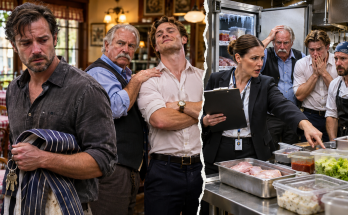
The document had my name on it.
That was the first thing I couldn't understand.
The second was the signature.
It looked enough like mine that somebody glancing quickly might have accepted it.
But I knew my own handwriting.
And I knew I hadn't signed that paper.
I sat at my kitchen table with the folder open.
My unfinished coffee was still on the counter.
The apartment was quiet again.
But the quiet no longer felt empty.
It felt heavy.
I started reading from the beginning.
The credit line had been opened four months earlier.
That meant the financing had been arranged while I was still working at Callaway's Table.
While I was checking invoices and making sure our staff got paid.
While I was training Colton.
While I still believed my father and I were working toward the same future.
The borrower was the restaurant's limited liability company.
The guarantee, however, named me personally.
My old apartment address was printed on the application.
That bothered me almost as much as the signature.
Somebody had used information connected to my private life to arrange financing I knew nothing about.
I kept reading.
The account limit was eighty thousand dollars.
Of that amount, sixty-three thousand had already been borrowed.
I put the paper down.
Sixty-three thousand.
I thought about all the mornings I'd worried over food costs.
All the times I'd argued with suppliers over small billing mistakes.
All the nights I'd stayed after closing because the numbers weren't balancing the way they should.
I had spent years taking those amounts seriously.
And now there was a debt for sixty-three thousand dollars tied to my name without my permission.
I turned to the transaction records.
Several payments had gone to a business called Blue Ridge Hospitality Consulting.
I read the name twice.
Nothing.
I couldn't remember any vendor, consultant, or service provider by that name.
I looked through the invoices included with the records.
One carried a contact telephone number.
That number bothered me.
I had seen it somewhere before.
I opened my phone and searched.
Then I found it.
Brinley.
Colton's girlfriend.
I stared at her name.
Brinley had been around our family for three years.
I'd served meals for her birthday celebrations.
I'd even helped Colton pick out a Christmas gift for her.
And now a number associated with her appeared on an invoice connected to money borrowed under a guarantee I had never signed.
I didn't know what it meant yet.
I didn't know whether she understood where that money had come from.
But I knew I couldn't ignore it.
I took out my phone again.
For three days, I'd been carrying the number of a lawyer named Rebecca Shaw.
She handled disputes involving small businesses.
Until that moment, I'd kept putting off calling her.
Some part of me still wanted to believe the restaurant situation could end without attorneys.
That I could leave and everyone would simply move on.
Looking back, I was still trying to make things easier for my family.
Even after they had made it clear how little consideration they had given me.
I called Rebecca.
She answered, and I told her what I'd discovered.
“I've got paperwork showing a loan guarantee in my name.”
She asked whether I'd signed it.
“No.”
“Are you certain?”
“Completely.”
Her tone became more focused.
“Do you have copies of everything?”
“Yes.”
“Then bring the documents in before you speak to anyone involved.”
I glanced at the time.
10:18.
I thought about Emmett.
About the walk-in cooler.
About my father arriving at the restaurant.
I told Rebecca the health inspector was there and that the business could be shut down.
She listened.
Then she told me something I wasn't ready to accept.
“The restaurant has people responsible for operating it now, Nathan. You need to deal with what they've put in your name.”
I looked at the papers.
She was right.
I knew she was right.
But admitting it felt almost disloyal.
“I know how to fix the kitchen problems,” I said.
“That doesn't make them your responsibility.”
I went silent.
There was a time when hearing something like that would have made me angry.
I would have started explaining why the restaurant needed me.
Why my father couldn't manage everything.
Why Colton wasn't prepared.
Why the employees would suffer if I stayed away.
I had explanations for every reason I couldn't leave.
Rebecca didn't ask for any of them.
She simply reminded me that other people had made decisions, and those decisions had consequences.
I ended the call and started gathering the documents.
Meanwhile, Rhonda's inspection was getting worse.
I learned the full details afterward.
By late morning, the problems were no longer limited to the walk-in cooler.
Rhonda had found food containers without the proper dates marked on them.
A handwashing sink wasn't accessible because equipment had been placed in front of it.
The sanitizer being used in the kitchen wasn't at the proper concentration.
The temperature documentation was incomplete.
And the refrigeration problem remained unresolved.
Each issue mattered.
But taken together, they told a much bigger story.
The restaurant's safety procedures weren't being followed.
That was what frightened me.
Not a mistake on a single form.
Not one employee overlooking a label.
The systems themselves were breaking down.
I had spent years making those systems routine.
You checked temperatures because the food had to be safe.
You recorded them because you needed to know what happened during the day.
You kept the handwashing sink clear because employees had to be able to use it.
You tested sanitizer because guessing wasn't enough.
Those weren't complicated ideas.
But they required somebody to take them seriously every day.
Colton had apparently decided the inspection was a disagreement he could win by talking.
He kept bringing up the restaurant's earlier inspection results.
He told Rhonda the business had always met the requirements before.
He seemed to believe our history should count in his favor.
But Rhonda was inspecting what existed that Friday morning.
Not what I'd maintained the year before.
Not the kitchen as it had operated when I was still there.
The kitchen in front of her.
Dad was standing nearby when the inspector made that clear.
According to Emmett, he looked stunned.
I could picture it.
My father had always been proud of Callaway's Table.
The place had carried his name for decades.
Customers knew him.
Regulars asked about our family.
He had spent years believing that the restaurant would always be there.
And now someone with a clipboard was telling him the business wasn't operating safely.
At some point, Dad suggested calling me.
Colton objected.
He reminded everyone that I wasn't employed there anymore.
That detail almost made me laugh when I heard it.
Not because anything was funny.
Because Colton wanted my position.
He wanted my father's confidence.
He wanted the restaurant placed in his hands.
But the moment there was a serious problem, Dad's first instinct was to reach for me.
The person they'd pushed aside.
Rhonda didn't care about the family arrangement.
She wanted to know whether the business had someone capable of maintaining safe operations.
That was the only question that mattered to her.
By eleven thirty, she'd documented the violations.
The unsafe food had to be discarded.
The restaurant's food operations were suspended until the problems were corrected and the required reinspection was completed.
Callaway's Table was closed.
Six days.
That was how long Colton had been running the place without me.
Six days between my folded apron and the suspension.
When Emmett later described what happened, I could almost see my father's hand gripping a chair.
Colton couldn't believe Rhonda was actually closing them.
He complained that the restaurant was a family business.
As though that made its food less dangerous.
As though a customer getting sick would care who owned the building.
Rhonda didn't change her decision.
Her job was to protect the public.
And that was exactly what she was doing.
Dad was pale.
Colton turned to him for help.
He wanted something done immediately.
A call.
An argument.
Somebody who could make the problem disappear.
But no one in that room could simply talk the restaurant back into compliance.
For the first time, there was no easy way to pretend everything was fine.
I wasn't there to take over.
I wasn't there to reassure Dad.
I wasn't there to tell Colton which checklist he'd ignored.
The restaurant was in the hands of the people who had insisted they could run it.
And those people had to face what had happened.
At 12:07, my phone rang.
I was sitting in Rebecca Shaw's office.
The credit agreement lay open on her desk.
My father's name appeared on the screen.
I stared at it.
Rebecca noticed.
“You can take it if you want. Just leave the financial documents out of the conversation for now.”
I nodded.
Then I answered and put the call on speaker.
“Dad.”
He sounded tired.
“Nate, we've got trouble down here.”
I glanced at Rebecca.
“I know about the inspection.”
He exhaled.
“They've stopped us from serving food.”
“I heard.”
“Colton didn't handle some things properly.”
I said nothing.
Dad kept talking.
“He's under a lot of pressure. We're going to have to sort out the problems.”
I waited.
Then came the request I'd been expecting.
“I need you down here.”
I stared at the papers on the desk.
“Why?”
“To get us running again.”
I ran my finger along the edge of the document.
“What would my position be?”
Dad sounded confused.
“What do you mean?”
“Would I be managing the restaurant?”
“Nate, don't turn this into another argument.”
“I'm asking what you expect me to do.”
He paused.
“You know the kitchen better than anybody.”
That was true.
I knew the equipment.
The employees.
The paperwork.
The repairs.
The procedures.
I knew all of it because I had spent eighteen years making sure I knew.
But Dad still hadn't answered my question.
He wanted me to carry the responsibility.
Without the authority.
Again.
I asked him why I should come back and repair a business after he'd decided I had no place leading it.
His voice hardened.
He told me the restaurant was in trouble and that I shouldn't make the situation about my feelings.
I looked at Rebecca.
She remained quiet.
For once, I didn't feel the need to raise my voice.
“Then deal with the actual problem, Dad.”
“We're trying to.”
“Start by taking responsibility for who's running the place.”
There was a long silence.
Then he said, “I thought you cared about this restaurant.”
That hurt.
More than I wanted to admit.
Because I did care.
I cared about the customers.
I cared about the employees.
I cared about the place where my mother had once worked.
And Dad knew all of that.
He was counting on it.
I took a breath.
“I care about it. But I won't keep doing the job you gave away.”
He started speaking again.
I ended the call.
For a moment, I couldn't look up.
My father had never been someone I hung up on.
Even when I disagreed with him, I had always stayed.
I had listened.
Explained.
Compromised.
Found another way to help.
Now I had refused.
Rebecca waited.
Then she asked how I felt.
I looked at the phone.
“Awful.”
She nodded.
I told her I hated knowing the restaurant was closed.
I hated imagining the employees wondering what would happen next.
I hated the possibility that customers could have been served unsafe food.
But I also knew that going back wouldn't undo what my family had done.
Rebecca returned to the agreement.
“There's another detail I want to show you.”
I leaned forward.
I thought she was pointing to the forged signature.
She wasn't.
Her finger moved beneath it.
To the witness section.
A name was printed there.
Frank Callaway.
My father.
For several seconds, I couldn't understand what I was seeing.
Dad had signed as a witness to the authorization.
The authorization I had never signed.
I read his name again.
Then again.
My father hadn't just put Colton in charge of the restaurant.
He had signed paperwork supporting the use of my financial identity.
I looked at Rebecca.
My hands had started shaking.
And for the first time that day, I stopped worrying about how I could save Callaway's Table.
I began wondering how much of my own life I needed to protect from the people who owned it.