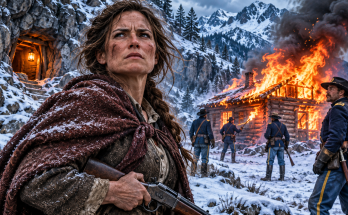
I used to believe a home belonged to the people who had suffered to build it.
I was wrong.
On November 15, 1888, a stranger stood outside my cabin with a piece of paper that said I had thirty days to disappear.
His name was Mr. Finch.
He worked for the Sterling Consolidated Mining Company in Denver.
He was young, perhaps not much older than twenty-five, with a clean face and a wool coat that looked inadequate for our mountain winters.
His hands were covered by gloves.
One of those hands held the paper.
I remember that detail because the paper looked so clean.
Everything around us was covered with mountain dust, dried mud, or the first traces of snow.
But that document was white.
Perfectly white.
He looked at me with the uncomfortable expression of a man delivering news he would rather not explain.
"Mrs. Thorne?"
"Yes."
"I'm here on behalf of Sterling Consolidated."
I knew what company he meant.
My husband, Elias, had worked for them for years.
He had surveyed their land, examined their rock formations, and helped locate the silver deposits that made their operation valuable.
Six months earlier, he had died in a rock slide in the upper basin.
Now the company had come for the house.
Mr. Finch cleared his throat.
"I'm afraid there's a matter concerning your occupancy."
I looked past him toward the trail.
His horse stood tied to our fence post.
The animal lowered its head against the wind.
I wondered whether Finch understood how far he had ridden to tell a widow she was no longer welcome in her own home.
"Go ahead," I said.
He opened the document.
"The cabin is located on Lot Fourteen of the Argentum claim."
"I know where my cabin is."
He glanced up.
Then he continued.
"Your husband was permitted to occupy this parcel under the terms of his employment."
I said nothing.
"With Mr. Thorne's passing, that agreement is no longer in effect."
There it was.
Elias had been dead for six months.
To me, that meant six months of waking beside an empty place in our bed.
Six months of setting one plate on the table instead of two.
Six months of walking behind the cabin to visit the grave I had dug for him.
To Sterling Consolidated, it meant a contract had ended.
Mr. Finch kept reading.
"The company is reclaiming the property. You will need to vacate by December fifteenth."
I looked at the logs beside the doorway.
Elias and I had spent days fitting those logs together.
He had built the fireplace from stones we carried out of the creek.
He had made our kitchen table from ponderosa pine.
One leg was slightly uneven.
He had promised to correct it.
Then we had gotten used to placing a folded piece of leather underneath.
That piece of leather was still there.
"Thirty days?" I asked.
"Yes, ma'am."
"In December?"
He tightened his lips.
"That's the period specified in the notice."
I looked toward the ridge.
Snow already covered the higher summits.
The peaks stood more than eleven thousand feet above sea level.
Our cabin was lower, around nine thousand feet, but that was still high enough for winter to kill anyone who misunderstood it.
By December, the passes could close without warning.
I knew because I had lived through six winters there.
Mr. Finch seemed anxious to finish.
"The company has authorized fifty dollars in compensation."
I looked back at him.
"Fifty dollars?"
"Yes, ma'am. Given your circumstances."
I nearly asked which circumstances he meant.
My husband's death?
My lack of family nearby?
The fact that I was a woman living alone?
Instead, I waited.
He explained that the money could be collected at the company office in Prospect.
There was one condition.
I would have to sign away any further claim against the company.
I understood that immediately.
They were not paying me for the home.
They were paying me to stop objecting when they took it.
I held out my hand.
Finch gave me the notice.
The paper had an official stamp and a notary's mark.
I read the clauses carefully.
I had spent enough years beside Elias to know that a person could lose a great deal by overlooking one sentence.
Nothing in the notice offered an extension.
Nothing acknowledged the work we had done to improve the property.
Nothing mentioned the grave behind the cabin.
I folded it once.
Then again.
"I need to make arrangements," I said.
Mr. Finch nodded.
"You have until the fifteenth."
He sounded relieved.
I suppose he had expected crying.
Perhaps anger.
Perhaps a widow begging him to reconsider.
I did none of those things.
That was not because I felt nothing.
It was because I could already see that he had no authority to change the decision.
He was there to deliver it.
Not discuss it.
"Good afternoon, Mrs. Thorne."
"Good afternoon."
He returned to his horse.
I stood in the doorway until he disappeared around the bend.
Then I stepped inside and closed the door.
The silence bothered me more than his words.
It was the same silence I had lived with since Elias died.
But now the cabin itself felt uncertain.
As though the walls had heard what Finch said and no longer knew whether they were allowed to stand.
I walked to the kitchen table.
I placed the folded notice beside the oil lamp.
Then I sat in Elias's chair.
I had avoided sitting there for months.
That afternoon, I needed the steadier chair because I intended to work.
I was thirty-seven years old.
My parents were dead.
I had one sister in Ohio, but we had not spoken in ten years.
I did not know whether she still lived at the address I remembered.
Elias had been my family.
And now he was buried behind the house.
I pulled our metal lockbox from beneath the bed.
Inside was all the money we had saved.
One hundred and twelve dollars.
I counted it twice.
The second count did not improve the amount.
I took a pencil and wrote the number on a sheet of paper.
Then I began listing everything we owned.
The cast-iron stove.
The bedframes.
Blankets.
Cooking pots.
A wagon that needed some attention.
Jericho, our old mule.
Elias's tools.
His books.
The Winchester rifle.
There were other household things, but nothing that would produce much money.
I wrote down what I thought I could sell.
Then I stopped.
Selling possessions was not the same as finding somewhere to live.
Prospect was twelve miles down the mountain.
It was the nearest settlement.
Almost every business there depended on Sterling Consolidated.
The mine paid the workers.
The workers paid the merchants.
The merchants depended on the mine remaining satisfied.
I knew what would happen if I arrived looking for employment after refusing to leave company property.
People might feel sorry for me.
That did not mean they would hire me.
Boarding houses sometimes employed women to wash linen, clean rooms, and cook.
But they generally wanted young girls who could work long days for very little pay.
I was not young.
I could work hard.
I had proved that every day for six years.
But the work I knew was mountain work.
I could grow vegetables where the growing season barely lasted.
I could split wood.
I could repair a roof.
I could judge when a change in wind meant the temperature would fall before night.
Those were useful skills.
They were not necessarily skills that would earn me a living in town.
I considered Denver.
Then I wrote down the cost.
The stagecoach fare was twenty-eight dollars.
The city was more than a hundred miles away, beyond two mountain passes.
If I sold Jericho and the wagon, I might receive another sixty dollars.
Added to my savings, after paying the fare, I could arrive with roughly one hundred and forty-four dollars.
That sounded like money until I considered food and lodging.
A room would cost something.
Meals would cost something.
And finding work might take weeks.
I had no one waiting for me there.
No trade suited to the city.
No guarantee I could even reach it before the passes closed.
I looked at the calendar.
November fifteenth.
December fifteenth.
Thirty days.
The mountains did not care about a company's deadline.
A storm could close the road long before my eviction date.
If I left early, I might end up stranded somewhere unfamiliar.
If I stayed beyond the deadline, Sterling could send the sheriff.
He could remove me from the cabin.
My furniture could be put outside.
My tools could be taken.
And once I lost the shelter, the cold would settle the matter.
I sat there until the room became too dark to read my figures.
I had been frightened after Elias died.
I had been lonely.
But that evening I felt something different.
I was beginning to understand that the company had placed me in a situation where almost every ordinary choice was dangerous.
I could leave and risk ruin.
I could remain and risk being thrown into the snow.
Or I could accept fifty dollars and pretend the transaction was fair.
I looked at the folded notice.
I knew what signing their release would mean.
Once I signed, they would have their own written proof that I had accepted the arrangement.
I put a line through the fifty dollars on my paper.
I would not collect it.
That decision reduced my resources.
It also meant I would not help the company describe what they were doing as a generous settlement.
Outside, the wind grew stronger.
The temperature had fallen sharply since sunset.
I added wood to the fire.
Then I stood beside the hearth for a long time.
Elias had built it from stones he carried one at a time.
I remembered him holding each stone against the others, adjusting it until the weight settled properly.
He never rushed stonework.
When something failed to fit, he looked for another arrangement.
That memory sent me to his bookshelf.
Elias had kept technical books on geology, mineral deposits, surveying, and engineering.
He had also kept journals.
Leather-covered ledgers filled with his handwriting.
He wrote in them almost every evening.
At the time, I had sometimes teased him about recording things the rest of us simply lived through.
Wind direction.
Temperature.
Creek levels.
Snow depth.
The kind of rock exposed after a storm.
He could spend half an evening describing a formation he had examined that morning.
I understood his work, though not always every technical detail.
He saw connections other people missed.
I took the newest journal from the shelf.
For the first time since his death, I opened it without being overcome by the sight of his handwriting.
I was not trying to make myself feel better.
I needed to think as he had thought.
Slowly.
Carefully.
Without accepting that the first obvious answer was the only answer.
I turned past his final entries.
The notes he had written shortly before the rock slide were still difficult to read.
I remembered the morning he left for the upper basin.
I remembered expecting him home.
I remembered waiting.
I moved past those pages.
I went backward through his records.
There were drawings of ridges.
Measurements of rock seams.
Small sketches of animal tracks and exposed granite.
I turned another page.
Then another.
Most entries were ordinary observations.
Things he had noticed because he believed the landscape was worth understanding.
I had never imagined those notebooks might become important to my own survival.
But there I was, with thirty days left in my home and almost no money to begin again.
And for the first time that evening, I stopped looking at the numbers on my paper.
I looked at the mountain through Elias's eyes.