Chapter 1
Three paper dollars and six dimes folded into a square in the pocket of her apron.
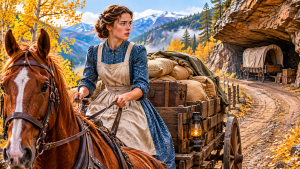
A chestnut mare named Molly hitched between the shafts of a freight wagon that did not quite belong to her and a loaded box behind that mare carrying flour and iron and coffee bound for a sawmill camp two days east of Pine Hollow.
She was driving the Wolf Ridge Road that morning, the way she had driven it 87 times before, with her hands easy on the lines and her eyes on the near shoulder, because the near shoulder was where a wagon lived or died on that cut.
What she did not know, and what nobody who knew her knew, was that 400 ft below the shelf she was climbing toward, under a 60-year drift of canyon dust, and under an overhang of red stone that had kept the worst weather off it since Grant was president.
Another wagon still sat on its wheels under its own gray canvas, still loaded, waiting without knowing it was waiting for someone of its own blood to come down to it.
And in a strong box inside that other wagon was a packet of letters and a leatherbound ledger and a signed receipt from the Harrow County Land Office that would before the year was out overturn every story Emma Fletcher’s family had ever told about the man they called her grandfather. Let’s leave Emma on the road for a minute. We put out a book.
It’s called Hidden Country. 19 new frontier tales of courage, discovery, and home written just for it. None of them are on this channel.
These are the ones we couldn’t put on YouTube, and it comes with the full 10-hour audio book, completely free with your purchase, so you can listen anywhere. Scan the QR code on screen or check the link in the description. Now, back to that October morning.
So, settle in where you are tonight. Pour yourself something warm. Pull the blanket up a little closer and tell us down in the comments where you are listening from.
What town, what porch, what kitchen window? Because this is a long story and it is worth the time it takes. And if you like the kind of story we tell on this channel, the quiet ones about the people the frontier forgot and then remembered, go on and tap that subscribe button before we start because there are more of them coming.
And we would like you to be here when they do. It was the 27th of October, and the aspen along the lower wolf ridge had gone the yellow of beaten brass a week before, and were only now beginning to let the first leaves loose.
The pines above the road still held the night cold under their skirts at 8:00 in the morning, and where the sun had not yet reached. The shadows on the shale were blue and slick, with the thin frost that forms before you can see it.
The road itself had been cut by hand into the shale face above Dryfork Canyon in the summer of 1879 by a crew paid in Army Script, and it ran 4 and 1/2 miles from the Pine Hollow turnoff up to the long shelf, and then another 2 mi along that shelf before it dropped by three switchbacks into the drainage on the far side.
The road was 12 ft wide where it was widest and nine where it was narrowest. And in two places along the shelf there was no shoulder at all on the canyon side. Only the lip and the drop and the stones in dry fork 400 ft below.
People in Pine Hollow called the Wolf Ridge Road the Dry Fork cut when they wanted to be plain about what it was, and most of them would not drive a loaded wagon over it for less than $4 a trip. which was why most of them did not drive it and why Emma Fletcher did.
The wagon she drove that morning had belonged to the Pine Hollow Freight Company for 16 years before it had been sold to her grandmother Hattie at the end of its working life for $22, and it had been patched and repainted twice since then, and its leaf springs had been reset in the spring by the Pine Hollow Smith for a dollar and a quarter.
The box behind her was 8 ft long and 3 and 1/2 ft wide with sideboards 18 in high, and it was loaded that morning with six 50-lb sacks of white flour from the Pine Hollow mill. Each sack stamped in blue with the mills running stag bound for the kitchen of the sawmill camp at Darnell’s Crossing.
On top of the flower sacks was a long pine crate from the pine hollow merkantile that held two broadaxes with hickory helves, three draw knives wrapped in oiled paper, a cooper’s ads, a brace of files, a box of eight penny cut nails, and two fulllength crosscut saws with their teeth sheathed in leather and their handles lashed to their blades with
waxed cord.
Behind the crate, uh, tucked up against the forward sideboard where it would ride easy, there was a smaller parcel in brown paper and twine that held four pounds of coffee beans from the Harrow roaster, a cone of loaf sugar, 2 lb of salt pork wrapped in oil cloth, and a tin of lamp oil for the Darnell’s Crossing Cookhouse.
The whole load weighed near 400 lb without the wagon under it, and it was the kind of load the little freight wagon had been built for, and the kind of load Molly could draw up the Wolf Ridge Road at a steady walk without blowing if her driver took it easy on the grade.
Molly herself was an 8-year-old chestnut mare, 15 hands and some, with a white snip on her nose and a lefthind sock that stopped just below the hawk. and she had been bought at auction at the Harrow Stockyard in the spring of 1920 by Emma’s grandmother, Hattie, for $12 because her previous owner had died owing a feed bill.
She had been Hadtie’s wagon mare for four years and Emma’s for two, and she knew the Wolf Ridge Road and the shelf above Dry Fork, the way a school child knows the path from the schoolhouse to the pump.
She would set her near front hoof on the inside of the road at every narrow place without being told, and she would stop of her own accord at the lightning split juniper that marked the three-mile post, because that was where Hattie had always let her blow for a minute on the climb.
Emma had not changed any of Hadtie’s habits with the mayor, because Hadtie’s habits had been earned over 40 years of driving a wagon, and Emma had never seen cause to improve on them. Emma had been running freight between Pine Hollow and the three settlements beyond the ridge for two years now, since the week she turned 19.
And she took the Wolf Ridge contracts because the Pine Hollow Freight Company would pay $110 weight to anyone willing to drive the dry fork cut and only 60 cents a 100 weight for the longer wagon road around the south end of the mountain. And she needed every nickel of the difference.
The men who drove freight out of Pine Hollow, six of them, all of them older than her father would have been if her father had lived, would not take the Wolf Ridge Road for less than $4 a load, and most of them would not take it in October at all, because October was the month the shale sweated at the seep and froze again overnight, and nobody
wanted to be the man who found the ice first.
Emma took it in October and had taken it in October the year before because she had learned the road from Hattie before she had ever driven it alone, and because Hattie had told her once, sitting at the kitchen table with a cup of chory coffee between her hands, that the Wolf Ridge Road was not a dangerous road.
It was only a road that did not forgive carelessness, and if a driver was not careless, the road would carry her as faithfully as any other. So Emma Fletcher that morning was not frightened of the road ahead of her.
And she was not thinking about the drop on her right wheel, and she was not thinking about the $3.60 in her apron pocket, which was all the money she had in the world.
She was thinking about the cracked rivet sheet she had felt under the lead trace somewhere above the first switchback, and about whether it would hold to Darnell’s crossing, or whether she would have to stop at the shelf and set a patch, and about the price Orin Mack would charge her at the Pine Hollow Forge to rework the whole backband on her way
home, and about whether there would be a letter from her brother at Odell’s feed store when she got back on Friday night.
She was thinking about the small practical things a driver thinks about on a long haul. And she was not thinking at all about her grandfather because her grandfather was a man she had been taught not to think about. A man whose name was spoken in her father’s house only as a warning and in her grandmother’s house not at all.
She did not know driving up the Wolf Ridge Road that October morning with the sun just now reaching the tops of the pines on the east side of the cut. That the name she had been told was her grandfather’s name was not the name on the patent of entry still folded inside an oilcloth packet inside an ironbed strong box at the floor of Dry Fork Canyon.
She did not know that the story her family had carried for 60 years. That Thomas Fletcher had taken his young wife and infant son West in the spring of 1866, filed a homestead claim on 320 acres of grass and willow along a creek called Lark, and then before the proving year was out, walked off into the mountains and left them both.
was not a story at all, but a mistake. And the mistake had a date on it. And the date was the 27th of October, 1867, which was 60 years to the day from the morning Emma Fletcher now drove her wagon up the shale cut above Dry Fork Canyon.
She did not know any of that because nobody alive knew any of it, and the only man who had ever known it had died with the knowing still in his coat pocket, and the letter still sealed with brown wax.
She clicked once to Molly at the lightning split juniper, and the mare dropped her head and blew out through her nose, and started again up the grade, and the lead trace gave that small jerking slack it had been giving for the last half mile, and Emma made a note to herself to check it at the top of the next switchback, where the road widened
enough to stand down beside the wheel.
The sun had just now cleared the ridge line, and the shale ahead of her went from blue to the color of wet iron as the light touched it. The wagon rolled on toward the narrow shelf above Dryfork Canyon, where the road bent hard against the shale wall, and the drop fell 400 ft to the stones below.
Emma had been born in a two- room house three miles outside Pine Hollow in a room with a window facing the mill race to a father named William Fletcher and a mother named Sarah who died of a fever that came up from the creek in the summer of Emma was nine.
William worked the pine hollow mill as a hand, feeding sacks into the hopper and hauling out flour, and his lungs had gone bad from the dust, so he breathed like a man climbing stairs even when he sat still in a chair.
Emma’s two older brothers, Thomas and William, both called by their middle names, Frank and Russell, had gone up to the railroad in Wyoming in 1920 and 1921.
taken on as track walkers and later as junior foremen and they sent money home twice a year but did not come home themselves not even for Christmas or for their father’s funeral when he died of pneumonia in February 1924 the winter Emma was 16 and learning to drive the wagon after her father died Emma’s older brother Frank had written to say he was
sorry about the house meaning that he could not afford to keep up the payment and that the bank would likely take it and that she should plan accordingly.
The bank did take it in March of that year, and Emma moved into a boarding room in Pine Hollow and began taking work where she could find it, hauling water, mending clothes, working the mill office 2 days a week for 30 cents a day. And it was her grandmother, Hattie, who had come to find her that April with news of a better arrangement.
Hattie was 71 years old at that time, straightbacked and lean, with hair she wore in a single gray braid pinned at her neck and a face that had been handsome once and had become something more useful than handsome with age.
She wore a blue wool shaw in the winter that she had owned since the 1890s, and her hands were scarred with the marks of a lifetime spent in cordage and leather and the sharp edges of canning jars.
Hattie had kept a small team of horses and a freight wagon for over 40 years, and she had hauled cargo between Pine Hollow and the settlements beyond the ridge, and she had watched Emma grow up and had seen in the girl something that most people did not see, which was competence not from schooling, but from the way she moved through the world, and
the way she paid attention to the small problems that other people overlooked.
When William died, Hattie had ridden her mayor into Pine Hollow and found Emma at the boarding house and had said without any preamble that she wanted to teach Emma to drive the wagon properly, and that Emma could stay in Hattie’s house and work for her in the mornings and take the freight runs in the afternoons, and that Hattie would pay her 15
cents a mile as long as she drove the road safely, and did not waste time on sentiment.
So, Emma had moved into Hadtie’s house in April 1924. a small structure on a quarter acre plot two miles west of Pine Hollow with a barn and a pole corral and a dry shed where Hattie kept her tools and her harness leather and the ledgers in which she recorded every job and every penny.
Hadtie had taught her how to splice harness that had torn at the eye. How to grease a hub without wasting the grease, how to repair a cracked whipple tree by setting a lath and wrapping it with rawhide. How to read the weather by the way the ridge line looked at dawn.
And most importantly, how to drive a loaded wagon down a bad road without touching the brake because the brake was a last resort and a fool’s option. And the only thing that kept a wagon on a narrow road was the speed of the horse and the angle of the tongue and the driver’s hands and her sense of the ground beneath the wheels.
Hadtie had driven the Wolf Ridge Road for 23 years without incident, and she had lost two other drivers to carelessness and one to an honest accident that had killed both the horse and the man. and she had decided that Emma would not be among those losses if intention and instruction could prevent it.
For two years Emma had ridden in the wagon beside Hattie, learning each curve and each soft shoulder, each place where the shale sweated after rain, each switchback and each drop. And in the spring of 1926, when Hattie had judged her ready, Emma had taken her first run alone, and she had made 87 runs since then without incident.
Hadtie had kept one peculiar thing in her house that no one in the family understood, a tin box under her bed that she did not speak about, and that she did not open in front of anyone. And it was not until very late that Emma learned what was in it.
The box contained 11 letters, all dated between 1866 and 1867, all addressed to Mrs. Hattie Fletcher in care of general delivery at Pine Hollow, Idaho territory, and all written in the same careful hand. The letters had come from a man named Thomas, and Thomas had signed each one with a T and a flourish.
Had he never explained what the letters meant or why she kept them, but she had shown them to Emma once in the winter before she died. and she had said only that Thomas had carried a compass on the trail west, a small brass compass with his initials scratched on the back, and that Hattie had wanted Emma to have it someday.
And that if Emma carried it, she should know that every man who had ever loved anyone had carried something like it, some small thing that said,”I am coming home.” Hattie had given Emma the compass in December 1925, and it had lived in Emma’s apron pocket ever since.
worn smooth by her fingers and by the movement of her hand against it a hundred times a day. The compass was scratched and dented, and one of its corners was bent, but it still worked. And the initials on the back were so worn with age that you had to turn it into the light to see them at all.
Hadtie had died two years earlier in February 1926 of pneumonia that came up sudden and took her in 5 days. And the doctor from Harrow had sat beside her bed and read poetry aloud because there was nothing else left to do. And Hadtie had listened without moving.
And on the fifth night she had stopped breathing. She was buried behind the Methodist Chapel in Pine Hollow in a grave that was kept neat by a woman named Mrs. Odell, who swept the chapel steps and kept the flowers on the graves in the summer.
Emma had been 19 when her grandmother died, and she had kept the wagon and kept the mayor and moved into a rented room above Odell’s feed store for a $1.50 a month, and she had taken on the freight work because she already knew how to do it better than most of the men on the ridge, and because Odell would give her credit if a run was slow to pay.
The room was small and cold in the winter with a single window that faced the street and a narrow iron bed and a chair and a shelf where she kept her clothes and the compass in its apron pocket. She had worked the same routes that Hattie had worked.
And she had driven the Wolf Ridge Road 87 times in two years without losing a load and without losing her nerve. And that was who she was and what she carried when she drove out of Pine Hollow before dawn on the 29th of October with the compass in her apron pocket and $3.60 to her name.
All the money she had in the world and Molly’s reigns in her hands and no idea that the story she had been told her whole life about a man named Thomas Fletcher was not the story at all, but an accident of words that had been passed down so many times that nobody remembered anymore. that a story is not the same thing as the truth.
And the truth was waiting for her 60 ft below the wolf ridge shelf under gray canvas and red stone in a wagon that had been falling toward her for 60 years. The road climbed through pine shadow for two miles above the pine hollow turnoff, and Emma let Molly walk, saving the mayor’s strength for the long shelf where the real work began.
The October air was thin and cold at this altitude, and the morning sun had not yet reached the canyon side of the ridge. Emma sat easy on the box with the lines loose in her hands, feeling the wagon settle into its rhythm on the climbing grade, the leaf springs taking the small stones with their familiar creek and shift.
At the first switchback, where the road widened enough to turn the wagon in a full arc, she pulled Molly to a stop and set the brake with the lever, and she climbed down from the box to inspect what her hands had felt a half mile back.
A small jerking slack in the lead trace, the left harness strap that ran from Molly’s backband to the whipple tree, and carried the full weight of the pull. She ran her palm along the leather, reading its condition the way Hattie had taught her, feeling for the telltale crease that meant a rivet was working loose, or a seam was beginning to tear.
The trace was good leather, darkened with age and use, but not brittle, and she found it near the middle of the strap where the backband attached, a rivet, small and iron, sitting proud of the leather by perhaps the width of a fingernail. She pressed her thumb against it and felt the rivet shift a fraction in its hole.
The leather around it was still sound, and the crack was new. Perhaps from the strain of Molly’s lunge at a startled hawk 2 mi back, or from the accumulated pressure of four years of hauling. Emma stood back and considered.
Orin Mack, the pine hollow blacksmith, would rework it properly for 20 cents, setting a new rivet with his tools and backing plate. But that would mean turning back, losing a day, losing the freight fee.
She took her all from the tool bag on the wagon bed and a square of rawhide from the leather scraps Hattie had kept in a canvas sack, and she set a temporary wrap around the rivet, binding it tight with the rawhide, pulling the leather together and holding the rivet firm in its place.
It would hold to Darnell’s crossing, she judged, where she could stable Molly overnight and have Orin rework it properly the following morning before the return run. She climbed back onto the box and clicked once to Molly, and the mayor resumed the climb, steady and sure-footed on the shale.
The road curved past the lightning split juniper that marked the three-mile post. A tree hit decades ago and still standing with its two halves wrenched apart. the wood inside exposed and silvered by the weather.
Emma had passed it 87 times, and she had never counted them until recently, but Hadtie had taught her to mark distance by objects and not by time. And this juniper was as reliable as a mile marker set in stone. Beyond it the road narrowed and the grade flattened, and Emma could see ahead the beginning of the shelf.
That quarter mile stretch of the wolf ridge cut where the road ran 12 ft wide along the shale face with nothing on the right but air and the long fall to the rocks below. The seep was visible from here, too. A darker stripe on the stone where water bled from the rock face in summer and froze hard in October.
A thin glaze of ice already forming on the north side of the shale where the morning sun had not yet reached it. Emma checked Molly’s pace and kept her steady, and she thought of Hattie’s voice. The ridge forgives no carelessness.
You pay for carelessness with your life or the horse’s life, and the horse did nothing to deserve that debt. She reached the beginning of the shelf as the sun cleared the far ridge and began to light the rock face beside her.
The wagon box lurched slightly as the grade leveled, and she adjusted her weight to compensate, keeping the lines even in her hands. Molly was calm and sure, and the wagon was tracking straight, and Emma felt the old familiar centered feeling that came from knowing a road and trusting a horse.
and having your hands on the reinss of a thing that mattered. Then a gust of wind came down from the ridge, pushing hard and sudden from behind her left shoulder, the kind of wind that rode the thermals off the canyon floor in the morning, and could flip an unwary driver clean off the box if it caught at the wrong moment and the wrong angle.
Molly flinched and cidled forward and to the right, and the wagon rocked on its leaf springs, the right front wheel drifting toward the edge of the road by perhaps 3 ft.
Emma pulled the lines hard to the left and called sharp and steady to Molly, who knew her voice and knew what it meant, and the mayor gathered herself and stepped back onto the center of the road.
And for a moment, Emma thought the wind had passed, and the crisis had resolved itself, the way small crises do on narrow roads, when a driver keeps their nerve, and a horse is worth the money you paid for it.
But the wind was still pushing, a sustained pressure now rather than a gust, and it pushed the wagon box sideways on the springs, and the right wheel drifted again, and this time the cracked rivet in the lead trace, the small compromise she had made with Orinax’s expertise and Molly’s safety gave way completely.
Chapter 2
The rawhide wrap split, and the rivet tore free of the leather with a sound like a branch snapping, and the entire left trace came loose in a sudden jolt that threw Molly forward and sideways all at once, free on the left side, lurching to the right, the wagon tongue swinging with her, the right front wheel running off the lip of the road and out
into the air above the canyon.
Emma, trained by two years of riding beside Hattie, and two years of solo runs, and two years of learning to trust her own hands more than her own fear, did not reach for the break or try to hold the lines. She dropped the lines and threw herself sideways off the box, launching her body to the left toward the canyon wall.
And she hit the inside shoulder of the road hard on her left ribs and her hip, and her left wrist folded under her as she landed, and she rolled, and the breath drove out of her lungs. And for a moment, there was nothing but the sound of her own body striking stone, and the sound of the wagon pitching behind her.
The wagon box tilted on its right side as the wheel caught the lip of the road one final time. And then the weight of the load carried it over the edge. Six sacks of flour, a crate of saws and tools.
The wagon box itself with all its iron fittings, 88 years of accumulated mass and momentum, went over the shelf and out into the open air above Dry Fork Canyon. and Emma heard it strike the first stone ledge 40t down with a sound that seemed to contain the whole morning.
A crash of wood splitting, of iron warping, of canvas tearing, of objects in motion ceasing to move at all. Then silence, then the sound of debris still falling, and then the wind in the canyon again, cold and uncaring, the way wind always was after a thing was done.
Molly stood trembling in the middle of the road, the traces hanging loose and broken from her hams. Her near foreg cut above the pastn by the shale, blood running dark red down to her hoof. Emma lay on her back against the canyon wall, taking inventory the way Hattie had taught her, moving each piece of herself to see if it still answered.
Her left wrist throbbed with a bright pain that made her think of Orin Max’s hammer. Her ribs achd, all of them, and she suspected at least two were cracked, but not broken through. The kind of injury that would hurt when she breathed for a week and hurt more when she laughed.
Her lip was split and tasted of blood and dust. But she could breathe and she could move her legs and she could open her eyes to the blue sky above the canyon wall and she understood that she was alive and Molly was alive and everything else on that wagon was gone into the canyon and that was the fact of the morning now simple and complete.
She rose carefully holding her left wrist tight against her ribs. And she walked to Molly and caught the mayor by the halter and spoke to her low and steady. the way Hattie had spoken to frightened horses.
Not the voice you used for foolish animals, but the voice you used for creatures that had been through something and needed to know they were safe now and that the trembling could stop. Molly’s head dropped by degrees and her breathing slowed. And after a long moment, her eyes stopped rolling back and she stood calm under Emma’s hand.
Emma tied Molly to the lightning split juniper 50 yards back from the edge where the mayor could graze if she wanted to and could not spook into the canyon if her nerves broke again. She took her lantern from where it still lay on the road beside the wagon’s departure point.
A small brass lantern dented now and its oil sloshed, but the glass still whole. She took her coil of rope, a quarterinch hemp line 30 ft long that she kept under the wagon seat for emergencies, and she took the brass compass out of her apron pocket and held it a moment in her good hand.
And then she walked back to the place where the wagon had gone over. She stood at the lip of the shelf a long moment before she looked down, because Hattie had taught her that you did not look over a drop without first setting your feet and your breath, and because her ribs would not let her bend quickly at the waist.
When she did look, she looked slow, her good hand braced flat against the shale wall at her left, her boots an inch back from the crumbling edge, and she studied the canyon face the way she would have studied a bad shoulder of road. not for what frightened her, but for what she could use.
The chute the wagon had cut was plain enough once she found it. The right wheel had struck first, and plowed a long gray furrow through the loose shale, and the box had tumbled after it, and knocked a wider path. And now there ran down the canyon face a kind of trough 40 ft deep, where no stone sat that was not freshly turned.
Below the first 40 feet, the slope eased into a bench no wider than a wagon box itself, but long, running north and south along the face, grasped over in places, and furred with juniper and a few twisted cedars that had rooted into the cracks. The bench caught the sun at this hour, and the frost on it was already going.
Below the bench the ground fell again, not sheer this time, but steep, by a cleft of weathered red rock, where water had run in some wetter century, and that cleft opened out onto the floor of dry fork proper, where the wagon lay. She could see it from where she stood. The right side was pressed against a pale boulder the size of a smokehouse.
The box stove in, one wheel still turning in the air with the patient slowness of a thing that did not yet know it had stopped being a wagon. And from the ruptured sacks, a white bloom of flower spread downs slope across the stones. She counted the drop with her eye three times to be sure.
40 ft of shale, 20 ft of bench, 40 ft of cleft, give or take. Her rope was 30. The rope would hold her through the first chute if she tied it well, and the second drop she would have to climb without it, using her hands and her feet and the weathered rock to carry her weight.
She measured the juniper. The lightning split tree where Molly stood tied was too far back, but there was another juniper at the very edge of the shelf, older, lower, its trunk thick as her thigh, and its roots dug deep into a seam of the shale. and that one would hold her weight and the weight of the going down.
She tested the trunk with her good hand, leaned her shoulder against it, pushed and found it did not give. She tied her rope to the base of it in two half hitches and a round turn above them. The knot Hattie had taught her to use when she wanted a line that would not slip under a long pull.
and she tested it with her boot, and then with her hip, and then with the whole of her weight sat back against the drop, and the knot held, and the juniper held, and she felt the small, clean satisfaction of a thing properly done, that she had always felt when she tied a load.
She coiled the slack and dropped it over the edge, and watched the end of it swing and settle against the shale 10 ft short of the bench. 10 ft she would have to find without the rope. She could do 10 ft.
She put the lantern down at the foot of the juniper because she could not carry it going down and would come back for it. And she took one slow breath and let it out and did not take another until she had turned her back to the canyon and set her boots sideways to the slope the way Hattie had shown her for shale.
The first 10 ft were only steep enough to make her glad of the rope. She went down hand over hand with the line wrapped once around her right wrist, and the rope paid between her thumb and her palm, and the shale slid under her boots in little rattling slips, and sent small avalanches of gray stone chattering ahead of her down the chute.
Her left wrist she kept tucked tight against her chest, inside the opening of her coat. And when the line jerked under her, she took the jerk in her shoulder and not in that hand. The ribs she could not spare.
Every breath pulled at them. And halfway down she had to stop at a place where the shale eased a step and rest her feet flat and breathe shallow until the sharpness in her side settled back to a long dull ache she could carry.
She looked up once and saw the pale line of the road above her as a seam of lighter stone against the darker shale, and she saw the top of the juniper, and that was all. She did not look up again.
She went down the rest of the chute faster than she meant to because the shale gave way under her boots in a long rolling slide, and she rode the slide with the rope burning through her good hand.
And when she reached the end of the rope, the slide carried her the last 10 ft without it, boots sideways, left shoulder to the slope, her good hand catching at juniper roots and at the bare brown stubs of grass as she went past, until she came to rest on the bench with the flat of her back against a cedar trunk, and her boots braced against a
stone the size of a loaf of bread.
She lay there a moment and looked at the sky. It was the same blue it had been at the top. She breathed as deep as her ribs would let her three times, and then she sat up and looked around.
The bench was wider than it had seemed from above, maybe 4t across where she sat, narrowing at both ends. The grass on it was still green under the frost in patches, and juniper berries lay blue in the needles.
A cedar had grown there long enough to twist its trunk around a boulder, and the boulder had sunk into the roots, as into a cup, and together they made a sort of chair that she sat in without having planned to.
She looked out over the lip of the bench, and saw the wagon again, closer now, and the smell of the spilled flower came up to her on a breath of wind, and under the smell of the flower, the drier smell of old stone warmed in sun. She did not rest long. She was afraid that if she rested long, she would stiffen.
And if she stiffened, she would not be able to make the second drop. And if she did not make the second drop, she would have to climb back up to the road on nothing but a bruised wrist and two cracked ribs, and whatever strength her good arm still owed her.
And that was not a thing she wanted to try before she had put her hands on what was left of the load. She stood up slowly using the cedar trunk and she walked along the bench to the place where the clft of red rock began.
The clifft went down in a series of steps and seams, almost a stare, as if a slow water had cut it over patient centuries, and left footholds for whoever came after. She went down it on her good hand and her boots, keeping her left side turned away from the rock, feeling for each step with her toe before she set her weight.
Twice the stone crumbled under her foot, and she caught her weight on her good arm, and felt the crack of her ribs answer in a hot white line along her side. And both times she stopped and breathed until the line went dull again.
Once a dry juniper branch cracked under her boot, and she rode the small slide of pebbles 10 ft down the clif before her boots caught a lip of rock and held. And when she looked up, she saw she had come down more quickly than she had meant to, and that below her the canyon floor was only the length of a wagon tongue away.
She stepped off the last ledge of the clif onto the floor of dry fork, and stood on the stones a moment, and did not go to the wreck right away. Her legs were shaking in the way legs shake after a thing is over, not during it. She let them shake.
She looked up the way she had come and saw the thin line of her rope hanging small as a thread against the shale and above it the pale seam of the road and above that the blue sky. Then she walked to the wagon. The right axle had snapped clean through at the hub and the wheel that still turned turned on nothing but its own weight.
The box was stowve in on the downhill side. The sideboards splintered, the iron corner bands torn loose at their nails. The tool crate had split lengthwise where it had struck the boulder, and the two cross-cut saws lay bent across the stones, their leather tooth sheaths still laced on, their waxed cord handle lashings whole.
One of the broades had come clean out of the crate, and its hickory helve had cracked at the eye. The ads had rolled against the boulder and sat upright as if a man had set it there for the night. Four of the six flower sacks had burst and lay empty, their blue running stag stamps crumpled in white dust.
Two sacks were whole, lodged beneath the splintered sideboards, dented but holding. The brown paper parcel of coffee and sugar and salt pork had come free of its twine, but had held together inside its oil cloth, and the oil cloth had kept out the dust. The tin of lamp oil had rolled 30 ft along the stones and lay against a root uncrushed.
She did not sit down. She walked a slow circle around the wreck first, cataloging what was still worth lifting, because Hattie had said that when a thing was lost, you did not stand and mourn the loss, but counted what the loss had left you.
She counted the two flower sacks if she could carry them, the oil cloth parcel, the smaller draw knife which lay bright and unbent on the stones, the two broadaxes. Helves cracked but iron sound. The box of eight penny nails scattered but gatherable, the tin of lamp oil.
Her canteen was still lashed to the splintered side of the box where she had tied it that morning. She worked it loose and hung the strap on her good shoulder. From under the wreck of the seat, she pulled out Hattie’s old wool blanket, gray with brown stripes at the ends, that had ridden under the seat as a cushion since Hattie was alive.
The blanket was torn along one edge, but hole in the mane. She shook it out, and the dust came off it in a cloud, and settled on the stones. She carried the salvage one arm load at a time to the pale boulder and stacked it against the le side where the sun fell.
The two flower sacks she dragged. The oilcloth parcel she carried under her good arm, the draw knife and the lamp oil and the dented lantern and the compass and the canteen and the blanket she set in a careful row on top of the sacks.
When she had done, she sat down on the pile with her back against the boulder and let her ribs rest, and she closed her eyes a moment and listened to the wind in the canyon, which came up dry fork in a long, low breath that she could feel against her face. She opened her eyes, and that was when she saw it.
40 paces farther down the canyon, under the shadow of an overhang of red stone that leaned out from the west wall and made beneath itself a dry porch of pale dust, where no snow and no rain had settled in longer than she had been alive.
There sat a shape she had not seen before, because the shape was almost the same gray white as the stone behind it, and the eye slid off it the way the eye slid off a bird in a thicket until the bird moved. The shape did not move, but now she had seen it, and now she could not unsee it.
And she sat up straight against the boulder and looked at it a long time without rising, because the shape was wrong for a boulder. It was too square across the top. It was too flat along one side.
It had where its lower edge met the dust, a dark line that was the line of a thing with corners and planks. She stood up slowly, hand against the boulder, and she walked toward it.
She walked slow because her legs were still unsteady, and because the stones along the floor of Dryfork were rounded and loose and would roll under a boot that came down careless, and because as she drew nearer, she began to see what she was walking toward.
The curve of iron rims came clear first, half sunk in the dust of the dry porch, red with rust the color of the stone that sheltered them. Then the ribs of bowed canvas, held up by what must be hickory bows bent to the pattern she had seen on every covered wagon of her grandmother’s generation.
Four bows, she counted, spaced the way the old pattern spaced them. Then the dark, long line of a wagon box under the canvas, silvered with weathering but whole, its sideboards upright, its tailgate still latched.
The tongue lay broken on the ground forward of the wheels, snapped off 2 feet from the box, the splintered end gone brown with 60 years of the dust that drifted across it. She stopped 10 ft from it and understood what she was looking at. Another wagon, old settled on sunken wheels, the rims 4 in deep in the pale dust of the porch.
The canvas gone stiff with age, but held upright by the bows, as a dress is held by its stays, standing almost as upright as the morning it had come to rest under this stone. She stood 10 ft from it, and she did not go closer right away because a thing that had sat where it sat for 60 years deserved a moment before a stranger laid hands on it.
Then she went closer. She walked around it slow. On the le side, the side turned to the stone wall and sheltered by it.
The canvas was stiff and brittle, but whole, held together by its own weave and by the hickory bows beneath it. On the windside, where the little weather that found its way under the overhang had worked at it over the decades.
The canvas was torn in two places, long, thin tears that ran with the grain of the weave, and that she could have put her hand through if she had wanted. The iron tires were sunk 4 in into the dust, as if the wagon had grown roots. The wood of the box was silvered and furred with lyken in patches of pale green and black.
But when she set her palm against the sideboard and pressed, the wood did not give. The wood had cured in the dry dust of this porch for 60 years, and had not rotted. It had only gone to silver.
She came to the back of the wagon where the tailgate was and stood a moment looking at it. The tailgate was latched by a wooden pin pushed through two iron eyes. The pin whittleled from a piece of hardwood and worn smooth at both ends by a hand that had set it there carefully one last time.
Above the tailgate the canvas was gathered and laced with a hemp rope through brass grommets, drawn tight and knotted on itself in a knot. she recognized as the knot a man tied who meant to come back for his load. She set her good hand against the canvas flat and she pressed.
Through her palm she felt what she had come 40 ft of shale and 20 ft of bench and 40 ft of weathered cleft to find without yet knowing she had come for it. The canvas gave an inch and no more. The wagon was still loaded.
The weight of what sat under the canvas pressed back against her hand. The way a sack of flour pressed back when you set your palm on top of it to feel what it held.
She stood that way a long moment with her hand on the canvas and the wind coming up dry fork in its low, long breath past her face, and she did not say anything because there was no one to say anything to.
And because Hattie had taught her that the first thing you did when you came upon a thing you did not understand was to be quiet in front of it until it began to tell you what it was. Then she lifted her hand off the canvas and moved it to the lacing at the tail.
She unnotted the lacing rope at the tail of the canvas with her good hand, and the knots crumbled under her fingers like old bread. She drew the lacing out through the brass grommets, one eyelet at a time, careful of the rotten fibers.
And when the last grommet came free, she folded the stiff canvas back on itself in a half moon, and set the fold across the top edge of the tailgate so it would not drop and tear. Then she lifted the whittleled hardwood pin out of its iron eyes and let it rest in her coat pocket.
Because it had been set there by a hand, she did not want to shame by dropping its work in the dust. And she opened the tailgate down on its iron hinges, and the hinges did not creek so much as sigh. The way an old door sigh when it has not been asked anything in a long time.
The inside of the wagon opened to her the way a room opens to a person who has walked up on a house in the woods and found the door unlocked. The air inside smelled of dry pine and of oil cloth and of the thin dusty sweetness of straw packed 60 years. Nothing in it had been disturbed.
Nothing in it had rotted through. The overhang above had kept the weather off the windside, and the canvas had kept the dust off the load. and what she was looking at was not a wreck, but a cargo laid in and lashed down, waiting to be unloaded at the end of a trip that had never come.
She stood at the open tail and counted what she saw the way Hattie had taught her to count a load before signing the manifest. Three nail kegs lashed with hemp cord against the right sideboard. oak staves bound by four iron hoops each.
The heads still sound, and the chalk marks on the heads still legible in a hand she did not yet know she knew. 8D, 10D, 20D. Forward of the kegs, a walking plow laid on its side, with the handles unshipped, and crossed over the beam.
The moldboard dulled by 60 years of dry air, but still bright under the dust, where she brushed it with the edge of her thumb. Not the dull gray of old iron, but the pale polished steel of a plow that had been bought new and had never cut a furrow.
Against the left sideboard, a long crate half the length of the box, its lid loose, filled with sheets of window glass set upright and separated by handfuls of straw gone brittle but still spaced the way the packer had spaced them. And she counted eight panes without lifting the lid higher than her hand.
From a hook screwed into the forward sidewall hung a cast iron skillet black with cure, its handle wrapped in a square of leather tied by a thong, as if someone had meant to carry it slung over a shoulder when they walked up to the house at the end of a day. Below the skillet, a bundle of dress goods tied in oil cloth and roped crosswise.
The oil cloth yellowed but whole. the knots sound.
And at the back of the wagon box, pushed up against the forward wall under the driver’s seat, a woman’s trunk, the lid dome topped, bound at the corners with brass that had gone green, but held a brass lock plate at the front with the key still in the keyhole, turned to the open position by a hand that had meant whoever opened the trunk next to
have no trouble.
She stood a moment with her good hand on the tailgate and let it come to her slowly because it would not do to let it come to her all at once. These were not things a man carried on a trip to town. These were things a man carried home.
Chapter 3
Closest to where the driver would have sat, braced against the front sideboard with a short length of cord nailed through its iron bands into the plank. There was a smaller wooden strong box, no bigger than a seed drawer, oak by the look of it, bound in four iron straps and locked with a block the size of her palm.
The wood of the box was the darker wood of a thing kept inside a coat rather than inside a wagon, and the hasp had not rusted shut because something, oil, or a scrap of greased rag had been worked into it before the box was set down. She did not go to the strong box first.
She would not have known why if asked, but she knew that a strong box would wait and that the wagon would not. She climbed into the box over the tailgate with her good hand on the sideboard and her ribs held tight against her left arm, and she worked slowly forward along the right sideboard between the plow and the kegs.
And that was when she saw cut into the inside face of the right sideboard at about the level of a seated man’s shoulder. Two capital letters carved into the plank with the point of a knife. The strokes were clean and the plank around them unweathered, protected by the canvas and the overhang and the 60 years of stillness.
The letters were T and F with a short line scored under them the way a man scored a line under his name on a receipt. She stood with her hand two inches from the carving and did not touch it.
She reached into the apron pocket beneath her coat with her good hand and brought out the small brass compass that had lived there since the winter before her grandmother died. The one Hattie had pressed into her palm in December of 1925 and told her every man who had ever loved anyone had carried something like it.
She turned the compass over in her hand and tilted it to catch the light coming slantwise through one of the tears in the canvas. And she looked at the back where two letters were scratched into the brass so worn you had to turn them into light to see them.
T and F, the same two letters scored by the same hand in the same careful upright strokes with the same short line beneath them. She put the compass back into her apron pocket with the care of a person laying a child down who has at last fallen asleep.
And she sat down on a nail keg because her legs were not going to carry her the two steps to the trunk without a rest. She sat for what might have been a minute and might have been five. The wind came up dry fork and moved the brittle canvas a hands width and let it fall again.
Somewhere above the shelf, a raven called once and did not call again. When she stood up, she went to the oilcloth bundle hung below the skillet and worked the knots loose with her good hand. The oil cloth fell open across her forearm, and inside it was a man’s winter coat.
brown wool, the shoulders broad for a man not tall, the collar lined in rabbit fur, the fur gone thin at the throat where a man’s chin would have rubbed it in cold weather. She lifted the coat out and held it up by the shoulders, and the sleeves fell straight, and in the breast pocket she felt the flat edge of a leather wallet.
She took the wallet out. The leather had cured dry and stiff, but had not cracked. Inside the wallet were two papers folded in halves.
The first was a railroad timetable from the Union Pacific line out of Omaha dated the spring of 1866. The printing still legible, the paper gone the color of week tea. The second was a single sheet of ruled paper with the heading of the Harrow County Land Office printed across the top in black ink.
And underneath the heading, in the slow, careful hand of a clerk, there was a receipt made out for one Thomas Fletcher for improvements filed on 320 acres of grass and willow bottomland along Lark Creek in Harrow County, dated the 4th day of October 1867, signed and sealed by the register in two inks and endorsed on the back by Thomas Fletcher
himself in the same upright strokes as the carved letters on the plank.
She read the receipt once, standing at the oil cloth bundle. She walked to the open tailgate and sat down on the wagon tongue because her legs would not hold her up any longer. And she read it again.
Then she read it a third time because her grandmother, Hattie, had told her the family story of Thomas Fletcher for 16 years, and had not once told her that any such receipt existed in the world. And three readings were what Emma needed to be sure the paper was not going to change in her hand.
She sat on the wagon tongue a long moment after the third reading and did not move. And she did not cry because she was Hadtie’s granddaughter and Hattie did not cry in daylight. After a while, she stood up and climbed back inside the wagon box and went to the trunk at the back.
The key was already in the lock, turned to open, and she lifted the lid and the brass hinges held. Inside the trunk, laid in flat with the care of a thing packed by a man who had been shown how to pack it, was a folded piece of white linen tied at its narrow end with a scrap of blue ribbon.
She lifted it out with her good hand and shook the fold open across her arm. It was a baby’s christening gown, no more than 18 in long, the yolk smocked in fine thread, the hem embroidered in white chain stitch with a scalloping along the edge.
The blue ribbon run through two eyelets at the yolk in a slip knot a mother’s hand would have untied in a minute. The linen had yellowed only at the folds. The ribbon was still blue.
There was no one in the canyon with her to tell her who the gown had been meant for, but she did not need telling. She folded the gown back along its original creases and set it inside the trunk and closed the lid.
She climbed out of the wagon over the tailgate and stood on the stones in the full of the sun for a moment with her hand flat against the weathered wood of the sidewall.
Then she turned to the tailgate and reached in and ran her good hand along the inside of the tailboard where it met the back wall of the box, and her fingers found what she had seen out of the corner of her eye on the way out.
A dver’s whip, lashed by two leather thongs to the inside of the tailboard, hung the way a workingman hung his tools when he set his wagon down at the end of a long day. The handle was wrapped in black waxed cord worn smooth at the grip, and the braid of the lash came off the handle in a long tapered rope the color of old tobacco.
And she had heard her grandmother describe such a whip once at Hadtie’s kitchen table on a winter night in 1924, when Hattie had drunk half a cup of coffee black, and said that Thomas had carried a Dver’s whip wrapped in black waxed cord, and had used it only to point with, and never to strike.
Emma lifted the whip off its thongs and laid it across her good arm and climbed back out of the box with it. She stood by the tailgate and looked at the inside of the wagon again, from the kegs to the plow to the glass to the skillet to the dress goods to the trunk to the two letters carved into the plank.
And she understood then with the plain understanding of a person who had been shown her hand plainly by the facts in front of her that she was not standing in front of a load abandoned on the trail. She was standing in front of a man’s whole future, laid in and lashed down and packed to carry home to his wife.
She set the whip down carefully across the tailgate, and she walked out around the pale boulder and across the stones to the shale slope at the foot of the chute, and picked up a flat riverstone the size of her two hands laid together, gray, blue, and smooth from Dry Fork’s spring runs, and she carried it back to the wagon.
She climbed in over the tailgate once more and worked her way forward along the sideboard to the small ironbanded strong box at the front. She knelt by it and set her good hand on the lid for a moment.
The way she had set her hand on the canvas at the tail, and then she brought the riverstone down against the careful short stroke, and the lock did not give. And she struck it a second time harder, and the hasp bent, and the staple pulled an inch out of the wood.
and she struck it a third time, and the staple came free of the lid with the small, clean sound of iron letting go of oak.
The lid fell back, and inside, wrapped in oil and tied with cord, was a flat bundle of letters, and a slim leather-bound ledger with the words Lark Creek Ranch written across its cover in a hand she had seen before on the brittle papers Hattie had kept under her bed.
She lifted the oilcloth bundle out of the strong box with both hands, and carried it back along the sideboard to the open tailgate, where the light was better, and the overhang threw a dry, pale shade onto the planks. And she sat down cross-legged on the boards, and laid the bundle across her knees, and loosened the cord with her good hand.
The oil cloth had been folded in on itself four times, and tied in a square knot that gave as easily as the lacing on the canvas had given. And when she drew back the flaps, she found what the weight had already told her she would find.
There were 12 letters bound by a strip of soft black ribbon that had kept its color down inside the dark, each one addressed in the same careful hand she had been seeing on the brittle sheets Hattie had hoarded under her bed since Emma was a child. Mrs. Hattie Fletcher, General Delivery, Pine Hollow, Idaho territory.
There was the slim leatherbound ledger with Lark Creek Ranch set in neat block letters across its cover, and the leather darkened at the four corners, where a man’s thumb and forefinger had opened it a thousand times.
There was a folded square of heavier parchment, the color of weak tea at the edges and still cream in the middle, bearing on its face the printed United States Land Office heading and in the center in copper plate hand the words patent of entry, Harrow County, Territory of Idaho, with a red wax seal pressed clean under the register’s thumb and the
date of filing written out in full as the 12th day of May in the year 1866.
six. There were three paid tax receipts folded together, each stamped by the county treasurer, each marked across the back in Thomas’s hand with the year and the sum and the word paid.
There was a single sheet of fool’s cap folded once that proved to be a sworn affidavit of six months continuous improvement witnessed before a notary and signed at the bottom in a hand she had seen on the land office receipt already in her apron pocket. Thomas Fletcher in two inks, the date on the 4th day of October, in the year of our Lord, 1867.
She laid them out one by one on the lid of the strong box, the way Hattie had taught her to lay the pieces of a torn harness out on the barn floor before a repair, left to right, in the order she had taken them, so that none would be lost and none would be mistaken for another.
Then she took up the leatherbound ledger and opened it across her knees. It began on the 8th of May in 1866, 3 days after the patent of entry had been signed in Harrow, and the first page said,”Only in that same careful hand, arrived Lark Creek with H and the child by way of Harrow and the Wolfridge cut.”
Camped at the North Bend, grass to a horse’s belly. The entries after that were tight and dry columns ruled by hand with a straight edge and brown ink gone sepia. Each day of work set down with the kind of plain accounting a man keeps when he knows his life depends on his memory being correct a year later.
6th of June broke two acres on the south slope with the breaker plow bought at Harrow for $9. 12th of June hauled stone from the dry wash for the chimney footing. two loads.
15th of June through the 22nd dug foundation 12 by 18t 2t deep backfill of clay from the creek bend. 8th of July laid first course of chimney 4tx3 with 18in firebox lime brought from the harrow kiln at 70 cents the bushel. 23rd of August framed cabin walls of hune pine from the south ridge.
Two- room plan with sleeping loft above kitchen. roof pitch eight and 12. Through the autumn and the winter and the spring, the entries ran by hundreds of them.
The setting of 212 fence posts on the north and east lines. The breaking of 60 acres between May and the end of September 1866, and another 40 in the spring that followed, the sinking of a well on the bench behind the house to 22 ft, where it struck clean water in April of 1867.
The digging and timbering of a root cellar 7 ft by seven at the back of the cabin. The hauling of three loads of cedar shakes from the Darnell saw pit for the roof. The trade of a yearling heer for the plow horse to a man named Bergland down the creek.
Every nail driven and every post set as if Thomas had known somehow that the day would come when a stranger would read the book and ask whether he had done the work. She turned past the summer of 1867 and found a passage dated the 14th of September that she read twice through slowly with her finger moving under the words.
Walter Price, it said, has brought 140 head of cattle onto the south quarter without leave and claims open grazing by prior use. Spoke to him at the fence on Wednesday last. He said the land was never properly proved and the register would say so if asked.
We’ll ride to Harrow at month’s end with the improvement book and the affidavit and settle the matter plainly. H uneasy told her price is only loud not dangerous and the law will see what the law sees.
She turned on until she came to the last entry, and she knew it was the last because the page after it was blank, and the ribbon marker lay [clears throat] against its gutter. We’ll rest here with Emma a short while. We put out a book.
It’s called Hidden Country. 19 new frontier tales of courage, discovery, and home written just for it. None of them are on this channel.
These are the ones we couldn’t put on YouTube. and it comes with the full 10-hour audio book completely free with your purchase, so you can listen anywhere. Scan the QR code on screen or check the link in the description.
Now, we return to the canyon floor. It was dated the 27th day of October, 1867. Written in a hurry, but still in the hand she had come to know in the course of an hour, as well as she knew her grandmothers.
filed at register’s office this morning. It said patent recorded and endorsed. Price matter resolved by the register’s own voice.
Riding home by the wolf ridge cut with the papers in the coat. Hattie expects me by Thursday supper light in the window. Emma sat for a long while with her good hand flat on the open page, and then she closed the ledger and set it beside the patent on the lid of the strong box, and took up the bundle of letters.
The topmost letter was dated the same day as the final entry, the 27th of October, 1867, addressed in the familiar hand to Mrs. Hattie Fletcher, General Delivery, Pine Hollow, Idaho Territory, and sealed on its back with a round of brown wax into which Thomas had pressed, not a signate, but the ball of his own thumb, so that the whirl of the print
stood clean in the wax 60 years later.
He had meant to carry it in his coat pocket, and set it in her hand that Thursday night, and so had never passed it to a postwriter.
She eased the wax up with the tip of her thumbnail without breaking it, unfolded the single sheet, and read,”My hattie,” it began.”I have the patent in my hand this afternoon, and the register has signed and sealed it and endorsed the improvement proof in his own hand, and told Price to his face that there is no claim in the county books that
stands against ours.”
Mr. Mch said it was the clearest proof book he had seen in his nine years at the register’s office, and asked me if I had been a clerk once in another life. And I told him only that my wife had taught me to keep a straight column and to set down the day’s work before I sat down to supper.
And he laughed and said my wife had done the territory a service. The price matter is finished. He will not trouble us.
I have paid the final filing fee of $3.60. 60 cents out of the Darnell money, and we are clear with the county for the year.
I bought 12 apple cutings from the nursery man at Harrow, Baldwin, and Northern Spy, and two kinds I do not know the names of for the South Slope above the well, and a paper of beet seed, and a paper of carrot seed for your spring garden, and a length of blue ribbon for the baby’s gown, which I remembered without being asked and want you to notice.
Tell John when he is older that his father rode in good weather with a good horse and the papers in his coat and his heart high. I will be at the top of the Wolfridge cut by Thursday afternoon if the weather holds.
And I will see the lamp in your window from the shelf and I will come down the switchback slow because the road is bad in October and because I would rather be an hour late to your door than not come to it at all. Light the lamp for me Thursday night.
Whoever one day finds this letter, if it should not reach her, let them know I did not leave her and I did not leave the valley. I was coming home. Yours in this life and the next, Thomas.
Emma read the letter through once, and then she read it through again. And when she had read it a second time, she folded it along its crease and set it down on top of the ledger on the lid of the box, and she did not cry because she was Hadtie’s granddaughter, and Hadtie had not cried in daylight either.
had not cried the day the fever took Sarah, and had not cried the day the bank took the house, and had not cried in the five days of her own dying, while the doctor read poetry in the chair beside her bed.
Emma sat very still on the planks of the tailgate with her good hand flat on the folded letter, and listened to the wind in the canvas above her head, and to the small, dry sound of the hickory bows shifting a hair’s breath against the stays.
And after a time she bent forward over the strong box and reached down past the place where the bundle had lain and felt in the corner of the box with the tips of her fingers. Because she had learned from her grandmother that a man who packed one thing carefully packed everything carefully, and a strong box had corners for a reason.
Her fingers closed on a small round weight wrapped in a scrap of shamua. She drew it out and unwrapped it on her knee, and the shammoir fell open to show a silver pocket watch. The case tarnished to the color of a storm cloud, the glass unbroken, the chain broken at the fob and curled on the shammo like a thin snake.
She turned the watch over in her palm and read in a flowing engraver’s hand across the back case from H to T, 1865.
She pressed the stem with her thumb, and the front case opened on its hinge, and the white dial inside was clean under the glass, the Roman numerals black and plain, the two hands fixed in the exact angle they had held for 60 years, the hourhand just past the four, and the minute hand on the fourth mark past the 12.
20 minutes past 4 in the afternoon. She closed the case and sat with the watch in her right palm. And then she reached with the same hand into her apron pocket beneath the coat and brought out the small brass compass that had lived there since the winter before Hattie died.
Scratched and dented with one corner bent, worn smooth in a thousand days of her fingers moving over it. The initials on its back worn almost into the brass, but still there if you turned it into the light.
She held the watch in one hand and the compass in the other and sat with them both while the wind came up dry fork in its long low breath and moved the canvas above her a hands width and let it fall again.
She understood then in that quiet and the understanding came without noise and without any sudden motion of the mind only the way a thing you have long felt in the dark becomes a thing you can see in a lit room.
the story that had been spoken in her father’s house as a warning, and spoken in her grandmother’s house, not at all, and carried by her two brothers out to the Wyoming railroads, and sat down somewhere in the back of their minds, like a bad coin not worth passing, had not been true.
Her grandfather had not walked off into the mountains in the autumn of 1867, and left a young wife and an infant son on a half-prod claim. He had ridden out of Harrow on the 27th of October with the patent in his coat pocket and the price matter settled and 12 apple cutings for the South Slope and a length of blue ribbon for the baby’s gown.
And he had come up the wolf ridge cut by the shelf where she had gone over that morning. And somewhere above or beside this very overhang his horse had slipped, or his trace had parted, or the shale had sweated under a cold rain, and he had gone down into dry fork with his wagon and his load and the letter in his coat, and he had died there.
And the valley along Lark Creek that the Price family had run as the Price Ranch for 60 years, had been Thomas Fletcher’s land, proved up and patented and endorsed on the day he died.
She wrapped the letters in the ledger and the patent and the watch in the oil cloth, tied the bundle tight against her chest beneath her coat, and began to work out how a woman with a hurt wrist and a cutup horse was going to climb back out of Dryfor Canyon and carry that bundle to Harrow.
She did the work of the body first, because the body would not wait on the mind. She unlashed Hadtie’s gray wool blanket from the salvage pile and cut a strip the length of her forearm with the small draw knife, kept the broad body of the blanket folded for later, and shook the dust out of the strip before she wrapped it.
She found two of the shorter nail keg staves split off clean when she levered them from a loose head, laid them along the inside and outside of her left wrist, and bound them in with the blanket strip, pulling the knot tight with her teeth and her good hand.
The splint set the wrist straight and took the drag off the swollen joint, and the pain fell by a degree she could count.
Then she slipped the oilcloth bundle out from under her coat, laid it across her ribs, and belted it there with the Dver’s whip from the old wagon’s tailboard, running the long waxed lash twice around her chest above the bruise, and knotting the handle under her left elbow where the splint would hold it.
The patent and the ledger, and the 12 letters, and the stopped silver watch sat flat against her shirt like a second rib cage. and she buttoned her coat over them to the throat. She climbed out the way she had come down, because there was no other way, and because Hattie had taught her never to look for a new road on a bad afternoon.
The cleft of weathered red rock was slower going up than down, each towhold tested twice. Each pull on the good hand measured against the bundle at her ribs, and the splint along her wrist. She rested twice on the way.
Chapter 4
Once at a cedar route where a raven looked at her from a crack and then went back about its business, and once on the lip of the grass bench, where she sat 10 minutes with her back against the twisted trunk, and the taste of the split lip gone metal in her mouth. The 40-foot shale shoot took her twice as long as the drop had.
Hand overhand on the hemp line. Boots dug sideways, the slide of loose stone running down past her ankles with a sound like water in a tin trough.
By the time she pulled herself up over the lip of the Wolf Ridge Road, the pads of her good hand were raw and bleeding in two places, and the shale dust had worked into every crease of her coat, and the sun was already past three.
Molly stood where she had left her, tied to the lightning split juniper with the broken trace trailing, and her near fore leg crusted dark along the pastn where the cut had sealed itself in the cold. Emma spoke to her low and steady for a long minute before she touched her, and the mayor’s head dropped against her shoulder, and stayed there.
She unlashed her canteen, poured half of what was left into the hollow of a flat stone at the roots of the juniper, and let Molly drink while she washed the cut above the pastn with the other half.
Careful to work loose the dried blood without pulling the scab, she tore a strip from the hem of her petticoat with her teeth and the draw knife, bound the cut in two turns in a square knot above the hawk, and tested the leg under Molly’s weight.
The mayor took the step and the next and the one after that without flinching, favoring the leg, but not failing on it. She walked Molly the three miles back along the Wolfridge Road to the Pine Hollow turnoff rather than mount her, both because of the leg and because her own ribs would not stand the jolt of the mayor’s gate on shale.
And at the turnoff she climbed onto Molly’s back from a stump, and rode her bearback the last four miles down the long, easy grade into Pine Hollow, with the splint across her lap and the whip belt tight against the bundle at her chest.
She came in at full dark, past the shutup mill and the dark windows of the Methodist chapel and the one lantern burning over Odell’s feed store door.
Odell himself came out onto the porch when he heard the mayor’s hoof beatats, took in the state of her and the state of Emma without a word, and led Molly around to the lame horse stall at the back of the barn, while Emma stood with her good hand on the porch rail and let the shaking happen now that there was somewhere to stand.
He gave her a plate of beans and a cup of coffee from the stove in the back room and did not ask what had happened on the ridge. And she paid him a dollar out of her apron pocket for the stall and the plate and the bed above the store. And she slept 6 hours without dreaming on the narrow iron bed under the single window facing the street.
She was on the stage east to Harrow at 6:00 in the morning with the bundle still belted at her ribs and the splint hidden under her coat sleeve and $210 paid out of $360 for the 41 miles.
The stage ran through the frosted bottomland along Dry Fork and over the low pass into the Harrow Basin, and Emma watched the valley open gray and brown beneath her and did not speak to the two other passengers in Harrow.
She walked from the stage office down two blocks of plank sidewalk to the land office on the north side of the square and asked the clerk at the counter for the register by name.
Albert Mch was 60 that winter, bald to the crown and gray at the fringes, 40 years in that office, nine of them under the man who had sealed Thomas Fletcher’s patent in 1866. He took Emma into the back room without a question when she said she had papers to show him.
And he spread the oil cloth across his broad oak table and read the patent and the affidavit and the three tax receipts and the top letter in the order she set them before him. He read them a second time before he spoke.
And when he spoke, he leaned back in his chair with his hands flat on his knees and said quietly that in 40 years at that desk, this was the first time he had ever seen a lost patent come home.
He went to the long bookcase behind him and pulled down the entry volume for 1868, laid it open on the table, and traced his finger down the column until he found the Price filing.
Walter Price entered on the same 320 acres along Lark Creek, dated the 14th of April, 1868, five months and change after Thomas Fletcher had ridden out of Harrow by the Wolfridge cut, sworn on affidavit of two neighbors that the previous occupant had abandoned the land in the autumn of the preceding year.
Mch closed the book with both hands and did not say what he thought of the two neighbors.
He walked Emma across the square to the office of Mrs. Agnes Hensley, the only woman at the Harrow County Bar, 44 years old that December, widowed six years, two children grown and gone, who kept her practice in a front room of a brick house on Fremont Street, with a brass plate on the door and a kettle always on the stove.
Mrs. Hensley read what Mimch set before her without speaking, poured Emma a cup of tea with lemon from a jar on the shelf.
asked her three plain questions about the condition of the bundle when found and the location of the old wagon and the name of her grandmother, and then said she would take the case for a dollar, paid today against a share of the first season’s hay crop off the Lark Creek land if the correction went through.
Emma counted out the last dollar from her apron pocket and laid it on the desk. And that left her 60 cents and the clothes she stood in and a lame mare in Odell’s backstall. And she signed Mrs. Hensley’s retainer with her good hand while the ink dried slow in the cold.
Mrs. Hensley filed a petition for correction of record in the Harrow County Probate Court on the 30th of October with the patent and the affidavit and the ledger entered as attached exhibits and she sent a sheriff’s notice out to the current occupant of the Price Ranch by the hand of Ruben Hodgej himself.
Hajj was 58 that fall, mustache yellow with 40 years of tobacco, sheriff of Harrow County for 11 of those years, and he had known Walter Price in life, and had sat across a card table from him more times than he cared to count.
He read the petition twice in Mrs. Hensley’s office before he took the papers and he rode the 22 miles out to Lark Creek himself rather than send a deputy because he wanted to see the ledger and the letter with his own eyes and he wanted to put the notice into Nathaniel Price’s hand across his own kitchen table.
Nathaniel Price, Walter’s grandson, 36 years old, married with two small daughters, running the ranch for seven years since his father died, read the notice at his kitchen table with Hajj standing by the stove, and he did not speak for a long time, and then he said he would come into Harrow in the morning.
He rode in alone on a bay geling and tied the horse at the rail in front of Mrs. Hensley’s house and climbed the three steps and knocked on the door himself. Mrs. Hensley sat him at her table with Emma across from him and spread the ledger and the patent and the stopped watch and the last letter in a row along the oak.
And she poured him coffee and left the room and shut the door behind her. He read the ledger from the first entry on the 8th of May 1866 straight through to the last.
On the 27th of October 1867, without once lifting his eyes, and then he read the letter twice, and he turned the silver watch over in his palm, and read the engraving on the back, and set it down. He sat for what Emma later remembered as a very long time, with his hands flat on the table on either side of the watch.
And then he looked up at her and said,”My grandfather told my father Thomas Fletcher walked off. He told my father that until he died, and my father told me the same. He said it plainly and without excuse, and Emma did not answer, and after another minute, he gathered his hat off the chair back and stood and asked where Mrs. Hensley had gone.
The hearing was set for the second week of December in Judge Harlland’s courtroom on the second floor of the Harrow Courthouse. Mrs. Hensley called Albert Mch to the stand first, who read the patent of entry into the record and swore to the signature of the register who had signed it, long dead now these 30 years.
She called Sheriff Hajj second, who testified that the condition of the old wagon in Dryfork Canyon and the stopped watch and the sealed letter were consistent in every particular with a man dying on the 27th of October 1867.
She called Emma last, who sat in the box with the splint still on her left wrist, and told plainly how she had gone over the shelf and found the wagon beneath the overhang, and the courtroom was quiet enough through her testimony that the ticking of the clock above the bench carried to the back row.
Nathaniel Price’s attorney brought no challenge to any of the documents, and offered on the record to settle the matter rather than take it to trial. The settlement was drawn by Mrs. Hensley and Price’s attorney in two long afternoons across her oak table and read into the court on the 18th of December.
Full title to the original 320 acres along Lark Creek as described in the patent of entry sealed on the 12th of May 1866 was restored to the heirs of Thomas Fletcher meaning Emma. The Price family kept the 800 adjoining acres they had themselves homesteaded in their own name across the following decades.
A cash accounting was drawn of the improvements the prices had made on the Fletcher ground over the 60 years. fence, two sheds, a stock pond, a stretch of lane, set off against a cash accounting of 60 years of grazing use at a fair annual rate, and the two columns came within $7 of each other, and were called even and cancelled to the dollar.
Judge Harland signed the correction of record at a quarter 3 on the 18th of December, 1927, and Mrs. Hensley handed the deed across the oak table to Emma herself, and Emma walked out of the Harrow Courthouse at 4:00 in the afternoon, with the deed folded against her ribs, where the ledger and the letter and the patent had written all those weeks,
and 60 cents in her apron pocket, and the whip belt coiled in her coat pocket, where she had carried it since the morning she climbed out of Dryfork.
She rode the stage back to Pine Hollow that evening with the deed to 320 acres along Lark Creek folded against her ribs and no clear idea how a woman of 21 with 60 cents and a lame mayor was going to make a living out of a valley she had not yet seen.
She waited out the last week of December in her rented room above Odell’s feed store with the deed laid flat under the thin mattress and the splint off her wrist for the first time since dry fork.
And she spent two of her 60 cents on a sheet of lined paper and a two cent stamp and wrote to Mrs. Hensley to say she would ride out to the valley on the 1st of January and would send word when she had slept a night under her own roof.
She spent the rest of the week with Molly and Odell’s back stall, walking the mayor up and down the lane behind the store twice a day until the near forle took weight without favoring and the dark crust above the pastn lifted away in flakes to show pink skin beneath.
And on the morning of the 31st of December, Odell came out in his shirt sleeves and said the mayor could carry her to the valley and back twice over, and he would not take another dime for the stall. Emma thanked him and did not argue because Hattie had taught her that a kindness refused was a wound given.
And she loaded a canvas sack with the draw knife and the dented lantern and the bundle of Thomas’s papers and Hattie’s gray wool blanket and what little else she owned and tied it behind the saddle. Odell had lent her off a peg in the tack room without asking a question.
She rode out of Pine Hollow before first light on the 1st of January, 1928, with the Wolf Ridge Road frozen hard under Molly’s hooves, and the sky over the ridge the pale green of a jay’s egg, and she took the long way around by the south end road rather than the shelf, because she was not yet ready to look down into Dryfork, and because the long
way added only four hours, and she had the whole day, she came up through the pass above Lark Creek at the end of the second afternoon, with Molly blowing white in the cold and she stopped on the lip of the pass and looked down into the valley for the first time in her life.
It opened below her the way Thomas had written it in the ledger, a bowl of grass and willow six miles long and better than a mile wide at the middle. Lark Creek running black between its snow banks down the center, cottonwoods bare and gray along the water.
the two miles of fence her grandfather had set on the north line still standing in a long dark line of posts above the snow and the wire sagging in places but holding. She sat in the saddle a long time with the stopped watch flat against her ribs where she had carried it inside her coat since Harrow.
And then she clicked once to Molly the way she had clicked at the lightning split juniper on the morning the trace broke. And Molly went down the pass road into the valley at a walk.
She found the original Fletcher cabin at the head of the valley, an hour before full dark, set a quarter mile back from the creek on a flat shelf of ground above the spring.
Built by Thomas in the summer of 1866, and used by the prices for the 60 years since as a lime shack in winter, and a lamming shed in spring, the stone chimney Thomas had laid up in July of that first summer stood sound against the north gable. The mortar washed hollow between the courses, but the stones themselves settled true.
The roof shakes were half gone on the weather side, and the ridgepole showed through in a long, dark line. The two front windows were boarded over with pine planks nailed crosswise.
The door hung off its upper hinge and swung inward at a touch, and the floorboards inside were scarred to white splinters by 60 years of lamb hooves and scored dark where lanterns had been set down and forgotten. Emma walked through the two rooms once in the last gray light.
Found the sleeping loft over the kitchen with the ladder gone, but the loft beams sound. found the hearthstones laid flat and swept clean of ash, as if someone had made a last fire there a season ago, and taken the trouble to tidy before leaving.
And she stood in the main room a long minute, with her good hand flat on the stone of the chimney Thomas had built, and the stone was cold under her palm, but not dead.
She slept the first night rolled in Hattie’s blanket on the hearthstone with a small fire of cedar scraps burning in the firebox, and Molly tied in the lean-to against the north wall, and she woke at first light to the sound of a wagon coming up the valley road.
Nathaniel Price drove it in, and set the brake at her door, and climbed down without taking off his hat, and he unloaded in silence a wagon load of cedar shakes bundled in rope. two kegs of eight penny nails, a side of smoked bacon wrapped in cheesecloth, a sack of oats for the mayor, and a folded sheet of paper he put into her hand without a word.
The paper read in a clean draftsman’s hand. This is not charity. It is a thing owed.
NP. He climbed back onto the wagon seat and touched his hat and drove down the valley the way he had come without staying for coffee. and Emma stood in the door with the paper in her good hand and watched the wagon out of sight around the first bend of the creek.
Mrs. Dorothia Keane rode in the second afternoon on a long-eared mule up out of the next valley over, 67 years old that winter and widowed since 1911, straight backed in the saddle in a man’s canvas coat with a wool scarf tied under her chin.
and she had come 11 miles across the ridge trail to bring Emma a double wedding ring quilt her mother had pieced in the winter of 1870 and a stone jar of apple butter sealed with wax and the news delivered sitting at Emma’s one chair at the hearth with a tin cup of coffee between her hands that she had known Hattie Fletcher as a girl of 14 in a
school room in Harrow before Hattie ever met Thomas and she had wondered for 60 years what had become of them both.
She stayed two hours and rode out at dusk with the promise that her grandson would come up in the morning to help with the windows, and Emma spread the quilt on the Hearthstone that night, and slept warmer than she had slept in two years. Jesse Keane was 14 that January.
Dorothia’s second grandson, lean and long in the arm, and quiet in the way boys raised around older women learned to be quiet. and he came up the valley the next morning on a done pony leading a pack mule with a buck saw and a hatchet lashed to the pack. He stayed three days.
He pulled the pine planks off the front windows with Emma holding the pry bar and him working the claws, hauled four trips of water from the creek and a cedar bucket to scrub the floorboards and set the door back on its upper hinge with two leather straps cut from the trace of a harness Doraththa had sent along in the pack.
He slept in the leanto with Molly for warmth and ate what Emma could put together of bacon and biscuits made with pine hollow flour. And on the third evening before he rode home he said standing in the yard with the done pony’s rain in his hand that his grandmother wanted to know would Emma come down to the keen place for Christmas next year.
And Emma said yes without needing to think about it. Orin Mack rode up out of Pine Hollow on the fifth day of the new year on the gray mule he kept for long trips. 49 years old that winter, bald under his wool cap, and blackhanded to the wrist from 40 years at the forge.
And he had tied across the mule’s withers a new whipple tree of green ash he had turned himself the week before, a set of four iron strap hinges for the cabin door, and the reworked backband from the trace that had broken on the Wolf Ridge shelf, the one Emma had patched with raw hide, and an all the morning the whole thing started.
He unloaded the three pieces in the yard and set them against the cabin wall and would not take pay.
He said with his cap in his hand and his eyes on the chimney stones that Hattie Fletcher had nursed his wife Marta through childbed fever in the spring of 1909 for 11 nights running without closing her eyes once, and he had owed Hattie a debt since the morning Marta had opened her eyes and asked for soup, and he was glad to pay it to Hadtie’s
granddaughter, standing in her own doorway in her own valley.
He drank one cup of coffee at the hearth and rode out before dinner.
Miss Rowan, who had taught the Pine Hollow School for six years, and who was 28 that winter, sent a packet up by the Thursday mailwriter the second week of January containing turnup seed, two kinds of onion, a sleeve of carrot seed, a paper of pole beans, and a paper of bush beans, with a short note in a school mistress’s clean hand, saying she had
read the account of the hearing in the Harrow Weekly, and she wanted the valley planted, and she would take no payment, but a jar jar of whatever Emma put up at the end of the summer.
Emma folded the note into the ledger between the entry for the 22nd of June and the entry for the 8th of July and set the seed packets on the mantle in a row above the firebox.
She reshaked the roof in three days with Jesse Keane come up again on his done pony and standing on the ladder below handing up bundles of cedar shakes while she worked the ridge and the weather side on her knees with a hammer and the box of eight penny nails Nathaniel Price had unloaded that first morning.
She re-chinkked the walls with clay she dug from the bend of the creek below the spring, mixed in a wooden bucket with chopped straw from the lean-to floor, and water heated on the hearth, worked into the gaps between the huneed pine logs with her good hand, and the heel of a wooden spoon.
She scrubbed the floorboards on her knees with a lie and water bucket she had bought on credit at Odell’s and a stiff brush borrowed from Dora, worked across the main room one plank at a time until the pine came up pale yellow under 60 years of lamb and lantern.
She dug out the root cellar behind the cabin on a thaw day in the third week of January, took the shovel she had borrowed from the leanto, and worked down through the drifted leaves and the packed earth until she struck the first of the original cedar shelves Thomas had built in the entry for the 15th of September, 1866.
Found them sound under the dirt with the heartwood dry and the knots clean. wiped them down with a rag soaked in vinegar she had carried up from Pine Hollow in a ced bottle, and laid in a sack of yellow potatoes, and a sack of yellow onions she had bought on credit from Odell against the first haycrop.
She brought the compass down from where she had kept it in her apron pocket, and the silver watch out of the oilcloth bundle on an evening at the end of January, and set them together on the mantle over the stone chimney Thomas had built in the summer of 1866.
side by side on the pine board she had cut and planed and nailed up herself with Jesse holding the far end. The little brass compass Hattie had put into her palm in December of 1925. Scratched and dented with one corner bent and the initials worn so soft you had to turn it into the lamp to see them.
and the silver watch with the tarnished case and the broken chain and the back engraved from H to T1 1865 and the hands stopped at 20 4 in the afternoon. And she stood a long moment looking at the two small objects on the mantle of the house they had both been meant to come home to.
And she did not cry because she was Hadtie’s granddaughter, and Hadtie had not cried in daylight either.
Sheriff Hodgej rode out on the first thaw of February on his black geling and sat his horse in her yard long enough to tell her the Price brand would be lifted off the Fletcher range at the spring roundup in April by his own hand and witnessed by two of his deputies.
And he asked, with his hat pushed back and his mustache yellow against the pale winter light, whether she had thought yet about a brand of her own. Emma said she had not and would need time to think on it. And Hodgej said that was the right answer and rode out again before noon.
By the last week of February, a path was beaten down through the thin snow between her door and the wood pile behind the chimney and the creek where she drew water at the spring hole and the leanto where Molly stood at night with her hay and the heers Nathaniel Price had said he would sell her come June.
And the floor of the main room was scrubbed down to pale pine, and the chimney mortar was sound to the top course, and the two front windows had new oiled paper tacked where the glass had been, and would hold until spring, brought a wagon out of harrow with pains.
Chapter 5
And when a traveler on the ridge road above the valley looked down into the bowl of grass and willow at dusk that last week of February, he could see where no light had shown in 60 years, a lamp burning yellow in the window of the oldest cabin in Lark Creek.
Emma stood in her own doorway at dusk on the last day of February, with a tin cup of coffee in her good hand, and watched the first stars come out over the ridge her grandfather had been riding home across the afternoon. The watch on the mantle had stopped.
The thaw came slow to Lark Creek, and Emma watched it the way Hattie had taught her to watch weather by the ridge line and the color of the willows and the sound of the creek under its ice.
The second week of March, the creek went from white to brown in a single afternoon, and ran brown for 9 days, and the willows along the banks swelled red, the way skin swells before it bleeds. and the drifts behind the cabin shrank an inch each morning and left black earth in widening patches around the chimney foot.
She hauled her last winter wood up from the pile the second Thursday of the month and set the splitting mall inside the leanto under a square of canvas.
And that afternoon she walked the fence of the kitchen garden Thomas had marked out 60 years earlier in a corner behind the cabin where the south wall threw its warmth and the chimney stones held heat into the night.
The old garden fence was mostly gone, three posts standing out of 14, but the furrows showed in low light where he had turned them under in the spring of 1867 and never turned again.
She reset the posts on a Monday with cedar offcuts from the roof shaking, and strung the line with wire Orin Mack had sent down by the April mailwriter, wound in a careful coil. And on a Tuesday morning in the second week of April, she opened Miss Rowan’s seed packets on the lid of the strong box she had set beside the mantle to use as a table.
And she planted the turnipss and the two kinds of onion and the carrots and the pole beans and the bush beans in rows measured off at the length of the drover’s whip handle because she had no stick that she trusted more.
She wrote the names of each row on strips of pine shingle with a piece of carpenters’s pencil Jesse Keane had left behind in January and stuck the strips at the row ends.
And when she had tamped the last soil down with the flat of her good hand, she stood a long while at the garden fence and looked out across the brown valley to the north line where her grandfather’s posts leaned patient against 60 years of weather.
That same week she sat at the plank table she had set up on saw horses in the main room and wrote a letter to her brother Frank in Rollins. She wrote it in daylight because the window light was good and because she wanted no softness in the sentences.
She told him plainly what had been in the strong box and what the court in Harrow had done and what the valley looked like through the window as she wrote.
She did not blame him for not coming home for their father’s funeral and did not blame him for the house the bank took because Hattie had told her once that blame was heavy to carry and almost always carried the wrong direction.
She copied out the three paragraphs of the Harrow Weekly’s account of the hearing on a second sheet and folded both together with a tint type of the cabin’s chimney Jesse had taken with a borrowed box camera in February and she signed the letter. your sister who inherited more than any of us knew.
She walked the letter down to the pass road and left it in the leather pouch nailed to the trail post for the mailriter. And she did not think about it again until a week into May when Odell sent word through Dorothia that a letter had come back west and would wait at the feed store until she could ride down.
She did not ride down that week because she had other work. On the 9th of May, she rode out with Jesse Keane and Nathaniel Price to the Wolf Ridge Canyon in bright warm sun. Molly carrying her at an easy walk and Jesse’s done pony behind and Nathaniel’s bay geling at the lead with a longeared pack mule on a short line behind him.
They came to the shelf by the middle of the morning, and Emma showed them the lip and the chute and the juniper at the edge where she had tied the rope in October. and the three of them climbed down the shale and the bench and the clif of weathered red rock without speaking much because the canyon did not seem to invite speech.
They brought up the strong box first, roped it to the pack saddle, and walked it up the chute by a long line, and after it the plow with its handles lashed to the beam, and the crate of window glass still packed in its brittle straw, and the woman’s trunk with its brass corners, and the three nail kegs, and the cast iron skillet, and the bundle of
dress goods, and the man’s winter coat folded over Nathaniel’s arm.
They left the broken box of the wagon where it sat under the overhang because Emma said it had been part of that canyon too long to move. And Nathaniel nodded once at that and did not argue. And Jesse laid his hand on the silvered sideboard a moment as if saying goodbye to a thing he had only just met.
They came up out of dry fork with the last load in the long slant of afternoon light. And before they turned the mules back toward the pass, Orin Mack rode up out of the pine hollow road with a cedar post balanced across his withers and a plank wrapped in sacking across his lap.
He had carved the plank in his forge the week before, and he set the post in the shale at the edge of the road 10 ft back from the chute, while Jesse packed stones around it, and he nailed the plank to the post with four square head nails. The plank read in letters sunk half an inch deep and blacked with lampsuit.
Thomas Fletcher, 1842 to 1867, and below the dates in smaller letters he was coming home. The four of them stood at the post a short while and then turned toward the valley, and Orin rode with them as far as the pass, and took supper at the cabin before riding back to Pine Hollow in the dark.
Emma unpacked the christristening gown from the woman’s trunk the next morning and spread it on the table in the window light and looked at it a long time. The linen had yellowed only at the folds, and the blue ribbon through the eyelets at the yolk was faded almost to gray, but held its shape. She did not fold it back into the trunk.
She took it instead down to Pine Hollow on the Thursday of that week with the Odell letter waiting. And she asked the carpenter at the back of the mill to build her a shallow pine frame glazed with a single pane cut from the window glass crate.
And she carried the frame back up the pass road the next morning behind Molly’s saddle wrapped in Hadtie’s gray wool blanket to keep it from the dust.
She hung it on the wall above the mantle between the compass and the watch with the ribbon lying flat across the smocked yolk the way a mother would have lain it on a child’s chest the morning of a baptism that never came from the mantle after that the valley looked a little different through the window because the gown took part of the light the
letter from Frank and Rollins she read sitting on the hearthstone that evening with her boots off and he had written only one page in a railwayman’s blocky hand.
But he had written at the bottom that he had read the paper twice and would come at the end of summer if the work let him and would bring with him a tint type of their grandmother Hattie at 19 that their mother Sarah had kept and had passed to him in the week before she died. A tint type no one else in the family had known existed.
Emma folded the letter and set it in the ledger between the entries for the 12th and the 14th of September, 1867, where there was a thin space in Thomas’s handwriting, as if he too had paused on a page.
In June she rode across the North Line to Nathaniel Price’s place and came back with two red heers in calf and a yearling bull trailing on a lead rope bought at a fair price settled by handshake on the porch of his house with his wife looking on through the screen and his two small daughters watching from the step and the price was marked paid in
the ledger Mrs. Hensley kept at Harrow and would come off the first haycrop at summer’s end.
The next morning, she rode to the county seat alone, and she registered the Fletcher brand with Reuben Hodgej at the clerk’s desk on the first floor of the courthouse, an F inside a circle. And Hajj wrote the design out on a clean sheet with his own pen, and showed her where to sign.
And he said, with his mustache, no yellower than it had been in December, that it was a good brand, and would wear well on a hide. She rode home with the paper folded against her ribs where other papers had written before it.
And that evening she stood a long while at the leanto, looking at the heers in the near pasture, with their heads down to the first thick grass of the year.
In July, she rode the North Line with Jesse Keane over four long days, and found what she had half believed and half feared, that more than half the fence posts her grandfather had set in the summer of 1866 were still sound in the ground after 60 years, and only wanted new wire.
Jesse pulled staples and she unrolled coils of barbed wire bought on credit at the Harrow feed and hardware store. And they walked it hand over hand along the posts and stapled it tight with the crack of the hammer carrying across the valley to Molly standing in the shade of a cottonwood.
And in four days they strung two miles of fence from the pass road to the willowbend at the east corner where her grandfather had set a double corner post and braced it with a diagonal stay that still held true to the plum line. In August she put a scythe to the 4acre square of wheat she had drilled in on the south slope above the well in April.
Standing to the east of the row of apple whips she had set that same week from 12 cutings, a harrow nurseryman named Peek had given her out of memory of a man named Thomas Fletcher, who had bought 12 cutings on the 4th of October, 1867, and never come back for the planting. She hired Jesse Keane for the first hay cutting lower down along the creek.
And she paid him in cash out of her apron pocket and in two cotton sacks of her own flower ground at the pine hollow mill from the wheat of the test plot and stamped by the miller with a plain f in a circle instead of the blue running stag.
Jesse carried the sacks home to Doroththa across the ridge trail, and Doroththa sent back by him a jar of honey and a message to come to supper when the hay was in.
Emma sat on the porch step of the cabin on a Sunday afternoon in September, with the valley gold around her, and the creek running low and clear between its banks, and the apple whips alive on the south slope, and the heers grazing in the near pasture, and the stacked hay standing in two long ricks against the north wall of the leanto.
and she thought, without putting it into words, even to herself, about the chain of things that had brought her to that step.
She thought of the compass in her apron pocket worn smooth by 60 years of two different hands, and the watch on the mantle stopped at 20 4, and the two wagons in the Wolfridge Canyon, one shattered on stones, and one standing patient on sunk wheels under its overhang.
She thought of Hattie teaching her to drive a loaded wagon down a bad road without touching the brake, and of the 11 letters Hattie had kept in the tin box under her bed for 40 years without ever reading them aloud, and of a family that had carried a sentence as a warning for 60 years, without once suspecting the sentence was a lie somebody else
had told.
She understood, sitting there with the sun on her hands, that she had not come down into dry fork to claim a thing, and had not climbed up out of it to inherit a thing either. She had only, by way of a cracked rivet and a strip of rawhide, and a gust of wind off the shale, finished a trip her grandfather had been on when he died.
Emma Fletcher was 21, and she had been driving the Wolf Ridge Road with $3.60 60 cents in her apron pocket and the broken trace that cost her a wagon had brought her home to a valley her family had not stood on in 60 years and it was the finest wreck she would ever have. October came back around the valley the way weather does when it has a habit.
The aspens on the pass road went yellow in the second week. The willows along Lark Creek lost their leaves in a single wind out of the north, and the mornings came up frosted on the grass between the cabin door and the woodpile.
On the 27th of October, 1928, one year to the day since Thomas Fletcher had set his pen to the last entry in the Lark Creek ledger, and ridden out of Harrow, with the patent folded in the breast pocket of a brown wool coat, Emma rode up to the cedar post above Dry Fork Canyon alone.
She went in her working clothes, the gray wool skirt and the dark coat, and the boots that had carried her down the chute a year before, and up out of it with the bundle belted to her ribs.
She carried a cut of late aers from the kitchen garden, tied with a piece of brown twine, their purple heads frost dulled at the edges, but still holding color, and she went on Molly without a saddle. Molly’s near pastn long since healed and the hair grown back dark over the scar.
She rode the long way around by the south end road because she had not ridden the shelf since the morning the trace broke and she was not sure she needed to ride it even now. She came up on the cedar post from behind from the pine hollow side where the road widened against the shale wall and a man could stand without the drop at his boot.
She stepped down and dropped the rains over Molly’s neck and let the mare blow out and settle. She walked to the post and laid the aers at its foot in the dry grass, straightened once and read the carved plank out loud to the wind the way Orin Mack had cut it in his forge in the spring.
the name and the two dates and the four words below them that said what Thomas’s last letter had said and what Hattie had never been able to say because the words had been locked in brown wax in a coat pocket in a wagon under an overhang 400 ft down. The wind out of dry fork took the words and carried them off along the shelf.
She stood a long time with Molly’s reigns over her arm, long enough that the sun crossed the lip of the far wall and began to warm the shale at her boots. And then she took the rains and turned the mayor’s head and rode back down the south end road into the valley.
That evening, Dorothia Keane sat at the kitchen table of the Fletcher cabin with a cup of coffee between her hands and the lamp burning on the pine shelf beside her. and Emma took the bundle of letters down from the shelf above the mantle and untied the soft black ribbon and set the top letter in front of her.
Dorothia had asked for it in September, had asked plainly across a bowl of beans at her own kitchen table in the next valley, saying that she had known Hattie as a school girl of 14 in a Harrow school before Hadtie ever met Thomas, and that she had wondered for 60 years what became of them, and that if it was not a trouble, she would like to hear
the letter read in Thomas’s own words once before she died, and only once.
Emma had said she would read it on the day. She read it slow, the way the voice in the letter was slow, and Doroththa listened with her hands flat on either side of the cup and her eyes on the lamp. When Emma came to the line about lighting the lamp in the window Thursday night, so he could see it from the top of the ridge.
Dorothia closed her eyes, and when Emma came to the last line, the one about not having left her and not having left the valley and coming home, Dorothia opened her eyes and looked at the window where the lamp was burning. Neither of them said anything for a while after that. Emma folded the letter along its old creases and tied the ribbon again.
And Doroththa drank the last of her coffee and said she had better start the ride back before the moon dropped. And she went out to her mule in the dark and rode the 11 miles over the ridge trail the way she had come.
Late in October, in the last clear week before the first snow, Nathaniel Price brought his two young daughters up the valley to meet Emma and to see the cabin. The older girl was nine and the younger six, and they rode together on a quiet gray pony with Nathaniel walking at the pony’s shoulder.
Nathaniel had told them, he said at the door, that their great-grandfather Walter had helped Thomas Fletcher set the first stones of the chimney in the summer of 1866 before any of the other business between the two men, and that the girls ought to see the chimney while it still stood, and that they ought to meet the woman whose name was on the
land now.
Emma set a supper of beans and cornbread on the table she had put up on saw horses in the main room. a long plank of pale pine she had planed and oiled herself, laid across two saw horses Jesse Keane had knocked together in August, and the four of them ate by the light of the lamp and the firebox.
The older girl asked Emma whether the compass on the mantle worked, and Emma took it down and let the girl hold it in her palm and watch the needle swing north and settle. And the younger girl asked whether the christristening gown in the pine frame on the wall had been for a baby.
And Emma said,”Yes, for a boy who grew up to be her own father’s father and whose name was William.” And the younger girl nodded as though that explained a thing she had been wondering about. They left before full dark.
Nathaniel shook Emma’s hand at the door, which was the first time he had done it, and lifted the younger girl up behind the older on the pony and walked them down the valley toward home.
Frank’s letter came back from Rollins in the second week of November, carried in by the Thursday mail writer and set on Odell’s counter in Pine Hollow and brought out to the valley by Jesse Keane on his Dun Pony on the Saturday after.
Frank wrote in the same blocky railwayman’s hand he had written the first time, two pages this time instead of one, and he said he had read her April letter three times and read the Harrow Weekly account twice, and had sat with the news for the better part of a summer, before he could put a pen to it.
He said he would come in the spring if the line could spare him, meaning April or May, and that he would bring Russell with him if Russell could be pried loose from the Wyoming track, and that he thought their father had carried the shame of the valley with his bad lung and the dust from the mill all the way to his grave, and had never once
suspected that the shame was somebody else’s, and not his father’s at all.
He enclosed with the letter a tint type in a stiff paper sleeve. And when Emma slid it out at her table under the lamp, she saw a young woman of 19 in a dark dress with a high collar and a straight back and a face that had not yet become more useful than handsome. And the handwriting on the back of the sleeve said,”Hatty, at 19, Harrow, 1865.”
In a hand Emma did not know, but guessed to be her mother, Sarah’s.
Frank wrote that their mother had given him the tin type the week before she died when he was 14 and had told him to keep it until he had a reason to pass it on and that he had kept it in a tobacco tin for 18 years without ever being quite sure what the reason would be and that he supposed this was it.
Emma placed the tint type on the mantle the next morning between the brass compass on the left and the silver pocket watch on the right, propped against the pine wall below the framed christening gown, so that all three objects stood in a short row above the stone chimney Thomas had laid in the summer of 1866, the thing Hattie had given her, and
the thing Thomas had carried the day he died, and the face of the girl both of those men had been coming home to.
She stood back and looked at them for a long minute and then went out to split kindling for the morning fire.
The first snow of the second winter fell on the 5th of December in the afternoon, slow and steady out of a low gray sky, the flakes big and dry and settling without wind on the willows along the creek and on the two long hicks against the north wall of the leanto and on the backs of the heers standing in the near pasture.
Emma stood in the doorway of the cabin with a tin mug of coffee cuped in both hands and watched it come down. The lamp was lit behind her on the pine shelf by the window.
Molly was in the leanto out of the weather with the two red heers and the yearling bull and the wood pile was stacked to the eve of the shed and the root cellar at the back of the cabin was laid in with potatoes and onions on Thomas’s cedar shelves and jars of apple butter from Doroththa on the top shelf where the air was coldest.
Emma Fletcher was 21, and she had $3.60 in her apron pocket the morning the trace broke on the Wolf Ridge Road, and the wagon she lost in Dry Fork Canyon brought her home to a wagon her grandfather had lost 60 years before, and the land she walked out of that canyon with was the finest inheritance a broken strap had ever handed down.
If you have sat with this story to the end, consider for a moment the stories your own family carries. The sentence spoken over a supper table about somebody who walked off, the uncle who was said to have gambled it away, the grandmother who was said to have been difficult, the father who was said to have left.
Consider that some of those sentences were put together a long time ago by people who did not have all the papers in front of them and that some of them have been passed down so many times nobody remembers who said them first or why.
Ask yourself what story in your own family might turn out if somebody bothered to climb down after it to be the opposite of what you were told.
If this one moved you, take a moment now to subscribe and share the story with someone who will sit still long enough to hear it and tell us in the comments the name of a person in your own family whose story you think deserves a second look. A grandfather, a great aunt, a cousin two generations back whose side was never heard. We read every name.
Settle in with us again next week for another one. The lamp burned in the window of the oldest cabin in Lark Creek, and the compass and the watch and the tint type sat side by side on the mantle above the stone chimney. and Emma Fletcher went inside and closed the door against the