PART 1 — THE WOMAN EVERYONE LAUGHED AT
Montana, June 1886.
They called her the crazy Swedish widow.
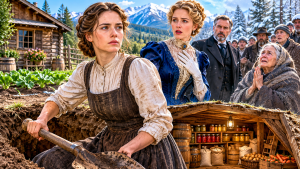
They laughed when she dug an enormous hole beneath her cabin.
They whispered when she bought potatoes by the hundredweight.
And when she told them she was preparing for a winter that might last seven months,
even the town preacher suggested she had lost her faith.
But six months later,
the wealthiest woman in the valley would come crawling through the snow to that very cabin,
trembling, starving, and begging for the food she had once mocked.
And what Astrid Calgren discovered that winter would
change the valley forever. But first, she had to survive the summer.
At thirty-two,
Astrid had already buried more dreams than most people carry in a lifetime.
Her husband, Lars, had died in a blizzard the previous February.
He had left their small cabin with a rifle over his shoulder,
promising to return before sundown.
“We’re almost out of food,” he had told her. “I’ll find something.
Don’t worry.” Astrid had grabbed his sleeve. “The sky looks wrong, Lars.
Please wait.” He smiled, kissed her forehead, and stepped into the snow.
Those were the last words he ever spoke to her. Three days later,
she found him frozen beneath a stand of pine trees, two miles from home.
His rifle was still in his hand. Three weeks after burying her husband,
Astrid lost the baby she had been carrying. Nobody knew about the baby.
Nobody knew how she had lain in bed for two days,
staring at the ceiling,
wondering whether there was any reason left to live.
On the third morning, she rose. She made herself a cup of weak tea,
pulled a scrap of paper across the table, and wrote a single number.
600\. Six hundred pounds of food. Enough, she calculated,
to keep one person alive through seven months of brutal winter,
provided every pound was chosen and preserved carefully.
She remembered her grandmother Sigrid’s stories about
the terrible Swedish famine of 1867. People had died waiting for spring.
Mothers had watched their children grow too weak to cry.
And the families who survived had learned one lesson.
Never trust the weather to be merciful.
Astrid folded the paper and whispered: “Never again.”
By May, she was digging.
The hole beneath her cabin floor grew deeper every day. Four feet.
Six feet. Eight feet. She reinforced its walls with timber,
lined sections with straw and sawdust,
and built a trapdoor that could be closed tightly against the freezing air.
Her hands blistered. Her shoulders burned.
Sometimes she worked so long that her fingers trembled
when she tried to hold a spoon at supper. But she never stopped.
Her neighbor, Ruth Hanson, watched her one afternoon from the fence.
“Astrid, you’ll kill yourself working this hard.”
Astrid drove her spade into the earth. “Working won’t kill me, Ruth.”
“Then what are you so afraid of?” Astrid looked toward the mountains.
“Another February.” Ruth had no answer.
Soon the entire valley was talking. At Walter Pruitt’s general store,
men joked that the widow intended to bury herself with her vegetables.
At church,
Reverend Albrecht preached about trusting Providence instead of hoarding earthly possessions.
Astrid heard every rumor. She answered none of them.
Her garden expanded until rows of potatoes, carrots, cabbage,
and turnips covered nearly every patch of workable soil.
She hunted deer, smoked venison, dried apples, preserved berries,
and traded for beans. Every evening, she counted.
Every morning, she worked. Then, one hot afternoon in June,
a fine carriage rolled up the dusty track toward her cabin.
Inside sat Dorothea Winslow. Dorothea was the wife of Reginald Winslow,
one of Montana’s wealthiest cattle ranchers.
Her family owned tens of thousands of cattle and more
land than Astrid could imagine.
She stepped from the carriage wearing polished shoes and
a beautiful dress brought from Boston.
She stared into Astrid’s excavation. “My goodness.
What are you doing down there?” “Building a root cellar.”
“Under your house?” “Yes.” “Whatever for?” “Winter.”
Dorothea glanced at the enormous garden. “I’ve heard the stories.
You’re really planning to store six hundred pounds of food?”
Astrid nodded. Dorothea gave a little laugh.
“My dear woman, this is Montana.
We have railroads, merchants, and cattle everywhere.
Nobody is going to starve.” Astrid slowly climbed from the pit.
“My husband froze to death because we ran out of food.”
Dorothea’s smile weakened. “I’m sorry,
but surely you don’t believe another winter like that will come so soon?”
“I don’t know what will come.” “Then why go to such extremes?”
Astrid brushed the dirt from her hands.
“Because I don’t intend to find out I’m wrong when it’s too late.”
Dorothea shook her head.
“You’re allowing grief to make decisions for you.”
Astrid looked directly at her.
“And you’re allowing comfort to make yours.” Dorothea’s cheeks reddened.
She returned to her carriage without another word. That evening,
she told her husband about the widow’s ridiculous underground pantry.
Reginald listened carefully. Then he set down his glass.
“Perhaps we should purchase extra flour and dried goods.”
Dorothea stared at him. “Surely you don’t believe her?”
Reginald looked toward the darkening mountains.
“I believe a woman who has already survived one terrible
winter may know something we don’t.” He instructed his ranch manager,
Greer, to purchase two months of emergency provisions before autumn.
But Greer believed the money would be better invested in more cattle.
He purchased livestock instead. He never told Reginald.
And that single decision would eventually destroy the Winslow fortune.
Meanwhile, Astrid continued working. In September,
her eighty-three-year-old grandmother Sigrid visited from near Helena.
When Astrid lifted the trapdoor and showed her the underground stores,
the old woman became silent. Then she knelt beside the opening.
“Eight feet deep?” “Yes, Grandmother.” “Insulated walls?”
“Straw, sawdust, and timber.” “Enough for seven months?”
“That’s the plan.” Sigrid reached for Astrid’s hand.
For the first time since Lars died,
someone understood without needing an explanation.
“I remember the winter of 1867,” Sigrid whispered.
“People said it would end in March. Then April came. Then May.”
Her eyes filled with tears.
“I watched my mother and two sisters die because we
believed spring would save us.” Astrid squeezed her grandmother’s hand.
Sigrid looked toward the open cellar.
“Don’t let anyone persuade you to stop.”
By October 31, Astrid had exceeded her goal.
Inside the hidden cellar lay 640 pounds of carefully stored food.
Potatoes and carrots. Dried beans and smoked meat.
Pickled cabbage, preserved fruit, and dried apples.
Enough to endure the winter she feared.
On November 9, the first snow fell.
Within days, the valley disappeared beneath white fields and frozen roads.
By December, temperatures plunged far below zero.
Cattle began dying in the open. Supply wagons stopped coming.
The railroad could not deliver what desperate families needed.
And the people who had laughed at Astrid began looking
nervously toward their empty pantries.
On Christmas Eve, Astrid heard sharp explosions from the forest.
Trees were splitting open in the terrible cold.
She sat beside her fire, listening. Then she opened her ledger.
Her food stores were holding. She was safe. Or so she believed.
In late January, a desperate knock sounded at her door.
Standing outside was Jacob Miller,
accompanied by his wife and hungry children.
“We have nothing left,” he whispered. “Please, Mrs. Calgren.
The children haven’t eaten properly in days.”
Astrid looked at their hollow faces. Then she looked at the trapdoor.
Every pound she gave away would shorten her own survival.
She had prepared for one person. Not an entire valley.
But she remembered the night Lars had walked into the
snow because their shelves were empty. She lifted the trapdoor.
And she began sharing. First came the Millers. Then the Petersons.
Then the Hendersons.
Soon eleven families depended on what lay beneath her floor.
By early February,
Astrid’s carefully calculated reserves were disappearing faster than she could replace them.
She sat at her table one night, staring at two terrible possibilities.
If she stopped helping, she might survive until spring.
If she continued, she might starve alongside everyone else.
At sunrise, another knock came. Astrid opened the door.
There stood Dorothea Winslow. No expensive hat. No elegant carriage.
Only torn gloves, a frost-covered scarf,
and tears running down her pale cheeks.
The woman who had mocked Astrid now struggled to remain standing.
“My children are hungry,” Dorothea whispered. Astrid stepped aside.
But before she could offer food, Dorothea caught her arm.
“There’s something you need to know about Reginald,” she said, trembling.
“And about what happened to the supplies he ordered after meeting you.”
Then Dorothea revealed a secret that made Astrid realize
the winter was about to become far more dangerous than she had imagined.
PART 2 — THE SECRET BEHIND THE FROZEN RANCH Then
Dorothea revealed a secret that made Astrid realize the
winter was about to become far more dangerous than she had imagined.
“Reginald listened to you,” Dorothea whispered.
“After I returned from your cabin last June,
he ordered our manager to purchase emergency provisions.”
Astrid frowned. “Then why are your children starving?”
Dorothea’s lips trembled. “Because Greer never bought them.”
She explained how the ranch manager had secretly redirected the money into more cattle,
believing another profitable season mattered more than a few sacks of flour.
By the time Reginald discovered the deception, the roads were buried,
the supply wagons had stopped, and thousands of his cattle were dying.
“He trusted the wrong man,” Dorothea said.
“And now he blames himself for everything.”
Astrid looked toward the wooden trapdoor.
“How much food do you have left?” “Perhaps two weeks.”
“And your children?” “Three. Vera is the youngest. She’s only six.”
Astrid’s expression changed.
She remembered a child she had never been able to hold.
Without another word, she lifted the trapdoor and descended into the darkness.
When she returned, she carried potatoes, smoked venison,
and a precious jar of preserved pears. Dorothea stared at the food.
“After what I said to you?” “Your children never laughed at me.”
Dorothea covered her mouth.
For a moment, the only sound was the wind rattling the shutters.
Then she began to cry. Astrid helped her pack the provisions.
“Come back in two weeks.”
“But you can’t possibly have enough for everyone.”
Astrid did not answer.
When Dorothea rode away, Astrid opened her ledger. 322 pounds remained.
Less than half the food she had buried beneath her cabin.
And winter had no intention of ending. February became March.
The cold persisted. More desperate families arrived.
One evening, Dorothea returned looking older than Astrid remembered.
She sat beside the fire, gripping a folded letter.
“Reginald is dead,” she said. Astrid went still.
Dorothea explained that her husband,
overwhelmed by the collapse of his ranch and the guilt he carried,
had died by suicide on March 4.
“He knew we should have prepared,” she whispered.
“He told me in this letter.” Astrid sat beside her.
For a long time, neither woman spoke.
Then Astrid gently covered Dorothea’s shaking hand with her own.
“You still have your children.” Dorothea nodded through her tears.
“And they still have you.” But when Dorothea finally left,
Astrid descended into the cellar and discovered a terrifying truth.
Her remaining food would not sustain eleven families until May.
By April, Astrid was eating only one small meal a day.
Her clothes hung loosely from her shoulders.
She grew dizzy carrying water.
Then a four-day snowstorm struck, burying the valley once again.
When it ended, she counted her provisions. Only 97 pounds remained.
That evening, someone knocked on her door.
It was Clara Henderson, holding her youngest child beneath a blanket.
The boy’s lips were pale. His eyes barely opened.
“He won’t eat,” Clara sobbed. “Astrid, please.
I think we’re losing him.” Astrid rushed toward the trapdoor.
But when she lifted it,
her hands began trembling so violently she could scarcely grip the ladder.
She looked at the child. Then at the darkness below.
And she realized that saving him might mean giving away
the last food she needed to survive.
What Astrid did next would become the most unforgettable
act of the entire winter.
PART 3 — THE LAST 97 POUNDS:
WHAT THE WIDOW DID WHEN THE WHOLE VALLEY WAS STARVING The little boy was barely breathing.
Astrid Calgren stood in the doorway of her Montana cabin,
staring at the child wrapped in Clara Henderson’s trembling arms.
Outside, the wind dragged loose snow across the frozen ground.
Inside, the fire crackled softly. But Astrid heard neither.
All she could see was the little boy’s face. His name was Samuel.
He was not yet two years old. Only a month earlier,
he had toddled across her cabin floor, grabbed the hem of her apron,
and looked up at her with enormous dark eyes.
He had laughed when she lifted him.
Now those same eyes were half-closed. His cheeks were hollow.
His tiny hands were cold.
“He hasn’t eaten properly for days,” Clara whispered.
“He takes a little water, but he’s so weak.
Jacob’s trying to find more food, and I didn’t know where else to go.”
Her voice broke. “Astrid, please. I can’t lose him.”
Astrid felt something inside her chest twist.
For a moment, she was no longer standing in her cabin in April 1887.
She was back in the winter before.
Back in the little bedroom where she had lain alone
after losing the baby she and Lars would never meet.
She remembered the terrible silence. The unbearable emptiness.
The way she had pressed both hands against her stomach
and whispered an apology to a child who would never hear
it. She had survived that grief. But she had never forgotten its weight.
Now another mother stood before her, holding a child who was slipping away.
Astrid reached out. “Give him to me.” Clara hesitated. “Please.”
Astrid took Samuel carefully into her arms and carried him toward the fire.
He felt terribly light. Too light.
She settled him in her chair, wrapping another blanket around him.
Then she turned to his mother. “Has he been ill?” “Some coughing.
Mostly weakness. He sleeps all the time.” “Has he had water?”
“A little.” Astrid nodded. “We’ll warm him slowly.
And we’ll try to get something into him.” Clara sank onto a stool.
Her face crumpled. “I don’t know what to do anymore.”
Astrid placed a hand on her shoulder. “You brought him here.
That was something.” Then she crossed the room.
She knelt beside the trapdoor. And lifted it.
Cold, earthy air rose from the darkness.
The underground cellar that had once held 640 pounds of
provisions now contained only 97. She knew the number exactly.
She had counted the remaining stores that morning.
She had also counted the days.
There were still weeks before the valley could reasonably expect spring.
Perhaps longer. Grandmother Sigrid had warned her.
Sometimes winter lasted until May.
Sometimes the land remained frozen long after the
calendar insisted that spring had arrived.
Astrid had prepared for seven months.
But she had not prepared to feed eleven families.
And she had certainly not prepared to watch a child die in her living room.
She lowered herself down the ladder.
The cellar smelled of cold earth, old wood, potatoes, and smoked meat.
Her lantern illuminated shelves that had once been packed with food.
Now there were empty spaces everywhere.
Where heavy sacks of beans had stood, only two small bags remained.
Where preserved fruit had filled the shelves, there were a few precious jars.
The smoked venison had dwindled to several wrapped portions.
Astrid stood in the silence.
Her mind began doing its familiar arithmetic.
How much would Samuel need? How much could Clara carry?
How much remained for the Millers? For the Petersons?
For Dorothea and her children? And how much would be left for herself?
The answer was becoming frighteningly simple. Not enough.
For the first time in months, Astrid whispered aloud.
“Lars, what am I supposed to do?” There was no answer.
Only the stillness of the underground room. She closed her eyes.
She remembered her husband’s final morning. The rifle. The snow.
His smile when he promised to return.
He had gone hunting because they had run out of food. And now,
after all her planning, after months of labor and sacrifice,
she was once again standing at the edge of hunger.
She could preserve what remained. She could close her door.
She could survive. But upstairs, a little boy was waiting.
Astrid opened her eyes. She reached for the beans. Then the dried meat.
Then one of the remaining jars of preserved pears.
She stopped herself before taking too much at once.
The child needed careful feeding, not a feast. But he needed something.
And she was going to give him every chance she could.
When Astrid climbed back into the cabin,
Clara was sitting beside the fire, holding Samuel’s little hand.
Astrid placed the food on the table. “We’ll start with broth.”
She heated water, added a small portion of meat,
and simmered it until the liquid took on a rich smell.
Then she mashed a few beans until they were soft.
She checked Samuel again. His breathing was shallow but steady.
“Can you sit him up a little?” she asked Clara.
Together, they supported him. Astrid offered a spoonful of warm broth.
Most of it spilled down his chin. Clara looked terrified.
“Try again,” Astrid said gently. They waited. Another spoonful.
This time, Samuel swallowed. Clara stared. “He swallowed.”
Astrid nodded. “Yes.” A third spoonful.
Then a fourth, after a little rest. Samuel’s eyelids fluttered.
He made a faint sound of protest.
It was the first sign of energy he had shown all morning.
Clara began crying again. But this time, her tears were different.
Astrid did not tell her that everything would be fine.
She knew better than to promise what she could not control.
Instead, she pulled another chair close to the fire.
“You’ll stay here tonight.” “But Jacob—” “Jacob will worry.
And then he’ll come looking. We’ll tell him where you are.”
Clara glanced at the food on the table.
“Astrid, you’re giving us too much.” Astrid looked at Samuel.
“No.” She sat down slowly. “Not today.”
That night, Clara and Samuel slept near the stove.
Astrid remained awake long after the fire had burned low.
She listened to the little boy breathe. Every sound mattered.
Every pause frightened her.
And in the silence between his breaths, she remembered the baby she had lost.
She had never known whether her child would have had
Lars’s blue eyes or her own. Whether the baby would have laughed easily.
Whether there would have been a little hand reaching for her apron one day.
She had spent more than a year refusing to imagine such things.
she allowed herself to grieve
she allowed herself to grieve. The tears came quietly.
They were not dramatic. They did not shake the room. They simply fell.
For Lars. For their unborn child.
For the life she had believed was gone forever.
And for the little boy who still had a chance.
By morning, Samuel was awake. He was weak.
He was still frighteningly thin.
But when Astrid offered him a little broth, he accepted it.
Then he reached toward her apron. Just as he had done weeks earlier.
Astrid stared at his small hand.
Something warm and painful moved through her chest.
“Well, little man,” she whispered, “I suppose we’re not finished yet.”
Clara watched from across the room. “How can I ever repay you?”
Astrid shook her head. “Go home when he’s strong enough.
Feed him carefully.
And when summer comes, plant twice as much as you think you’ll need.”
Clara wiped her eyes. “I will.” “Promise me.” “I promise.”
When Jacob Henderson arrived later that day,
exhausted and frightened after searching for his wife and child,
he found Samuel sitting against his mother’s shoulder.
The boy was awake. Jacob dropped to his knees beside them.
For a long moment, he could not speak. Then he looked up at Astrid.
“I heard people call you mad.” Astrid said nothing. “I believed them.”
He looked at the food on the table.
“And now my son is alive because you wouldn’t listen.”
Astrid helped him stand.
“He’s alive because his mother refused to give up on him.”
Jacob swallowed hard. “You’re a good woman, Mrs. Calgren.”
Astrid looked toward the trapdoor. “I hope so.”
She was not certain goodness could be measured.
But she knew what hunger looked like.
And she knew she could not ignore it.
### THE WINTER THAT REFUSED TO DIE The Hendersons returned home.
Samuel gradually grew stronger. But the winter did not soften.
April stretched on with endless gray skies.
Snow fell on fields already buried beneath several feet of ice.
The roads remained dangerous. The forests stood silent. Every morning,
Astrid looked toward the mountains, searching for signs of change.
Every morning, the mountains looked back without offering an answer.
Her food stores continued shrinking. The Miller family returned.
Then the Petersons. Then the Gundersons,
whose name Astrid had finally learned after months of helping them.
Each family came with the same carefully controlled expression.
The same shame. The same fear.
They tried to ask for less than they needed.
Astrid learned to recognize it.
A mother would say her children were managing when their faces said otherwise.
A father would claim he had eaten before leaving home.
An old man would insist he only needed a little flour.
Astrid knew hunger made people lie. Not because they were dishonest.
Because they were trying to leave enough for someone else.
She began asking different questions. “How many children?”
“How much grain remains?” “Has anyone been ill?”
“How many days since you last had meat?”
She measured what she could spare. She divided it carefully.
And sometimes, when the arithmetic became impossible,
she gave a little more anyway.
By the middle of April, she was eating only one small meal each day.
Her dresses hung loosely. Her hands looked older.
The skin around her eyes had tightened.
Sometimes, when she stood too quickly, darkness swam across her vision.
She learned to pause before rising.
She learned to sit when her legs trembled.
And she learned how frighteningly loud hunger could
become when a person was trying not to hear it.
One evening, she opened her ledger and stared at the remaining numbers.
She thought about what she had done.
She had worked through an entire summer.
She had built a cellar with her own hands.
She had stored more than her original goal.
And now nearly all of it was gone.
She could hear Dorothea’s voice from the previous June.
You’re burying yourself alive under your own floor.
Astrid almost laughed. The woman who had mocked her was now feeding her
children with Astrid’s potatoes.
The valley’s wealthiest families had lost nearly everything.
And a poor widow’s hidden food cellar had become the
difference between survival and disaster.
Yet it was Astrid who sat alone at night wondering
whether she would live long enough to see green grass again.
The irony was almost cruel.
Then she remembered something Grandmother Sigrid had said.
“Food stored only for pride is as useless as food never stored at all.”
Astrid had not fully understood those words as a girl. Now she did.
The food had served its purpose. But she still wanted to live.
She wanted another summer. Another garden.
Another morning when the sun warmed the porch.
She wanted to stand at Lars’s grave and tell him she had made it.
And some small part of her, a part she had almost forgotten,
wanted to believe that happiness might still be possible.
She closed her ledger. “Just a little longer,” she whispered.
Whether she was speaking to the winter or to herself, she did not know.
THE WOMAN WHO HAD ONCE LAUGHED Dorothea Winslow
arrived again on the third Tuesday of April.
Astrid recognized the horse before she recognized the rider.
The once-elegant rancher’s wife dismounted stiffly.
Her coat was patched. Her boots were muddy. Her face was thin and tired.
But there was something different about her now.
She no longer stood waiting to be invited into a servant’s care.
She tied her own horse. She carried her own bags.
And when Astrid opened the door,
Dorothea immediately noticed how pale she looked. “You’re ill.”
“No.” “Then you’re starving.” Astrid stepped aside.
“Come in before you freeze.”
Dorothea entered but did not remove her gloves.
Her eyes moved toward the trapdoor. “How much is left?”
“Enough for today.” “That isn’t what I asked.” Astrid said nothing.
Dorothea approached the table. For a moment,
she looked like the woman she had been in June—proud, determined,
unwilling to accept an answer she disliked.
Then her expression softened. “Astrid, please.”
Astrid lowered herself into a chair. “Not much.” “How little?”
“Enough that I count every potato twice.” Dorothea closed her eyes.
“Oh, God.” Astrid almost smiled.
“He hasn’t provided a new shipment yet.”
Dorothea gave a short, broken laugh.
Then she began removing the gloves from her hands. “I can help.”
“With what?” “Whatever needs doing.”
Astrid looked toward the stack of firewood by the stove.
“The wood needs sorting.” Dorothea nodded immediately.
She spent the next hour carrying logs, sweeping the floor,
and helping bundle food for her children.
The work was unfamiliar to her. Her hands were clumsy.
She dropped one of the bundles.
And once, when she tried to lift a heavy bucket, she nearly lost her balance.
Astrid watched without comment. Finally Dorothea stopped.
“I used to think you were beneath me.” Astrid continued tying a knot.
“I know.” “Not because you were Swedish. Not entirely.
Because you worked with your hands and lived in this
little cabin while I had servants and fine dresses.” Astrid looked up.
Dorothea swallowed. “I thought money made people safe.”
The wind pressed against the windows. “And now?”
Dorothea glanced around the cabin.
“Now I think safety is something you build before you need it.”
Astrid returned to the bundle. “That’s a good start.”
Dorothea stood silently for a moment.
Then she said, “My daughter Vera wants to meet you.”
Astrid’s hands paused. “Why?” “She wants to thank you.” “She’s six.”
“She’s old enough to know where her food came from.” Astrid looked away.
She had not expected that answer. Dorothea continued.
“She asked me last week if you’re a witch.” Astrid raised an eyebrow.
“A witch?” Dorothea smiled faintly.
“She said nobody could possibly have potatoes when
everyone else had none unless they knew magic.”
“And what did you tell her?” “I told her you’re a farmer.”
Astrid laughed. It was a small laugh. Barely more than a breath.
But Dorothea stared at her as though she had heard a
sound she never expected to hear. Astrid had laughed.
For one brief moment, the winter loosened its grip.
When Dorothea finally prepared to leave,
Astrid handed her twenty pounds of provisions.
Less than the previous visit.
Dorothea accepted the bundle without complaint.
Then she asked quietly, “What do you want from me when this is over?”
Astrid looked puzzled. “What do you mean?”
“I owe you more than money could ever repay.
You fed my children after I humiliated you.
You kept helping us when you barely had enough for yourself.”
She took a breath. “Tell me what I can do.” Astrid thought for a moment.
Then she pointed toward the floor. “Build a cellar.” Dorothea blinked.
“What?” “A proper one. Deep enough. Dry enough.
Store what your family needs before winter begins.”
Dorothea stared at her. “That’s all?” “No.” Astrid stepped closer.
“When your cellar is full, remember the families whose cellars aren’t.”
Dorothea’s eyes filled.
“Astrid—” “Don’t thank me with speeches, Dorothea.
Thank me by making sure fewer people need to knock on a
stranger’s door next February.” Dorothea nodded. Slowly.
Seriously. “I promise.”
As she mounted her horse, Astrid stood on the porch watching.
The wealthy woman who had once arrived in a fine Boston
dress now rode away with muddy boots and potatoes
strapped behind her saddle. And she carried something else.
A lesson she would never forget.
### SIXTY-THREE POUNDS After Dorothea disappeared around the bend,
Astrid returned inside.
She lifted the trapdoor and climbed into the cellar.
She checked the remaining stores carefully.
Then she climbed back up and opened her ledger. 63 pounds.
She wrote the number. Underlined it. And stared at the page.
In October, she had counted 640 pounds.
She could still remember the satisfaction of writing that total.
The feeling of security.
The certainty that no matter how terrible the winter became,
she would have enough. Now she had 63. She sat for a long time.
The fire snapped. A cold draft crept beneath the door.
Somewhere outside, a branch broke beneath the weight of snow.
Astrid imagined the calendar moving forward. April 20. April 25.
May 1. May 10. What if the snow remained?
What if the roads stayed closed?
What if the ground could not be planted until June?
She worked through the possibilities. None of them gave her comfort.
At last, she folded her hands. “I’m frightened, Lars,” she whispered.
It was the first time she had admitted it aloud.
She had been brave for so long that fear almost felt like betrayal.
But she was frightened. Not of dying alone.
She had already come close to that.
She was frightened of having survived so much only to
lose the future she had begun to imagine.
She thought of Samuel Henderson. Of Vera Winslow.
Of the Miller children. They had futures now.
She had helped protect them. But she wanted a future too.
She wanted to live long enough to see the consequences of her kindness.
To watch children grow. To hear neighbors laughing in the fields again.
To plant something and see it rise from the soil.
Astrid lowered her head onto her folded arms.
For a few minutes, she allowed herself to cry. Then she wiped her face.
She stood. And she put another log on the fire.
There was still work to do.
### THE SOUND THAT CHANGED EVERYTHING On the morning of May 3, 1887,
Astrid woke to a sound she had almost forgotten. Water.
At first, she thought she was dreaming.
There was a soft, continuous trickling somewhere beyond the cabin walls.
Not the wind. Not the cracking of frozen timber.
Not snow sliding from the roof. Water. Moving water. She sat up.
Her heart began beating faster.
She pulled on her boots, wrapped herself in a shawl, and hurried to the door.
When she opened it, the world looked different.
Snow still covered the valley. The fields were still white.
The roads remained buried.
But sunlight touched the eastern mountains with a pale golden glow.
And beneath the eaves, drops of water were falling. One after another.
Astrid stepped onto the porch. She looked toward the southern slope.
There, where the sunlight reached the earth first,
the snow had begun to soften.
A narrow thread of water slipped along the edge of the field.
She stood perfectly still. Then she knelt.
She pressed her fingers into the wet surface. It gave way.
Not much. But enough.
For months, the world had been hard and frozen and unyielding.
Now it was changing. Astrid looked toward the mountains.
Then toward the sky. “You’re finally leaving,” she whispered.
A bird called from the cottonwoods. Astrid lifted her head.
Another call answered.
The sound was so ordinary that it nearly broke her heart.
She began laughing. Then crying. Then laughing again.
She stood on the porch with tears running down her face
while water dripped from the roof behind her.
The winter had lasted nearly seven months.
Just as Grandmother Sigrid had warned. Just as Astrid had feared.
But the snow was melting. And she was alive. She went inside.
Opened her ledger. And wrote one final winter count.
41 pounds remaining. She looked at the number for a long time.
From 640 pounds to 41.
Almost six hundred pounds had been consumed or shared through the long winter,
most of it feeding the eleven families who had come to depend on her.
She thought about every bundle she had carried to the door.
Every jar she had placed into a mother’s hands.
Every frightened child who had sat beside her fire.
Every time she had looked at the remaining provisions
and wondered whether she was making a terrible mistake.
Now the answer sat before her. Forty-one pounds. And spring had begun.
Astrid closed the ledger. She pressed her hand against its worn cover.
Then she whispered: “We made it, Lars.”
### WHEN THE VALLEY SAW WHAT WINTER HAD DONE Spring did
not arrive all at once. The snow melted slowly.
The roads turned into rivers of mud.
Wagons became stuck in places where horses had traveled
easily the previous summer.
Broken fences appeared beneath the retreating drifts.
And across the valley, the evidence of winter’s destruction emerged.
Dead cattle lay in the fields. Barn roofs had collapsed.
Ranches that had once seemed prosperous stood silent.
The Winslow operation had been devastated. Across Montana,
the terrible winter would become remembered as the Great Die-Up,
a catastrophe that changed the future of cattle ranching in the American West.
Men who had owned enormous herds had lost almost everything.
Fortunes had vanished. Families had abandoned their farms.
The valley that had laughed at Astrid Calgren now
understood how quickly abundance could become desperation.
But Astrid had little time to think about being right.
The soil was waiting. And she needed to plant.
On May 20, she walked into her garden with a basket of seed potatoes.
The earth was still cold.
Her muscles were weak from months of insufficient food.
She could no longer work as quickly as she had the previous summer.
But she could work. She knelt beside the first row.
Pressed a seed potato into the soil. Covered it carefully.
Then moved to the next.
After a while, she stopped and looked across the field.
The same field where she had spent the previous summer
working beneath the judgment of her neighbors.
The same ground where Ruth Hanson had told her she would kill herself digging.
The same land Dorothea Winslow had looked upon with amusement.
Astrid smiled faintly. “Well,” she whispered, “we’re doing it again.”
Only this time, something had changed.
She was no longer trying to prove anything. She had already survived.
And she knew what survival had cost.
### A VISITOR WITH A DIFFERENT KIND OF GOODBYE Dorothea
Winslow came to see her in the final week of May. She arrived on foot.
Four miles through the muddy valley. There was no carriage.
No driver. No expensive dress.
Only a woman wearing sensible boots and a plain coat, carrying a small bag.
Astrid saw her approaching from the garden. “You’re walking now?”
Dorothea smiled. “I’ve discovered it’s possible.” Astrid laughed softly.
“Come inside.” They sat at the wooden table where so many frightened
conversations had taken place during the winter. Astrid poured coffee.
Real coffee, purchased after the roads began opening.
Dorothea held the cup between her hands.
For a while, she seemed content simply to enjoy its warmth.
Then she spoke. “I’m leaving Montana.” Astrid looked at her.
“Where will you go?” “Boston. My family is there.
I have enough from what remains of the property to get the children settled.”
She looked down. “I can’t stay here, Astrid.” Astrid waited.
“Everything reminds me of Reginald. The fields. The house.
The animals.
Every morning I look toward the ranch and remember what we thought we owned.”
Her voice trembled.
“I used to believe money could protect us from anything.”
She looked toward the window. “Now I know better.” Astrid nodded.
“Will the children be safe in Boston?” “Yes. I believe so.”
“Then go.” Dorothea looked surprised.
“You don’t think I’m running away?” “No.”
Astrid leaned back in her chair.
“Some people belong where they can begin again.
There’s no shame in choosing a place where your children can grow.”
Dorothea stared at her. “You make everything sound simple.”
“It isn’t simple.” Astrid looked toward the garden.
“But sometimes the right thing is still clear.”
Dorothea was quiet for a long moment. Then she reached into her bag.
She removed a small handkerchief. Inside was a silver brooch.
It was beautifully made,
with a delicate leaf pattern surrounding a pale blue stone.
“My mother gave me this before I left Boston,” she said.
“It’s one of the few valuable things I still have.”
She pushed it toward Astrid. “I want you to keep it.”
Astrid shook her head. “No.” “Please.” “You need what you have left.”
Dorothea’s eyes filled. “It’s not payment.” “Then what is it?”
“A reminder.” Astrid looked at the brooch. “Of what?”
Dorothea smiled through her tears.
“That a woman can be completely wrong about another
person and still be given the chance to become better.”
Astrid picked up the brooch. It caught the sunlight from the window.
For the first time, she understood that Dorothea was not offering wealth.
She was offering a piece of the person she had once been.
A person she was finally willing to leave behind.
Astrid closed her hand around it. “Thank you.” Dorothea stood.
Then, unexpectedly, she embraced her. Astrid stiffened for an instant.
She had not been held like that since Lars died.
Then she returned the embrace.
privilege and poverty held each other in the littl…
privilege and poverty held each other in the little
cabin that had saved them both.
When Dorothea finally stepped away, her eyes were wet.
“I’ll tell my children about you.” Astrid shook her head.
“Tell them about the cellar.”
“I’ll tell them about the woman who built it.”
“Tell them to build their own.” Dorothea laughed. “I will.”
At the doorway, she stopped. “One more thing, Astrid.” “Yes?”
“I told everyone you were crazy.” Astrid raised an eyebrow.
“I remember.” Dorothea looked directly at her. “You weren’t.”
Then she turned and walked down the muddy road.
Astrid watched until she disappeared behind the cottonwoods.
She never saw Dorothea Winslow in Montana again.
But she would remember her for the rest of her life.
### THE ONE PERSON WHO HAD BELIEVED HER In July,
a letter arrived from near Helena.
Astrid recognized the handwriting of Grandmother Sigrid’s son.
She opened it at the kitchen table. The letter was short.
Sigrid had died peacefully in her sleep. She was eighty-four years old.
Astrid read the words twice. Then she folded the paper.
For a long time, she sat without moving.
She remembered the old woman’s visit the previous September.
The careful way she had descended the porch steps. The weathered hands.
The nearly blind eyes.
The way she had knelt beside the open cellar and immediately understood.
Everyone else had seen madness. Sigrid had seen wisdom.
Everyone else had questioned Astrid’s grief.
Sigrid had recognized the knowledge behind her determination.
And that recognition had given Astrid strength when she needed it most.
She walked to the trapdoor and opened it. The cellar was filling again.
New potatoes. Freshly dried apples. Sacks of beans.
Provisions gathered one careful pound at a time.
Astrid lowered herself down the ladder.
She stood where her grandmother had once stood.
Then she whispered: “You were right.”
Her voice echoed faintly against the timber walls. “Seven months.”
She looked at the shelves. “And we survived.”
For the first time since receiving the letter, she allowed herself to cry.
Not because Sigrid’s death had taken away her strength.
But because she finally understood how much strength the
old woman had given her. ### THE PEOPLE WHO NEVER FORGOT That summer,
something remarkable happened throughout the Gallatin Valley.
People began digging. Not graves. Not foundations for grand houses.
Cellars. Deep, carefully insulated food-storage cellars.
Jacob Miller spent two weeks building one beneath his barn.
He used timber, straw, and sawdust, following the method Astrid had described.
When his wife asked why he was making it so large, he answered:
“Because I remember February.”
The Peterson family preserved more vegetables than ever before.
Clara Peterson visited Astrid to learn how to smoke meat properly.
The Gundersons began storing enough dried beans and
flour to last beyond the usual winter.
Even Ruth Hanson expanded her pantry.
One afternoon, Ruth walked across the field carrying a basket of fresh bread.
She found Astrid repairing a fence. “I brought you something.”
Astrid looked at the basket. “What’s the occasion?”
Ruth shifted awkwardly.
“I thought you might like bread you didn’t have to bake yourself.”
Astrid smiled. “That’s kind of you.” Ruth stood watching her.
Then she said, “I owe you an apology.” Astrid continued working.
“For what?” “For telling you that you were working too hard.”
“I was working too hard.” Ruth shook her head. “No.
You were working for something the rest of us couldn’t see.”
Astrid stopped. Ruth looked toward the cabin.
“When you started digging, I thought grief had made you afraid of everything.”
“And now?” Ruth swallowed.
“Now I think grief taught you something the rest of us
were too comfortable to learn.” Astrid was quiet.
Then she reached for the bread. “Come inside. I’ll make coffee.”
Ruth smiled. The two women walked back toward the cabin together.
They had been neighbors for years.
But that afternoon, something between them became a friendship.
Across the valley, the change continued.
Parents taught their children how to preserve food.
Farmers discussed storage instead of laughing at it.
Families measured their winter provisions in months rather than weeks.
And whenever someone complained that preparing for a disaster seemed unnecessary,
somebody else would remind them: “Remember the widow.”
Astrid had never intended to become a teacher.
She had simply wanted to survive.
But by opening her cellar when the valley was desperate,
she had taught a lesson no sermon or argument could have delivered.
Preparation was not foolish.
And generosity did not become less important when survival was difficult.
It became more important. ### THE QUIET MAN WHO UNDERSTOOD In June 1887,
a stranger arrived at Astrid’s farm. He was a tall,
broad-shouldered man with weathered hands and a calm expression.
Two young boys waited beside his wagon. The man removed his hat.
“Mrs. Calgren?” “Yes?” “My name is Gunnar Calgren.”
Astrid looked at him with mild surprise. “Calgren?” He smiled faintly.
“A common enough name where I come from.”
He explained that he was a Swedish-American farmer from
the northern end of the valley. He had heard about Astrid’s cellar.
He had also heard she was rebuilding her food stores.
“I have potatoes to trade,” he said.
“Three hundred pounds from my last harvest.” Astrid raised an eyebrow.
“That many?” “They kept well.” “What do you need?”
“Smoked venison, if you have any.” Astrid nodded. “I do.”
They discussed quantities. Weights. Preservation. Storage conditions.
Gunnar did not ask why she had buried food beneath her floor.
He did not praise her survival. He did not mention the rumors.
He simply examined the food, asked practical questions,
and agreed to a fair trade. Astrid found herself studying him.
Most men who visited her farm talked too much.
Gunnar seemed comfortable with silence.
When the exchange was finished, Astrid glanced toward the wagon.
“Your sons?” “Erik and Nils. Nine and seven.” “Where’s their mother?”
Gunnar’s expression changed. “She died three years ago. A fever.”
Astrid lowered her eyes. “I’m sorry.” He nodded.
“I heard about your husband.” They stood quietly for a moment.
There was no need to explain the terrible distance
between a life before loss and a life after it. Both understood.
Gunnar put on his hat. “Thank you for the trade, Mrs. Calgren.”
“Thank you.” He turned to leave. Then he looked toward the smokehouse.
“Your roof needs attention.” Astrid followed his gaze.
The winter snow had damaged part of the structure. “I know.”
“It’ll leak when the heavy rain comes.” “I know that too.”
Gunnar nodded.
Then, almost casually, he said: “I have some spare timber.”
Astrid looked at him. He did not smile. He did not offer sympathy.
He simply waited.
After a moment, Astrid answered: “Well, I suppose timber is useful.”
He returned in July. The timber was already cut.
He repaired the smokehouse roof in a single day.
Astrid offered him supper. He accepted. They ate potatoes,
beans,
and smoked meat at the same table where Astrid had once sat alone counting the food that might save her life.
They spoke about farming. About the winter.
About the best ways to store vegetables.
At one point Gunnar asked: “How deep is your cellar?” “Eight feet.”
He nodded approvingly. “Good depth.” Astrid almost laughed.
It was the first compliment she had received about the
cellar that did not sound like admiration for a miracle.
To Gunnar, it was simply good work. And somehow, that meant more.
He came back in August. Then September.
Each visit brought some practical reason. A tool to exchange.
A question about preserving meat. An offer to help repair a fence.
Astrid began noticing the sound of his wagon before it reached the cabin.
She began setting an extra cup on the table.
And sometimes, after he left, she caught herself smiling.
That frightened her more than she expected. She had loved Lars deeply.
She still did. She would always remember his laughter, his kindness,
and the way he had believed he could build a safe future through hard work alone.
But Gunnar was different. He knew what it meant to lose someone.
He knew that winter could be cruel.
And he never told Astrid she was worrying too much. One afternoon,
while they were stacking firewood, Gunnar said:
“Erik asked whether we’d visit again next Sunday.” Astrid looked at him.
“Did he?” “Yes.” “What did you say?”
“That it depended on whether you wanted us.”
Astrid placed another log on the stack. Then she smiled.
“I think Sunday would be fine.”
### THE QUESTION IN THE ROOT CELLAR By October,
Astrid’s provisions were growing again.
The underground cellar was nearly full. She had worked hard all summer,
but this time she had not worked entirely alone.
Gunnar and his sons had helped when they could.
The Millers had brought vegetables.
The Petersons had exchanged preserves.
Even neighbors who had never needed Astrid’s food during
the winter began trading with her. The valley was slowly rebuilding.
And so was Astrid. One Sunday afternoon in October,
Gunnar arrived to help her inspect the stored food.
They climbed into the cellar together.
The lantern illuminated rows of potatoes, jars, beans,
and carefully wrapped meat. Gunnar examined one of the timber supports.
“Still solid.” Astrid nodded. “I built it to last.” “I can see that.”
He looked around. Then he turned toward her. “Astrid.”
Something in his voice made her pause. “Yes?” “I’ve been thinking.”
She smiled faintly. “That sounds dangerous.” He laughed.
Then his expression became serious. “I know you loved Lars.”
Astrid looked down. “I did.” “And I loved my wife.” She nodded.
Gunnar took a breath.
“I don’t believe people stop loving those they’ve lost.” “No.”
“But I do believe they can find something good again.”
Astrid felt her heart beating harder. Gunnar continued.
“My boys care for you. And I…” He paused, searching for words.
“I would like to build a life with you.” Astrid stared at him.
For a moment,
she could hear nothing but the faint movement of air through the cellar.
Then Gunnar asked: “Would you consider marrying me?”
Astrid looked around the underground room.
The very place she had built during the loneliest summer of her life.
The place that had protected her from winter.
The place that had allowed her to save eleven families. And now,
standing among the food she had prepared for another season,
someone was offering her a future. Tears filled her eyes.
Gunnar stepped closer. “You don’t have to answer today.”
Astrid smiled through her tears. “Good.” He looked startled.
She laughed. “I need to think.” He nodded. “Then think.”
And he waited. For a week, Astrid considered the question carefully.
She thought about Lars. About the child she had lost.
About Gunnar’s two boys. About what it would mean to love again.
She walked through the garden. Sat at the table. Visited Lars’s grave.
There, she placed fresh flowers beside the stone.
“I haven’t forgotten you,” she whispered.
The wind moved gently through the grass. “I never will.”
She was silent for a long time.
Then she said something she had not expected.
“But I think I want to be happy again.”
A week after Gunnar’s proposal, Astrid gave him her answer. Yes.
Not because she had forgotten her past.
But because she had finally allowed herself to believe in a future.
They married in November 1889.
The ceremony took place at the Lutheran church in Meridian.
It was small. The Millers attended. The Petersons came.
The Hendersons were there with their children. Samuel Henderson,
now a lively little boy,
ran between the benches until his mother caught him.
Ruth Hanson wiped tears from her eyes.
Reverend Albrecht stood at the front of the church.
The same minister who had once preached about the danger
of storing too much earthly food.
He looked at Astrid with a solemn expression.
Then, before beginning the ceremony, he said something she never forgot.
“Faith does not excuse us from caring for our neighbors.
Sometimes faith asks us to prepare so that we have something to give.”
Astrid looked at him. Then smiled. He had learned something too.
When Gunnar took her hand, she felt neither guilt nor fear.
Only gratitude. She had survived one winter by herself.
Now she would build a life with someone who understood what survival meant.
### TWO THOUSAND POUNDS AND A NEW PROMISE Together,
Astrid and Gunnar expanded the farm. They purchased another forty acres.
They built a larger garden.
They improved the smokehouse and constructed another.
And beneath the enlarged farmhouse,
they created a new storage cellar with a capacity of approximately two thousand pounds.
Gunnar examined the finished structure. “That’s a lot of food.”
Astrid smiled. “Enough for our family.” “And more.” She looked at him.
“Yes.” He nodded. “Good.” There was no argument. No laughter.
No suggestion that she was imagining disasters that would never happen.
He understood exactly why she wanted more space.
They were not planning merely for themselves.
They were planning for the possibility that someday
another family might knock on the door.
Over the years, their household grew.
Erik and Nils gained younger siblings.
Astrid and Gunnar welcomed four children together, two boys and two girls.
The farmhouse became filled with noise. Laughter. Arguments.
Running footsteps. The ordinary chaos of family life.
Sometimes Astrid stood in the kitchen doorway and simply watched.
She had once believed she would never hear children’s
laughter beneath her roof.
Now there were days when she could scarcely hear herself think.
She loved those days. She taught every child how to store food.
How to dry apples. How to preserve vegetables.
How to inspect a root cellar. How to count what was needed for a winter.
And, most importantly, how to recognize when someone else was hungry.
One cold November evening, her youngest daughter asked: “Mama,
why do we keep so much food?” Astrid looked toward the pantry.
“Because winter can last longer than we expect.” “But we have plenty.”
“Today.” The child considered this. “Will we always have plenty?”
Astrid knelt beside her. “I hope so.” “Then why do we need all of it?”
Astrid smiled. “Because hoping and preparing are two different things.”
The little girl frowned.
Then she asked: “What if our neighbors don’t have any?”
Astrid looked at her daughter for a long moment.
Then she answered: “That’s why we store a little extra.”
### THE OLD CELLAR AND THE STORY THAT SURVIVED Decades passed.
The valley changed. Roads improved. Towns grew. New families arrived.
The terrible winter of 1886–1887 became something
younger people knew only through stories.
But the older generation never forgot. They remembered the dead cattle.
The frozen roads. The empty shelves. The children who had gone hungry.
And the Swedish widow who had hidden hundreds of pounds
of food beneath her cabin floor.
By 1923, the original cabin was old and worn.
The family decided to replace it with a larger farmhouse.
Workers arrived to dismantle the structure.
As they lifted the old floorboards, they discovered the trapdoor.
Below it lay the original cellar. Eight feet deep.
Lined with timber, straw, and sawdust. The wood had darkened with age.
The straw had settled. But the structure remained surprisingly sound.
One young worker leaned over the opening. “What’s this?”
An older man standing beside him removed his hat.
“That’s where she kept the food.” “What food?”
The older man looked into the darkness.
“The food that saved the valley.” He explained the story.
The widow. The digging. The laughter. The terrible winter.
The starving families.
The food that had been shared until almost nothing remained.
The young worker listened.
Then he asked: “Why didn’t she keep it all for herself?”
The older man was silent for a moment.
Then he answered: “Because she understood something most people don’t.”
“What’s that?” “Surviving alone isn’t always the same as living well.”
The young man looked back into the cellar.
For a long time, neither spoke. Eventually, the old pit was filled in.
A new farmhouse rose above it.
But the story did not disappear beneath the earth.
It remained in family conversations. In lessons taught to children.
In cellar doors built deeper and stronger.
In baskets of food carried to neighbors during difficult seasons.
And in the memories of those who had survived because
one woman refused to stop preparing.
Astrid had never set out to become famous.
She had never wanted revenge against those who mocked her.
She did not dream of being remembered as the wisest woman in Montana.
She had wanted something much simpler. To survive another winter.
To avoid the suffering that had taken her husband.
To keep hunger from taking everything she loved.
But the winter had asked more of her. And when it did,
she discovered that courage was not simply the ability to endure hardship.
Sometimes courage meant opening the door when fear told you to lock it.
Sometimes it meant sharing what you desperately needed yourself.
Sometimes it meant risking the future you had worked so
hard to protect because someone else’s child needed help
today. Astrid’s story was never really about six hundred pounds of food.
It was about the work nobody saw as necessary until disaster arrived.
It was about the people who laughed before they understood.
It was about the difference between owning a fortune and possessing wisdom.
And, above all,
it was about a woman who learned that even after losing nearly everything,
she still had something precious to give. The winter eventually ended.
The snow melted. The fields turned green.
Children who had once been too hungry to play ran laughing through the grass.
And the little cabin that had sheltered one grieving
widow became the birthplace of a lesson generations would remember.
Preparation kept Astrid alive. But compassion made her survival matter.
Years later,
whenever her children asked why she insisted on preparing for winter while the summer sun still warmed the earth,
Astrid always gave them the same answer.
“Because one day the snow will come,
and you won’t be able to change what you did in June.”
Then she would look toward the cellar.
“And if you’ve done your work well,
perhaps you’ll have enough to open your door when somebody knocks.”
❤️ THE END A question for everyone reading:
If you had only enough food to protect yourself through a dangerous winter,
would you share it with families who had once laughed at you?
Comment “KINDNESS” if you believe helping someone in
their darkest hour is one of the greatest things a person can do.
And if Astrid’s story moved you,
share it with someone who needs a reminder that being underestimated doesn’t mean being wrong—and that one person’s preparation and compassion can change many lives.
Disclaimer:
This story is entirely fictional and created for entertainment purposes only.
It does not represent any organization or individual,
nor does it encourage inappropriate behavior.
Content was created with the support of artificial intelligence.
Historical settings and events are used as elements of