PART 1 — THE DOOR THAT SHOULD NEVER HAVE BEEN FOUND
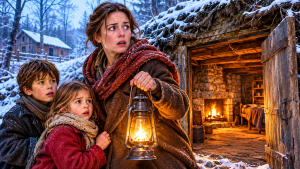
The first time Ruth heard someone knocking from inside the abandoned hillside,
she nearly dropped her lantern. There should have been nobody there.
The shelter had been forgotten for decades.
Its wooden door was buried beneath cedar roots, its hinges were rusted,
and its entrance was hidden behind thorn bushes so thick that even wild animals rarely passed through.
Yet Ruth heard it clearly. Three slow knocks. Then silence.
She stood in the gathering darkness,
gripping her dead husband’s axe with trembling fingers. “Who’s there?”
she whispered. No answer came.
Outside, a freezing Nebraska wind screamed across the prairie.
Inside the hill, something waited.
And Ruth had no idea that the place she had discovered while searching desperately for firewood would soon become the difference between life and death—not just for her children,
but for people who had laughed at her misery. Three weeks earlier,
Ruth had buried her husband beneath a cottonwood tree near Red Willow Creek.
Thomas had been only thirty-eight.
He had left their cabin before sunrise to repair a
damaged fence after heavy rain. By noon, his horse returned without him.
Ruth found Thomas beside the creek, where the muddy bank had collapsed.
She never forgot the sight of his hat lying several feet from his body.
Nor the terrible silence when she called his name. At thirty-two,
Ruth was suddenly a widow with two hungry children,
a poorly insulated cabin,
and winter approaching faster than she could prepare. Ben was nine.
He had his father’s serious brown eyes.
Lucy had just turned five and still believed that if she asked enough questions,
somebody would eventually make the world right again.
“Will Papa come home when the snow melts?” Lucy asked one evening.
Ruth could barely answer. “No, sweetheart.”
“Then who will keep our fire burning?” Ruth looked toward the stove.
That was the question haunting her every night.
Their cabin had been built quickly,
with gaps between the logs and a chimney that wasted almost as much heat as it provided.
When Thomas was alive, he spent autumn cutting firewood.
But Ruth had no strong horse, no hired help,
and barely enough food to survive.
By late October, their woodpile had shrunk to a handful of logs.
One morning, Ben quietly pushed his breakfast toward Lucy.
“I’m not hungry,” he said. Ruth knew he was lying. That afternoon,
she wrapped her injured hand in cloth, took Thomas’s axe,
and dragged their little wooden sled toward the limestone ridge.
She hoped to find fallen branches.
Instead, she found something that would change their lives.
At first, it looked like an animal burrow beneath a massive cedar tree.
Then Ruth noticed the straight edge of a wooden plank
protruding from the earth. She pulled away branches. A hinge appeared.
Then a handle. Then an entire door.
Someone had built a room beneath the hillside.
Ruth pushed against the rotten wood. It groaned open.
Cold, earthy air touched her face. She raised her lantern.
The chamber beyond was surprisingly large.
Thick cedar beams supported a ceiling buried beneath several feet of earth.
Rough limestone formed the rear wall.
An old sleeping bunk stood in one corner, while empty shelves lined the other.
But the strangest object stood near the center.
A massive stone fireplace. Except it wasn’t an ordinary fireplace.
Instead of rising directly into a chimney,
its smoke passage appeared to travel sideways through the stone.
Ruth crouched beside it. Old black soot covered the opening.
She touched the stone wall. It was cold, but not painfully cold.
Outside, the wind was brutal enough to steal the breath from her mouth.
Inside, the air remained still. Ruth stood there, astonished.
“Thomas,” she whispered, “what is this place?” She explored farther.
Behind the heater was a narrow passage.
Near the floor, a small air inlet opened through the hillside.
Higher up, another channel disappeared into the earth.
Someone had carefully designed the room to breathe.
And someone had clearly lived here through more than one winter.
Marks were carved into one of the cedar beams. Lines. Numbers.
Tiny symbols resembling flames. Ruth traced them with her finger.
Then she noticed something beneath the old bunk. A weathered wooden box.
Inside lay a broken pencil, a handful of rusty nails,
and a piece of folded paper, too stained and fragile to read.
Across the paper, she could make out three words. KEEP THE AIR CLEAR.
Ruth felt uneasy. Why would anyone abandon a shelter like this?
And why had its last occupant left a warning?
She was still examining the paper when she heard the knocking.
Three slow sounds. Knock. Knock. Knock. Ruth spun toward the passage.
“Who’s there?” Nothing.
She raised her lantern and saw loose soil falling from a crack in the ceiling.
The sound came again. This time she understood.
An old cedar beam was shifting under the weight of the earth.
The hill itself was knocking. Ruth hurried outside.
The sun was almost gone. She had collected only six branches.
Six miserable branches to keep three people warm through
another freezing night.
But as she looked back at the hidden entrance, a thought struck her.
What if the shelter could hold warmth better than their cabin?
What if she didn’t need to burn so much wood?
What if Thomas’s children could survive here?
She returned home after dark. Ben opened the door. “Mama!
We thought something happened!”
Lucy sat beside the stove wrapped in Thomas’s oversized coat.
Ruth carried in the branches. Ben counted them.
His hopeful expression disappeared. “Is that all?” Ruth nodded.
He lowered his eyes. “It’s okay, Mama.”
Those three words nearly broke her heart. Ruth knelt in front of him.
“Listen carefully. Tomorrow we’re moving.” Ben stared at her.
“Where?” “Into the hill.” Lucy blinked. “Like rabbits?”
Ruth smiled faintly. “Something like that.”
The next morning, snow began falling.
Ruth led the children toward the ridge, carrying blankets,
flour, dried beans, tools, matches, and the last of their firewood.
When Ben saw the hidden entrance, he stopped.
“We’re going to live underground?” “Yes.”
“But people don’t live underground.” “Some do,” Ruth said.
“And this winter, we may have to.” Their first day was miserable.
Dust filled the air. The old bunk was broken.
The ceiling needed attention.
The children were frightened, and Ruth feared she had made a terrible mistake.
Still, the room remained noticeably less cold than the cabin.
They cleaned the floor, arranged blankets,
and stacked supplies along the wall. On her final trip to the cabin,
Ruth took Thomas’s belt and the wooden box containing his few treasured possessions.
She stood in the doorway, remembering his laughter.
“I don’t know if I’m doing the right thing,” she whispered.
The wind answered through the gaps in the walls.
Back at the shelter, Ruth investigated the stone heater.
She discovered a hidden chimney opening above the ridge and carefully cleared nests,
dirt, and debris from its passage. She inspected the firebox,
then tested the draft with a tiny flame while keeping the entrance open.
The smoke traveled into the passage and disappeared outside.
Encouraged, she burned one small piece of cottonwood.
The fire died within an hour. Ben frowned.
“That’s not going to keep us warm.” Ruth worried he was right.
But an hour later, the stone began releasing warmth.
First around the firebox. Then along the sides.
Then through the adjoining masonry. Lucy removed her heavy coat.
Ben touched the stones. “Mama! They’re still warm!”
Ruth could hardly believe it. The fire had been out for hours.
Yet the room was becoming more comfortable.
That night, they slept without feeding the fire continuously.
For the first time since Thomas died,
Ruth woke without feeling frost on her blankets. She touched the stone.
Still warm. She looked at the woodpile. Almost untouched.
Tears filled her eyes. “Thank you,” she whispered,
unsure whether she was speaking to God, Thomas,
or the stranger who had built the shelter. But the miracle did not last.
The following afternoon, Ben noticed dirt falling near the old sleeping bunk.
“Mama?” Ruth looked up.
A long crack had appeared across one of the ceiling beams.
She climbed onto the bunk and pressed against it. The wood shifted.
Her stomach tightened. Several feet of frozen earth rested above them.
And snow was accumulating on the hillside.
They needed a new support immediately. Over the following days,
Ruth and Ben dragged a fallen cedar from a distant draw and used its timber to brace the damaged ceiling.
Ruth’s hands blistered. Ben fell repeatedly in the snow.
Lucy carried stones and fetched tools.
By the time they finished, Ruth could barely straighten her back.
But the roof held. Then, one evening, someone knocked at their door.
It was Caleb Mercer, their nearest neighbor.
He stared at the underground room.
At the children eating supper without coats. At the stone heater.
At the tiny woodpile. “How much wood are you burning?” he asked.
“One small fire each evening.” Caleb examined the heater again.
“That’s impossible.” Ruth said nothing. Caleb’s expression darkened.
“People in town are talking.” “About what?”
“They say you’ve lost your senses.
Denton Crow called you a foolish widow hiding her children in a grave.”
Ruth looked toward Ben and Lucy. “They’re warm. They’re fed.
That’s enough for me.” Caleb hesitated. Then he lowered his voice.
“Ruth, that’s not why I came.” He pulled a folded message from his coat.
“The weather station at Fort Kearney sent a warning.”
Ruth felt something tighten in her chest. “What kind of warning?”
Caleb swallowed. “A storm worse than anything we’ve seen in years.”
Outside, snow began falling harder. “How long do we have?”
“Maybe three days.” He glanced at the ceiling. “Maybe less.”
After Caleb left, Ruth worked without stopping. She stored water,
counted potatoes, dried rabbit meat, reinforced the door,
and gathered every branch she could reach. Ben stacked the firewood.
Lucy helped arrange the food. On the fourth morning,
the western horizon vanished behind a towering wall of white.
The storm arrived like a living monster.
Ruth barely managed to pull the children inside before
the first terrible gust struck. She slammed the door.
The hillside trembled. Snow poured through the cracks.
Within hours, the entrance was completely buried. “Mama!”
Ben cried. “We can’t get out!” Ruth held him close.
“We’ll dig when the storm passes.”
Then a terrible cracking sound echoed above them. The three froze.
A cedar beam split across the ceiling. Dust fell onto the table.
Ruth lifted her lantern.
The recently repaired support was still standing.
But another beam, deeper inside the shelter, had begun to collapse.
And beneath the falling dirt, Ruth saw something she had never noticed before.
A narrow opening appeared behind the cracked wall.
Inside it was a second wooden door. On the door,
carved deeply into the dark wood, were four words:
DO NOT OPEN IN WINTER. Then something heavy shifted on the other side.
And the entire wall shuddered.
PART 2 — THE TERRIBLE SECRET BEHIND THE WALL And the entire wall shuddered.
Ruth grabbed Lucy and pulled her away.
Another deep crack echoed through the shelter.
Ben stared at the mysterious door. “Mama, there’s something behind it!”
Ruth raised the lantern. The wooden door was covered with scratches,
and a thick iron latch held it shut.
Above it, the warning was unmistakable. DO NOT OPEN IN WINTER.
Suddenly, something slammed against the other side. Lucy screamed.
Ruth stepped backward.
For one horrifying moment, she imagined someone trapped beyond the wall.
Then she noticed moisture seeping between the wooden boards.
It wasn’t a person. It was snow.
The hidden passage led toward the upper hillside,
where drifting snow had accumulated against a sealed entrance.
The immense pressure was forcing the old door inward. If Ruth opened it,
the packed snow could burst into the shelter,
burying their food and destroying their only warm room.
“Ben, help me move the table!”
They pushed the heavy table against the dangerous door.
Another impact shook the wall.
Above them, the cracked ceiling beam sagged. Ruth’s heart raced.
They were trapped between two threats. The roof might collapse.
And the hidden passage might fill their home with snow.
“Mama,” Ben whispered, “are we going to die?” Ruth turned toward him.
Her son was trying so hard not to cry.
She remembered Thomas standing beside that same boy during the previous winter,
teaching him how to build a fire.
“Fear isn’t something to be ashamed of,” Thomas had told him.
“The important thing is what you do while you’re afraid.” Ruth knelt.
“Listen to me. Your father didn’t raise us to surrender.”
Ben wiped his eyes. “What do you need?” “Bring the cedar post we saved.”
It was too short to reach the ceiling.
So Ruth stacked flat limestone blocks beneath it while
Ben carried wedges and Lucy collected smaller stones.
The damaged beam groaned. Ruth struck the final wedge. Once.
Twice. A shower of dirt fell. Then the new support tightened.
The ceiling stopped moving.
But the hidden door was still under pressure.
Ruth studied the warning again. “Do not open in winter,” she murmured.
It was not a threat. It was an instruction.
The stranger who built this place had known the upper
passage could become dangerous when snow accumulated.
Ruth checked the stone heater’s air inlet. Still clear.
The chimney was drawing properly. They could keep the room warm,
provided the air passages remained open and the door held.
She secured another brace across the hidden entrance. Hours passed.
The blizzard continued.
The children slept beside the stone heater while Ruth
sat awake with Thomas’s axe resting across her knees.
Near midnight, a distant rumble rolled through the hillside.
The floor trembled. Then came a deafening crash. Lucy woke screaming.
Ruth shielded both children as dust filled the shelter.
When the air finally cleared, the hidden doorway was still standing.
But the sound had come from somewhere outside.
Something enormous had collapsed. Ruth didn’t know what.
By morning, the wind was still roaring. Then she heard another noise.
Faint. Almost swallowed by the storm. Three knocks.
Not from the hidden passage. From the buried entrance.
Ruth seized the lantern. The knocking came again.
This time, a man’s weak voice followed. “Ruth! Please!”
She knew that voice.
It belonged to Denton Crow—the man who had publicly mocked her,
called her foolish, and said she was putting her children in a grave.
Now he was outside, buried somewhere beyond the snow.
And behind his desperate pleading came the faint cry of a child.
“Please, Ruth,” Denton sobbed. “My granddaughter is freezing!”
Ruth stared at the blocked entrance.
Opening it could expose her children to the storm.
Leaving it shut could condemn the people outside.
And as she reached for the shovel,
the injured ceiling beam gave another ominous crack.
PART 3 — THE WINTER THAT TAUGHT AN ENTIRE TOWN WHAT A
WIDOW WAS WORTH The ceiling cracked again.
A thin stream of dirt fell onto Ruth’s shoulder.
Outside, a little girl was crying.
Inside, her own children stood trembling beside the stone heater.
For several terrible seconds, Ruth couldn’t move.
She knew what opening the entrance might mean.
The blizzard had buried the hillside beneath mountains of snow.
The shelter’s main door was blocked,
and the old roof was already strained under the weight of frozen earth.
One wrong movement could send snow pouring into their home.
One wrong decision could cost Ben and Lucy their lives.
But beyond the door, another child was begging for help.
“Grandpa, I’m cold,” the faint voice cried.
Then came Denton Crow’s desperate reply. “Stay awake, sweetheart.
Please, just stay awake.” Ruth closed her eyes.
For a moment, she remembered Thomas.
Not the terrible day she had found him beside Red Willow Creek,
but an ordinary summer evening when he had returned home carrying an injured stray dog.
The animal had bitten his hand while he tried to help it.
“That creature doesn’t even know you’re trying to…
“That creature doesn’t even know you’re trying to save it.”
Thomas had smiled.
“Then it’s a good thing kindness doesn’t depend on being understood.”
The memory struck her so powerfully that tears filled her eyes.
She turned toward Ben. “Bring me the shovel.” Her son stared at her.
“Mama, the roof—” “I know.” “What if the snow comes inside?”
“Then we stop it.” “What if the ceiling falls?”
Ruth knelt in front of him. She placed both hands on his shoulders.
“Ben, there are things I can protect you from, and things I can’t.
But I will never teach you that a child should be left
outside to die because an adult has been cruel.” Ben swallowed.
Then, without another word, he brought her the shovel.
Ruth looked toward Lucy. “Stay beside the heater, sweetheart.
Keep your blanket around you.” Lucy nodded solemnly.
“Are we saving somebody?” “Yes.” “Like Papa would?”
Ruth’s throat tightened. “Yes. Just like Papa would.”
Outside, Denton’s knocking grew weaker.
Ruth crouched beside the entrance and listened carefully.
“Denton!” she shouted. A faint answer came. “Ruth?”
“Are you directly against the door?” “No!
There’s a hollow beside the cedar roots.
The snow hasn’t filled all of it!” “How many are with you?”
“Just me and Ella!” Ruth pressed her forehead against the cold wood.
“Listen carefully. Don’t push the door.
I’m going to clear the snow from my side.”
She and Ben began digging through the packed snow that
filled the short entrance passage. The work was brutally slow.
Every shovelful had to be carried backward and piled against the far wall.
Ben used the cooking pan when there wasn’t enough room for two shovels.
Ruth’s injured hand reopened. Blood darkened the cloth around her palm.
She barely noticed.
Outside, Denton kept speaking, his voice becoming increasingly faint.
“I shouldn’t have come this way.” Ruth continued digging.
“I thought the ridge would block the wind.” Another scoop.
“I saw the chimney smoke yesterday.” Another.
“Then the snow came down so hard I lost the trail.” Ruth stopped.
“Denton, where’s your granddaughter?” “Beside me.”
“Keep talking to her.” There was a long silence.
Then Denton said something Ruth would remember for the rest of her life.
“Her hands won’t move anymore.” Ruth dug faster.
Ben’s face drained of color. “Mama?” “Keep working.”
The snow was packed so tightly that the shovel barely cut through it.
Ruth struck a frozen layer again and again until a small
section finally broke loose. A narrow opening appeared.
Cold air rushed inward.
Through the darkness, Ruth saw the pale outline of a man’s face.
“Denton!” “Here.” She widened the opening just enough to reach him.
Denton was lying on his side, shielding a little girl beneath his coat.
Ella Crow was seven years old. Her eyelashes were coated with ice.
Her cheeks were pale. She hardly reacted when Ruth touched her shoulder.
Ruth’s heart lurched. “Ben, move the blankets closer!”
Denton tried to lift the child, but his arms shook uncontrollably.
“I can’t feel my fingers,” he whispered. “Then let me.”
Ruth pulled Ella through the narrow opening while Ben helped from inside.
The little girl’s body was frighteningly cold.
Ruth carried her toward the heater and wrapped her in dry blankets.
“Lucy, bring another.”
Lucy immediately surrendered the blanket around her own shoulders.
“She can have mine.” Ruth looked at her daughter for half a heartbeat.
Then she took it. “Thank you, sweetheart.”
Denton crawled into the shelter behind them.
His beard was frozen white, and his boots were stiff with ice.
When Ruth finally secured the entrance again,
she turned and found him staring at the stone heater.
He seemed unable to understand what he was seeing. A warm room.
Food on the shelves. Water that wasn’t frozen.
Children alive and sheltered beneath the hill he had mocked.
But Ruth had no time for his astonishment. She was kneeling beside Ella.
“Can you hear me, darling?” The girl gave the smallest nod.
Ruth checked her breathing and gently removed her wet outer clothing,
replacing it with dry blankets.
She knew that warming someone so badly chilled had to be done carefully.
Ella opened her eyes. “Grandpa?” “I’m here,” Denton whispered.
“Are we home?” The old man made a broken sound. “No, sweetheart.”
He looked toward Ruth. “Somewhere better.” For the next hour,
the shelter remained quiet except for the wind and Ella’s shallow breathing.
Ruth kept the girl resting in the warmest part of the room,
away from the firebox itself. Gradually, Ella became more alert.
She asked for water. Then she whispered that her toes hurt.
Ruth was almost relieved to hear her complain.
Denton sat on the floor nearby. He had said very little since entering.
Finally, his eyes moved toward the woodpile.
“How much wood have you burned?” Ruth looked at him.
It was nearly the same question Caleb had asked days earlier.
“Not much.” Denton frowned. “But you’ve been here through the storm.”
“Yes.” “And it’s warm.” “Yes.” He touched the stone wall.
“How?” Ruth gestured toward the heater.
“The fire travels through the stone passages before the smoke leaves the hill.
The masonry stores the warmth and releases it afterward.”
Denton stared. “Who built it?” “I don’t know.” He looked around again.
Then his face changed. “There’s something familiar about this place.”
Ruth frowned. “What do you mean?” But before Denton could answer,
a terrible sound came from the far end of the room. CRACK!
Everyone looked up. A line of dirt fell from the ceiling.
The cedar support Ruth had installed beneath the second
damaged beam remained upright.
But the frozen earth above the hidden doorway was beginning to shift.
A low rumble rolled through the hill. Ben grabbed Lucy. Ruth stood.
“Everybody away from that wall!”
They hurried toward the entrance side of the shelter.
Denton lifted Ella. Another piece of earth fell.
Then the old passage door bulged inward. The iron latch bent.
Ruth felt her blood turn cold.
The snow pressure beyond it was increasing.
If that barrier failed, their refuge could become a trap.
Denton set Ella down on the blankets. “What can I do?”
Ruth pointed toward the spare cedar pieces.
“Help me strengthen that brace.” Denton hesitated only a second.
Then he moved. For the first time since Thomas’s funeral,
Ruth wasn’t carrying the full weight of survival alone.
She and Denton dragged heavy timbers toward the threatened wall.
Ben fetched wedges.
Ruth positioned the remaining supports while Denton held them steady.
The old man might have been harsh, stubborn, and prideful,
but he had spent forty years building fences, sheds, and barns.
He knew how timber carried weight. He studied the failing section.
“We can’t force the roof upward,” he warned.
“That could bring the whole thing down.” Ruth nodded.
“Then we support what is already there.”
They worked cautiously, avoiding the damaged ceiling as much as possible.
Denton adjusted the position of a support.
Ruth checked the adjoining beam.
Together, they formed a temporary brace across the most vulnerable section.
For a few minutes, the ominous sounds stopped.
Then Denton noticed the carved warning above the hidden door.
DO NOT OPEN IN WINTER. He went completely still.
Ruth saw the expression on his face. “What is it?”
Denton moved closer to the inscription. He brushed dirt from the wood.
His lips parted. “I’ve seen those letters before.” “Where?”
“My grandfather’s old workshop.” Ruth stared at him. Denton swallowed.
“His name was Elias Crow.” A silence settled over the shelter.
Denton touched the letters again.
“When I was a boy, he told stories about a shelter he built into a hillside.
Said it could stay warm through a hard winter with less
wood than a normal cabin.” Ruth stepped toward him. “This shelter?”
“I thought they were just stories.”
“Why didn’t he tell anyone where it was?” Denton stared at the floor.
“Because nobody believed him.”
Ruth felt an unexpected ache in her chest. Denton continued.
“My grandfather was a stone mason before he came west.
He knew things about fireplaces and old European heating systems.
He spent years trying to build something that would keep
a family warm without burning a forest every winter.”
“What happened to him?” Denton rubbed his forehead.
“He left the valley after a terrible winter. I was very young.”
“Why?” “People said his ideas were foolish. They mocked the shelter.
Called it a dirt cellar.” Ruth glanced around the room.
“And now it has saved us.” Denton nodded slowly.
But his expression was troubled. “There’s more.” Ruth waited.
Denton took a long breath.
“My grandfather had a younger brother, Samuel.
They built parts of the shelter together.
During one winter, a storm blocked an upper storage passage.
Samuel tried to open the door from inside.”
Ruth turned toward the hidden entrance. “The warning.” Denton nodded.
“The snow came through.
They survived, but Samuel injured his leg and nearly froze.
After that, Grandfather carved a warning into the door.”
“Then he sealed it?” “That’s what he told us.”
Ruth looked at the warped boards. The mystery suddenly made sense.
The hidden door was not protecting a treasure.
It was protecting the shelter from a dangerous mistake.
The knocking Ruth had heard on her first visit had been the old roof shifting.
The sounds during the blizzard came from pressure
building against a forgotten storage passage.
The place had never been haunted.
It had simply been abandoned, neglected, and left to age beneath the earth.
Yet the thought did not make Ruth feel safer.
Because the door was still bending. And the storm was not finished.
That evening,
Denton sat beside the heater while Ella slept against his shoulder.
Ruth distributed the remaining food.
A small bowl of beans for each person.
One potato shared between Ben and Lucy. A little dried rabbit meat.
Denton stared at his portion. “You shouldn’t feed us.”
Ruth raised an eyebrow. “Why not?” “You barely have enough.”
“We’ll make it last.” He shook his head.
“After everything I said about you…”
Ruth placed the bowl in front of him. “Ella needs her grandfather.
Eat.” Denton lowered his face. For a long time, nobody spoke.
Then he whispered, “I’m sorry.” Ruth continued stirring the pot.
She had imagined hearing those words from him.
She had imagined feeling triumphant. Instead, she felt tired.
Very, very tired. “You said I was a foolish widow,” she replied quietly.
Denton nodded. “You said I was putting my children in a grave.”
“I know.”
“You laughed when I came to town asking if anyone had spare firewood.”
His jaw tightened. “I remember.” Ruth looked at him.
“Do you know what hurt the most?” Denton shook his head.
“It wasn’t that you wouldn’t help.
Everyone had their own families to feed. I understood that.”
Her voice trembled. “It was that you laughed.”
Denton stared at his hands. “I was wrong.”
Ruth looked toward Ben and Lucy.
“Then remember how it felt to need somebody.” Denton nodded.
He didn’t ask for forgiveness again. And Ruth didn’t offer it.
Not yet. Some wounds needed more than words.
That night, the storm continued tearing across the prairie.
The tiny shelter held seven people now instead of three.
Ruth watched her remaining food diminish.
She calculated how long the firewood might last.
She counted the potatoes again. Seventeen. Only seventeen.
The situation was no longer comfortable. But they were alive.
And the stone heater continued doing what its forgotten builder had intended.
A brief fire warmed the massive masonry.
The heat spread slowly through the room.
Hours after the flames died, the stone remained warm.
The earth surrounding them blocked the worst of the wind.
Ben sat beside Ruth. “Mama?” “Yes?”
“Why didn’t Papa ever build one of these?” Ruth smiled sadly.
“He probably didn’t know how.” “Would he have liked it?”
“Oh, Ben. He would have loved it.” Ben stared at the stones.
“Then maybe he helped us find it.” Ruth placed her arm around him.
“Maybe he did.”
She knew Thomas had not somehow guided her footsteps through the cedar roots.
She had found the shelter because she was desperate, cold,
and unwilling to give up.
But she also knew that Ben needed to believe his father
was still part of their lives. Perhaps, in a way, he was.
His axe had cut the replacement timber.
His tools had helped secure the roof.
His old coat was keeping Lucy warm.
His lessons had taught Ben how to work through fear.
And his kindness had shaped the decision that brought Denton and Ella inside.
Ruth kissed her son’s forehead.
“Your father is with us in everything he taught us.”
Ben leaned against her. For the first time in weeks, he cried openly.
Not because he was cold. Not because he was frightened.
But because he missed his father. Ruth held him until he fell asleep.
On the fourth morning of the blizzard, the wind began to weaken.
The terrible roaring above the hillside faded to a lower, distant sound.
Ruth woke immediately.
For a moment, she couldn’t understand the silence. Then Ben sat upright.
“Mama, has it stopped?” Ruth listened. “Not completely.”
Denton stood near the entrance. “The wind’s changing.”
He pressed his ear against the wood.
“Snow’s still moving, but not as hard.”
Hope moved through the shelter like a small flame.
Ruth checked the chimney opening and air passages once more.
They had remained clear enough to keep the heater functioning,
but frost had formed around part of the lower inlet.
She carefully cleared it. Then she examined the door.
The entrance tunnel was still buried.
But they could hear the faint sound of wind instead of
the crushing roar of the previous days.
By late morning, Denton announced that it might be possible to dig outward.
Ruth considered the risk. The children were warm for the moment.
They had food for several more days if rationed carefully.
But the ceiling was deteriorating,
and the hidden passage remained under immense pressure.
They couldn’t stay forever. “We dig carefully,” Ruth decided.
“And nobody goes beyond the entrance until we know the snow is stable.”
Denton nodded.
The two adults worked while Ben carried loose snow away in the cooking pan.
The tunnel advanced slowly. The snow had hardened in layers,
and some sections had to be broken apart before they could be moved.
After nearly two hours, Ruth’s shovel struck something solid.
She brushed away the snow. A cedar root.
The same roots that had concealed the entrance when she first discovered it.
They were close. Denton took the shovel. “Let me.” Ruth stepped aside.
He worked carefully, cutting through a thick drift.
Then the shovel suddenly broke into open air.
A thin beam of daylight entered the tunnel. Ben gasped. “Sunlight!”
Ruth felt tears rising. Not because the light was beautiful.
But because she had begun to fear she would never see it again.
Denton enlarged the opening. Then he crawled outside.
A moment later, he shouted. “Ruth! Come look!”
She followed him through the narrow tunnel.
What she saw stole the breath from her lungs.
The Nebraska prairie had vanished. Fence lines were buried.
The road was invisible. Snow lay in enormous drifts across the fields.
Only the highest branches of the cottonwood trees stood
above the white expanse. But it was not the snow that stopped Ruth.
It was the sight of her old cabin.
Half a mile away, the roof had collapsed.
The eastern wall leaned outward. The chimney was broken.
Snow had filled what remained of the kitchen.
Ruth stood completely still. She thought of the little stove.
The wooden table Thomas had made. Lucy’s corner by the window.
Ben’s narrow bed.
The place where she and Thomas had spent five years building a life.
Gone.
If they had remained there, they might have been buried beneath the roof.
Ben crawled out behind her. He followed her gaze.
“I know.” “Papa built that house.” “I know, sweeth…
“I know.” “Papa built that house.” “I know, sweetheart.”
“It’s gone.” She held him tighter. “The house is gone. But we’re here.”
Ben pressed his face into her coat.
Ruth looked toward the hillside entrance.
The little shelter remained hidden beneath the earth.
A thin ribbon of smoke curled from the chimney opening.
She had been ashamed, at first, to bring her children into that dark place.
Now she understood what it had truly given them. Not wealth.
Not comfort. Not an easy life. Time. Time to survive. Time to rebuild.
Time to grow older. Time for Ben and Lucy to have birthdays,
make mistakes, fall in love,
and live the years their father would never see.
Ruth sank to her knees in the snow.
For the first time since Thomas died,
she allowed herself to weep without hiding from the children.
The next morning, Caleb Mercer arrived on snowshoes.
He had a rope around his waist and a shovel strapped across his back.
When he saw Ben standing outside the hillside entrance,
he stopped so abruptly that he nearly fell. “Ben?” The boy waved.
Caleb stared. Then he hurried forward. “Good Lord! You’re alive!”
He pulled Ben into a fierce embrace. “I thought—” His voice broke.
“I saw your cabin.” Ruth appeared at the entrance. Caleb looked at her.
For a long moment, neither spoke. Then Caleb removed his hat.
“Thomas would have been proud of you.”
Those words struck deeper than anything he could have said.
Ruth covered her mouth. Caleb stepped forward and embraced her.
She cried against his shoulder. Not for long.
Just long enough to remember what it felt like to have
another adult tell her she didn’t have to be strong every second.
When Caleb entered the shelter, he found Denton sitting beside Ella.
The old neighbors stared at one another. “Denton?”
Caleb looked utterly bewildered. “What are you doing here?”
Denton glanced toward Ruth. “Living because this woman opened her door.”
Caleb slowly removed his gloves. He walked around the room,
touching the warmed stone and examining the reinforced ceiling.
Then he looked toward the woodpile. “How much have you burned?”
Ruth laughed for the first time in days.
“Everyone keeps asking me that.” Caleb smiled faintly.
“Because nobody can believe it.”
But his expression quickly became grave.
“Ruth, the valley is in terrible shape.” “How bad?”
“The Reeves barn is down. Crow’s woodshed is gone.
Two cabins south of town lost their roofs.
The road to the mill is buried.” Ruth looked at Denton.
The old man lowered his head. Caleb continued.
“People are staying wherever they can find shelter.
Some are burning fence rails. Others have almost no wood left.”
Ruth looked around her small room.
Seven people were already crowded inside.
She had barely enough supplies for them.
Yet outside, others were suffering. “Are there children?”
she asked. Caleb nodded. “Several.”
Ruth’s eyes moved toward Ben and Lucy. Then toward Ella.
She thought of the cold, the hunger,
and the fear that had ruled her life since Thomas’s death.
And she understood something.
Surviving the storm had been only the beginning.
Now came the question of what to do with the life she had been given.
“Caleb,” she said slowly,
“I think we need to find out whether anyone else knows how to build a heater like this.”
He frowned. “Why?” Ruth placed her hand against the stone.
“Because one shelter saved my children.” She looked toward Denton.
“And perhaps it can help save more.”
Over the following days, news of Ruth’s shelter spread through the valley.
At first, people didn’t believe it.
They had heard stories of the widow who moved her children underground.
Some had laughed. Others had shaken their heads.
A few had predicted she would abandon the place before Christmas.
But the storm changed everything.
Men who had lost their barns arrived at the hillside carrying shovels.
Mothers came with children wrapped in blankets. Neighbors brought food,
spare nails, candles, and what firewood they could spare.
They stood inside the strange room and stared at the heater.
They touched the stone walls. They studied the air passages.
They examined the earth-covered ceiling and the newly installed supports.
The same people who had called Ruth foolish now asked questions.
How did the chimney work? How was the room ventilated?
Why did the stones remain warm after the flames disappeared?
How much wood had she saved? Ruth answered what she could.
She was not an engineer. She was not a builder.
She had simply observed something useful, studied it carefully,
and worked desperately to keep her children alive.
She also refused to pretend the shelter was perfect.
She showed the visitors the damaged beams.
She warned them about the blocked upper passage.
She explained that old smoke channels, weak roofs,
and poor ventilation could be deadly.
“This place survived,” she said, “but not because every part of it was safe.”
The people listened. Perhaps that surprised Ruth most of all.
Before the storm, few had listened when she spoke. Now they fell silent.
One afternoon,
Denton Crow arrived with a small iron-bound trunk strapped to his sled.
Ruth was outside clearing snow from the entrance. He stopped beside her.
“I found something.” He looked embarrassed.
“Among my grandfather’s belongings.” Ruth wiped her hands on her coat.
“What is it?” Denton opened the trunk.
Inside were several thick notebooks, a folded drawing,
and a worn carpenter’s ruler. He handed her the largest notebook.
On the first page, written in dark brown ink, were the words:
Elias Crow — Winter Shelter and Masonry Heating Notes Ruth stared.
Denton spoke softly. “I never understood why Grandfather kept these.
I thought they were drawings of some strange fireplace.”
She opened the book. The pages contained sketches of stone channels,
air openings, smoke passages, wall thicknesses, and support beams.
Several drawings showed the hillside itself.
The entrance beneath the cedar roots. The central heater.
The hidden storage passage. The sleeping platform. It was the shelter.
Exactly as it had once been. Ruth’s hands began trembling.
On one page, Elias had written a short explanation.
He wanted to build a refuge that could use the earth’s
protection and retain heat after a fire burned out.
He had hoped the design would help families who couldn’t
afford enormous winter woodpiles. Ruth turned another page.
There was a drawing of the roof. Then another.
Then a page marked with a heavy black cross.
She read the note beneath it.
The cedar beams must never be trusted forever.
Replace weakened supports before heavy snow. Ruth felt a chill.
Elias had known. He had warned whoever came after him.
But no one had remained to maintain the shelter.
The knowledge had been forgotten.
And decades later, Ruth had nearly lost her children beneath those same beams.
Denton watched her. “There’s more.”
He pointed to the back of the notebook. Ruth turned the pages.
Near the end, Elias had written a personal account.
His handwriting was smaller, uneven.
He described leaving the valley after years of ridicule.
He wrote about neighbors who dismissed his ideas because they were unfamiliar.
Then came a paragraph that made Ruth stop reading.
Elias had described seeing a young family struggling
through a terrible winter. Their father had injured his leg.
Their mother was gathering branches with a child on her back.
He wanted to offer them the shelter.
But when he returned, the family had already left.
The old man wrote that he regretted never helping them.
Ruth read the final sentence aloud.
“Perhaps someone who needs this place more than I do will find it one day.”
The wind moved softly through the cedar branches above them.
Denton stared at the ground. “My grandfather wasn’t a foolish man.”
“No,” Ruth whispered. “He was trying to help.” Ruth closed the notebook.
For a moment,
she imagined Elias Crow standing alone in the unfinished shelter,
carving his numbers into the cedar beams while neighbors laughed at him.
Decades later,
she had walked into that same darkness with a bleeding hand and six pieces of firewood.
Neither had known the other.
Yet their lives were connected by something stronger than time.
One person’s unfinished work had become another family’s salvation.
Ruth placed her palm on the notebook. “I wish I could thank him.”
Denton looked toward the shelter. “Perhaps you already have.”
As winter deepened, the community began changing. Not suddenly.
Not easily. Pride was stubborn.
Old resentments did not disappear because one storm had frightened everyone.
But necessity made people listen.
Caleb gathered several experienced builders to study Elias Crow’s drawings.
They inspected the shelter’s masonry and roof,
using Ruth’s experience to identify both its strengths and its weaknesses.
They discovered that the heater was similar in principle
to old masonry heating systems that stored energy in
stone rather than sending most of it straight up a chimney.
They also discovered how dangerous the original roof had become.
Several supports were rotten. A hidden drainage channel was blocked.
The upper storage passage had been damaged long before Ruth arrived.
The old shelter needed more than a few new posts.
It needed serious repairs. When Caleb told Ruth, she looked heartbroken.
“Does that mean we have to leave?” “For a while,” he replied.
“Where will we go?” Caleb smiled. “My son has an empty room.
And my daughter-in-law says Lucy can help with the baking.”
Lucy, who was listening nearby, immediately looked interested.
“Can I make bread?” Caleb laughed. “As much as she’ll let you.”
Ben glanced toward the shelter. “But this is our home.”
Ruth knelt beside him. “Then we’ll make it safe enough to come back.”
They moved temporarily into Caleb’s farmhouse.
For several days, Ruth felt strange sleeping beneath an ordinary roof again.
She missed the quiet of the earth-covered room.
She missed the stone heater’s steady warmth. Most of all,
she missed knowing that every small fire was giving her children another night of safety.
But she also understood something she had learned through bitter experience.
A shelter that saved lives once was worth repairing properly,
not risking those lives again out of pride.
With help from the neighbors, they began rebuilding the damaged sections.
Denton provided timber from his property. Caleb organized the work.
The Reeves family brought stone.
Several young men hauled materials through the snow.
Ruth worked beside them whenever she could.
She refused to be treated as a helpless widow.
But she also learned to accept help without feeling ashamed.
That was harder than anyone realized.
For months, she had believed survival depended on doing everything herself.
Now she began to understand that strength could also
mean allowing others to carry part of the burden.
One afternoon, Denton found her standing beside the repaired entrance.
He held something wrapped in a piece of cloth. “For Ben,” he said.
Ruth unfolded it.
Inside was a small carpenter’s plane with a polished wooden handle.
“My grandfather’s,” Denton explained. Ruth looked at him.
“Are you sure?” Denton nodded.
“He wanted children to learn how things were made.
Seems right that Thomas’s boy should have it.” Ruth smiled.
“Thank you.” Denton hesitated. Then he reached into his coat again.
This time, he produced a folded paper. “There’s something else.”
Ruth opened it. It was a handwritten statement. Denton had signed it.
He acknowledged that he had mocked Ruth publicly,
treated her hardship with contempt,
and judged her decisions without understanding what she was facing.
He also described how she had saved his granddaughter
when she could have turned him away. Ruth stared at the words.
“Why did you write this?” Denton looked uncomfortable.
“Because I said cruel things where everyone could hear them.”
He swallowed. “I figured the apology ought to be public, too.”
Ruth felt tears gather. She folded the paper carefully.
“You don’t have to do this.” “Yes,” Denton replied. “I do.”
He looked toward Ben, who was carrying cedar shavings into a basket.
“My grandfather taught me many things.
But I forgot the most important one.” “Which was?”
Denton looked at Ruth. “Never mistake somebody’s poverty for stupidity.”
Ruth stood quietly.
For the first time, she believed the old man truly understood.
By January, the repaired shelter was ready.
The damaged roof sections had been strengthened.
The unsafe upper passage was isolated and secured.
Drainage around the hillside had been improved.
The heater and its smoke passages had been examined and
repaired where necessary.
Ruth returned with Ben and Lucy on a clear, freezing morning.
The children ran inside. Lucy immediately claimed her sleeping corner.
Ben placed his father’s wooden box beside the repaired bunk.
Ruth stood in the doorway. The room was still small. Still humble.
Still buried beneath a hillside that most people would never have noticed.
But it no longer looked abandoned.
Fresh cedar supports stood along the walls.
Clean blankets covered the sleeping platforms.
Food was arranged neatly on the shelves.
Thomas’s belt hung beside the tools. And near the stone heater,
Ruth had placed Elias Crow’s notebook inside a protective wooden box.
Ben came beside her. “Are we staying?” Ruth smiled. “Yes.”
“Forever?” She considered the question. “Maybe not forever.”
He looked worried. She placed an arm around his shoulders.
“But long enough to build something better.” Ben grinned.
“Another house?” “Maybe.” “Above ground?” Ruth laughed.
“Perhaps part of it.” Lucy appeared behind them. “I want a window.”
Ben nodded. “And a big table.” Ruth looked around. “What else?”
Lucy thought carefully. “A place for people who get cold.”
Ruth stared at her daughter. “What do you mean?”
Lucy pointed toward the entrance. “Like Ella.
When someone gets lost in the snow, they need somewhere warm.”
Ruth felt something move inside her heart.
She looked at the central heater. Then at Elias Crow’s notebook.
Then toward the valley, where families were still rebuilding their homes.
A new idea began forming.
One she would spend the next several years turning into reality.
The first community meeting was held in Caleb Mercer’s barn.
Nearly thirty people attended.
Ruth stood near the front with Elias Crow’s notebook resting on the table.
She had never spoken before a crowd that size. Her hands trembled.
She could hear whispered conversations. Someone coughed.
A chair scraped across the wooden floor.
Denton stood beside the doorway, watching quietly. Caleb introduced her.
“Most of you know why we’re here.” He looked around.
“Last month’s storm nearly destroyed half this valley.”
Several people lowered their heads. “We lost barns. Cabins.
Livestock. Nearly everything some families owned.” He paused.
“But we also learned something.” He gestured toward Ruth.
“This woman found a place nobody remembered. She studied it.
She worked on it. And when the storm came, it kept seven people alive.”
Ruth felt every eye turn toward her.
She wished Thomas were standing beside her. But he wasn’t.
So she stepped forward alone.
“I didn’t come here to tell you that everyone should
live underground,” she began. A few people chuckled.
Ruth smiled nervously. “I know how strange it looked.”
Then her expression became serious.
“I found that shelter because my children were cold.”
The room fell silent. “I had six branches on my sled. Six.
I was afraid to go home because I knew Ben would count them.”
Her voice trembled. “I didn’t have enough wood.
I didn’t have enough money.
And I didn’t know how we were going to make it through November,
much less the whole winter.” A woman in the back wiped her eyes.
Ruth continued. “When I found that shelter, I didn’t understand it.
I only knew it felt different from our cabin.” She touched the notebook.
“Someone had built it carefully, but time had damaged it.
It had dangers, and we almost learned that too late.”
She looked toward Denton.
It saved us because somebody before us had learned…
It saved us because somebody before us had learned how to use stone,
earth, and fire in a different way.” She paused.
“Maybe we can learn from that.” A man raised his hand.
“What are you proposing?” Ruth took a breath.
“That we build a proper winter refuge.” Murmurs filled the barn.
She continued.
“Somewhere families can go when storms destroy their homes.
Somewhere there is food, water, firewood, and a safe heating system.
Somewhere no one has to stand outside wondering whether
they’re important enough to be let in.” Silence followed.
Then a voice came from the back. “Who would pay for it?”
Ruth nodded. “That’s a fair question.” Another man spoke.
“Most of us can barely repair our own places.” “I know.”
“Then where does the money come from?” Ruth looked at her hands.
She had no easy answer. She had no fortune. No powerful relatives.
No influence. Only the shelter, a notebook, and an idea.
Then Denton Crow stepped forward. “I’ll provide the timber.”
Every head turned. The old man looked uncomfortable.
“But I’ll need help cutting and hauling it.” Caleb raised his hand.
“I’ll organize the teams.” A woman named Martha Reeves stood.
“We can sew blankets.” Another neighbor spoke.
“My boys can dig the foundation.” Someone else offered stone.
Another offered nails. A third offered stored grain.
Within minutes, the room was filled with voices. Not arguing.
Planning. Ruth stood motionless.
For months, she had begged herself not to cry in front of her children.
Now tears rolled down her cheeks.
The people who had once watched her drag a miserable
sled through the snow were offering to build something together.
She looked toward Caleb. He smiled. Then she looked at Denton.
He gave a small nod.
And Ruth realized something she had not understood when
she first found the hidden door.
The greatest strength of a shelter was not the earth above it.
It was the willingness of people to make room for one another.
The refuge was completed the following autumn.
It stood near the center of the valley on higher, well-drained ground.
Unlike the old hidden shelter, it had been designed openly,
with experienced builders checking its structure, ventilation,
chimney, and heating system.
The building was larger than Ruth had imagined. Its walls were thick.
Its roof was reinforced.
Its central masonry heater was built with principles
drawn from Elias Crow’s notes and improved by skilled craftsmen.
There were sleeping platforms along two walls. Shelves for food.
A storage area for blankets. A place to cook.
And a strong entrance built to remain accessible during deep snow.
The community named it Red Willow Winter House. At first,
Ruth protested when people suggested putting her name above the doorway.
“I didn’t build this alone.” Caleb smiled.
“That’s precisely why it matters.”
Instead, Ruth proposed a different inscription.
On a wooden plaque above the entrance, the carpenter carved:
NO ONE SHOULD FACE THE WINTER ALONE. Below it, in smaller letters:
In memory of Thomas, whose kindness lived on, and Elias Crow,
whose forgotten work gave others warmth.
When Denton saw his grandfather’s name, he turned away and wiped his eyes.
His own name was not on the plaque. He never asked for it to be.
Winter returned. It always did.
The prairie did not become gentle simply because the
valley had learned a lesson. There were still freezing mornings.
Still hungry seasons. Still difficult harvests.
Still losses that no amount of planning could prevent.
But things were different now.
Families began storing extra supplies at the Winter House.
Neighbors organized checks on isolated homesteads after storms.
The community worked together to make homes more weather-resistant.
And when somebody struggled,
there were more people willing to help before desperation became disaster.
Ruth’s own life changed slowly. She continued growing vegetables,
tending chickens, and teaching Ben and Lucy the skills she had learned.
She never became wealthy. She never stopped missing Thomas.
Some evenings, grief still arrived so suddenly that she had to sit down.
She missed the sound of his boots by the door.
The way he hummed while repairing tools.
The way he could make Lucy laugh simply by raising one eyebrow.
But grief no longer filled every corner of the room.
There was space for other things now. For Ben’s questions.
For Lucy’s stories. For neighbors who stopped by. For bread baking.
For laughter. And sometimes, even for peace.
Ben became fascinated with building.
He spent hours studying Elias Crow’s sketches.
Denton taught him how to shape timber and fit wooden joints.
Caleb taught him how to read the land and recognize dangerous weather.
Ruth taught him something harder.
She taught him never to forget what hunger felt like.
Never to judge somebody by the clothes they wore.
And never to believe that asking for help made a person weak.
Lucy grew into a cheerful little girl who insisted that
every visitor needed something to eat.
Whenever someone came to the shelter,
she would bring a stool toward the heater. “Sit here,” she would say.
“This is the warm spot.” Ruth never corrected her.
Three years after the great blizzard,
a new family arrived in Red Willow Valley. They came in late November.
A father with an injured leg. A mother carrying a baby.
And a boy about Ben’s age, though thinner and quieter.
Their wagon had broken an axle several miles from town.
They had little money and almost no supplies.
By the time they reached the settlement,
the mother was crying from exhaustion.
The father approached the general store and asked
whether anyone knew of a place they could stay until he found work.
One man shrugged. Another said the inn was full.
The father lowered his head. “We can sleep in the wagon,” he murmured.
“Just need somewhere the baby won’t freeze.”
Ruth happened to be buying flour when she heard him. She turned.
For a moment, she saw herself three years earlier. A tired woman.
A cold child. A future that looked too frightening to face.
She approached the family. “How old is your baby?”
The mother looked startled. “Six months.” “What’s his name?”
“Thomas.” Ruth went very still. The woman noticed. “Is something wrong?”
Ruth smiled through sudden tears. “No.” She took a breath.
“Nothing at all.” She turned toward the father.
“There’s a place where you can stay.” His eyes filled with hope.
“How much will it cost?” “Nothing tonight.” He stared.
“We don’t want charity.” Ruth understood that pride.
She knew exactly how it felt.
“Then when you’re settled,” she replied, “you can help somebody else.”
The father opened his mouth, then closed it. Finally, he nodded.
Ruth led the family toward Red Willow Winter House. The door opened.
Warm air touched their faces. The mother looked at the heater.
At the blankets. At the food shelves.
At the sturdy roof above their heads. Then she began crying.
The father removed his hat. “Who built this place?”
Ruth glanced toward the plaque over the doorway.
“People who knew what it meant to be cold.” He looked at her.
“And why would they do that for strangers?” Ruth smiled.
“Because someone once did it for me.” Years passed.
Ben grew tall and strong. He eventually became a skilled builder,
combining the practical lessons of his father, Elias Crow’s drawings,
and the craftsmen who had repaired the hillside shelter.
Lucy became known throughout the valley for her kindness
and her stubborn belief that nobody should leave a warm kitchen hungry.
Caleb Mercer grew older. Denton Crow did too.
His hair turned completely white,
and his hands became too stiff for heavy carpentry.
But he visited Ruth often. Sometimes he came with Ella,
who had grown into a lively young woman and remembered little of the storm that had nearly killed her.
Other times he came alone.
He would sit beside the heater and watch the flames.
One afternoon, many years after the blizzard, Denton looked toward Ruth.
“Do you remember what I called you?” She was mending a shirt.
“A foolish widow?” He winced. “Yes.” Ruth smiled faintly.
“I remember.” Denton stared into the fire.
“I’ve spent years wishing I could take those words back.”
Ruth set down her needle. “You can’t.” He nodded. “I know.”
She looked toward the shelves, where the old notebook still rested.
“But you changed what you did afterward.” Denton turned toward her.
“Was it enough?” Ruth considered the question. Then she answered.
“It was enough to show me you meant it.” The old man closed his eyes.
For a while, they sat without speaking.
Then Denton whispered, “Thank you for opening the door.”
Ruth looked at him. “You’re welcome.”
It was the first time she had answered his gratitude without pain.
And somehow, it felt like another part of winter finally ending.
On the twentieth anniversary of the great blizzard,
Red Willow Valley gathered at the Winter House. Children played outside.
Families brought food. Ben, now a grown man with children of his own,
stood beside the masonry heater explaining how it worked.
Lucy arranged bread along the table.
Caleb’s grandchildren helped hang lanterns.
And Ruth sat near the entrance,
watching the life that had grown from one terrible winter.
Her hair was streaked with gray now. Her hands were rough.
The scar across her left palm had faded into a pale line.
But she still remembered exactly how that injury had
felt when she first found the hidden door beneath the cedar roots.
She remembered the six branches on her sled. The smell of damp earth.
The rusted hinges. The strange stone heater.
The night Ben asked whether they would have enough wood.
The sound of the ceiling cracking.
And the little girl’s desperate cry outside the buried entrance.
Ben approached her. “Mama?” She looked up.
He held something wrapped in cloth.
“I found this while we were clearing the old storage shelves.”
Ruth unfolded the bundle. Inside lay a small wooden carving.
A simple house. Half above ground. Half beneath it.
The workmanship was rough, but careful.
On the bottom, someone had carved initials. E. C. Elias Crow.
Ruth turned it over in her hands. “Where was it?”
“Behind a loose stone near the heater.” She smiled.
“The old man left us another surprise.” Ben sat beside her.
“There’s something else.” He handed her a small folded paper.
Its edges were yellowed. The writing was faded.
Ruth carefully opened it. Only a few lines remained legible.
They appeared to be Elias’s final message to whoever
might one day discover the shelter. Ruth read them slowly.
I built this place because I believed warmth should not
belong only to those with strong backs and full woodpiles.
If this room shelters another family after I am gone,
then my labor was not wasted.
May they be kinder to the next cold traveler than the world was to me.
Ruth’s eyes blurred. She stared at the words.
For twenty years, she had wondered what kind of man had built the shelter.
She had imagined his loneliness. His disappointments. His determination.
But now she held something that felt almost like a conversation across time.
“He would have loved this,” she whispered.
Ben looked toward the crowded room. “All of it?” Ruth nodded.
“All of it.”
Outside, laughter rose from the children playing in the snow.
Inside, bread was being sliced. Someone added a log to the heater.
An old man began telling a story.
Ruth folded the paper and pressed it against her heart. Then she stood.
“Ben, help me put this somewhere people can read it.”
They framed the note and placed it beside the entrance.
Not as a decoration. As a reminder. That evening,
after the visitors left,
Ruth walked alone toward the original hillside shelter.
Snow lay softly across the prairie.
The sky was clear, filled with stars. She carried a small lantern.
The same kind she had carried on the day she found the entrance.
The cedar roots had grown thicker.
The old door had been replaced years earlier. A safe,
repaired roof covered the chamber,
and the dangerous storage passage had long since been secured.
But the room still felt familiar. Quiet. Protected. Humble.
Ruth stepped inside. The heater held the last warmth of the day.
She placed her lantern on the table.
Then she approached Thomas’s wooden box. She opened it.
Inside were his belt, a few tools, his wedding keepsake,
and a small piece of fabric from the shirt he had worn on their last happy Sunday together.
Ruth sat on the sleeping bench.
For a long time, she simply held the fabric.
“Well, Thomas,” she whispered, “we made it.” Her voice trembled.
“Ben has children now.” She smiled through tears. “He’s a good father.
You would be proud of him.” She looked toward the doorway.
“And Lucy still brings home every creature that needs looking after.
Just like you.” The heater clicked faintly as its stones cooled.
Ruth laughed softly.
“Remember how you used to worry we would never have enough?”
She glanced around the little room. “We had enough after all.”
Then her smile faded. “I wish you could have seen it.”
She allowed herself to cry.
Not with the raw desperation of a woman who had just lost her husband.
But with the gentle sorrow of someone who had loved
deeply and carried that love through many years.
When her tears stopped, she closed the wooden box.
She stood and looked around the shelter one last time.
It had once been a dark, forgotten hole beneath a hillside.
She had entered it with almost nothing. A wounded hand. Six branches.
Two frightened children.
And a heart that believed it could not bear one more loss.
Yet that place had given her an unexpected beginning.
Not because it had made winter disappear.
Not because it had turned poverty into wealth.
But because it had shown her that the world still
contained things worth discovering. People worth trusting.
Knowledge worth preserving. And goodness worth giving away.
Ruth stepped outside. The night was cold.
But she no longer feared the cold the way she once had.
Far across the valley,
lights glowed from the windows of Red Willow Winter House.
Inside, travelers were sleeping beneath warm blankets.
A tired mother was feeding her baby.
A family that had lost its home was safe for another night. And someone,
perhaps,
was whispering the same words Ruth had once whispered beside the stone heater.
“Thank you.” Ruth watched the distant light.
Then she turned toward home.
Above the old shelter, the stars shone over the silent prairie.
And beneath the earth,
the stones slowly released the warmth they had been given.
Just as Ruth had spent the rest of her life doing. THE END.
❤️ A FINAL THOUGHT They laughed at Ruth because she was poor.
They mocked her because she was a widow.
They called her foolish because she found hope in a place nobody else valued.
But when the blizzard came,
the woman they had underestimated became the reason others survived.
Sometimes the person with the least to give understands
the value of generosity better than anyone.
And sometimes the greatest treasure isn’t gold hidden behind an old door.
It’s the chance to keep someone else warm. If you were Ruth,
would you have opened the door for Denton Crow after everything he said about you?