I had begun to recognize the sounds of the cabin.
That surprised me.
Only a short time earlier, I had crawled through its window believing I might die before morning.
Now I knew which shutter rattled when the wind struck from outside.
I knew how the sleeping bunk creaked when I shifted my weight.
I knew the soft scraping sound the broken chair leg made against the stones of the fireplace.
None of those sounds belonged to me.
But they had become familiar.
I sat beside the hearth with Mama's blanket around my shoulders.
The flames had settled low.
I watched them carefully.
There wasn't much wood left.
That worried me more than I wanted to admit.
The cabin had four walls and a roof, but it couldn't keep me warm forever without fuel.
I had burned the damaged stool.
Most of the broken chair was gone too.
The pieces that remained were small.
I had to make them last.
I looked toward the window.
Snow still hid most of the ground.
The two pines stood beyond the cabin, their trunks dark against the white.
I remembered seeing them through the blizzard.
At first, I hadn't understood what lay between them.
Then I noticed the roof.
And the chimney.
I could still remember the relief that struck me when I realized I was looking at a building.
Relief.
That word seemed too small for what I had felt.
I had been freezing.
Exhausted.
Almost ready to surrender.
The cabin had looked like the only possible answer.
Now I was inside, worrying about wood and food.
I almost laughed at myself.
Surviving one danger didn't mean every problem disappeared.
It only gave me the opportunity to face the next one.
Grandpa had taught me that long before I understood it.
I remembered working beside him when I was younger.
Sometimes a piece of furniture had several things wrong with it.
One joint had loosened.
A board had split.
A leg had begun to wobble.
I wanted to repair everything at once.
Grandpa always made me choose where to begin.
He said a person couldn't work properly while trying to solve every problem in the room.
I thought about that now.
The cabin needed repairs.
My clothing needed repairs.
My shoes needed drying.
I needed food.
I needed work.
And there was a metal box beside my bundle that I still didn't know what to do with.
Too many problems.
I lowered my eyes to the fireplace.
The fire was the one I could handle immediately.
I reached for the remaining chair leg.
Its surface was rough where the wood had broken.
I used it to move a small piece toward the glowing center of the hearth.
The flame caught slowly.
I waited until it steadied.
Then I set the chair leg down.
One useful thing.
I could manage that.
I turned my attention to the stone near the bottom of the fireplace.
It still sat unevenly.
I had moved it when I discovered the hidden compartment.
Since then, I had been careful to keep burning wood away from the gap.
But careful wasn't the same as repaired.
I knew that.
Grandpa had made that distinction often enough.
A temporary arrangement might prevent immediate trouble.
It didn't necessarily solve the problem.
I knelt beside the hearth.
The stone was large and flat.
Its edges were darkened by years of smoke.
I studied the surrounding stones before touching anything.
I didn't want to disturb the fireplace while it was burning.
I had already survived one dangerous mistake.
I wasn't eager to make another.
I leaned closer to examine the gap.
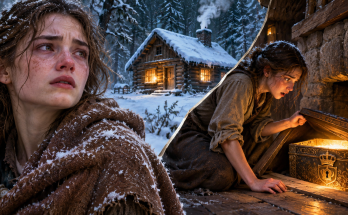
The rectangular opening beneath the stone remained visible.
That was where I had found the box.
I remembered reaching inside.
My fingers touching cold metal.
The surprising weight of the container.
The rusted latch refusing to open.
I could still hear the little click when the blade of my knife finally loosened it.
And I could still remember what happened when I lifted the lid.
Twenty gold coins.
I closed my eyes briefly.
The sight had been so unexpected that I almost doubted my own memory.
But the box was still there.
I could reach it without standing.
I didn't.
Not immediately.
I looked at the stone instead.
The fireplace was older than anything I had ever repaired.
Silas Croft had built the cabin in 1848.
That date was written in his letter.
I had read it enough times to remember it clearly.
I wondered whether he had placed every stone himself.
I couldn't know.
The cabin didn't tell me who had helped him, if anyone.
But I knew what careful work looked like.
And I knew the fireplace had survived a great deal.
It had stood through winters.
Through years when the cabin was apparently empty.
Through weather strong enough to pile snow against the walls.
And when an exhausted girl needed warmth, it had still worked.
That was something.
I touched the floor near the hearth.
The boards were old.
I had worried about embers reaching them from the beginning.
That concern had led me to the hidden box.
I thought about how strange the discovery had been.
I hadn't gone searching for money.
I hadn't expected treasure.
I had simply been trying to keep a fire from becoming dangerous.
The thought stayed with me.
Sometimes doing the necessary thing revealed something unexpected.
Grandpa had probably said something like that.
I couldn't remember his exact words.
I didn't want to pretend I could.
But I remembered the way he worked.
One task at a time.
With attention.
Without wasting movement.
I sat back.
My knees ached against the wooden floor.
The cold had left its mark on me.
My legs were still sore from walking through deep snow.
The place where I had fallen hurt whenever I bent too quickly.
I had been fortunate.
I knew that.
I could still move.
I could still use my hands.
I could still think clearly enough to recognize my mistakes.
I rubbed my palms together.
Then I looked at the box.
The folded cloth beneath it had protected the metal from the dusty floor.
I had kept it away from the heat.
Inside were the coins, the hunting knife, and the letter.
Everything remained together.
I wanted to keep it that way.
I pulled the box closer.
Its metal surface felt cool.
I lifted the latch.
The lid opened with a familiar scraping sound.
The coins lay beneath the letter and knife.
I didn't need to count them.
I knew there were twenty.
Still, I looked at them.
I was beginning to understand how easily a person could become attached to something that promised relief.
Those coins could have changed my circumstances.
I couldn't deny it.
But every time I imagined using them, I remembered Rose.
Her father had intended the treasure for her.
She hadn't lived to receive it.
That was what I knew.
I couldn't erase it.
I took out the letter.
The paper was beginning to feel familiar beneath my fingers.
I was careful not to handle it more than necessary.
It had survived long enough to reach me.
I didn't want to be the reason it was destroyed.
I read the name at the beginning again.
Silas Croft.
Then the date.
Then the part about Rose.
I wondered what it had cost him to write those words.
There was no answer.
The letter gave me a glimpse of his grief.
It didn't give me permission to invent the rest of his life.
I reminded myself of that.
I had already caught myself imagining Rose's childhood.
Her voice.
Her laughter.
Whether she had ever sat beside this fireplace.
Those images came easily.
Too easily.
And that troubled me.
Because none of them was something I knew.
I didn't want to turn a real child's loss into a story that pleased me.
Rose had been somebody's daughter.
That was enough.
I looked at the antler-handled knife.
It lay carefully inside the box.
The workmanship was fine.
I could see that without touching it.
Grandpa would have noticed the same thing.
He always appreciated an object made with skill.
He said good work deserved respect, regardless of whether the person examining it knew the maker.
I thought about the hands that had shaped the handle.
How carefully the antler must have been polished.
How the blade had been fitted.
Someone had spent time making it.
Someone had cared.
That made the knife different from an ordinary thing picked up in a shop.
I wanted to understand why it had been saved for Rose.
But the portion of the story I knew didn't explain everything.
I couldn't force the answer.
I placed the letter back.
Then I closed the lid.
The latch settled into place.
I looked toward the window.
The light outside seemed a little different.
Perhaps the storm had shifted.
Perhaps clouds had moved.
I wasn't sure.
I had learned not to trust hopeful guesses about the weather.
The road had disappeared beneath snow when I believed I could still follow it.
I wasn't going to repeat that mistake.
I remained where I was.
I pulled the blanket around my shoulders.
The gray wool was worn and thin.
Yet it was the closest thing I had to my mother.
I touched the frayed edge.
I remembered watching her fold it.
I remembered seeing it laid across furniture in our old house.
I had never thought it would become so important.
It had simply been there.
Like Mama herself.
I suppose that was one of the things I regretted most.
I hadn't understood how much of my life depended on her presence until she was gone.
I had taken comfort for granted.
I had taken belonging for granted.
I had assumed the house would always be somewhere I could return.
Then she died.
And Elias showed me how little those assumptions meant.
I remembered the envelope on the mantelpiece.
Twelve dollars.
He had called it generous.
I could still hear the calmness in his voice.
That was what hurt.
He hadn't shouted.
He hadn't lost his temper.
He had simply decided that I was no longer his responsibility.
As if eight years under one roof could be erased by a birthday.
I looked at the old cabin.
It didn't belong to me.
Nobody had offered it to me.
Yet its roof had sheltered me when the house I knew would not.
The difference made me feel sad in a way I couldn't fully explain.
I had received more protection from an abandoned building than from the man who had promised to care for our family.
I didn't know what that said about the world.
I only knew what it said about Elias.
And I didn't want his cruelty to decide who I became.
I had thought about that repeatedly since finding the treasure.
Perhaps too much.
But it mattered.
If I took the gold without considering its history, I would be making a choice based only on what benefited me.
That didn't automatically make me like Elias.
I knew my circumstances were desperate.
But I wanted to be careful.
I wanted to make a decision I could remember without shame.
I reached for the flannel bundle.
Grandpa's sharpening stone rested inside.
I unwrapped it.
The smooth surface fit my palm.
I rubbed my thumb along the edge.
He had given it to me when I was eight.
At the time, I thought the gift was ordinary.
Now it was one of the most valuable things I owned.
Not because anyone would pay much for it.
Because of what it represented.
His patience.
His work.
The time he spent teaching me.
The belief that I could learn useful things.
I looked down at the stone.
I wished I had thanked him more often.
I wished I could tell him how much his lessons mattered now.
I had used his striker.
I had found the quartz.
I had prepared the wood carefully.
I had kept trying until the flame caught.
Every part of that effort reminded me of him.
I didn't know whether I would ever become as skilled as Grandpa.
But I had survived because he took the time to teach me.
I folded the flannel around the stone.
Then I put it away.
The fire was growing smaller.
I reached for the last pieces of loose furniture.
I chose one.
Only one.
I fed it into the hearth and waited for it to catch.
The flames brightened.
I warmed my hands.
Then I looked toward the hidden compartment.
The empty space beneath the stone remained dark.
I wondered whether Silas had imagined anyone finding it.
Perhaps he had.
Perhaps he hadn't.
The letter suggested he wanted his words to remain with the objects.
But I couldn't know more than that.
I didn't need to.
For now, I had to preserve what I found.
I had to survive until the weather allowed me to leave.
And I had to keep from making another frightened decision simply because I wanted an answer immediately.
I sat back against the wall.
The wooden boards felt cold through my clothing.
I shifted closer to the fire.
Outside, the wind moved through the pines.
Inside, the old cabin creaked softly.
I listened to those sounds.
I no longer mistook every noise for danger.
But I didn't ignore them either.
That was another lesson Grandpa had given me.
Pay attention.
Not because everything will go wrong.
Because noticing things gives you a chance to respond before they do.
I looked at the box.
Then at the fire.
Then at my shoes drying nearby.
The smallest details had kept me alive.
The loose fireplace stone had led me to Silas's letter.
And the letter had forced me to consider what mattered beyond my own survival.
I wasn't ready to decide what would become of the treasure.
But I knew I couldn't treat it casually.
Not after reading Rose's name.
Not after understanding that a father's grief had been preserved inside that little metal box.
I folded my hands in my lap.
The storm had not yet released me.
I remained in the cabin.
And for the time being, I accepted that my task was simple.
Protect the fire.
Protect the letter.
And remain alive long enough to make a careful decision.