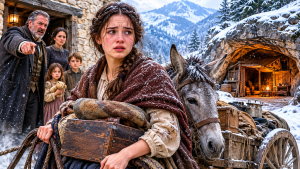
PART 1 — THE GIRL THE MOUNTAIN REFUSED TO BREAK
At eighteen years old, Carmen Sayán was given exactly one hour to leave the house where she had been born.
One hour to gather everything she owned.
One hour to say goodbye to the rooms where her mother had sung while cooking,
where her father had laughed beside the fireplace,
and where every wooden beam held a memory of a family that no longer existed.
And the man throwing her out was her own uncle.
“You have until sunrise,” Anselmo said coldly.
“After that, I don’t want to see your face here again.”
Carmen stood in the doorway, trembling. Outside,
the first snowflakes were falling over the mountains of northern Spain.
“Uncle, please,” she whispered. “Winter is coming.
Where am I supposed to go?” Anselmo folded his arms.
“That is no longer my problem.”
Behind him, his wife Pilar stood silently with their two children.
She lowered her eyes when Carmen looked at her.
No one defended the girl. No one offered her a place to sleep.
And what none of them knew was that this cruel morning
would begin a chain of events that would change their lives forever.
It was November 1891, in a small village near the Venasque Valley,
deep in the Aragonese Pyrenees. Two years earlier, Carmen’s father,
Joaquín, had been killed while working in the forest.
A falling log had crushed him before anyone could help.
Her mother, Rosario, had never recovered from the loss.
She grew quieter, thinner, and weaker until, one spring morning,
she closed her eyes and never opened them again.
Carmen buried her mother beside her father.
Then she returned to their little stone house and continued working.
She tended the animals, planted vegetables, repaired fences,
carried firewood,
and did everything necessary to keep the family property alive.
She was young, but she was capable.
Unfortunately, her uncle saw something very different. He saw a house.
He saw land. And he saw money.
Everyone knew Rosario had spent years selling cheese and
wool at the market in Graus.
She had saved carefully, spending almost nothing on herself.
Anselmo was convinced that those savings were hidden
somewhere inside the house.
But no matter how many cupboards he emptied or floorboards he lifted,
he found nothing. He accused Carmen of hiding the money.
She pleaded that she knew nothing.
The only clue her mother had left was a strange sentence whispered shortly before her death:
“What you need, my daughter, is in your father’s hands.”
Carmen had never understood it. And now,
standing in the freezing courtyard,
she had no time to think about mysteries. She had to survive.
Before dawn,
she loaded an old wooden cart with everything she could carry: flour,
cornmeal, potatoes, a little bacon, sacks of oats,
several bundles of animal feed, blankets, candles, a cooking pot,
rope, an axe, a saw, and her father’s battered toolbox.
Anselmo laughed when he saw the tools. “Take that junk. It’s worthless.”
Carmen said nothing.
She placed the toolbox carefully beneath her blankets.
Then she approached Canela, the family’s elderly gray mule.
The animal lifted her tired head as Carmen stroked her neck.
“It’s just you and me now, old girl,” Carmen whispered.
Canela pressed her muzzle against the girl’s shoulder.
That small gesture almost broke her.
For a moment, Carmen wanted to fall to her knees and cry.
Instead, she tightened the reins.
And before the sun rose, she left the only home she had ever known.
She did not look back.
The road into the mountains was narrow, rocky, and dangerously steep.
The cart’s left wheel creaked with every turn.
Snow gathered on Carmen’s eyelashes.
Her fingers grew numb around the reins.
Every few minutes she glanced toward the valley,
wondering whether she had made a terrible mistake.
But what choice did she have?
Her uncle had made it clear that she was no longer welcome.
Then she remembered something. When she was a little girl,
her father had once taken her to a limestone cave high above the Ésera River.
It was not a proper cave, only a deep shelter beneath an enormous rock ledge.
She remembered an old shepherd’s hut near its entrance.
The place was protected from the northern wind.
Perhaps, she thought, it could become her home.
“Come on, Canela,” she urged. They climbed for hours.
Twice, Carmen lost the trail.
Once, the cart nearly overturned on an icy bend.
But just as daylight began to fade, she saw it.
A dark opening beneath a white wall of stone. The cave.
She almost cried with relief. Then she stepped inside.
And her relief disappeared. The shepherd’s hut had partially collapsed.
One wall leaned dangerously,
and half the roof lay scattered across the ground.
Cold air swept through the shelter. The floor was uneven.
There was barely enough space for the cart and mule.
“This cannot be my home,” Carmen whispered.
She looked down the mountain.
Snow had already begun covering the path behind her.
She had nowhere else to go. So she rolled up her sleeves.
“Then I’ll make it one.” She pushed the cart beneath the rock ledge,
unloaded the food,
and dragged the heaviest sacks onto dry wooden planks.
She secured Canela beneath the remaining roof.
Then she gathered branches and lit a fire.
Within minutes, thick smoke filled the cave. Carmen coughed violently.
Her eyes burned. She dragged the burning wood toward the entrance,
but the wind sent sparks flying toward the animal feed.
One spark landed on a dry bundle. She stamped it out immediately.
If the feed burned, Canela would starve.
And without Canela, Carmen might never leave the mountain.
That first night, she huddled beneath two blankets,
shivering so violently that her teeth hurt. She thought of her mother.
She thought of the warm kitchen. Then she remembered her father’s voice.
“Fire is useful, little one. But smoke needs a road of its own.”
At sunrise, Carmen began building. Using stones, mud,
and pieces of broken metal,
she made a crude hearth near the cave entrance and arranged a hood to guide smoke outward.
She repaired the hut wall with branches and stones.
She covered gaps with her tarpaulin. She reinforced the remaining roof.
It took almost two days. Her hands blistered. Her back ached.
But when she finally lit the fire again, the smoke escaped.
For the first time, Carmen felt something other than fear.
She felt hope.
That night, she cooked a small meal, fed Canela, and sat beside the flames.
“Look at us,” she said softly. “We have a home.”
Canela flicked her ears. Carmen smiled.
Then, outside, the wind began screaming. The snowstorm lasted two days.
By the time it ended, the trail had completely vanished.
The cart wheels were buried.
The surrounding forest looked like a white wilderness.
Carmen counted her food and animal feed carefully.
She could survive until spring. Perhaps. But only if nothing went wrong.
And in the mountains, everything could go wrong.
One afternoon, she went out gathering firewood.
The sky was clear when she left. Half an hour later, the wind changed.
Snow blew sideways through the trees. Her footprints disappeared.
Carmen turned toward what she believed was the cave.
But the slope looked unfamiliar. She walked faster. Then stopped.
She was lost. The wind howled around her, swallowing every sound.
Panic rose in her throat. She imagined Canela waiting alone.
She imagined the fire going out.
She imagined her body being discovered beneath the snow
when spring finally came. Then she heard something faint.
Clink. Clink. A bell. Canela’s bell.
Carmen had tied it around the mule’s neck days earlier,
just as her mother used to do with the family’s animals.
She followed the sound desperately.
Every time the bell fell silent, she stopped and listened.
Finally, through the snow, the dark shape of the shelter appeared.
She stumbled inside, fell beside Canela,
and wrapped her arms around the mule’s neck. “You saved me,” she sobbed.
From that day forward,
Carmen tied a rope to the shelter whenever she ventured into uncertain weather.
But the mountain had another surprise waiting.
A far more frightening one. In the middle of December,
during another violent blizzard,
Canela suddenly began kicking against the wooden wall.
Carmen woke instantly. She grabbed her axe. Someone was outside.
At first she heard only wind. Then a human voice. “Help!
Is anyone there?” Carmen froze.
Her uncle could have sent someone after her.
There were thieves and smugglers who crossed the mountains.
She approached the entrance cautiously. “Who’s there?”
“An old man,” came the answer.
“And if you don’t open that door, I’ll be a dead one.”
She lifted the tarpaulin.
A gray-bearded stranger lay half-buried in the snow, dragging one injured leg.
His name was Bernardo.
He was a shepherd returning from France when he slipped
on ice and injured his ankle. Carmen hesitated.
She barely had enough food for herself.
But she could not leave him outside to die.
She helped him toward the fire.
That night, she slept with the axe beside her. Bernardo noticed.
He said nothing.
Over the following days, the old shepherd slowly earned her trust.
He taught her to recognize dangerous clouds,
find sheltered places to collect firewood,
identify avalanche-prone slopes, and stretch their food supplies.
He showed her how to set rabbit snares.
In return, Carmen kept his injured ankle wrapped and shared her meals.
One evening, while they roasted chestnuts over the fire,
Bernardo asked where she came from.
“Near the Venasque Valley,” she replied. “And your family?”
“Sayán. My father was Joaquín Sayán.” The old man’s expression changed.
“Joaquín? The woodsman?” Carmen nodded. Bernardo stared at the flames.
“I knew your father. We worked together when we were young.”
Carmen sat forward, suddenly desperate to hear anything about him.
But Bernardo’s face had grown serious.
“Then there’s something you must know.”
He explained that Anselmo owed money to several men across the valley.
Dangerous debts.
And he had heard something in Graus before entering the mountains.
Carmen felt her stomach tighten. “Tell me,” she whispered.
Bernardo looked at her with pity.
The old shepherd knew that the truth might be more painful than the cold.
And before he spoke,
Carmen had no idea that her entire future was about to be threatened again.
💬 If Carmen’s courage has touched you,
leave a comment and let me know what you think.
You can find Part 2 in the first comment,
where a devastating discovery changes everything.
Your feedback helps motivate me to share the next chapters faster.
Then Bernardo finally revealed what he had heard.
PART 2 — THE SECRET HIDDEN IN HER FATHER’S HANDS
Your uncle plans to sell your parents’ house at the spring fair.
The words struck Carmen harder than any winter storm.
For several seconds, she could not speak.
“He can’t,” she finally whispered. “That house belonged to my parents.”
Bernardo lowered his eyes. “Your uncle has debts, child.
Desperate men do terrible things when they believe nobody can stop them.”
Carmen stared at the flames.
She imagined strangers sleeping in her mother’s bedroom,
tearing down her father’s workshop,
and walking through the garden where she had spent her childhood.
“I have to go back.” “Not now,” Bernardo warned. “The passes are buried.
You wouldn’t survive the journey.” “Then what am I supposed to do?”
“Live long enough to fight for what’s yours.”
But January brought a danger neither of them expected. Wolves.
First came the tracks around the shelter. Then the howling.
One night, Canela began pulling desperately against her rope.
Beyond the stone wall, Carmen spotted two glowing eyes. Then four.
Then six.
Bernardo grabbed a metal pot and struck it with a wooden spoon.
Carmen seized two burning branches.
Together, they shouted and made as much noise as possible.
The wolves retreated into the darkness.
But the damage had already been done.
In her terror, Canela had struck one of the hut’s supporting posts.
Part of the roof collapsed onto the stored provisions.
A sack of oats burst open. Snow soaked the flour.
Almost half the mule’s grain was ruined, along with much of Carmen’s food.
She fell onto a wooden chest and began crying.
“I can’t do this anymore,” she whispered.
“Everything I try to save gets taken from me.”
Bernardo placed a hand on her shoulder. “Then cry, Carmen.
But when you’re finished, we still have work to do.”
That afternoon, Carmen decided to repair the cart’s damaged wheel.
She opened her father’s old toolbox and took out his favorite wooden mallet.
As she struck a wedge, the mallet’s head suddenly loosened.
“Not you too,” she muttered. She pulled the handle free.
And froze. The handle was hollow.
Inside it was a tightly rolled piece of paper.
With trembling fingers, she opened it. There were two documents.
The first was a legal deed bearing the signature of a notary in Graus.
Three years earlier,
Joaquín and Rosario Sayán had legally transferred the family house and land into Carmen’s name.
She read it again. And again. The house had been hers all along.
The second paper was a letter written in her mother’s handwriting.
My beloved daughter, If you are reading this,
your father and I are no longer beside you.
Your father feared what his brother might do.
That is why we made certain the house would always belong to you.
The money I saved is beneath the third stone of the fireplace.
Look for the small cross.
Never let anyone convince you that you have nothing.
You have our love, our home, and everything we taught you.
Carmen pressed the letter against her chest.
“In your father’s hands,” she whispered. Now she understood.
Her mother had not been speaking nonsense in her final hours.
She had been telling Carmen exactly where to find the truth.
Bernardo studied the deed.
“Your uncle cannot legally sell that property,” he said.
“But you must reach Graus before the sale.”
By late January, Bernardo could walk with a cane.
He prepared to return to the valley.
“I’ll be waiting in Graus,” he promised. “You won’t face him alone.”
Then he disappeared down the snowy path. Carmen was alone again.
February arrived with bitter winds and dangerously little food.
One night, while feeding Canela, Carmen heard a strange sound above her.
Crrrrack. She raised her lantern.
The wooden support damaged during the wolf attack was
bending beneath the enormous weight of snow. Carmen’s blood ran cold.
If it collapsed, it would crush Canela, bury their remaining food,
and block the cave entrance. She reached for the mule’s rope.
And then, directly above Canela’s head, the roof beam began to split.
❄️ Will Carmen save Canela and survive long enough to reclaim her inheritance?
PART 3 — THE WINTER COULDN’T KILL HER, AND THE MAN WHO STOLE HER HOME COULDN’T DEFEAT HER
The sound of splitting wood echoed through the cave like a gunshot.
Carmen looked up. A jagged crack was spreading across the beam that
supported the shepherd’s hut. Above it lay hundreds of pounds of snow.
Below it stood Canela. “Move, girl! Move!”
Carmen grabbed the mule’s rope and pulled desperately.
Canela resisted, frightened by the cracking wood and the sudden movement.
“Please!” Carmen cried. “Not now. I can’t lose you too!”
Another crack echoed overhead. Snow sifted through the roof.
Carmen dropped the rope, hurried behind Canela, and pushed against her flank.
At last, the mule stumbled forward.
They had barely reached the safety of the rock ledge
when a section of the roof gave way. Wood crashed onto the ground.
A cloud of snow filled the shelter.
Carmen threw herself against the stone wall, covering her head.
For several terrifying moments, she could see nothing.
Then came silence.
She coughed, brushed snow from her face, and looked toward the damaged hut.
The entire roof had not collapsed. But one side hung dangerously low.
The remaining food was exposed to the freezing air.
And the entrance could be blocked if another section fell.
Carmen sank to her knees. She had survived being abandoned.
She had survived hunger, blizzards, and wolves. But now,
with spring still weeks away,
the shelter she had fought so hard to build was falling apart.
Canela nudged her shoulder. Carmen turned.
The old mule stood beside her, breathing softly.
For some reason, that small sound reminded her of her father.
Whenever something broke at home, Joaquín never began by complaining.
He examined the damage. Found his tools. And started again.
Carmen closed her eyes. “I know, Papa,” she whispered.
“Get up and fix it.” She rose slowly. Then she picked up the axe.
The following hours were the most exhausting of her life.
Carmen dragged the remaining sacks away from the weakened roof.
She searched through the firewood until she found a thick, straight log.
Using the axe, she sharpened one end.
Then she positioned it beneath the damaged beam.
Her first wooden wedge slipped. The second cracked in two.
Her fingers were stiff with cold.
Every blow sent pain through her wrists. At one point,
the beam groaned so loudly that she dropped her tools and scrambled backward.
For a moment,
she considered abandoning the hut and staying entirely within the rocky shelter.
But without protection for the remaining food and feed,
the weeks ahead could become impossible.
She looked at her father’s mallet.
The same mallet that had hidden the truth about her inheritance.
The same tool Anselmo had dismissed as worthless. She picked it up.
“One more time,” she whispered.
She cut a thicker wedge and placed it carefully. Then she struck.
Once. Twice. Three times. The support tightened.
The damaged beam shifted slightly, transferring its weight onto the new post.
A shower of powdery snow fell from above. Carmen held her breath.
Nothing moved. She waited. The beam remained in place.
She reinforced the support with stones and added another brace.
By dawn, the weakened roof was stable enough to withstand the remaining snow.
Carmen stumbled toward Canela and rested her forehead against the mule’s neck.
“We’re still here,” she murmured.
And for the first time since her uncle had thrown her out,
Carmen understood something important.
Survival was not about never feeling afraid.
It was about deciding what to do while fear was still inside you.
The rest of February passed slowly.
Every morning, Carmen examined the sky before leaving the shelter.
Every evening, she counted her food.
Some days she ate only a small potato and a thin portion of cornmeal.
Other days she managed to catch a rabbit.
She gave Canela carefully measured portions of the
remaining oats and gathered suitable branches and
whatever forage she could find. The mule grew thinner. So did Carmen.
Her cheeks became hollow, and her clothes hung loosely from her shoulders.
But she continued working.
She cut marks into a piece of pine to count the passing days.
Every mark meant she was closer to spring.
Every mark also meant she had survived another night. Sometimes,
when the wind shook the tarpaulin,
Carmen read her mother’s letter aloud.
She had memorized almost every word.
Never let anyone convince you that you have nothing.
That sentence kept her going.
There were nights when she imagined walking into the family house again.
She pictured the old kitchen table. Her father’s wooden chair.
The little window through which her mother had watched the road.
And then she imagined Anselmo selling it all.
Whenever that thought came,
she pressed the deed against her chest and promised herself:
“I am coming home.” In March, the mountain finally began to change.
At first, Carmen scarcely believed it.
One morning, the water inside her cooking pot had not frozen.
A few days later, she heard something she had almost forgotten.
Running water. Beneath the snow, the river was beginning to awaken.
Carmen walked carefully toward the bank.
There, beside a patch of melting ice, stood a few blades of green grass.
Canela lowered her head and began nibbling. Carmen stared.
Then she laughed.
It was a strange sound after so many months of silence.
She laughed until tears rolled down her cheeks. “Look, Canela!
Spring!” The mule continued eating, completely unimpressed.
Carmen laughed even harder. But her happiness soon gave way to urgency.
The spring fair in Graus would begin in mid-April.
Bernardo had warned her that Anselmo intended to sell the house there.
If she arrived too late,
she might face a long and bitter struggle to recover her property.
She had the deed. She had her mother’s letter.
But she still needed to reach the town.
And between her and Graus lay miles of dangerous mountain roads.
Carmen began preparing immediately.
She dug the cart wheels out of the remaining snow.
She greased the damaged axle. She replaced worn leather straps.
She examined every rope.
Then she wrapped the deed and her mother’s letter inside
a piece of waxed cloth and hid them securely beneath her clothing.
She could lose the cart. She could lose the food.
But she could not lose those documents. One evening,
after finishing her preparations,
Carmen stood in the cave entrance and looked around.
The place had nearly killed her. Yet it had also saved her.
Its walls had sheltered her from storms.
Its small fire had warmed her when she believed the world had forgotten her.
And within those rocky walls,
she had found the truth her parents had left behind.
She could have abandoned the shelter without another thought.
Instead, she spent two days repairing what she could.
She strengthened the wooden wall. She cleaned the hearth.
She placed dry firewood beneath the rock ledge. And in a small hollow,
protected from the rain, she left candles, salt, and tinder.
“Someone else might need this place,” she said quietly.
She remembered Bernardo lying helpless in the snow.
She remembered how close she herself had come to dying.
Then she added one final bundle of wood.
Not because anyone would thank her.
But because she knew what it meant to have nowhere else to go.
In early April,
Carmen finally saw a narrow strip of muddy ground where the mountain trail had once been.
It was time. She loaded her remaining belongings onto the cart.
She secured her father’s toolbox. Then she climbed onto the wooden seat.
“Take us home, Canela.” The old mule began walking. The cart creaked.
The wheels turned. And slowly, they left the cave behind.
For several hours, the journey went smoothly.
Then Carmen reached a steep section of the mountain. And stopped.
The path ahead had disappeared beneath the remains of an avalanche.
Hard snow, stones, and fallen trees blocked the way.
The obstruction stretched across the narrow trail.
There was no room for the cart to pass.
Carmen climbed down and examined the damage. Her heart sank.
She could not turn around. She could not carry everything by herself.
And she could not abandon Canela.
She looked at the mountain road behind her.
Then at the impossible barrier ahead. The fair would not wait.
She took the saw from her father’s toolbox.
“Well,” she said, “we’ve faced worse.”
For two days, Carmen worked to clear a passage. She cut fallen branches.
She dragged stones aside. She dug channels through the packed snow.
At night, she slept beneath the cart, wrapped in her blankets.
Her hands bled. Her shoulders burned.
Several times, she collapsed from exhaustion.
But every morning, she stood again.
On the third day, she led Canela forward.
The old mule stepped carefully between the rocks. The cart tilted.
Its damaged wheel struck a stone. Carmen felt her heart stop.
For one terrible second, the cart seemed ready to overturn.
“Easy, girl. Easy.” Canela pulled. The wheel climbed the rock.
Then dropped safely onto the trail. They had crossed.
Carmen threw her arms around the mule. “You stubborn old miracle!”
she cried. Then they continued toward the valley.
By the second morning of the Graus spring fair,
the town square was overflowing with merchants, farmers,
cattle dealers, and travelers. Animals called from their pens.
Men shouted prices. Wagons crowded the streets.
Then an unusual sight appeared at the edge of the square.
A thin young woman in worn clothing led an elderly gray
mule pulling a battered wooden cart.
Her face was darkened by months of mountain wind.
Her hands were rough and scarred. But her eyes were steady.
At first, nobody recognized her.
Then a woman near the market stalls gasped. “Carmen?”
The young woman turned. Another villager stepped forward.
“Carmen Sayán?” Whispers spread through the crowd.
“That’s Joaquín’s daughter!” “But she’s dead!”
“I heard she went to Barcelona!”
“Someone said she married a man from France!” Carmen ignored the voices.
She approached a merchant she recognized. “Have you seen Anselmo Sayán?”
The man stared at her. “Your uncle?” “Yes.”
“He’s at the notary’s office. I believe he’s selling some property.”
Carmen’s blood turned cold. “Where?”
The merchant pointed toward a stone building near the square.
She tied Canela beneath a tree.
Then she walked directly toward the office.
Every step felt heavier than the last.
She thought about the morning Anselmo had thrown her out.
She thought about the cave. The hunger. The wolves. The collapsing roof.
And the months she had spent wondering whether she would ever see home again.
At the office door, she paused. Her hand trembled.
Then she remembered her mother.
Never let anyone convince you that you have nothing.
Carmen pushed open the door. Inside sat three men. The notary.
A wealthy cattle dealer. And Anselmo Sayán.
Several papers lay spread across the table. Anselmo was holding a pen.
He looked irritated by the interruption.
“What is the meaning of—” Then he saw her.
The pen slipped from his fingers.
For a moment, his face seemed to lose all color. “Carmen?”
She stepped into the room. “Good morning, Uncle.” He stood abruptly.
“You… you’re alive?” Carmen looked straight into his eyes.
“Yes. Despite the fact that you left me outside with winter coming.”
The cattle dealer glanced between them. “Who is this young woman?”
Anselmo opened his mouth. But Carmen answered first.
“My name is Carmen Sayán. I am Joaquín and Rosario Sayán’s daughter.”
The dealer frowned. “And why are you here?”
“Because the property you’re about to purchase belongs to me.”
Silence fell over the room. Anselmo slammed his hand against the table.
“That’s a lie!” Carmen did not raise her voice.
She removed the waxed cloth from beneath her coat.
Her fingers shook slightly as she unfolded it.
Then she placed the deed on the table. “Please read this.”
The notary adjusted his glasses. He examined the document.
Then he leaned closer. His expression changed. “Where did you get this?”
“My parents left it for me.” The notary studied the signatures.
He turned the paper over. Then he looked directly at Anselmo.
“This deed is authentic.” Anselmo’s jaw tightened.
“That girl doesn’t understand—” The notary interrupted him.
“I prepared this document myself three years ago.”
He placed his finger beneath the names.
“Joaquín and Rosario Sayán transferred the house and
land into their daughter’s ownership.”
The cattle dealer slowly lowered his own papers. The notary continued.
“Mr. Sayán, you have no authority to sell this property.”
Anselmo began shouting. “She’s only a girl!
She doesn’t know how to manage land!
I’ve kept the property running all winter!”
Then a voice came from the far side of the room. “Have you?”
Everyone turned.
An elderly man stood beside the window, leaning on a cane. Bernardo.
Carmen had not noticed him when she entered. Her eyes filled with tears.
He gave her a small nod.
“I spent six weeks in a freezing mountain shelter with this girl,” he said.
Anselmo stared at him. Bernardo continued.
“I watched her feed an injured stranger when she barely
had enough food for herself.” He stepped forward.
“I watched her face storms, wolves, and hunger.
And after my ankle healed,
I walked down here knowing she still had weeks of winter ahead.”
The old man’s voice grew stronger.
“If that girl can keep herself and an old mule alive through a winter like this one,
she can certainly manage a house.” Anselmo looked away.
Bernardo raised his cane slightly.
“The only thing you’ve been managing, Anselmo, is your debts.”
The cattle dealer stood. He picked up his hat.
“I will not purchase property that doesn’t belong to the seller.”
He walked out. The notary gathered the sale papers.
“The transaction will not proceed.”
Anselmo remained standing beside the table.
His face was twisted with anger.
For months, he had believed Carmen would never return.
He had believed the mountain would finish what his cruelty had started.
But she was standing in front of him. Alive. With proof.
And with the law on her side.
Carmen looked at her uncle for a long moment.
Then she said something he would remember for the rest of his life.
“You took away my home because you thought I was weak.”
Her voice trembled, but she continued.
“You left me with a broken cart, an old mule, and winter ahead of me.”
She took a breath. “But you forgot something.” Anselmo said nothing.
“My parents taught me how to survive without stealing from anyone.”
She picked up the deed. “And you never learned that.”
Outside, Bernardo was waiting beside Canela.
When Carmen stepped into the sunlight, the old shepherd studied her face.
“Well?” Carmen held up the document. “It’s still mine.” Bernardo smiled.
“I knew your father would have found a way to protect you.”
Carmen blinked away tears. “I wish he were here.”
Bernardo rested a hand on her shoulder.
“He would be proud of what you did.”
For a moment, Carmen could not speak. Then she embraced him.
“Thank you for believing me.” The old shepherd gently patted her back.
“You saved my life, Carmen. All I did was tell the truth.”
Three days later, Carmen returned to her village.
This time, she came openly. Not as an unwanted orphan.
Not as a helpless girl. But as the rightful owner of her family’s home.
When the old stone house appeared at the end of the road,
she stopped the cart. Her throat tightened. The roof. The garden.
The wooden doorway. Everything was still there.
She had dreamed of this moment throughout the winter.
Yet when she climbed down, her legs nearly gave way.
Pilar stood in the doorway. Her two children clung to her skirt.
She looked frightened. “Carmen,” she whispered.
Carmen approached slowly. Pilar lowered her eyes.
“I know what Anselmo did was wrong.” For a moment, neither woman spoke.
Then Pilar said: “I should have stopped him.”
Carmen remembered the morning she had been forced outside.
Pilar had stood in almost exactly the same place. Watching.
Saying nothing. “You could have said something,” Carmen replied.
Tears filled Pilar’s eyes. “I know.”
The children pressed closer to their mother. Carmen looked at them.
They had done nothing wrong.
They were frightened, just as she had been frightened.
She thought about the freezing cave.
About Bernardo arriving injured and helpless.
About the choice she had made to open the shelter.
And she understood that she now faced another choice.
She could give Pilar one hour to leave.
She could make her suffer exactly as she had suffered.
No one would blame her. For a moment, part of Carmen wanted to do it.
Then she looked at the children again.
“You and the children may stay until summer,” Carmen said quietly.
Pilar stared at her. “What?” “Until you find somewhere else.”
Her voice became firm. “But Anselmo cannot stay here.”
Pilar covered her mouth.
“After everything we’ve done to you, you would still help us?”
Carmen looked toward the mountains.
“I know what it’s like to have nowhere to sleep.” She turned back.
“I won’t make those children pay for their father’s cruelty.”
Pilar began to cry. Carmen stepped past her and entered the house.
Anselmo left the valley that same week.
Some said he went south looking for work.
Others believed he was trying to escape his creditors.
Carmen never learned exactly where he went. Nor did she need to.
For the first time in months, his decisions no longer controlled her life.
That evening, after the children had gone to sleep,
Carmen entered the kitchen alone.
The old fireplace stood against the wall.
Its stones were darkened by decades of smoke. She knelt before it.
“Third stone,” she whispered. She counted carefully. One.
Two. Three. There, almost hidden beneath the soot,
was a tiny cross scratched into the surface. Her breath caught.
She fetched her father’s chisel. Carefully, she loosened the stone.
Then she reached into the dark space beneath it.
Her fingers touched metal. Carmen pulled out a small tin box.
She stared at it for several seconds before opening the lid.
Inside lay her mother’s savings. Coins. Carefully folded notes.
And a few pieces of jewelry wrapped in cloth.
It was not an enormous fortune. But it was enough.
Enough to repair the roof. Enough to buy seeds.
Enough to purchase supplies and begin earning a living.
Carmen sat on the floor with the box in her lap. Then she began to cry.
Not because she was afraid. Not because she was hungry. But because,
after all those months,
she finally understood what her parents had done.
They had known they might not always be there to protect her.
So they had protected her future.
Her father had hidden the deed inside the tool he carried every day.
Her mother had hidden their savings beneath the hearth.
And both had left her the skills she would need if life ever became cruel.
Carmen held the little box against her chest.
“Thank you, Mama,” she whispered.
Then she looked at her father’s mallet. “And thank you, Papa.”
The following months were not easy.
Owning a house did not mean its problems vanished.
The roof needed repairs. The garden was overgrown.
Several fences were broken. Money had to be spent carefully.
But Carmen knew how to work. She planted vegetables.
She repaired the roof. She restored the neglected garden.
And then she did something that surprised the entire village.
She began repairing carts. At first, the neighbors were skeptical.
“A young woman fixing wagon wheels?”
But Carmen had spent an entire winter repairing her own.
She knew how to straighten an axle, strengthen a joint,
replace worn fittings, and sharpen an axe until it cut cleanly.
Her father’s toolbox became the foundation of her livelihood.
Farmers began bringing her damaged tools. Then broken cart wheels.
Then farm equipment. Slowly,
people stopped speaking about the orphan who had nearly frozen in the mountains.
They began speaking about Carmen the craftswoman.
Pilar and the children eventually moved into a small rented home.
Before leaving, Pilar approached Carmen in the garden.
“I don’t expect you to forgive me,” she said. Carmen looked at her.
“Forgiveness doesn’t change what happened.” Pilar nodded sadly.
“No.” “But perhaps it can change what happens next.”
Pilar began crying again. This time, Carmen did not turn away.
Summer arrived. The valleys turned green.
The mountain snow retreated toward the highest peaks.
One morning, Carmen loaded the cart with firewood, candles, and food.
Canela stood waiting in the yard. The mule was healthier now,
her coat clean and her body stronger after months of proper care.
Carmen stroked her neck. “One more journey, old girl.”
They climbed the familiar trail.
The same road Carmen had traveled while terrified and homeless.
But now the trees were bright with sunlight. The river sparkled below.
And the mountain no longer seemed like an endless prison of ice.
When they reached the limestone shelter, Carmen stopped.
She looked at the old wooden wall. The crude hearth. The battered roof.
And the place where she had once slept trembling beneath her blankets.
She remembered the first night.
She remembered thinking she would die there. Then she smiled.
“You kept us alive.” She carried the supplies beneath the rock ledge.
She repaired a loose board.
She arranged the firewood where it would remain dry.
Then she took a small piece of wood and carefully wrote a message.
She nailed it beside the entrance.
It read: If you are lost, you may shelter here.
There is firewood to keep you warm. Listen to your animal.
Always use a rope when the snow is dangerous.
And when the mountain tells you to turn back, listen. You are not alone.
Carmen stood back and looked at the words.
Then she climbed onto the cart. “Come on, Canela. Let’s go home.”
Years passed. Carmen grew into a respected woman.
She continued tending her land and working with her hands.
And every summer, no matter how busy she became,
she climbed to the old shelter. Sometimes she carried wood.
Sometimes blankets. Sometimes candles and food.
She never asked for payment. She never left her name.
She simply made sure that another frightened traveler
might survive a night that would otherwise be fatal. Then,
one particularly harsh winter,
a shepherd became lost in a sudden blizzard.
The storm swallowed the trail. His hands began losing feeling.
Darkness approached. He believed he would never see his family again.
But just before collapsing, he saw a dark opening beneath a limestone ledge.
He crawled inside. There was dry firewood. A place for a fire.
Candles. And a small wooden sign. The man read it by flickering light.
You are not alone. He survived the night.
When he returned to the valley,
he told everyone about the mysterious shelter that had saved his life.
The villagers recognized the place immediately.
And although the sign carried no signature, they knew who had written it.
Carmen Sayán. The girl they had once whispered about.
The girl who had been thrown out at eighteen.
The girl who survived the terrible winter in a mountain cave.
One evening, many years after that first winter,
Carmen sat beside the fireplace in her family home.
Her father’s old mallet rested on a shelf.
Her mother’s tin box sat safely inside a cupboard.
Outside, the wind carried the scent of coming snow.
A young neighbor who had come to collect a repaired tool noticed the mallet.
“Why do you keep that old thing?” he asked.
“It looks like it’s falling apart.” Carmen smiled.
“Because it once saved everything I had.” The boy frowned.
“A hammer?” Carmen nodded. “But not in the way you think.”
She looked toward the fire.
“For a long time, I believed my parents had left me nothing except sadness.”
She paused. “Then winter taught me something.” “What?”
Carmen’s eyes glistened. “Money can disappear. Houses can be taken.
People can abandon you.” She touched the old wooden handle.
“But what someone teaches you with love can remain inside you forever.”
The boy studied her thoughtfully.
“Is that why you keep helping people at the mountain shelter?”
Carmen looked out the window. For an instant,
she could almost see the young girl she had once been,
standing beside a broken cart beneath a sky full of snow.
Then she answered.
“Because there was a night when I needed someone to open a door for me.”
She smiled faintly.
“And I never want another person to believe that every
door in the world is closed.” The fire crackled softly.
Outside, the snow began falling.
But inside the little stone house, there was warmth. There was peace.
And there was a woman who had endured the harshest
winter of her life without allowing it to freeze her heart.
Carmen never conquered the mountain. No one truly conquers a mountain.
She did something far greater. She learned to survive it.
And when she finally reached safety,
she left a light burning for those who might come after her.
Because sometimes the greatest inheritance our parents leave us isn’t a house,
money, or land. It’s the courage to rebuild our lives when everything
has been taken away—and the kindness not to become like
the people who hurt us.
❤️ Note: This story is entirely fictional and created for entertainment purposes only.
It does not represent any organization or individual,
nor does it encourage inappropriate behavior.
Content was created with the support of artificial intelligence.