I kept imagining the moment I would leave the cabin.
I didn't know when it would come.
The snow still covered the ground.
The mountain road remained difficult to identify.
And I wasn't willing to risk another journey while the conditions were unsafe.
Still, I thought about leaving.
I pictured putting on my shoes.
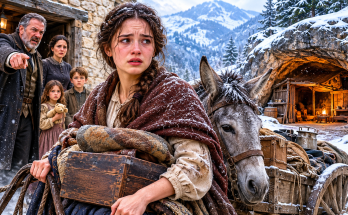
Wrapping Mama's blanket around my shoulders.
Gathering the few belongings I had carried from Elias's house.
Then finding my way toward Greenwater.
That was the future I had chosen before the storm.
I hadn't abandoned it.
But the cabin had changed how I thought about reaching it.
I no longer believed that simply continuing to walk was enough.
I needed direction.
A safe route.
Enough strength to travel.
And the patience to recognize when a decision was too dangerous.
I sat beside the fireplace and watched the small remaining flames.
The fuel was almost gone.
I had conserved it as carefully as I could.
Every piece of broken furniture I burned had served a purpose.
I looked at the space where the stool had stood when I first entered.
The stool was gone.
Most of the chair was gone too.
I felt a strange gratitude toward those broken things.
They had been useless as furniture.
But they became useful in another way.
I thought about Grandpa.
He never liked hearing people call something worthless without examining it.
He would look at a damaged piece of wood and consider what remained sound.
Sometimes the whole object couldn't be saved.
But parts of it could still serve.
I had watched him work that way for years.
Now I wondered whether I could think about my own life in the same manner.
Elias had treated me as though I were no longer worth keeping in his household.
I had believed him more than I wanted to admit.
Not openly.
I had been angry with him.
I had told myself he was cruel.
But beneath that anger was a question I couldn't stop asking.
Why wasn't I worth helping?
I had tried to be useful.
I had done chores.
I had worked.
I had avoided causing trouble.
I had spent eight years hoping he would eventually accept me.
Then, when I turned eighteen, he decided I must leave.
I had begun to wonder whether there was something wrong with me.
That was the part I was most ashamed to remember.
I knew Mama loved me.
I knew Grandpa had believed in me.
Yet Elias's rejection made me doubt what I already knew.
I looked at my hands.
They were marked by work.
Small scratches.
Rough skin.
The beginnings of strength Grandpa had helped me develop.
Those hands had started a fire.
They had moved broken wood.
They had lifted a stone and discovered something hidden beneath it.
They had kept me alive.
There was nothing useless about them.
I understood that.
And for the first time since leaving home, I began to believe it emotionally as well as intellectually.
I didn't need Elias to approve of me.
I wished he had cared.
That was different.
I wished he had looked at me and remembered that he had lived beside me since I was ten.
I wished he had considered the winter before sending me away.
I wished he had spoken about Mama with respect.
But wishes couldn't change his choices.
And his choices didn't have to define my future.
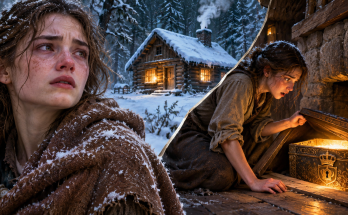
I looked toward the metal box.
It sat on the folded cloth beside my bundle.
The rusted latch was closed.
I had kept the contents together.
That decision had become important to me.
I wasn't certain what should happen to the treasure.
But I knew what I didn't want to do.
I didn't want to treat Rose's memory as an inconvenience.
I didn't want to use Silas's grief as an excuse to feel chosen by fate.
I didn't want to pretend the gold had been intended for me simply because I needed it.
I wanted to be honest.
That sounded easy.
It wasn't.
Honesty sometimes meant admitting that I didn't know what to do.
I had always found that uncomfortable.
Growing up, I thought adults had answers.
Mama usually knew what needed doing around the house.
Grandpa could examine broken furniture and explain the problem.
Even Elias spoke with certainty, though I had learned that certainty didn't make him kind.
Now I was eighteen.
Legally old enough to be sent out on my own.
Yet I had never felt less certain about anything.
I didn't know how to earn enough money to live.
I didn't know whether Greenwater would offer work.
I didn't know how long the weather would keep me in the cabin.
And I didn't know what I should do with the gold.
I had no one to ask.
That frightened me.
But it also forced me to recognize something.
Not knowing an answer didn't mean I was incapable of finding one.
I thought about Grandpa teaching me to repair a chair.
Sometimes he deliberately let me examine the damage before telling me what was wrong.
I would turn the chair over.
Test the joints.
Study the cracks.
Then make a guess.
He didn't always tell me immediately whether I was right.
He wanted me to think.
I used to find that frustrating.
Now I understood.
He hadn't been teaching me to memorize repairs.
He had been teaching me how to approach unfamiliar problems.
The cabin was full of them.
The frozen door.
The damaged shutter.
The loose hearthstone.
The old furniture.
The hidden box.
And beyond those practical things was the larger problem of building a life without the people I had depended on.
I couldn't solve that in one day.
I didn't have to.
I could begin with what I knew.
I knew how to work.
I knew how to learn.
I knew how to examine something carefully.
I knew how to continue after a failed attempt.
And I knew how important kindness could be when someone needed help.
Mama had taught me that.
Grandpa had shown me through his patience.
Elias had shown me what happened when it was absent.
I didn't want those lessons to disappear.
I reached for my mother's blanket.
The gray wool felt familiar between my fingers.
I remembered carrying it out of the attic room.
I hadn't known what would happen after the front door closed.
I only knew I wanted something of hers with me.
Now the blanket had become part of the reason I survived.
It hadn't been enough to protect me from the blizzard by itself.
But it had helped.
And it had given me comfort when I felt completely alone.
I pressed it against my cheek.
I wished Mama could see me.
I wished I could tell her that I had been frightened but hadn't given up.
I wished she could tell me what to do next.
Then I let the blanket fall around my shoulders.
I needed to stop waiting for an answer that couldn't come.
Mama had already given me years of love.
Grandpa had already given me years of teaching.
I had to use what remained.
I looked at the box.
Silas had left something too.
A cabin.
A letter.
A gift intended for Rose.
His story wasn't mine.
But it had crossed mine in an unexpected way.
I had taken shelter in his building.
I had made a fire in his hearth.
I had found what he hid beneath the stone.
That gave me a responsibility to act carefully.
It didn't tell me exactly what to do.
I had to accept that distinction.
I opened the box once more.
The coins were still there.
Twenty.
The knife rested with them.
The letter lay folded above it.
I took out the paper and read the familiar names.
Silas.
Rose.
I tried to imagine how I would explain the discovery to another person.
I would have to tell them that I was driven from home.
That I went to Pinewood looking for work.
That I decided to cross the mountain pass.
That a blizzard forced me away from the road.
That I found the cabin.
That I started a fire.
That I noticed the loose hearthstone.
And that beneath it lay the box.
Those were the events.
They sounded extraordinary when placed together.
But I remembered how ordinary each decision had felt while I was making it.
I hadn't known where the road would lead.
I hadn't expected the cabin.
I hadn't expected the box.
And I certainly hadn't expected to read about a child named Rose.
I wondered whether someone hearing the story would tell me the treasure was meant to be mine.
Perhaps they would.
People liked explanations that made suffering seem worthwhile.
I understood that temptation.
I wanted to believe my terrible journey had led to something good.
But I couldn't honestly claim Silas had hidden the treasure for me.
He had intended it for his daughter.
The letter made that clear.
I could not change it.
I folded the paper.
I placed it back inside.
I looked at the hunting knife.
Its antler handle still shone softly in the light.
I thought about how carefully it had been made.
Then I returned my attention to the coins.
They could buy things I needed.
I knew that.
But I didn't have to take them immediately.
I could leave the decision unresolved until I knew more.
That didn't make me weak.
It made me cautious.
I closed the box.
Then I set it aside.
I felt tired.
My body had recovered somewhat from the worst of the cold, but the exhaustion remained.
I moved to the bunk.
The rough boards held my weight.
I sat and stretched my legs.
My knee still ached.
I remembered falling into the snow.
The deep drift.
The struggle to stand.
How close I had come to surrendering.
I didn't want to experience that again.
I thought about the weather outside.
I would need to see enough of the route before leaving.
I couldn't simply trust the direction I remembered.
The blizzard had confused every landmark.
I knew that now.
If the road remained hidden, I would have to reconsider my plan.
I could not afford to repeat my mistake.
I looked toward the window.
The two pines stood outside.
The snow still covered the ground.
I stared at them for a while.
They had been the first recognizable things I saw when I approached the cabin.
I wondered whether I would remember them years later.
I thought I would.
Not because they were unusual.
Because of what they represented to me.
I had been lost.
I had been exhausted.
And between those trees, I had found a chance to survive.
I wanted to remember that.
I wanted to remember that my life hadn't ended on the day Elias turned me out.
It could have.
The storm had been dangerous enough.
But I was still alive.
I still had choices.
That was not a small thing.
I leaned back against the wall.
I thought about the person I wanted to become.
I didn't want to be someone who measured people only by what they could provide.
I didn't want to dismiss grief because it was inconvenient.
I didn't want to use power to make another person feel worthless.
I knew those things because I had experienced them.
I couldn't undo what Elias had done.
But I could refuse to repeat it.
I wanted to earn my living.
I wanted to make something useful.
I wanted to find a place that felt safe.
And if I ever had the chance to help someone else who was frightened and alone, I wanted to remember what it felt like to be refused.
Those were not grand ambitions.
They were the beginning of a life I could respect.
I looked toward the fire.
The small flames were still moving.
I thought about how carefully I had worked to light them.
Nothing about the process had been easy.
But the effort had mattered.
I wanted to carry that patience into whatever came next.
I could not guarantee that Greenwater would welcome me.
I could not guarantee that I would find employment.
I could not guarantee that the gold would solve my troubles.
But I could promise myself one thing.
I would not walk away from the cabin believing that Elias had been right about me.
I was more than a burden.
More than an unwanted stepdaughter.
More than a girl with twelve dollars and no home.
I had survived.
I had skills.
And I still had the ability to decide what kind of person I would become.
I sat quietly for a long while.
The box remained closed.
The blanket rested around my shoulders.
And outside, the mountain waited beneath the snow.