I returned to the letter because I didn't want to forget why the box mattered.
That may sound strange.
How could I forget twenty gold coins?
How could I forget a hunting knife with a beautiful antler handle?
I couldn't.
Those things were easy to remember.
It was Rose I was afraid of losing.
Not her name.
I could remember that.
I was afraid that hunger and fear would slowly make her seem less important.
I knew how easily that could happen.
When a person was desperate, every thought seemed to return to survival.
Food.
Shelter.
Money.
Warmth.
There was little room left for anything else.
I had felt it during the blizzard.
I had stopped thinking about the future.
Stopped thinking about work.
Stopped thinking about what Elias had done.
I had cared only about reaching the next sheltered place.
That had been necessary.
But now I was warm enough to think again.
And I didn't want to use desperation as an excuse for forgetting someone else's grief.
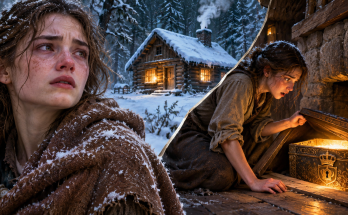
I lifted the metal box onto my lap.
The weight surprised me, even though I had handled it many times.
The rusted latch made a faint scraping sound when I opened it.
I looked at the contents.
Twenty gold coins.
The hunting knife.
The folded letter.
Everything remained exactly as I had arranged it.
I reached for the paper.
Its edges were delicate.
I unfolded it slowly.
The name Silas Croft appeared near the beginning.
The date 1848 followed in the account of the cabin.
Then came the part about Rose.
I read it carefully.
I didn't rush.
I had already learned how easily a person could overlook something important when distracted.
I wanted to understand every detail the letter actually gave me.
I wanted to separate those details from the questions I had invented.
I knew Silas had built the cabin.
I knew he had saved the contents for his daughter.
I knew Rose had died before receiving them.
Those facts were painful enough.
I didn't need to add imaginary explanations.
I looked at the fire.
The flames moved slowly across the remaining wood.
The room was warm enough for me to sit without shivering.
I remembered the night before.
My hands had been so stiff that I struggled to hold the striker.
I had tried again and again to make a spark.
Now I was holding an old letter without dropping it.
It felt like a small miracle.
I didn't use that word lightly.
I knew the fire had required work.
The cabin had been real.
The wood had been real.
The tools had been real.
Nothing had appeared simply because I wished for it.
Yet I was alive.
And I was grateful.
I thought about Rose's father.
I imagined him building the fireplace stone by stone.
I stopped before the image became too specific.
I didn't know exactly how he had worked.
But I understood the labor.
Grandpa had taught me enough to recognize it.
The stones were fitted with care.
The hearth had endured years of cold.
Even after being abandoned, it remained useful.
I wondered how Silas would feel if he knew a stranger had used his fireplace to survive.
Perhaps he would be pleased.
Perhaps he would be angry that I had entered without permission.
I couldn't know.
But I wanted to believe a father who had loved his daughter might understand why a frightened girl had crawled through a window to escape the snow.
I looked down at the letter.
I had begun thinking of Silas as a person rather than a name.
That mattered to me.
Elias had looked at me as though I were a responsibility that had expired.
I didn't want to look at Silas as though he were merely the previous owner of something valuable.
He had lived.
He had worked.
He had lost someone.
And he had left behind words that still carried that loss.
I touched the edge of the paper.
I thought about Mama.
The last two months had felt longer than the eighteen years before them.
Grief did strange things to time.
Some mornings, her death seemed to have happened only hours earlier.
Other days, I struggled to remember how normal life had felt when she was alive.
I could still picture her face.
But I wanted more.
I wanted a conversation.
I wanted her advice.
I wanted her to tell me whether I was doing the right thing.
I knew those wishes were impossible.
But knowing didn't make them disappear.
I looked at the gray blanket.
It lay across my knees.
The worn edge was familiar.
I rubbed it between my fingers.
I wondered whether Silas had kept any of Rose's ordinary belongings.
A piece of clothing.
A small object.
Something that reminded him of her.
The letter didn't give me enough to know.
I couldn't answer.
But I understood the desire.
Sometimes grief made the smallest possession precious.
I had spent my whole childhood surrounded by Mama's belongings.
I had barely noticed most of them.
Now I possessed only the blanket.
And I guarded it more carefully than I had ever guarded anything.
I thought about Elias.
I wondered what he would do with the things I had left behind.
I didn't own much.
But there had been parts of the house that reminded me of Mama.
I wondered whether he would remove them.
I wondered whether he would keep anything.
I didn't know.
And I had no way to find out from inside the mountain cabin.
I tried not to dwell on it.
There was nothing useful I could do about Elias at that moment.
I could not make him regret his decision.
I could not force him to care.
And I could not return to the house simply because I wanted to see Mama's things.
I had to accept what was in front of me.
The fire.
The food.
The weather.
The letter.
I lowered my eyes to the page again.
I realized I had been searching Silas's words for something I wanted from my own mother.
A message.
A little guidance.
Some reassurance that being left alone didn't mean I was worthless.
That wasn't fair to Silas.
He hadn't written to me.
He had written about Rose.
I needed to remember that.
Still, there was comfort in discovering that love could remain visible after death.
I hadn't expected to find comfort in a stranger's grief.
But I had.
I looked at the knife.
The polished antler handle was beautiful in the firelight.
I wondered how many hours had gone into making it.
The workmanship reminded me of Grandpa.
He had always admired things that were made carefully.
He didn't care whether they were expensive.
He cared whether they were sound.
He once told me that a well-made object showed respect for the person who would use it.
I remembered that now.
Silas had placed a carefully made knife beside the coins.
Whatever practical purpose he intended, he had chosen something worth preserving.
I touched the handle with one finger.
Then I withdrew my hand.
I didn't need to hold it.
I only needed to leave it safe.
I returned the letter above the knife.
Then I counted the coins.
Twenty.
The number hadn't changed.
I was beginning to feel foolish every time I counted them.
But the act reassured me that everything remained together.
I didn't want to lose anything.
I didn't want to be careless.
I didn't want to discover later that I had damaged the contents while trying to protect them.
I closed the lid.
The metal clicked softly.
I set the box beside the wall.
Then I looked at the fireplace.
The loose stone still needed careful attention.
I had been reluctant to settle it permanently because I hadn't decided whether to return the box beneath it.
But the hearth needed to remain safe.
I used the chair leg to adjust the stone as far as I could without risking the fire.
It moved slightly.
I checked the gap.
Then I stepped back.
I was satisfied that the burning wood remained safely inside the hearth for now.
A proper repair would require more time and attention.
I couldn't do everything at once.
I remembered Grandpa saying that a rushed repair could be worse than no repair at all.
I had often ignored that advice when I was younger.
Now I was beginning to understand it.
I didn't need to prove I could fix the entire cabin.
I needed to avoid making it dangerous.
That was enough.
I sat down again.
My legs were tired.
The muscles ached from walking through deep snow.
My knee still hurt where I had fallen.
I stretched it slowly.
Then I rested.
I wondered how far I had wandered from the mountain road.
I couldn't know.
The storm had erased my sense of direction.
When the weather improved, I would need to be careful.
I couldn't simply start walking and hope.
I had done that once.
I had nearly died.
I would have to look for signs of the route.
I would have to judge the conditions.
And if I couldn't identify a safe direction, I would need to think again.
I didn't like the uncertainty.
But I was learning to live with it.
I looked toward the two pines outside.
They remained partly visible through the blowing snow.
Those trees had helped me recognize the shape of the cabin.
I remembered thinking I saw a rock.
Then the roof.
Then the chimney.
I had almost missed it.
That frightened me even now.
A few steps in another direction might have changed everything.
I pressed my hand against the floor.
The boards were solid beneath me.
I was alive because I had reached them.
I didn't know whether to call that luck.
Perhaps it was.
Perhaps it was the result of refusing to stop.
Perhaps both.
I wasn't going to pretend I understood everything that brought me there.
But I could be grateful.
I stood and went to the window.
The loose shutter moved in the wind.
Snow rested along the outside edge.
I could see the dark trunks of the pines.
Beyond them, the world remained difficult to distinguish.
I didn't know when I would be able to leave.
I had begun to accept that.
I could not hurry the weather.
I could only prepare as well as my limited supplies allowed.
I returned to the fire.
I checked my shoes.
They were drier than before.
The leather remained stiff.
I would have to wear them again when I left.
I didn't have a choice.
I checked my coat.
The torn fabric still bothered me.
It would let cold air through.
I tried folding the damaged section more neatly.
It wasn't a repair.
But it was better than leaving it hanging loose.
I wrapped Mama's blanket around myself.
Then I touched Grandpa's whetstone.
Those two things had become my strongest reminders of home.
Not Elias's house.
Not the rooms where I had spent eight years.
The people who had loved me.
That was what home had really meant.
I hadn't understood it while I still lived there.
I had thought the walls were the important part.
But Elias had kept the walls.
And I had carried away the things that mattered most.
I sat beside the box once more.
I thought about Silas and Rose.
I wondered whether the cabin had once felt like home to them.
I couldn't know whether Rose had ever lived there.
I didn't want to invent that detail.
But the father had built the place.
And the things he saved for his daughter remained hidden inside it.
That was enough to make the cabin feel connected to their memory.
I looked at the box.
I had spent hours worrying about whether I should take the gold.
The question still wasn't settled.
But I had become certain of something else.
I would not separate the treasure from the story that explained it.
If the box remained in the cabin, the letter would stay with it.
If I ever had to move the box to protect it, the letter would go too.
The coins were not merely coins.
The knife was not merely a tool.
They had been intended for Rose.
I wanted that fact to remain with them.
I thought about how easily people could be forgotten.
A name disappeared from conversation.
A room was emptied.
Possessions were sold or thrown away.
And eventually, people who had once been loved became stories that fewer and fewer people remembered.
I couldn't prevent that for everyone.
I couldn't even preserve every memory of Mama.
But I could protect this letter.
I could remember Rose's name.
I could refuse to treat her father's gift as something with no history.
That was within my power.
I reached for the box and placed it carefully beside my bundle.
I didn't hide it again.
Not yet.
I wanted to keep it safe while the storm continued.
I checked that the lid was closed.
Then I sat back.
The fire was growing smaller.
I adjusted the remaining wood.
A few sparks rose.
The flames settled again.
I watched them for a long time.
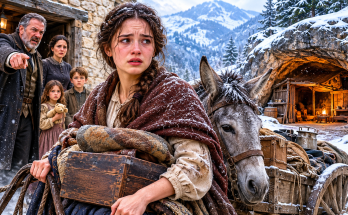
I thought about the morning Elias told me to leave.
He had stood beside a cold fireplace.
He had placed twelve dollars on the mantel.
He had spoken as though the matter were finished.
Now I was sitting beside another fireplace.
One that had nearly been buried beneath snow.
And beneath its stones, I had found evidence that a father had remembered his daughter long after losing her.
The contrast stayed with me.
I didn't know what would happen when I finally left the cabin.
I didn't know whether Greenwater would offer work.
I didn't know whether the gold would ever help me.
But I knew I wanted to carry forward the lessons of the people who had loved me.
Grandpa's patience.
Mama's care.
And the respect for memory that Silas's letter had awakened in me.
I looked toward the window.
The mountains were still white.
The road was still hidden.
For now, I would remain where I was safe.
I would guard the fire.
I would protect the letter.
And I would keep trying to make decisions that I could live with afterward.
I wasn't certain what destiny waited beyond the snow.
I wasn't even certain there was such a thing.
But I no longer believed that being turned away from Elias's house meant my life had lost its value.
I had survived.
I had learned.
And I still had choices to make.
I held the gray blanket close and watched the flames.
Then I looked at the old metal box.
Rose's name remained with me.
I intended to keep it that way.