I had never held another person's grief in my hands before.
Not like that.
The paper was old enough that I worried about tearing it every time I moved my fingers.
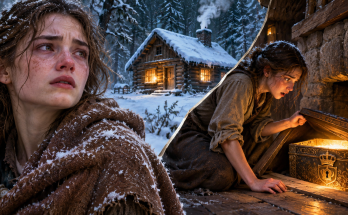
I sat close to the fire, with the metal box beside my knees.
The coins were still inside.
So was the hunting knife with the smooth antler handle.
And there was the letter.
Silas Croft.
I kept looking at his name.
I knew almost nothing about the man.
He had built the cabin in 1848.
He had a daughter named Rose.
And Rose had died before receiving the things he had saved for her.
That was what the letter had told me.
I looked toward the empty sleeping bunk.
Then at the broken furniture.
I wondered how many ordinary days Silas had spent inside those walls.
I couldn't know.
All I had were the things he had left behind.
I read the words about Rose again.
My eyes stopped at her name.
Rose.
Such a small name for so much sorrow.
I tried to imagine what she had been like, then stopped myself.
I had no right to invent a life for a child I had never known.
Perhaps she had been quiet.
Perhaps she had been lively.
Perhaps she had loved the cabin.
Perhaps she had never even seen it.
I didn't know any of those things.
What I knew was enough to make my throat tighten.
Her father had prepared something for her.
And she had never received it.
I looked into the box.
Twenty gold coins.
A beautiful knife.
Things that would have seemed extraordinary to a girl like me.
But the value of those objects had changed the moment I learned about Rose.
Before reading the letter, I had thought about what the coins could buy.
A room.
Food.
Time to look for work.
Now I wondered what Silas had imagined when he placed them there.
I couldn't answer that.
Still, the question stayed with me.
There was something painful about finding a gift after the person meant to receive it was gone.
It reminded me of the little sharpening stone in my bundle.
Grandpa had given it to me when I was eight.
At the time, I had thought it was simply another tool.
I hadn't realized how often I would reach for it after he died.
I hadn't realized that something so small could carry so much of a person.
The gold coins had been hidden beneath stone.
My sharpening stone had been wrapped in flannel.
Different things.
Different lives.
But both had been kept because somebody cared.
I placed the letter carefully on my lap.
Outside, the wind struck the cabin again.
The loose shutter rattled.
I looked toward the narrow window.
Snow was still blowing past it.
I remembered crawling through that opening.
My coat catching.
The wood tearing the fabric.
The fear that I wouldn't fit.
I had been so desperate to escape the storm that I hadn't cared whether the cabin belonged to anyone.
I had needed the walls.
I had needed the fireplace.
And now I was sitting inside someone else's past.
That bothered me.
Not because I regretted entering.
I would have died outside if I had kept walking much longer.
But I wished I could have asked permission.
I wished I could have told Silas that I wasn't there to take advantage of his home.
I was only trying to live through the night.
I looked down at the gold again.
That was the difficult part.
I had already imagined using it.
The thought had come so quickly.
Almost before I understood what I had found.
I was ashamed of that.
Then I remembered the twelve dollars Elias had given me.
I reached into my pocket and took out the envelope.
It was creased from being carried all day.
I opened it.
The money was still there, except for what I had spent on bread and cheese.
I counted what remained.
I didn't need the exact amount to understand the problem.
It wasn't enough to keep me safe for long.
Not without work.
I folded the envelope again.
Then I looked at the twenty coins.
I couldn't pretend the difference didn't matter.
One small envelope had sent me toward the mountains.
One hidden box might have kept me from having to make another desperate decision.
But the box wasn't mine.
I said that to myself.
Quietly.
I needed to hear it.
"The box isn't yours, Mary."
The words sounded strange in the empty room.
No one answered.
The fire cracked softly.
I thought about Elias.
If he had found those coins, I wondered what he would have done.
I knew what I believed.
But belief wasn't proof.
I didn't want to become the kind of person who decided that someone else's belongings were hers simply because she wanted them.
Grandpa had taught me to take care of tools.
He had also taught me to respect the work behind them.
When something was made well, he said, you didn't treat it carelessly.
I looked at the hunting knife.
The handle had been polished with obvious attention.
Whoever made it had taken time over the details.
I understood that much.
The knife hadn't simply appeared in the box.
Someone had worked on it.
Someone had cared how it felt in a hand.
I lifted it again.
It was beautiful.
I turned it slowly, examining the shape of the handle.
Then I put it back.
I didn't want to damage it.
I didn't even want to leave it lying on the dusty floor.
I spread a small section of my bundle cloth beside me and placed the box on it.
It was an unnecessary gesture, perhaps.
But it made me feel better.
I could at least treat the things carefully.
The letter still rested in my lap.
I brought it closer to the fire.
Not too close.
The paper was dry and old.
I was afraid a spark might reach it.
I read the opening again.
Silas Croft.
The date.
The cabin.
Rose.
I read slowly because I didn't want to miss anything.
The handwriting belonged to a person who had once sat somewhere, holding a pen, deciding what to leave behind.
That thought stayed with me.
When Mama was alive, I had rarely considered how much of a person could remain after death.
I knew about possessions.
Clothes.
Furniture.
Tools.
But a letter was different.
A letter allowed someone to speak when they were no longer there.
It didn't bring them back.
Nothing could.
Still, it preserved something that would otherwise be lost.
I wished my mother had left me a letter.
The thought came so suddenly that I began crying again.
I wished I had a page in her handwriting.
Something I could unfold whenever I missed her.
Something that told me what she hoped for my life.
I knew she loved me.
I didn't need written proof.
But I wanted something I could hold.
I wanted to hear her voice in words that wouldn't disappear.
Instead, I had her gray blanket.
I reached for its edge.
The wool was beginning to dry near the fire.
I touched the worn fabric.
I remembered my mother using it.
I remembered how ordinary it had seemed then.
Just a blanket.
Nothing precious.
Nothing anyone would have thought to hide in a metal box.
Now I would have guarded it with everything I had.
I wondered whether Silas had felt the same way about Rose's things.
I wondered whether he had ever sat in this room wishing for something small that she had touched.
Those questions hurt.
I looked away from the paper.
The flames had grown lower.
I needed to pay attention to the fire.
That was one thing I could control.
I reached for another piece of broken wood.
The stool had given me enough to begin.
The damaged chair offered more.
I examined one of its loose pieces before placing it on the flames.
It was dry enough to burn.
I fed it carefully into the hearth.
The fire brightened.
Warmth moved across my face.
I held my hands toward it.
The ache in my fingers had become easier to bear.
My feet still hurt.
I loosened my wet shoes.
They were difficult to remove.
The leather had stiffened in the cold.
When I finally pulled them off, I saw how damp my stockings had become.
I placed the shoes where the warmth could reach them without bringing them too near the flames.
Then I wrapped my feet in the blanket.
I felt ridiculous for being so relieved by such a small improvement.
But relief had become something very simple.
Dry feet.
A steady fire.
A place where the wind couldn't touch me.
I looked at the box again.
Gold couldn't have helped me if I had never managed to light that fire.
I would have died surrounded by something valuable.
The thought unsettled me.
For years, I had believed that having money meant having security.
Elias had money.
He had a comfortable house.
He had rooms kept warm through winter.
He had enough food.
Yet none of those things had made him generous.
My grandfather had possessed far less.
But he had given me knowledge that saved my life.
I didn't want to pretend money was unimportant.
That would have been foolish.
I needed it.
I needed shelter, food, and the chance to earn my living.
But I was beginning to understand that money alone didn't tell me what kind of person I wanted to become.
I looked down at my hands.
They were still red from the cold.
There were small marks from handling the broken wood.
They were my grandfather's hands in one important way.
Not in their size.
Not in their strength.
In what they knew how to do.
He had spent years teaching me, never knowing where those lessons might become necessary.
I thought about him placing the whetstone in my palm.
I remembered being proud that he trusted me with it.
I wished he could see me now.
Then I changed my mind.
I wished he could see me safe.
I didn't want him to know how frightened I had been.
I didn't want him to imagine me lying in the snow, trying to decide whether I had enough strength to stand.
I looked into the fire.
The orange light moved across the stones.
One stone still sat out of place.
The opening beneath it was dark now that the box had been removed.
I stared at the gap.
It was strange to think that I had found the treasure only because I was worried about embers reaching the floor.
If the stone hadn't moved forward, I might never have noticed anything.
I might have slept beside the fire and left in the morning without discovering the box.
Or perhaps I would never have survived long enough to examine the fireplace carefully.
Small things.
A loose stone.
A broken stool.
A piece of quartz.
Each had mattered.
Grandpa had always insisted that details were worth noticing.
I had sometimes grown impatient with him.
Now I was grateful.
I pulled the metal box closer.
I counted the coins once more.
Twenty.
I couldn't stop myself.
They seemed impossible.
I looked at them until the first excitement faded again.
Then I placed the hunting knife carefully above them.
The letter remained in my hand.
I wasn't ready to fold it away.
I wanted to understand what Silas had left.
Not merely what the objects were worth.
What they meant.
I knew that Rose had died before receiving them.
That fact changed everything.
I couldn't read her name without thinking of my mother.
And I couldn't think of my mother without remembering the cold way Elias had spoken about her.
It was almost unbearable that a man who had lived beside us for eight years could speak as though she had left no wishes worth honoring.
But a man I had never met had preserved the memory of his child inside a cabin.
I didn't know whether Silas had been kind in every part of his life.
I didn't know how he had treated other people.
All I knew was what the letter revealed about Rose.
He had remembered her.
And he had left those things hidden.
I held the paper carefully.
For the first time that evening, I didn't feel embarrassed by my tears.
I let them come.
Then I wiped my face.
The fire needed tending.
My clothes needed drying.
I needed to survive until morning.
There would be time to decide what to do about the box.
I wasn't going to make another important decision while exhausted and frightened.
I had done that in Pinewood.
I had taken the mountain road because I wanted an answer immediately.
I had nearly paid for that impatience with my life.
I wouldn't do the same thing again.
I set the coins and knife back inside the box.
I kept the letter close enough to read but safely away from the flames.
Then I sat beside the fire and watched the light move across the old stonework.
Silas Croft had left something beneath that fireplace for Rose.
I had found it because I needed shelter.
Those were the facts I knew.
Everything else would have to wait until I could think clearly.