I had never been very good at admitting when I wanted something badly.
Growing up with Elias had taught me to keep my wishes small.
If I needed something, I learned to ask carefully.
If he refused, I learned not to argue.
Sometimes I decided it was easier not to ask at all.
That habit followed me into the cabin.
Even alone, I felt ashamed of wanting too much.
I wanted food.
A warm room.
Safe clothing.
A place where I could sleep without fear.
And I wanted the gold.
I finally admitted that last part without trying to soften it.
I wanted it.
The twenty coins might have allowed me to begin again.
I had no reason to pretend otherwise.
But wanting something wasn't the same as having a right to it.
That was the trouble.
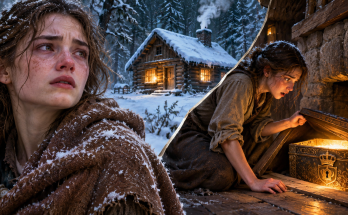
I sat beside the fireplace and looked at the metal box.
Its rusty latch seemed ordinary now.
I had opened and closed it so many times that the movement had become familiar.
I knew the weight of the lid.
I knew how the coins rested inside.
I knew where the letter had been folded.
And I knew the shape of the hunting knife's handle.
None of that made the contents mine.
I understood that.
But it didn't make the decision easier.
The cabin was quiet.
The wind had become less forceful for a while.
I could still hear it moving outside.
I hadn't seen enough of the road to trust the conditions.
So I remained indoors.
I was trying to be sensible.
That word had become important to me.
Sensible.
It was something I had not been when I left Pinewood.
I had been frightened and proud and determined not to spend my money.
I had mistaken that determination for good judgment.
Now I wanted to make a better decision.
I didn't know whether I would succeed.
I lifted the box.
It felt heavy against my knees.
I opened the lid and removed the letter.
I read the beginning.
Silas Croft had built the cabin in 1848.
His daughter Rose had died before she could receive the treasure.
I paused there.
Those facts were enough to change the meaning of everything beneath the paper.
I imagined how I might have felt if someone found Grandpa's sharpening stone after my death.
Would they understand why I kept it?
Would they know how much it meant?
Or would they see only a worn tool wrapped in old flannel?
I looked toward my bundle.
The stone lay inside.
I reached for it and unfolded the cloth.
The surface was smooth.
Years of use had changed its shape slightly.
I remembered Grandpa placing it in my palm when I was eight.
He had wanted me to learn how to care for tools.
He had wanted me to become capable.
I didn't know whether he imagined I would one day use those lessons in an abandoned mountain cabin.
Probably not.
But he had given me something that lasted.
I turned the stone over.
It was an ordinary object.
A stranger might have found it nearly worthless.
To me, it represented years of his patience.
That was why I couldn't judge Silas's gift only by its price.
The gold was valuable.
The knife was beautifully made.
But their meaning came from the person who had saved them.
I looked down at the letter.
Rose.
I wondered whether her father had ever imagined anyone else holding the objects.
I couldn't know.
The words I had read told me who they were intended for.
They didn't give me a complete answer about what should happen after Rose's death.
I wished they did.
I wanted a clear instruction.
Something that would free me from having to decide.
But I couldn't manufacture one.
I folded the letter along its old creases.
Then I placed it back inside the box.
I looked at the coins.
Twenty pieces of gold.
I wondered how many days of shelter they might represent.
I didn't know their exact value.
I couldn't make a reliable calculation.
But I knew they could buy more than the money Elias gave me.
That was enough to make them tempting.
I thought about the boarding house in Pinewood.
One dollar a night.
I had stood outside calculating how quickly my money would disappear.
I had been so afraid of becoming penniless that I refused to spend even one dollar on safety.
I wondered whether that decision would haunt me for years.
Perhaps it would.
Perhaps I would remember it whenever I saw snow falling.
I hoped I would at least learn from it.
I didn't want fear to rule every choice.
I wanted to become someone who could consider the consequences before acting.
I looked at the box again.
The temptation to use the coins wasn't wrong by itself.
I was hungry.
Homeless.
Without employment.
My circumstances were desperate.
But I still needed to consider where the money had come from.
I couldn't ignore Rose simply because she was no longer alive.
I thought about Mama.
If someone found her blanket years after I was gone, I hoped they would understand that it had mattered to someone.
I didn't expect them to know our whole story.
But I hoped they would treat it with care.
Perhaps that was all I could offer Silas.
Care.
Attention.
An unwillingness to erase the history of what he left.
It felt small beside twenty gold coins.
But it was something I could give honestly.
I closed the box.
Then I returned the whetstone to its flannel.
I set both near my bundle.
The fire was becoming low again.
I looked at the remaining wood.
There was so little.
I had already destroyed the stool and much of the chair to keep warm.
I couldn't regret it.
Those pieces had saved me.
But I needed to conserve what remained.
I moved nearer the hearth.
The warmth reached my hands.
My face still felt cold on the side turned away from the flames.
I adjusted the blanket.
Then I considered what I had learned about the cabin.
The walls were old but standing.
The roof sagged under snow.
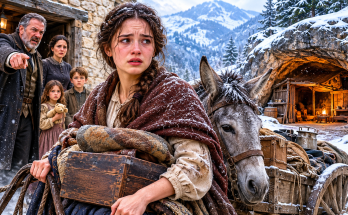
The door was frozen.
The window shutter was damaged.
The fireplace worked, though one stone had shifted.
It wasn't a comfortable place.
But it had offered me protection when nothing else did.
I wondered whether Silas had thought of the cabin as a home.
He had built it.
That much I knew.
I couldn't know what happened inside during his lifetime.
But I understood what it meant to put effort into making a place habitable.
Grandpa had taught me about timber.
I knew how much labor even a simple structure required.
Someone had to select wood.
Shape it.
Fit the pieces together.
Raise the walls.
Prepare the roof.
Arrange the stones of the hearth.
Each task demanded patience.
I thought about the hours involved.
I thought about the mistakes that might have needed correcting.
I thought about how carefully a person would have to work to build something that could endure mountain winters.
Silas had left behind more than a box.
He had left useful work.
Work that had saved me.
I felt grateful for that.
I also felt sad.
Because there was no one to thank.
I looked toward the fireplace.
The stones were dark with age.
I remembered trying to move the loose one.
The chair leg acting as a lever.
The opening appearing beneath it.
The cold metal box.
I hadn't known what I would find.
I hadn't even known the compartment existed.
Sometimes I wondered whether another person had passed through the cabin without noticing it.
Perhaps.
I couldn't know.
The thought reminded me how easily something important could remain unseen.
I had lived with Elias for eight years.
He had seen me every day.
He knew I was there.
He knew my mother loved me.
Yet when she died, he behaved as though I no longer mattered.
I had been visible to him.
But I hadn't been valued.
I didn't want to treat Rose that way.
I didn't want to look at her treasure and see only what I could gain.
I wanted to remember the person it was meant for.
Even if I never learned anything more about her.
I looked at the letter again.
It remained protected inside the box.
I wondered whether the words would have touched me so deeply if I had found them before losing Mama.
Perhaps not.
I had always understood that death was sad.
But understanding something in the abstract was different from waking up every morning with a person missing from the world.
I knew that now.
I knew how ordinary places could become painful.
A room.
A staircase.
A familiar blanket.
I knew how a person's absence could fill an entire house.
And I knew how badly someone could want a little evidence that love had not disappeared.
Silas's letter was that kind of evidence.
It made Rose's name visible.
It showed that her father had remembered her.
I couldn't ignore it.
I rested my head against the wall.
My eyes felt heavy.
I had spent so much time thinking that I was beginning to exhaust myself.
But I was afraid to stop.
If I stopped thinking about the treasure, would I simply decide to take it when the time came?
Would hunger become stronger than conscience?
I didn't know.
I didn't trust myself completely.
That was difficult to admit.
I wanted to believe I was a good person.
I wanted to believe Mama and Grandpa had raised me well.
But I also knew I was frightened.
And frightened people could make choices they later regretted.
I had proof of that.
The mountain road.
The snow.
The decision to keep walking when I should have sought shelter sooner.
I hadn't intended to put myself in danger.
But good intentions hadn't protected me.
I needed judgment.
Not merely hope.
I opened my eyes and looked toward the window.
The trees were still visible beyond the snow.
I wanted to leave.
I wanted to reach Greenwater and find work.
I wanted the next chapter of my life to begin.
But I couldn't force the weather to cooperate.
And I couldn't force a clear answer out of Silas's letter.
So I tried to do something simpler.
I accepted what I knew.
The coins were valuable.
The knife was carefully made.
The letter belonged with them.
The treasure had been intended for Rose.
She had died before receiving it.
And I had discovered the box while seeking shelter from a storm.
Those were the facts.
I could keep them separate from my wishes.
I could make a decision later without pretending the facts were different.
That seemed like progress.
Small progress.
But real.
I looked at the envelope Elias had given me.
It was still in my pocket.
I touched it through the fabric.
Then I looked at Grandpa's whetstone.
The two objects represented very different kinds of help.
Elias had given me money to make me leave.
Grandpa had given me a tool so I could learn to work.
I knew which gift had mattered more when I was freezing in the cabin.
That didn't make money useless.
It made the intention behind a gift important.
I thought about Silas again.
He had intended the treasure for Rose.
That intention remained part of it, even after her death.
I wouldn't forget that.
I reached for the box and made sure the lid was properly closed.
Then I placed it away from the hearth.
I didn't take a coin.
I didn't remove the knife.
I didn't separate the letter.
Everything remained together.
I sat back.
The decision was not permanent.
I still had to find a way forward.
But I had chosen not to let my immediate fear settle the question.
I felt a little lighter.
Not happy.
Not secure.
Just less hurried.
I could still be hungry and careful.
Still frightened and thoughtful.
Still desperate for a home without pretending someone else's history didn't matter.
I had never known those things could exist together.
I looked toward the fire.
Its small flame moved across the last pieces of wood.
I held my hands toward it.
Then I thought about Rose.
A little girl whose father had left something precious for her.
I couldn't give her the life she had lost.
I couldn't return her to Silas.
I couldn't change what happened before I was born.
But I could keep her name connected to the things he had saved.
For now, that was what I would do.