The longer I stayed in the cabin, the more I thought about what a home really was.
I hadn't expected that.
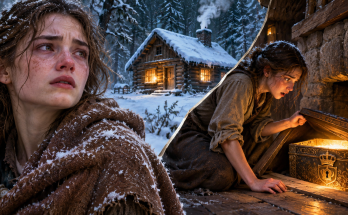
When I first saw the roof between the pines, I cared only that it might keep me alive.
I didn't ask who had lived there.
I didn't wonder who had built the walls.
I didn't think about whether the place had ever been happy.
I wanted shelter.
Nothing more.
But after finding Silas Croft's box, the building felt different.
It had a name attached to it.
A date.
A history.
And the memory of a child who had never received her father's gift.
I sat beside the fireplace and looked around.
The cabin wasn't comfortable.
The roof sagged beneath snow.
The window shutter was damaged.
The door was frozen.
The furniture was broken.
Yet I had felt safer there than I had felt during my final morning in Elias's house.
That was difficult to accept.
His house had everything a person might expect from a proper home.
A solid roof.
Warm rooms.
Furniture that wasn't falling apart.
Enough food.
But it had lacked something I hadn't known how to name when Mama died.
A sense that I belonged.
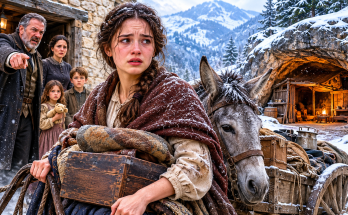
I looked at the gray blanket around my shoulders.
It was worn and thin.
Yet I would rather have kept it than any fine blanket Elias owned.
It had belonged to my mother.
That made it precious.
I remembered the last time I saw her coffin.
The frozen earth.
The terrible feeling of finality.
I had believed the hardest part of losing her would be learning to live without hearing her voice.
I hadn't understood that her death would also change my place in the world.
As long as Mama lived, Elias tolerated me.
After she died, he decided his obligation was over.
That was how he saw it.
Eight years in the same house.
Eight years of ordinary days.
And then an envelope with twelve dollars.
I could still remember where he placed it.
On the mantelpiece.
Beside the cold fireplace.
I thought about that while watching the flames in Silas's hearth.
Two fireplaces.
One in a comfortable house.
One in a nearly buried cabin.
Beside the first, I had been told I no longer had a home.
Beside the second, I had found a letter showing that someone had once loved a child enough to preserve a gift meant for her.
The contrast hurt.
But it also made me think.
Perhaps a home wasn't simply the place where someone allowed you to sleep.
Perhaps it was the place where your existence mattered.
I didn't know how to put that thought into words then.
I only knew that the cabin had sheltered me without demanding anything.
Of course, it was a building.
It had no intentions.
It hadn't chosen to help me.
Silas had built it years before I was born.
But his work had remained useful.
And that usefulness had saved my life.
I thought about Grandpa.
His lessons had done the same.
He had taught me to work with wood.
To recognize damage.
To sharpen blades.
To remain patient when something didn't go right the first time.
He had never known that an abandoned mountain cabin would someday require those skills.
Yet they had helped me survive.
I looked at my hands.
The scratches were beginning to feel less painful.
They were still there.
Small marks from the broken shutter and the furniture I had used for fuel.
I flexed my fingers.
Then I rubbed my palms together.
The movement reminded me of the night I had entered.
My hands had shaken so badly that I struggled to grip the steel striker.
I had been frightened by how little control I had over them.
Now I could handle the letter carefully.
I could lift the box.
I could tend the fire.
It seemed such an ordinary improvement.
But I was grateful for it.
I thought about the snowbank where I had fallen.
I had wanted to rest.
Just for a moment.
I had almost allowed myself to close my eyes.
I still remembered that temptation.
The strange ease of doing nothing.
The feeling that standing again would require more effort than I possessed.
I was afraid to think about what might have happened if I had stayed there.
I didn't need to imagine it in detail.
I knew enough.
I had been in serious danger.
And I had survived only because I forced myself to move.
I looked toward the window.
The two pines remained outside.
They were partly hidden by snow.
I wondered whether I would recognize them when I eventually left.
I hoped so.
I wanted to remember the place where I had found shelter.
But I didn't want to remain trapped there.
That was the difficulty.
The cabin was safe compared with the blizzard.
It wasn't a permanent answer.
I had little food left.
The fuel was running low.
The door remained blocked.
And I still didn't know the way to Greenwater.
I couldn't make a life inside those walls simply because I was grateful for them.
I needed to leave when it became safe.
I needed to find people.
I needed work.
I needed the chance to support myself.
I looked at the metal box.
The gold might make some of those things easier.
But I had not yet decided whether I could use it.
The letter continued to trouble me.
Not because I disliked what it said.
Because it made the treasure personal.
Before finding the paper, I had seen only coins and a fine knife.
After reading it, I saw a father and a daughter.
I couldn't go back to ignorance.
I lifted the box onto my lap.
The rusted latch opened with a small sound.
Inside were the twenty coins.
I counted them again.
I knew the number.
Still, I wanted to be certain.
Twenty.
I looked at the hunting knife.
The antler handle was polished.
Its shape reminded me of the tools Grandpa had admired.
Then I reached for the letter.
I unfolded it slowly.
The old paper rested against my fingers.
I read the name Silas Croft.
I read the date 1848.
I read about Rose.
The words had become familiar.
But the feeling they produced hadn't disappeared.
I was still moved by the thought of a child who had died before receiving what her father had saved for her.
I thought about Mama.
I had been fortunate to know her for eighteen years.
Rose's life had ended before her father could give her the treasure.
I didn't know how long she had lived.
I didn't know what she had enjoyed.
I didn't know whether she had ever entered this cabin.
The letter, as far as I had been able to understand it, didn't give me those answers.
I wouldn't invent them.
But I could recognize the sorrow.
I could respect the love.
And I could preserve the objects that remained.
I set the letter carefully on my lap.
I wondered whether Silas had expected it to be found.
Perhaps he had wanted someone to understand.
Perhaps he had simply needed somewhere to place the gift he could no longer give.
I didn't know.
I couldn't decide his intentions for him.
That uncertainty was frustrating.
I wanted the letter to tell me exactly what to do.
Take the gold.
Leave the gold.
Carry the knife.
Return the box.
Something definite.
But the facts I knew didn't provide a simple instruction.
I had to accept that.
I couldn't manufacture a command merely because I needed one.
I folded the letter.
Then I placed it back inside the box.
I felt the familiar temptation to reach for the coins.
I resisted.
Not because I believed hunger was noble.
It wasn't.
I had been hungry enough to understand how quickly pride became meaningless.
But I wasn't going to use that hunger to pretend the treasure had no history.
I closed the box.
Then I set it aside.
I thought about Greenwater.
The settlement beyond the western mountain pass.
I had chosen it because I hoped somebody there needed help.
Perhaps a cook.
Perhaps a housekeeper.
Perhaps a person who could repair furniture or sharpen tools.
I didn't know whether those opportunities existed.
I had imagined them because I needed hope.
That was another thing I was beginning to recognize about myself.
I often turned possibilities into expectations.
Then I felt betrayed when they didn't happen.
I had expected Elias to keep caring for me after Mama died.
He hadn't.
I had expected Pinewood to offer work.
It hadn't.
I had expected the mountain road to remain passable.
It hadn't.
I didn't want to stop hoping.
But I needed to stop mistaking hope for knowledge.
There was a difference.
I looked at the sharpening stone.
Grandpa had never allowed me to pretend a damaged piece of wood was sound simply because I wanted to use it.
He made me examine it.
He made me test the joints.
He taught me to trust evidence more than wishes.
I needed that lesson now.
The weather was still uncertain.
I couldn't assume the road was safe.
The box contained valuable objects.
I couldn't assume they belonged to me.
Greenwater might offer work.
I couldn't assume someone would hire me.
I had to proceed carefully.
One fact at a time.
One decision at a time.
I was beginning to understand why Grandpa had always worked that way.
I reached for the remaining bread.
There wasn't much.
I broke off a small piece.
I ate slowly.
The hard cheese was nearly finished too.
I looked at the food left in my bundle.
I didn't know how many more meals it would provide.
That worried me.
But worrying wouldn't make it grow.
I wrapped it carefully.
Then I put it away.
I checked the fire.
The remaining wood was almost gone.
I had to be sparing.
I moved closer to the hearth so I could benefit from the warmth without feeding it unnecessarily.
The flames were smaller than before.
But they remained alive.
I watched them.
I remembered the first little ember.
How easily it might have died.
How carefully I had blown across it.
How patiently I fed it the smallest splinters.
I wondered whether my future would be like that.
Fragile at first.
Dependent on careful attention.
Not something that could become strong immediately.
The thought comforted me.
I didn't need to transform my life in a single day.
I needed to keep it from going out.
I smiled faintly at my own comparison.
Grandpa might have appreciated it.
Or he might have told me to stop thinking and add another piece of wood.
I almost heard his voice.
Then I remembered he wasn't there.
The sadness returned.
I missed him.
I missed Mama.
I missed having someone I trusted nearby.
The cabin was quiet.
No one spoke.
No one moved in the other room, because there was no other person.
I was alone.
I had been alone since Elias closed the door behind me.
I couldn't pretend otherwise.
But I was learning that being alone didn't mean I had no connection to the people I loved.
Grandpa's whetstone remained in my bundle.
Mama's blanket remained around my shoulders.
Their lessons and care still affected what I did.
That was real.
I didn't need to imagine them standing beside me.
I could remember what they had given me.
And I could use it.
I looked toward the fireplace stone.
The hidden opening remained beneath it.
I remembered finding the box there.
I wondered whether the compartment had been made especially for the treasure.
Its shape suggested deliberate use.
But I couldn't know all the details.
What mattered was that the box had been preserved.
The letter had survived.
And I had found it.
I thought about the first words I read.
Silas Croft had named himself.
He had recorded the year he built the cabin.
He had left evidence that he existed.
Then he wrote about Rose.
Her name had survived with his.
I didn't know whether anyone elsewhere remembered them.
Perhaps nobody did.
Perhaps their names were still known to someone.
I couldn't answer.
But inside the cabin, I knew them.
That mattered to me.
I had spent the last two months afraid that Mama would be forgotten.
Elias spoke about her as though her wishes no longer mattered.
I couldn't bear that.
I wanted her life to mean more than the fact that she was gone.
I wanted to remember the way she cared for me.
The things she taught me.
The ordinary days we spent together.
I wanted to carry that memory into whatever life came next.
Perhaps that was why Silas's letter affected me so strongly.
He had refused to let Rose become merely an absence.
He had written her name.
He had preserved the things intended for her.
And years later, a stranger had found them.
I couldn't say whether that fulfilled his hopes.
I didn't know what his complete intentions had been.
But I knew the letter had made me care about someone I had never met.
I looked at the metal box.
I no longer saw it simply as an answer to my poverty.
It was part of another family's history.
I wanted to respect that.
I couldn't promise I would never need the gold.
My situation was too uncertain for such a promise.
But I could promise myself that I would not treat Rose as unimportant.
I would not separate the letter from the things it explained.
I would not pretend the treasure had appeared without a past.
And I would not make my decision simply because I was frightened.
I pulled the blanket closer.
The fire was low.
The wind moved outside.
I listened for a while.
The shutter rattled once.
Then settled.
I thought about the day ahead, though I couldn't tell exactly how much daylight remained.
I would continue watching the weather.
I would conserve the food and fuel.
I would protect the box.
And when it became safe to move, I would try to find the road again.
That was the plan I could honestly make.
I didn't know whether I would reach Greenwater.
I didn't know whether anyone would employ me.
I didn't know what Silas Croft had hoped would happen to his treasure after Rose's death.
I knew only the things already before me.
The cabin.
The fire.
The letter.
The twenty coins.
The hunting knife.
The memories of Mama and Grandpa.
And my own responsibility to choose carefully.
I looked at the little sharpening stone wrapped in flannel.
For years, I had thought it was a gift that helped me work.
Now I understood that it had also taught me how to face uncertainty.
Observe.
Think.
Try.
Correct your mistakes.
Keep going.
I placed my hand on the bundle.
Then I turned toward the hearth.
The flames were still there.
Small.
Steady.
I didn't know what my life would look like beyond those mountains.
But I knew I wanted to build it with the same care Grandpa had taught me to give a piece of wood.
I had been thrown out because Elias believed his duty to me had ended.
I didn't want that to be the final measure of my worth.
I wanted to become someone who could work.
Someone who could make a home.
Someone who would remember the people who had loved her.
And someone who could find another person's grief beneath a fireplace without forgetting that it belonged to a real life.
I watched the fire until my eyes grew tired.
The box remained closed beside my bundle.
Its contents were safe.
For now, that was enough.
I still had to survive the mountain.
And I still had to discover what came after it.
But I was no longer willing to believe that the loss of one home meant I would never have another.
I had not found that home yet.
I knew that.
Still, I could begin making the choices that might someday allow me to build one.