I looked at the cabin differently after that.
Not because the room had changed.
It hadn't.
The logs were still old.
The roof still sagged.
The window shutter still hung crookedly.
The sleeping bunk remained rough and uncomfortable.
But I had stopped seeing the building as merely a place where I had escaped the wind.
Someone had built it.
Someone had worked on every wall.
Someone had arranged the stones around the fireplace.
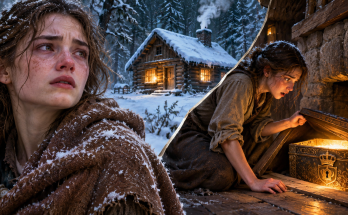
And someone had hidden a box beneath one of them.
I found myself wondering what the cabin had meant to Silas.
I didn't have enough information to know.
That bothered me at first.
Then I realized I had been asking the wrong question.
I didn't need to know everything about the man to respect the things he had left.
I could appreciate the work.
I could protect the letter.
I could leave the box intact.
And I could be grateful that his cabin had sheltered me.
Those were things I could actually do.
I stood near the fireplace and looked at the stonework.
The fire was smaller now.
I had to conserve the remaining wood.
I used the broken chair leg to move a piece closer to the center.
Then I set the leg aside.
The heat warmed my face.
I remembered lying on the floor when I first entered.
I had been so cold I could barely move.
The idea of standing there calmly examining the fireplace would have seemed impossible then.
I thought about how close I had come to surrendering outside.
The snowbank.
The heavy feeling in my legs.
The overwhelming desire to sleep.
I didn't like remembering it.
But I made myself.
Not to frighten myself.
To understand what had happened.
I had almost stopped because I believed I couldn't continue.
Then I remembered Grandpa's advice.
Focus on the next useful thing.
I had stood.
I had taken another step.
Then another.
Eventually, I saw the cabin.
It sounded simple when I thought about it that way.
But there was nothing simple about what it had cost.
I looked at my hands.
They had been almost useless when I crawled through the window.
Now I could flex them.
Grip the chair leg.
Hold the letter.
Count the coins.
I was grateful for ordinary movement in a way I had never been before.
I wondered whether I would remember that feeling once I reached safety.
Would I go back to taking warm rooms for granted?
Would I complain about cold mornings without remembering the mountain?
I didn't know.
I hoped not.
I sat on the bunk.
The boards creaked.
I pressed my palms against the rough surface.
Grandpa would have inspected the joints before trusting it.
I had done that already.
Still, I checked again.
It was a habit I wanted to keep.
Careful work.
Careful choices.
He had repeated those lessons so often that I sometimes grew tired of hearing them.
Now I wished I could hear his voice one more time.
I imagined him asking what I had learned.
I would have had plenty to tell him.
I had learned that a mountain road could disappear beneath snow.
I had learned that being young and determined didn't make me safe.
I had learned that twelve dollars could vanish quickly when a person had no income.
I had learned that a broken stool might be worth more than money when there was no fire.
And I had learned that finding something valuable didn't automatically make it yours.
I wondered which lesson he would consider most important.
Perhaps he would tell me they all mattered.
I looked toward the box.
It remained on the folded cloth.
The letter inside it had changed the way I thought about the treasure.
Before reading it, the coins seemed like an answer.
Afterward, they became a responsibility.
I still found that difficult.
Part of me resented it.
That was the truth.
I had suffered.
I had been abandoned.
I had nearly died.
Then I found something that might have made my life easier, and I couldn't enjoy it without feeling troubled.
I wanted the world to be simpler.
I wanted to find gold and feel happy.
I wanted to believe the cabin had appeared because I deserved a little kindness after everything that had happened.
But life didn't work that way.
The cabin had existed long before I needed it.
The gold had been hidden for reasons that had nothing to do with me.
Silas had never known my name.
Rose had never known I would sit beside her father's fireplace.
I wasn't the center of their story.
I was simply the person who found what remained.
That realization humbled me.
It also relieved me.
I didn't have to pretend the treasure had been placed there for my benefit.
I could be grateful for surviving without making everything that happened into some grand explanation.
I thought about the title of my own life, if such a thing existed.
An eighteen-year-old girl turned out of her home.
A journey toward Greenwater.
A storm.
A cabin.
A box.
Those were the events.
What they meant would depend on what I did next.
I didn't know whether I believed in destiny.
I had never spent much time thinking about it.
Grandpa had been more interested in work than in grand ideas.
Mama had cared about keeping us together.
Elias cared about his house and his responsibilities, at least as he understood them.
And I had spent most of my life trying to belong somewhere.
Now the word destiny seemed far too large for my situation.
I needed breakfast.
I needed dry shoes.
I needed employment.
Those needs were real.
They didn't become less important because I had found a mysterious box.
I reached for my food.
There was little left.
I divided it carefully.
One portion for now.
The rest for later.
I ate beside the fire.
The bread was hard.
The cheese had become cold.
I didn't complain aloud.
I knew how fortunate I was to have anything.
Afterward, I drank nothing because I had nothing to drink.
I thought about that problem.
I needed water.
The mountains were covered in snow, but being surrounded by snow wasn't the same as having safe drinking water ready.
I would need to think about how to obtain it without exposing myself to the storm.
I looked toward the fireplace.
Heat could melt snow.
That was obvious.
But I had no proper container suitable for the fire among the things I had found.
I examined what was available.
The metal box wasn't an option.
I wouldn't risk heating Silas's letter or damaging the container that protected it.
I didn't see anything else I trusted for the purpose.
I was frustrated.
Then I reminded myself not to invent solutions where the necessary materials weren't available.
I had to work with what I actually possessed.
I could endure the moment while I continued assessing the cabin.
I could avoid unnecessary movement.
And I could remember that leaving shelter during a storm carried its own dangers.
I looked through the room again.
Not searching for treasure.
Searching for ordinary usefulness.
The broken furniture had been obvious.
The bunk was still sound enough.
The fireplace worked.
The window offered an entrance, though it allowed cold air inside.
The front door remained frozen shut.
I studied the door from within.
I remembered pushing against it outside until my shoulder hurt.
Now I could see its inner surface.
The wood looked old.
The frame had settled.
Snow was packed against the other side.
I wondered whether it would become easier to open when the weather improved.
Perhaps.
But forcing it now might damage the frame.
I didn't want to do that.
The window had been enough to enter.
I hoped I wouldn't have to use it again.
I looked at the torn place in my coat.
The rough wood had caught the fabric.
I ran my fingers along the damage.
It wasn't beautiful.
It wasn't even neat.
But it was a problem I understood.
Cloth could sometimes be mended.
My mother had repaired clothing when it wore thin.
I had watched her.
I didn't possess everything needed for a proper repair.
So I didn't pretend I could make one immediately.
I simply folded the damaged edge inward to reduce how much it caught when I moved.
That was a small improvement.
I would need a better solution when I reached people.
The thought of reaching people made my stomach tighten.
I still remembered the refusals in Pinewood.
The shopkeeper.
The stables.
The boarding house.
The saloon.
I had walked from one place to another, asking for any work that was available.
Nobody had hired me.
What if Greenwater was the same?
What if I survived the mountain only to find another town where there was no place for me?
I closed my eyes.
I didn't want to think about it.
But avoiding the question wouldn't make it disappear.
I needed a plan.
Not an elaborate plan.
Something I could actually follow.
First, I had to remain alive until the weather improved.
Then I needed to find the road.
After that, I could continue toward Greenwater if it was safe.
Once there, I could ask for work again.
I would tell people what I knew how to do.
Cooking.
Cleaning.
Repairing simple wooden things.
Sharpening tools.
I would ask whether anyone needed help.
And if they refused, I would keep looking.
That was all I could promise myself.
I couldn't guarantee success.
But I could guarantee effort while I had the strength to offer it.
I looked at Grandpa's whetstone.
It lay inside its flannel beside my bundle.
I thought about bringing it with me to the next place I asked for work.
Perhaps someone would believe I could sharpen a tool if I showed them the stone.
Perhaps not.
It was worth considering.
I smiled faintly.
Grandpa had given me a practical gift.
Even now, years after his death, it might help me earn a living.
I wondered whether Silas had imagined something similar when he prepared the knife for Rose.
Perhaps he wanted her to possess something useful.
Perhaps he simply thought it beautiful.
I didn't know.
I refused to make up an answer.
I looked at the antler handle through the open box.
The knife was still there.
It had been preserved carefully.
I wondered how it would feel to use such a fine tool.
Then I closed the lid.
It wasn't mine to practice with.
That simple decision gave me a little peace.
I didn't need to settle every question to behave carefully.
I could leave the knife untouched.
I could keep the coins together.
I could protect the letter.
And I could focus on surviving.
The light beyond the window remained dull.
Snow drifted across the glassless opening behind the damaged shutter.
I couldn't tell whether it was morning, afternoon, or simply a darker moment in the storm.
I had lost track of the hours.
That troubled me less than it had before.
I couldn't control time.
I could only use it.
I checked the fire.
I adjusted the blanket.
I rested when my legs ached.
I watched the roof and listened for changes in the wind.
I didn't do anything remarkable.
But ordinary care was keeping me alive.
I thought about Elias's house.
There had been comfort there.
Enough food.
A solid roof.
Rooms where I could sleep without fear of the weather.
But there had also been a man who had decided I no longer belonged.
Now I was inside a damaged cabin that offered almost none of those comforts.
And yet, for the first time since Mama died, nobody was telling me that my presence was unwanted.
That realization hurt.
I had become grateful for a place that couldn't reject me.
The thought was so sad that I sat still for a long time.
Then I looked around again.
The cabin wasn't a person.
It couldn't love me.
It couldn't choose to protect me.
But its walls had protected me anyway.
Silas had built something useful.
And long after he was gone, that work still mattered.
Perhaps that was the most important lesson I could take from him.
A person's actions could continue affecting others long after they were absent.
Grandpa's lessons had saved my life.
Mama's blanket had helped me through the cold.
Silas's cabin had given me shelter.
Their kindness, work, and care remained in the world in different forms.
I wanted to leave something useful behind someday.
Not necessarily a cabin.
Not necessarily money.
Just something that might help another person when they needed it.
I had never thought about my future that way before.
I had been too busy wondering whether anyone would let me stay.
I looked toward the old fireplace.
The flames were small but steady.
I felt their warmth against my hands.
For a moment, I allowed myself to imagine a life beyond Greenwater.
A place earned through work.
A room where I could shut the door without fear.
A table I had repaired myself.
A fire I could tend without worrying that somebody would order me out before noon.
It wasn't a grand dream.
But it was mine.
I opened my eyes fully and looked at the room around me.
Nothing had changed.
I was still in the cabin.
Still waiting for the weather.
Still hungry.
Still uncertain.
But the dream had given me a reason to keep planning carefully.
I didn't need to know my entire future.
I needed to make the next useful decision.
And I could do that.