The first time I looked at Cross Ridge without thinking about what we had lost, I almost felt guilty.
The sky was clear.
The trees stood quietly.
The ground was drying after the storm.
From the unfinished house, I could see the slope descending toward the cedar grove.
Beyond it lay the land Dmitri had purchased.
Forty-two acres.
I had repeated that number so many times that it had begun to feel like part of my own name.
But I had not yet understood what it meant to stand there.
The property was not just a line on a document.
It was earth.
Trees.
A spring.
An old orchard.
A place where my children could stand without wondering whether the bank would tell us to leave.
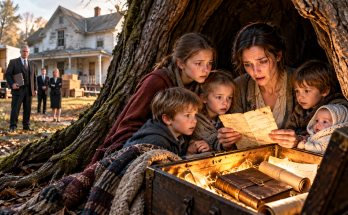
I looked toward the cedar.
Its great trunk was still visible.
The broken branch lay beside it.
I remembered the storm.
The creek rising.
Water entering the hollow trunk.
Luke shouting.
The violent crack.
I closed my eyes.
I could still feel the terror of that moment.
Sometimes I thought the memory would remain sharper than anything else that happened on Cross Ridge.
Then I remembered the cellar.
The boxes.
The deed.
The iron key.
The passage.
The unfinished house.
The same land held both fear and hope.
I was learning to accept that.
I stood beside the window opening for a long time.
The children were behind me.
I could hear them moving around our little resting place.
They had begun to recognize the safest parts of the unfinished room.
They knew where we kept the blankets.
Where the notebook rested.
Where the gifts were placed.
Those things were not enough to make the building complete.
But they made it feel less strange.
I listened to Anna speaking to Luke.
Peter answered a question.
Julia moved quietly nearby.
The baby made a small sound.
I counted them without looking.
Five.
I smiled at myself.
I doubted I would stop doing that soon.
Perhaps I never would.
I turned toward the room.
Julia was looking at the plans again.
She had become interested in the drawings.
I was careful not to let that become another responsibility she felt obliged to carry.
But I could see that understanding them gave her comfort.
She pointed to one of the windows.
“Mother, is this the same opening?”
I moved closer.
I studied the page.
The lines matched the shape.
“Yes.”
She smiled.
“I thought so.”
I looked at her.
Her father's letter lay inside the carved jewelry box beside her.
I wondered whether she had begun to understand its message.
That she could help without being responsible for everything.
That she could be strong without hiding her needs.
I hoped so.
I was still learning the same lesson.
Peter came over.
He looked at the drawing.
“Father measured all of this?”
“He wrote the measurements.”
Peter looked around.
“That's a lot.”
“Yes.”
He seemed impressed.
I understood why.
The notebook was thick with calculations.
Dmitri had spent time planning the building.
He had not simply imagined a house and hoped it would appear.
He had measured.
Corrected.
Listed materials.
Worked out how pieces should fit together.
I thought of the sawmill.
The long nights.
The repairs.
The sharpening jobs.
The money he saved.
Each part of the unfinished house represented hours I had not fully understood.
I felt grateful.
Then sad.
Then angry.
The feelings came so quickly that I no longer tried to separate them.
I watched Peter return to his boat.
He placed it carefully beside the blankets.
The small wooden object looked almost insignificant against the unfinished structure.
Yet it had something the house lacked.
It was complete.
I wondered whether Dmitri had finished the children's gifts because he knew they mattered in a different way.
Perhaps he had needed to make something he could complete with his own hands.
I did not know.
I would never know.
I reminded myself not to turn guesses into memories.
I had already spent too much time trying to imagine conversations that had never happened.
What I knew was enough.
He had prepared the gifts.
He had written the letters.
He had purchased the land.
He had left the plans.
He had made the passage accessible with the iron key.
Those facts were real.
I could build my decisions around them.
Anna came toward me with the music box.
“Can I put it by the window?”
I looked at the opening.
The weather was calm, but the space was unfinished.
I did not want her gift exposed.
“Not too close.”
She nodded.
We chose a safer place nearby.
She opened the lid.
The lullaby began.
I listened.
It no longer made me cry every time.
That surprised me.
I still missed Dmitri.
The song still reminded me of him.
But it had begun to belong to this place too.
I thought that was how a new home might slowly grow around old memories.
Not by replacing them.
By making room for them.
Luke came over with his horse.
He placed it beside the music box.
Then he stepped back to look.
I smiled.
He had found a place for his father's promise.
A small wooden horse with a black mane.
Not the living horse Dmitri had once mentioned.
But something made for him.
Luke seemed satisfied.
I wondered whether he would remember the promise when he was older.
Perhaps he would remember the little horse instead.
I hoped the memory would be gentle.
I looked toward the baby.
The knitted blanket had become one of our most familiar possessions.
I had carried it through the passage.
Used it during the storm.
Wrapped it around the baby in the unfinished house.
It was no longer simply a gift hidden in a box.
It had become part of our days.
I touched its edge.
Dmitri had wanted the baby to be warm.
Such a simple wish.
Such an ordinary act of love.
I thought of all the things he had tried to provide.
Food.
Shelter.
Land.
A future.
He had approached those needs with the skills he had.
Work.
Planning.
Building.
Saving.
But he had failed at something just as important.
Speaking.
I could see that more clearly now.
His silence had not protected me from fear.
It had left me unprepared for it.
When the bank took the farmhouse, I had not understood how we had reached that point.
When I found the notebook, I had to learn the truth from paper.
When I found the deed, I discovered property I had owned without knowing it.
When the storm came, I followed instructions left by a man who could no longer explain them.
I was grateful those instructions existed.
But I wished he had trusted me with the whole story while he lived.
I looked at Julia.
She was helping Anna settle the music box.
I watched the two girls speak quietly.
I thought about what I wanted them to remember from all of this.
Not simply that their father had hidden a house.
Not simply that the bank had taken our old home.
I wanted them to know that a family could be frightened and still speak honestly.
That love did not have to mean bearing everything alone.
That mistakes could be admitted.
That help could be accepted.
I had not learned those lessons easily.
Perhaps Dmitri had never fully learned them.
But I could begin now.
I sat beside the notebook.
The first message remained where I had read it so many times.
I no longer needed to examine every line.
I knew what he had tried to say.
He had failed to tell me the truth.
He hoped he had still managed to protect us.
I looked around.
In one sense, he had.
The cellar had given us shelter when the cedar became dangerous.
The passage had led us above the flood.
The house had stood through the storm.
The deed had proved that we owned the land.
But protection was not the whole story.
We still had to live.
We still had to make decisions.
We still had to face uncertainty.
And we still had to grieve.
I closed the notebook.
I looked at the house again.
The unfinished walls did not embarrass me as much as they once had.
At first, I had seen them as proof that Dmitri had died before completing his promise.
Now I saw something else.
A beginning.
Not a finished answer.
Not a miracle that made every difficulty disappear.
A place where work could continue.
I thought of the old farmhouse.
I would always miss it.
The rooms.
The familiar sounds.
The doorway.
The years we had spent there.
I could not pretend Cross Ridge was the same.
It wasn't.
The old house held a lifetime of memories.
This one held the possibility of making new ones.
I had to learn how to live with both.
Outside, the cedar stood in the sunlight.
Its broken branch remained on the ground.
I looked at it for a long time.
The tree had not become worthless because one part of it had fallen.
It was damaged.
Still standing.
Still rooted in the earth.
I wondered whether that was what our family looked like now.
Dmitri was gone.
The farmhouse was gone.
Something had broken that could never be repaired in the same way.
Yet we remained.
I almost laughed at myself for thinking in such grand terms.
I was not a woman who usually spoke about trees as if they could teach me anything.
I was a mother trying to keep five children safe.
But Cross Ridge had changed the way I looked at ordinary things.
A wooden hatch.
A triangle of stones.
A small iron key.
A folded deed.
A half-built wall.
Each had seemed unimportant until I understood what it meant.
I looked toward the passage door.
The cellar remained below.
I still wanted to inspect the supplies.
The water had receded from the grove, but I had not yet decided that the passage was safe.
I would wait until I could examine it without putting the children in danger.
I had learned not to rush simply because uncertainty made me uncomfortable.
That was a difficult lesson.
I wanted answers.
I wanted them immediately.
But wanting something did not make it wise.
I turned back toward the family.
Peter was looking at the notebook.
Anna had closed the music box.
Luke held his horse.
Julia was arranging the little wooden boxes.
The baby slept.
They looked ordinary for a moment.
Not like children who had survived a terrible storm.
Not like children who had lost their father and their farmhouse.
Just children keeping their favorite things close.
I wanted that ordinary feeling to last.
I knew it would not always.
There would be difficult days.
There would be questions I could not answer.
There would be moments when I missed Dmitri so much that I could barely speak.
But there would also be small moments like this.
A song.
A carved boat.
A little horse.
A blanket.
A daughter studying her father's handwriting.
I sat among them.
Nobody asked me to explain the future.
Nobody needed a promise.
For a little while, we were simply together.
I looked at the notebook.
Hope.
I had been thinking of that word as something Dmitri left behind.
Now I understood that what happened next could not belong only to him.
He had bought the land.
He had begun the house.
He had prepared what he could.
But he was no longer here.
The responsibility had passed to me.
And one day, the children would help shape their own lives here too.
I could not finish Dmitri's story exactly as he had imagined it.
I did not even know everything he had imagined.
But I could carry forward what was useful.
I could learn from what had gone wrong.
I could let the children be children while giving them room to help.
And I could make choices without hiding every fear.
I looked out toward the cedar one last time.
Then I turned back to the unfinished walls.
We were not ready to call the work complete.
There were still too many things to examine.
Too much we did not know.
But for the first time, I was not waiting for Dmitri to return and tell me what to do.
I was ready to begin making the decisions myself.
Source: news1.shoptonytv.net