I had thought the worst silence in the world was the one that followed a funeral.
Then I spent a night listening to my children breathe inside a hollow tree.
Nobody asked for anything impossible.
That almost made it harder.
The baby needed tending.
Luke needed reassurance.
Anna wanted to know whether we would be staying beneath the cedar again.
Peter was already thinking about the things we might need.
Julia watched my face every time I spoke.
I wished she would stop.
I wished she could be a child without feeling responsible for the rest of us.
But she had seen too much.
We all had.
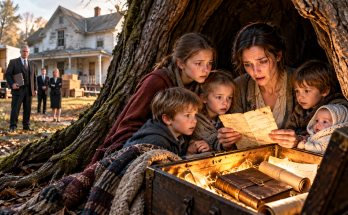
Morning light entered through the opening in the trunk.
It reached only part of the space where we had slept.
The rest remained dim.
The cedar was larger inside than it looked from a distance.
I kept noticing that.
Its wood was rough and uneven, shaped by years I could not imagine.
Some parts of the trunk were worn smooth.
Others caught at my clothing when I brushed against them.
I moved carefully while the children began to stir.
I still had no proper answer to the question of where we would go.
I looked toward the farmhouse in my mind, though it was no longer within sight.
I knew the bank's decision had not changed overnight.
I knew we could not simply return.
Still, the thought came.
Perhaps there had been a mistake.
Perhaps someone would realize what taking that house meant to five children.
Perhaps I would wake and find Dmitri alive.
I was ashamed of how much time I spent wishing for things I knew would not happen.
Wishing did not warm the baby.
It did not give Peter a bed.
It did not give Anna or Luke back their familiar rooms.
And it did not help Julia put down the burden she had begun carrying.
So I stood.
I started looking at what we had.
I checked the blankets.
I checked the children's things.
I checked the inside of the cedar for anything that might make the space safer.
It was the kind of searching a frightened mother does when she cannot fix the larger problem.
I looked at the ground.
I looked along the inner walls.
I noticed how the light fell on certain places and left others dark.
For a while, I was not searching for anything except a way to make the place bearable.
Then I found the notebook.
I remember the feeling before I remember what I said.
A sudden tightening in my chest.
A familiar object where no familiar object should have been.
I reached for it.
The cover felt ordinary beneath my fingers.
That was the strange part.
Everything around me had become unfamiliar, yet the notebook seemed to belong to the life I had just lost.
I opened it.
And there was Dmitri's handwriting.
I knew it immediately.
He had always written in a cramped, careful way, as though paper was too valuable to waste.
His figures were close together.
His letters leaned slightly.
Sometimes I had complained that his notes were difficult to read.
Now I would have given anything to watch him write another line.
I held the notebook open and stood very still.
For a moment, I forgot where I was.
I forgot the hollow cedar.
I forgot the cold morning.
I could almost see Dmitri sitting with a pencil in his hand.
Then I began reading.
The message was addressed to me.
Not to the children.
Not to whoever happened to find the notebook.
To me.
He told me that if the pages had reached my hands, he had left something important unsaid while he was alive.
He admitted that he had kept the truth from me.
He hoped, despite his silence, that what he had done would still keep us safe.
I had to stop.
The words blurred.
I pressed my lips together and read them again.
Dmitri had known there was something I needed to be told.
He had written it down.
And somehow I was standing in a tree with our children, learning it only after his death.
I sat down.
The notebook rested across my knees.
I could hear the branches moving overhead, but they seemed very far away.
I wanted him there.
Not to comfort me.
Not at first.
I wanted answers.
I wanted to ask why he had chosen paper instead of speaking to his wife.
I wanted to know what truth could be so difficult that he had taken it to his grave.
And I wanted him to see what that silence had done to us.
“You should have trusted me,” I whispered.
The words sounded small inside the cedar.
I wiped my face and returned to the page.
Dmitri wrote that three years earlier he had discovered something connected to the land.
He believed it could change our future.
At first, he had wanted to keep it secret because he meant to surprise me.
Then the debts had grown.
He had become ashamed.
He had understood that the farmhouse might be taken from us.
Instead of telling me how serious things were, he had tried to solve them before I learned the full extent of our trouble.
I stared at that part for a long time.
A surprise.
That was how it had begun.
My husband had imagined giving me something good.
Then fear had entered the picture.
And shame.
He had continued alone, even when the thing he was hiding had stopped being simple.
I thought of the evenings when he came home tired.
I thought of the times he said there was nothing I needed to worry about.
I thought of how relieved I had been to hear that.
Looking back, I was angry at both of us.
He should have spoken.
I should have questioned him when his answers became too easy.
But I had trusted his calm voice.
It was the voice that had promised me we would manage when the children were small.
It was the voice I had believed through every difficult season.
Now I was learning that calm did not always mean certainty.
Sometimes it meant a frightened man was trying not to frighten his family.
That realization hurt more than I expected.
Because I could understand why he had done it.
And I could still hate the choice.
I turned the page.
The writing gave way to drawings.
There were lines and measurements.
Walls.
Windows.
Pieces of lumber listed with careful figures beside them.
I moved my finger over a sketch.
At first I could not make sense of it.
Dmitri had always understood building plans more easily than I did.
He could look at a drawing and picture the finished structure.
I usually needed him to explain it.
Now there was nobody to ask.
I studied the pages.
Some drawings were simple.
Others were covered in numbers.
He had checked dimensions, worked out quantities, and written notes in the narrow spaces he left himself.
I recognized the habits.
Dmitri had never liked guessing when he could measure.
Even when he repaired something small, he checked what would fit before cutting the wood.
I used to think that made him slow.
But the things he made lasted.
I turned another page.
More drawings.
More calculations.
Nothing that explained why a widow and five children were sheltering inside a hollow cedar.
I almost closed the notebook.
I was tired.
I was grieving.
And I was not sure I could bear discovering that Dmitri had been planning something while our farmhouse slipped away.
But I kept reading.
There was a reason he had left these pages for me.
I had to believe that.
I returned to the opening message.
He had written about protecting us.
Not about his pride.
Not about being remembered.
About us.
I looked toward my children.
Julia was helping with the younger ones.
Peter had found something to occupy himself.
Anna sat near Luke.
The baby rested close by.
Their father had loved them.
I had never doubted that.
He might have made mistakes.
He might have hidden debts and fears.
But love had been present in the ordinary things.
In the way he carried a sleeping child.
In the hours he spent working after he was already tired.
In the small objects he made because buying something new was not possible.
That love was not enough to explain the notebook.
Still, it kept me turning the pages.
I found another series of figures.
Then a rough outline of the land.
The cedar appeared near the middle.
I recognized its shape immediately.
Dmitri had drawn it larger than the trees around it.
I glanced up at the trunk surrounding us.
For the first time, I wondered whether our shelter and his notebook were connected in a way I had not understood.
Perhaps it was foolish to think so.
Perhaps I only wanted the place where we had spent the night to mean something.
But the drawing was too careful to dismiss.
He had marked distances.
He had marked directions.
And the cedar stood at the center of it all.
I looked back at his first message.
There was a tenderness in it that made me want to weep.
But there was also an admission.
He had not told me the truth.
I had lived beside him while he carried something I did not know about.
I remembered how often I had watched him leave for work.
Sometimes he returned from repairing wagons.
Sometimes he came home after sharpening tools.
There were nights when his work at the sawmill kept him away until he was exhausted.
I had known he was earning money.
I had not known everything he intended to do with it.
The thought made me feel strangely distant from him.
As though I were looking at my marriage through a window and seeing parts of it for the first time.
Then I turned the notebook sideways.
The map had been folded into the pages.
I opened it carefully.
The cedar was unmistakable.
A distance had been marked to its north.
And there, beyond the tree, Dmitri had drawn a small circle.
I read the words beside it.
He had described that point as the place around which the rest of his work depended.
I frowned.
There was no building there that I knew about.
Only the northern rise, brush, fallen wood, and ground covered in moss.
I looked through the cedar's opening.
The slope lay beyond the trees.
I had never thought there was anything worth finding there.
But Dmitri had marked it.
Measured it.
Given it importance.
I looked down at the notebook again.
My hands were shaking.
This time, it was not only grief.
It was the beginning of understanding that my husband had been working toward something larger than I had imagined.
I called for Julia.
She came to me at once.
“What happened?”
I showed her the map.
She leaned closer.
“That's this tree.”
“Yes.”
She followed the marked distance with her finger.
“What's there?”
“I don't know.”
The answer embarrassed me.
For years, Dmitri and I had shared a home, a family, meals, worries, and ordinary days.
Now his handwriting was asking me to search land I barely knew.
I looked toward the northern slope.
The brush was thick enough to hide the ground beneath it.
And the drawing showed a precise place.
I closed the notebook around the map.
Then I looked at Julia.
“We need your father's shovel.”
She studied my face.
She must have seen something different there.
I had spent so long trying to sound certain for the children.
Now I had found a reason to move that was not merely fear.
Julia nodded.
And I realized I was no longer searching the cedar for a place to endure another night.
I was following something Dmitri had left for us to find.
Source: news1.shoptonytv.net