I did not expect to feel grateful when I looked at the damaged cedar.
For days, the sight of it had frightened me.
I could still hear the branch breaking.
I could still see Luke standing near the flooded opening.
I could still remember how hard I pulled the cellar hatch closed.
But that morning, when I looked down from the unfinished house, I felt something different.
The cedar was still standing.
One enormous branch lay on the ground.
The creek beside it had returned to a quieter course.
The grove looked peaceful again.
I knew better than to think that meant it was harmless.
But I could finally look at the tree without seeing only the storm.
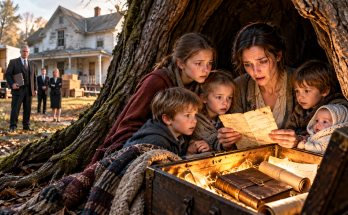
I remembered the first evening we arrived.
Five children.
A few belongings.
No farmhouse.
No husband.
No idea what would happen next.
I had stood before that hollow trunk feeling more ashamed than I had ever felt in my life.
I had believed a mother should provide something better.
A roof.
A door.
A room where her children could sleep without being afraid.
Instead, I had led them into a tree.
At the time, I thought it proved how badly I had failed.
Now I was no longer certain.
We had needed shelter.
I had found it.
It was not comfortable.
It was not permanent.
But it had kept us together long enough to find the notebook.
And the notebook had led us to everything else.
I looked toward the lower slope.
The three stones had marked the hidden hatch.
Beneath them lay the cellar.
The cellar had held supplies and the six wooden boxes.
My box had contained the deed.
And the iron key.
The key had opened the passage.
The passage had brought us uphill to this house.
I followed those places with my eyes.
They were all part of the same land.
Dmitri had known that.
I had not.
I wondered how often he had walked between them.
Perhaps he had stood where I was standing and looked toward the cedar.
Perhaps he had checked the slope after rain.
Perhaps he had imagined bringing us here on a clear day, with time to explain everything.
I wanted to believe that.
But I reminded myself that wanting something did not make it true.
I had learned enough about secrets to be careful with my imagination.
The notebook gave me facts.
The deed gave me facts.
The house gave me facts.
The rest belonged to questions I could never ask.
I turned away from the window.
Julia was helping Anna arrange the little gifts.
Peter sat nearby.
Luke had placed his horse beside the music box.
The baby rested in the knitted blanket.
I listened to them for a moment.
They were not discussing the bank.
They were not asking where we would sleep.
They were trying to decide where their father's gifts should stay.
It seemed such a small problem.
I was grateful for it.
I had spent too many days answering questions with fear.
Now I could watch them care about something ordinary.
Anna wanted the music box somewhere she could reach it.
Luke wanted his horse close.
Peter did not want his boat where it might be knocked over.
Julia wanted to keep her carved box away from any dampness.
They were making choices about their belongings.
I recognized the feeling.
The same thing had happened in the farmhouse.
Each child had a place for small treasures.
I had not thought much about it then.
Now I saw those little habits as part of what made a home.
Not the size of the rooms.
Not the appearance of the walls.
The knowledge that something belonged to you and could be placed where you wanted it.
I watched Peter move his boat.
Then I looked at Julia.
She caught me watching.
“What?”
“Nothing.”
She smiled.
I almost told her I was happy.
But the word felt too large.
I was not happy in the way I had once been.
Dmitri was still dead.
The farmhouse was still gone.
The house remained unfinished.
The cellar had still been flooded.
Those things had not changed.
But I was relieved.
And that relief was beginning to make room for other feelings.
I sat near the children.
Anna opened her music box.
The lullaby played.
I closed my eyes.
This time, I did not imagine the farmhouse immediately.
I imagined the cellar.
Anna opening the box for the first time.
The lantern light on her face.
The way she listened without moving.
Then I remembered the passage.
The unfinished house.
The tune playing here after the storm.
The music had begun gathering new memories.
I had not expected that.
I thought grief meant every familiar thing would remain tied to what was lost.
But perhaps familiar things could travel with us.
They could carry the past without trapping us inside it.
I opened my eyes.
Luke was listening.
He held his horse against his knee.
I wondered whether he would remember the terrible storm when he was older.
Perhaps he would.
Perhaps he would remember only the strange adventure of sleeping in a tree and finding a hidden cellar.
I hoped the fear would soften with time.
I knew mine would take longer.
I still remembered the sound of the branch.
Sometimes I heard it when the wind rose.
Even when no branch was falling.
I tried not to show the children.
But I did not want to hide everything from them either.
I had promised myself that after learning how much Dmitri had kept secret.
There was a difference between sharing a fear and passing it to a child.
I was still learning where that difference lay.
Peter looked up.
“Do you think the tree will fall someday?”
I followed his gaze toward the grove.
“I don't know.”
He considered that.
“It's very old.”
“Yes.”
He looked at the wooden boat.
“Father liked old wood.”
I smiled.
“He did.”
Peter looked toward the window.
“Would he have repaired it?”
I thought of the broken branch.
The enormous trunk.
The damage the storm had done.
“I don't know what he could have done for a tree that size.”
Peter nodded.
I appreciated that he did not expect me to answer every question.
Perhaps he was beginning to understand that adults did not know everything.
I hoped that understanding would not frighten him.
I wanted it to teach him something gentler.
That uncertainty was not the same as helplessness.
We could admit what we did not know.
Then decide what could be done.
I thought about the cellar.
The water had receded from the lower ground.
But I still had not inspected the underground room.
I wanted to know whether its contents had survived.
I wanted to see the shelves again.
I wanted to stand beside the five small boxes and remember how the children had opened them.
But I would not treat the cellar as safe merely because the creek was quieter.
The flood had taught me that water could move in places I could not see.
I needed to be careful.
I looked toward the passage door.
It was closed.
The iron key rested beside the notebook.
The door itself was ordinary.
Wooden.
Narrow.
Easy to overlook.
I had mistaken it for a cupboard when I first saw it.
Now I knew it connected the house to the hidden shelter beneath the ridge.
I found myself thinking about that mistake.
How often had I looked at things without understanding what they were?
Dmitri's tired face.
His late nights.
The debts.
The land.
The notebook.
I had believed I knew the whole story of our marriage.
Then I found out there had been another part.
I was still trying to make peace with that.
I touched the key.
It was cold.
Heavy.
Plain.
I remembered the first time I held it.
I had been sitting in the cellar with the deed open across my knees.
I had just learned that the land belonged to me.
Thunder was beginning outside.
The key seemed like another puzzle.
I had not understood how urgently I would need it.
Then the rain came.
The cedar flooded.
The branch fell.
The cellar began filling.
And the key became the difference between remaining below and finding higher ground.
I closed my hand around it.
Dmitri had left us a way forward.
But he had not lived to see whether we would find it.
I wished he had.
I wished he could know that his children were safe.
That Julia had read her letter.
That Peter loved the boat.
That Anna still played the lullaby.
That Luke carried the horse everywhere.
That the baby was warm in the blanket.
I wished he could see the deed in my name.
And the unfinished house he had worked so hard to begin.
Most of all, I wished he could hear me tell him that I understood what he had been trying to do.
Not everything.
Not every choice.
But the love beneath it.
I looked toward the cedar again.
The tree had been the place where my fear was greatest.
It had also been the place where the notebook appeared.
I wondered whether I would ever have found the hidden cellar without spending that night inside the hollow trunk.
Perhaps not.
But I did not think of the discovery as a reward for suffering.
I did not believe the loss of our farmhouse had been necessary.
I did not believe Dmitri's death had been made right by the land he left.
Those things were still terrible.
The discoveries had not changed that.
They had only given us something to do afterward.
Something to build on.
I thought that was important.
I did not want the children to believe every painful thing happened for a good reason.
Sometimes pain was simply pain.
Sometimes a mistake remained a mistake.
Sometimes someone you loved died before you had finished speaking to them.
But even then, the people left behind could choose what came next.
I looked at Julia.
She was reading her letter again.
I watched her face.
I wondered whether she understood how much her father had loved her.
I hoped she did.
I hoped she also understood that she did not need to spend her life proving she was worthy of that love.
She had always been worthy.
Before helping with the younger children.
Before carrying the lantern.
Before following me to the hidden hatch.
I wanted her to know that.
I sat beside her.
She looked up.
“Mother?”
I put my arm around her.
“You don't have to earn your place here.”
She frowned.
“I know.”
I smiled.
“I just wanted to say it.”
She leaned against me.
For a while, we watched the others.
Peter was examining his boat.
Anna was closing her music box.
Luke was moving his horse.
The baby slept.
I thought of Dmitri's six boxes.
Five for the children.
One for me.
The children's gifts were personal.
Mine was practical.
A deed.
A key.
A letter.
At first, I had felt cheated by that difference.
Now I understood why he might have chosen those things.
He had wanted to leave me the means to protect the family.
He had not known how much grief would come with that responsibility.
He had not known how much I would wish for something small that belonged only to him and me.
But perhaps the notebook was that thing.
His handwriting.
His confession.
His careful work.
His hope.
It was not the gift I would have chosen.
It was the one he left.
I had to decide what to do with it.
I looked once more at the cedar.
The enormous trunk remained rooted in the earth.
Its damaged branch lay nearby.
I no longer saw only the desperate shelter we had entered after losing the farmhouse.
I saw the place where my understanding of Dmitri had begun to change.
I had arrived believing we had nothing.
I had left knowing we owned the ground beneath our feet.
The cedar had not become our home.
But it had led us to one.
That was enough to make me grateful.
Source: news1.shoptonytv.net